Bar Pipa
We pay for a post of 10$

#Forex #currencypairs

Exotic Currency Pair: Why Traders Avoid This Currency Pair.

Exotic Currency Pair: Why Traders Avoid This Currency Pair.

Exotic Currency Pairs: Why Many Nigerian Traders Avoid It At First

“Sir, I see one funny currency pair for my chart o.”

“Sir abeg, come explain this thing for us.”

Everybody for the class just turn head at once.

Chinedu don already half stand, dey point him laptop like say the thing go explode.

“I just open my MT5 this morning, I see USD/TRY. I even think say my app don spoil. Wetin be this one again?”

The whole class just burst laugh.

I just smile shake my head. “Relax, your app no get problem. That one na exotic currency pair.”

Another student quickly jump in, still dey confused.

“Sir, we don already learn major and minor pairs. So this one come from where again?”

I pick my marker, turn face the board.

“Forex market big pass wetin most beginners dey think. If na only EUR/USD and GBP/USD you know, you just dey see small corner of the market.”

---

What Are Exotic Currency Pairs?

“Make I break am down for simple way.”

Exotic currency pair na when one major currency pair with currency of developing or emerging country.

For example:

- USD/TRY – US Dollar and Turkish Lira

- USD/ZAR – US Dollar and South African Rand

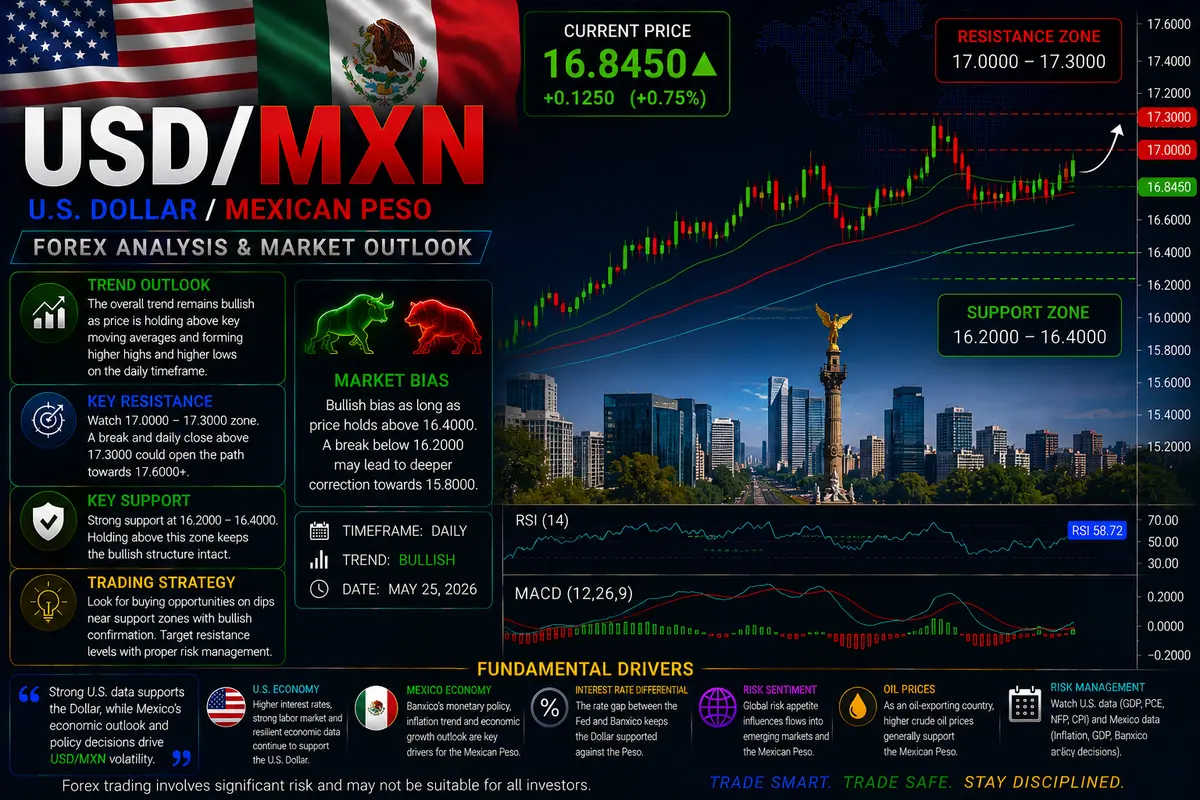
- USD/MXN – US Dollar and Mexican Peso

- USD/THB – US Dollar and Thai Baht

- EUR/TRY – Euro and Turkish Lira

“So sir,” one student ask from middle, “Nigeria get its own pair?”

I laugh small.

“Not really. Nigerian Naira no dey common for most retail forex platforms. Na why you no dey really see USD/NGN like EUR/USD.”

Everybody just dey nod slowly like say things don dey clear small small.

---

Why Traders Dey Like Exotic Pairs?

One student for back raise hand.

“Sir, if these pairs no popular,...

Continue reading...
0
0
joy

USD/MXN – Nearshoring Flows, Banxico Policy, and Pemex Risk Signals

USD/MXN – Nearshoring Flows, Banxico Policy, and Pemex Risk Signals

Ask any spot trader in Chicago or London about the Mexican Peso and they’ll tell you the same thing: it’s the undisputed king of Latin American liquidity. But calling USD/MXN just an "emerging market currency" misses the entire point.

On institutional desks, the Peso isn't just traded for direct exposure to Mexico. It’s used as a giant, macro sponge. Whenever risk sentiment breaks across South America—or when a global fund needs to quickly hedge a messy basket of illiquid Brazilian real or Colombian peso positions—they don't mess around with local order books that freeze up the moment headline risk hits. They hit the bid on USDMXN ... .

That constant volume creates a weird paradox. On normal days, spreads during North American trading hours are tight—sometimes tight enough to rival minor G10 pairs like AUD or

. Execution feels smooth. Slippage is minimal. But the moment global macro turns ugly, that clean order book can evaporate instantly.

If you want to trade this pair consistently without getting liquidated during random liquidity gaps, you have to track three specific engines: real-economy trade flows, Banxico’s interest rate cushion, and the fiscal bomb ticking inside Pemex.

1. The Real Economy: Physical Trucks and Nearshoring Capital

Forget pure technical analysis for a second. At its core, USD/MXN is anchored by physical goods moving across border crossings like Laredo and El Paso.

Mexico’s manufacturing sector is directly hooked into North American supply chains under USMCA. Those thousands of assembly plants—the maquiladoras—produce everything from pickup trucks to medical equipment destined for US store shelves. When American consumer demand is solid, those factories run non-stop. To cover local payrolls, electricity, taxes, and domestic suppliers, these companies constantly dump Dollars and buy Pesos. That’s a persistent, real-money bid beneath MXN.

Then you have nearshoring.

When global shipping lines ground...

Continue reading...
0
0
pixel

The Order Book Predicts the Next Move 62% of the Time. Retail Never Opens It

The Order Book Predicts the Next Move 62% of the Time. Retail Never Opens It

There is a number that forecasts the next price tick with an R-squared of 0.62, and it updates thousands of times per second on data that every exchange publishes for free.

It is not RSI. It is not a moving average. It is not in any indicator pack you have ever bought.

It is the imbalance between the buy orders and the sell orders sitting in the order book right now.

Retail traders look at a price chart, which is a record of what already happened. Quant desks look at the order book, which is a record of what is about to happen. Those are not the same picture, and the gap between them is where a measurable amount of money changes hands every single day.

This article is about that gap. The mechanism is public, the math is published, and almost nobody outside a trading desk has ever looked at it directly.

What the Chart Actually Hides

A candlestick is a summary. It tells you the open, high, low and close over some interval. By the time you see it, the interval is over and the information is spent.

Underneath every one of those candles is the thing that actually produced it: the limit order book. A live, continuously updating ledger of every resting order in the market. Every price someone is willing to buy at, every price someone is willing to sell at, and critically, how many shares sit at each level.

The book has two sides. Bids are buyers waiting to be filled, stacked below the current price. Asks are sellers waiting, stacked above. The gap between the highest bid and the lowest ask is the spread. The sizes at each level are the depth.

This is not proprietary data. Exchanges publish it as the Level 2...

Continue reading...
0
0

Understanding liquidity in forex marketing.

Liquidity in Forex Trading – Wetin E Mean?

The first day my oga mentioned liquidity, I no go lie, I think say na one big grammar wey I no need. Later I come realize say the thing simple pass wetin I imagine.

Make I explain am the way person for Naija go understand.

Imagine say you carry iPhone 15 go Computer Village, Ikeja. Before you even shout "Who wan buy?", three people don price am. You fit sell am sharp sharp because buyers full everywhere. That market get plenty activity.

Now imagine say na one small village market you carry the same phone go. You fit stand there tire before one person even ask of the price. Na so liquidity be.

For forex, liquidity simply means how easy e dey for people to buy and sell a currency pair. If buyers and sellers plenty, liquidity dey high. If people no too dey trade that pair, liquidity go low.

Why should you even care?

Because e fit affect your trade pass as you think.

Sometimes you click Buy, your order enter immediately. Other times, the price don shift before your trade open. One reason fit be because the market no get enough liquidity that moment.

Na why many traders like to trade pairs like EUR/USD. Plenty banks, hedge funds, companies and retail traders dey buy and sell am almost every minute. Activity no dey stop.

When market get high liquidity, spread normally small. You no go pay too much difference between buy and sell price. But once liquidity reduce, spread fit just widen anyhow. If you don trade during midnight before, you fit don notice am.

Another thing be say, no be every fast movement mean say market strong. Sometimes price just dey jump because buyers and sellers no plenty. One...

Continue reading...
0
0

Why do currency pairs moves? The simple truth every forex trader should know

Why do currency pairs moves? The simple truth every forex trader should know

Why Do Currency Pairs Move? The Simple Truth Every Forex Trader Should Know

One question nearly made me give up on forex.

I won't even lie.

Every time I opened my chart, the price was moving up and down like somebody was playing with it.

One minute EUR/USD was rising.

Five minutes later, it had dropped.

I just kept asking myself, "Who is pushing this market?"

At one point, I even thought there was one big man somewhere pressing Buy and Sell buttons for the whole world.

Omo, I didn't know how funny that sounded until I started learning.

The truth is, nobody controls the market.

The market moves because millions of people are buying and selling currencies every single day.

Banks are trading.

Big companies are exchanging money.

Governments are involved.

Investment firms are entering and leaving trades.

Even small retail traders like you and me are part of the market, although our trades are tiny compared to the big players.

Imagine you're in a busy market on Saturday morning.

Everybody wants to buy tomatoes.

Before you know it, the price goes up because demand is high.

Now imagine the next week. Tomatoes are everywhere and nobody is rushing to buy.

What happens?

The price comes down.

Forex works almost the same way.

When more people want to buy a currency, its value usually increases.

When more people want to sell it, the value usually falls.

Simple.

One thing that surprised me was finding out that news can move the market within seconds.

I remember watching a trade one afternoon.

Everything looked perfect.

Then one news report came out.

Omo, before I could even blink, one long candle appeared from nowhere.

That day taught me to always check the economic calendar before entering a trade.

Some news can completely...

Continue reading...
0
0
Navigation menu
instaforex banner