


Bar Pipa
We pay for a post of 10$
HSBC Holdings plc

HSBC Holdings plc

HSBC NYSE

$103.11
+1.97%

Key Statistics

Market Cap
$354.36 B
Volume
1,761,940
Open
$102.97
Day Range
102.76 - 103.50
52W Range
60.61 - 103.50
Price AVG 50
$94.45

About HSBC Holdings plc

HSBC Holdings plc functions as a prominent global entity, delivering a full spectrum of banking and financial services around the world. Its operations are structured into three key divisions: Wealth and Personal Banking, Commercial Banking, and Global Banking and Markets. The Wealth and Personal Banking unit is dedicated to individual customers, supplying a broad array of retail banking offerings. This includes essential services like current and savings accounts, various lending products such as mortgages and personal loans, a selection of credit and debit cards, and convenient local and international payment facilities. Furthermore, this segment provides in-depth wealth management solutions, encompassing insurance and investment products, worldwide asset management expertise, and tailored private wealth strategies for both general banking clients and affluent individuals. The Commercial Banking division targets businesses across the size spectrum. It extends crucial services such as credit and financing, treasury and cash flow management, payment processing, business insurance, and investment support. Additionally, it offers corporate cards, international trade and receivables financing, foreign exchange transactions, capital-raising capabilities via debt and equity markets, and strategic advisory services. Its client base spans from small and medium-sized enterprises to larger corporations. Lastly, the Global Banking and Markets segment focuses on advanced financial services for major organizations and investors. It provides sophisticated financing, expert advisory, and transaction execution across various asset classes, including credit, interest rates, foreign exchange, equities, and money market instruments, along with comprehensive securities services. This division also undertakes principal investment activities, serving governmental bodies, corporate entities, institutional clients, and high-net-worth private investors. Founded in 1865, HSBC Holdings plc maintains its central operations in London, United Kingdom.

Asset Type: Common Stock
Sector: Financial Services
Industry: Banks - Diversified

Discussion

Authentication Required

You must be logged in to post a comment.

Big Pip

The Engine of Capital Markets: Understanding the Role of the Issuer
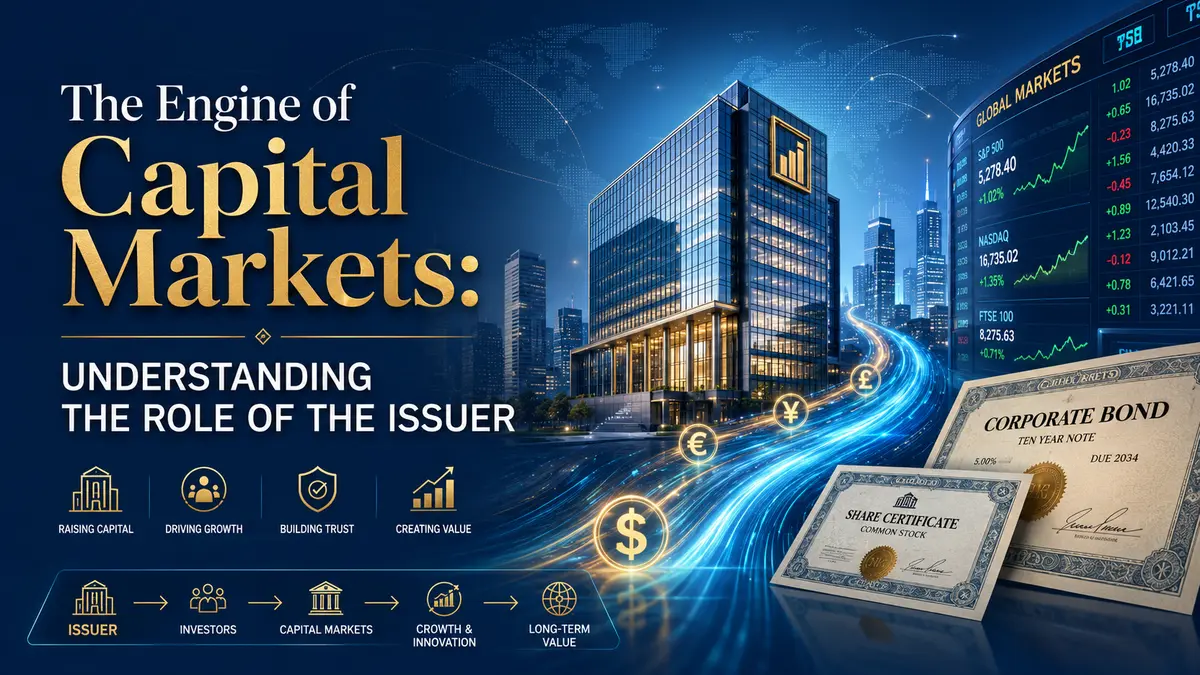
The Engine of Capital Markets: Understanding the Role of the Issuer

In the architecture of global finance, if capital is the lifeblood of the economy, the issuer is the beating heart that puts that capital to work. An issuer is a legal entity — which can range from a multinational corporation to a sovereign national government — that develops, registers, and sells securities to finance its operations.

Whether they are issuing equity (shares) to invite new co-owners or issuing debt (bonds and commercial paper) to borrow funds, the primary objective remains the same: raising capital. This influx of capital allows the issuer to execute ambitious business expansions, fund cutting-edge technological research, modernize infrastructure, or bridge national budget deficits. Without issuers, investors would have nowhere to deploy their wealth, and global economic growth would grind to a halt.

The Primary Categories of Global Issuers

The global financial market is vast, and the entities seeking capital are incredibly diverse. Depending on their legal structure and ultimate goals, issuers are generally classified into five distinct categories.

1. Corporate Issuers: Fueling Business Innovation

Corporate issuers are private and public companies that turn to the financial markets to fund their strategic objectives. When a private startup reaches a massive scale, it may issue shares to the public through an Initial Public Offering (IPO) on exchanges like the Nasdaq or the London Stock Exchange (LSE). By giving up a percentage of ownership, they secure billions in equity capital without the burden of paying interest. Alternatively, mature companies often issue corporate bonds. For example, even highly profitable companies like Apple AAPL ... or Microsoft MSFT ... regularly issue billions of dollars in corporate bonds. They do this because borrowing money at low institutional interest rates is often more tax-efficient and strategically advantageous than draining their own cash reserves to fund stock buybacks or global expansions.

2. Sovereign Issuers: Funding Nations

...

Continue reading...
0
0
Navigation menu
instaforex banner