

The Engine of Capital Markets: Understanding the Role of the Issuer
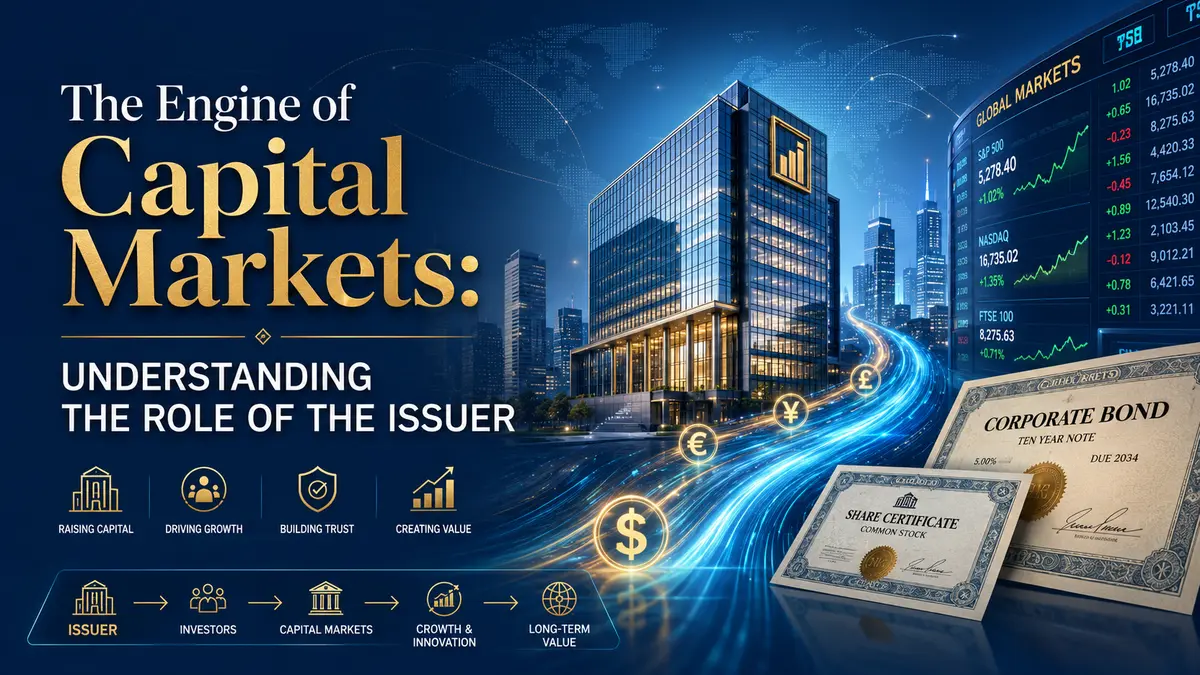
In the architecture of global finance, if capital is the lifeblood of the economy, the issuer is the beating heart that puts that capital to work. An issuer is a legal entity — which can range from a multinational corporation to a sovereign national government — that develops, registers, and sells securities to finance its operations.
Whether they are issuing equity (shares) to invite new co-owners or issuing debt (bonds and commercial paper) to borrow funds, the primary objective remains the same: raising capital. This influx of capital allows the issuer to execute ambitious business expansions, fund cutting-edge technological research, modernize infrastructure, or bridge national budget deficits. Without issuers, investors would have nowhere to deploy their wealth, and global economic growth would grind to a halt.
The Primary Categories of Global Issuers
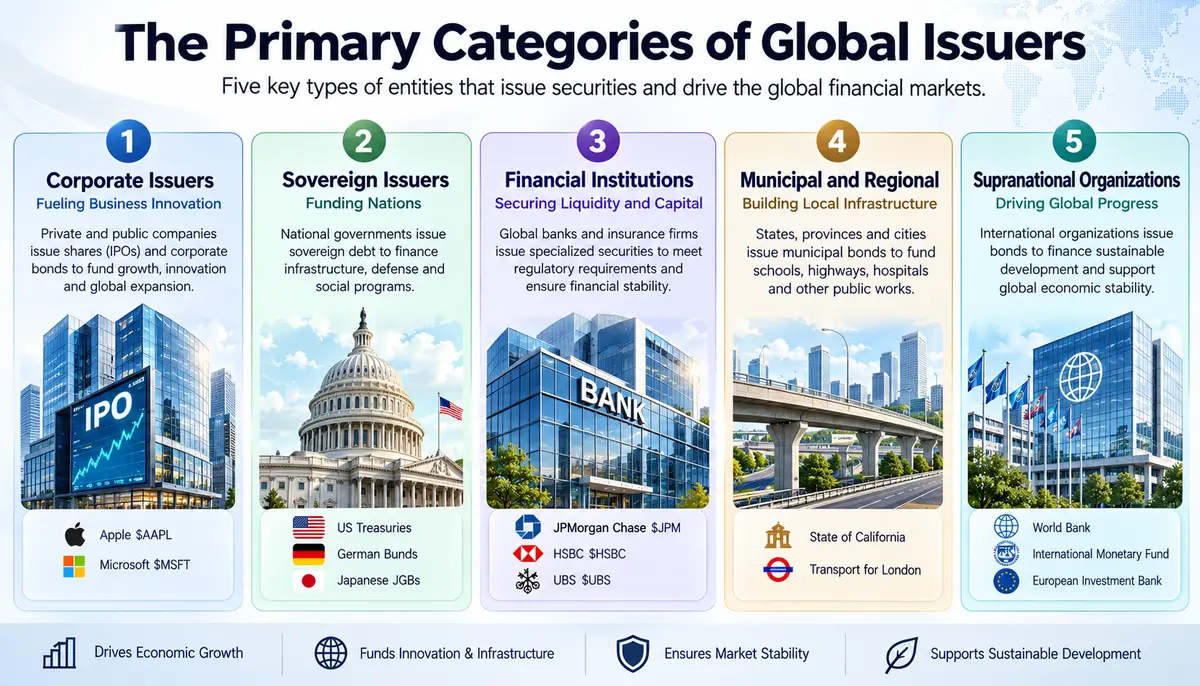
The global financial market is vast, and the entities seeking capital are incredibly diverse. Depending on their legal structure and ultimate goals, issuers are generally classified into five distinct categories.
1. Corporate Issuers: Fueling Business Innovation
Corporate issuers are private and public companies that turn to the financial markets to fund their strategic objectives. When a private startup reaches a massive scale, it may issue shares to the public through an Initial Public Offering (IPO) on exchanges like the Nasdaq or the London Stock Exchange (LSE). By giving up a percentage of ownership, they secure billions in equity capital without the burden of paying interest. Alternatively, mature companies often issue corporate bonds. For example, even highly profitable companies like Apple AAPL ... or Microsoft MSFT ... regularly issue billions of dollars in corporate bonds. They do this because borrowing money at low institutional interest rates is often more tax-efficient and strategically advantageous than draining their own cash reserves to fund stock buybacks or global expansions.
2. Sovereign Issuers: Funding Nations
National governments are among the most powerful and prolific issuers in the world. When a country needs to finance public infrastructure, military spending, or social programs that exceed its tax revenue, it issues sovereign debt. These instruments are generally considered the safest investments in the world because they are backed by the taxing power of an entire nation. The United States Department of the Treasury issues US Treasuries, which serve as the bedrock of the global financial system. Similarly, the German government issues Bunds, and the Japanese government issues Japanese Government Bonds (JGBs). Investors flock to these sovereign issuers for guaranteed, risk-free yields.
3. Financial Institutions: Securing Liquidity and Capital
Global banks, insurance conglomerates, and investment firms act as massive issuers in their own right. Megabanks like JPMorgan Chase JCICX ... , HSBC HSBC ... , or UBS UBS ... issue specialized financial instruments, including preferred stock and subordinated debt. Unlike standard corporations that issue debt to build factories, financial institutions often issue securities to meet strict international regulatory capital requirements (such as the Basel III framework). By issuing these instruments, banks ensure they have enough liquidity to survive economic downturns, protect depositors, and continue lending to the broader economy.
4. Municipal and Regional Issuers: Building Local Infrastructure
While sovereign debt is issued on a national level, local governments — states, provinces, and cities — also need capital to build public schools, highways, hospitals, and water treatment facilities. They achieve this by issuing municipal bonds (often called “munis”). For example, the State of California or the Transport for London (TfL) authority regularly issue bonds to fund massive public works. These municipal securities are highly attractive to domestic investors, as the interest earned is frequently exempt from federal or local taxes, making them a cornerstone of conservative wealth-building strategies.
5. Supranational and International Organizations: Driving Global Progress
Some of the most unique issuers operate beyond the borders of any single country. Supranational organizations, such as the World Bank, the International Monetary Fund (IMF), or the European Investment Bank (EIB), issue highly rated bonds to the global market. The capital raised by these entities is strictly deployed for global development, such as financing clean energy projects in emerging markets, eradicating poverty, or stabilizing struggling economies. In recent years, these organizations have pioneered the issuance of “Green Bonds,” which are specifically earmarked for environmentally sustainable projects.
The Strategic Rights of the Issuer
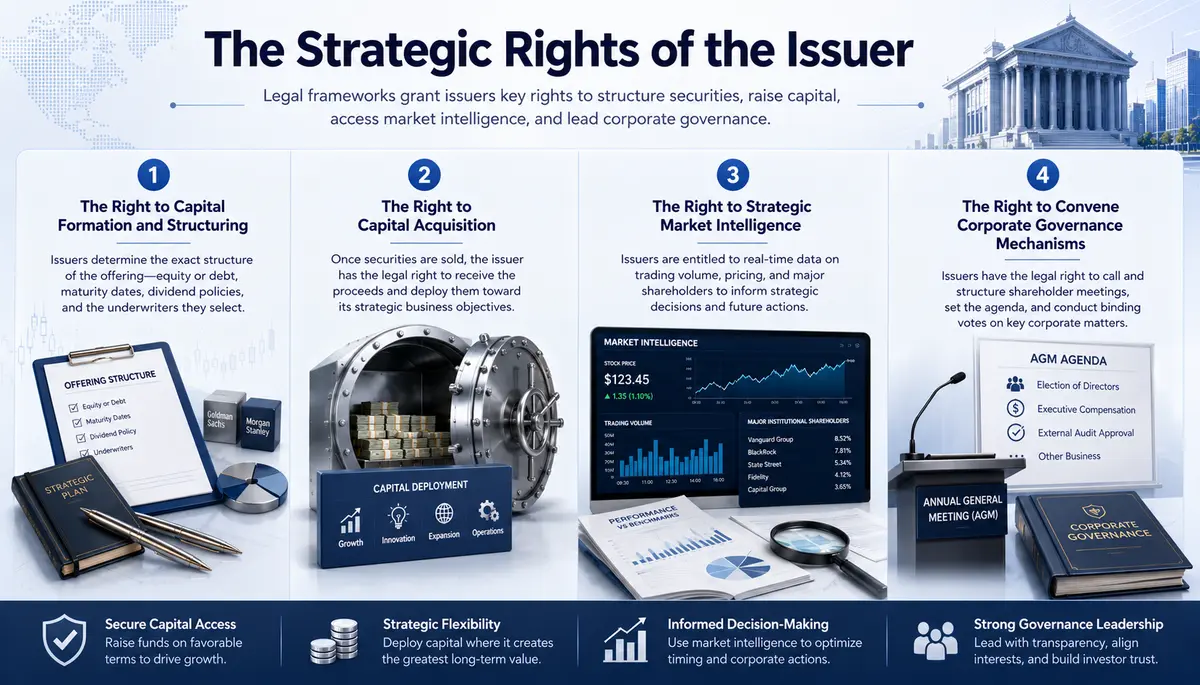
When an entity decides to enter the public markets, it assumes a position of strategic authority regarding how its securities are structured and managed. The legal frameworks of global markets guarantee issuers several fundamental rights.
1. The Right to Capital Formation and Structuring
The fundamental right of an issuer is the ability to create and deploy financial instruments. The issuer has the right to determine the exact structure of the offering. They decide whether to issue equity or debt, set the maturity dates for bonds, determine the dividend policies for stocks, and choose the investment banks (like Goldman Sachs or Morgan Stanley) that will underwrite the offering.
2. The Right to Capital Acquisition
Once the securities are successfully placed on the market and purchased by retail or institutional investors, the issuer has the absolute legal right to receive those funds. This capital injection becomes the property of the issuer, allowing them to deploy it toward the strategic goals outlined in their business plan, free from day-to-day micromanagement by the investors.
3. The Right to Strategic Market Intelligence
Issuers are entitled to receive highly accurate, real-time data regarding the trading volume and market pricing of their securities. They have the right to know who their major institutional shareholders are and how their stock is performing against macroeconomic benchmarks. This intelligence is crucial for timing future stock splits, secondary offerings, or share buyback programs.
4. The Right to Convene Corporate Governance Mechanisms
Corporate issuers possess the legal right to call and structure shareholder meetings, most notably the Annual General Meeting (AGM). During these meetings, the issuer sets the agenda, presents its strategic vision, and conducts binding votes on the election of board members, executive compensation, and external auditing firms.
The Strict Obligations and Fiduciary Duties
The ability to raise billions of dollars from the public is an immense privilege. In exchange for access to this capital, global regulatory bodies (such as the SEC in the US, the FCA in the UK, and ESMA in Europe) impose a heavy burden of responsibility on the issuer.
1. Mandatory Transparency and Disclosure
The single most critical obligation of an issuer is absolute transparency. An issuer cannot simply take investors’ money and operate in the shadows. Before a single share or bond is sold, the issuer must publish a highly detailed prospectus outlining the exact nature of their business, their audited financial history, and every conceivable risk factor that could cause the investor to lose money. This transparency must continue in perpetuity. Public issuers are legally obligated to release audited quarterly earnings reports, annual summaries, and immediate disclosures of any material events (like a CEO resigning or a major lawsuit being filed) that could impact the security’s price.
2. Stringent Regulatory Compliance
Issuers must navigate a labyrinth of international financial laws and accounting standards (such as US GAAP or IFRS). They must implement rigorous internal controls to prevent fraud, embezzlement, or inaccurate bookkeeping. Failure to comply can be catastrophic. History is littered with examples of issuers — like the German payment processor Wirecard or the American energy firm Enron — whose executives faced criminal prosecution, and whose companies were entirely liquidated, due to a failure to meet their legal compliance and accounting obligations.
3. Continuous Shareholder Communication
Beyond legal filings, issuers have a fiduciary duty to maintain open lines of communication with their investors. This is typically managed by an internal Investor Relations (IR) department. Issuers must host regular earnings calls to explain their financial results to Wall Street analysts, answer difficult questions about market headwinds, and justify their strategic pivots. The issuer must ensure that all shareholders, regardless of their size, are treated fairly and receive market-moving information at the exact same time, effectively preventing insider trading.
Ultimately, the issuer is the foundational pillar of the capitalist ecosystem. By accepting the heavy burdens of regulatory compliance and public scrutiny, issuers transform raw capital into tangible global progress — building the infrastructure, technologies, and services that define the modern world.






Comments
No comments yet. Be the first to share your thoughts!
Authentication Required
You must be logged in to post a comment.