

Oil Rally: WTI Pushes Toward New Highs as Asian Markets Hold Their Breath
Morning on the Commodity Markets: The Bulls Wake Up Before Everyone Else
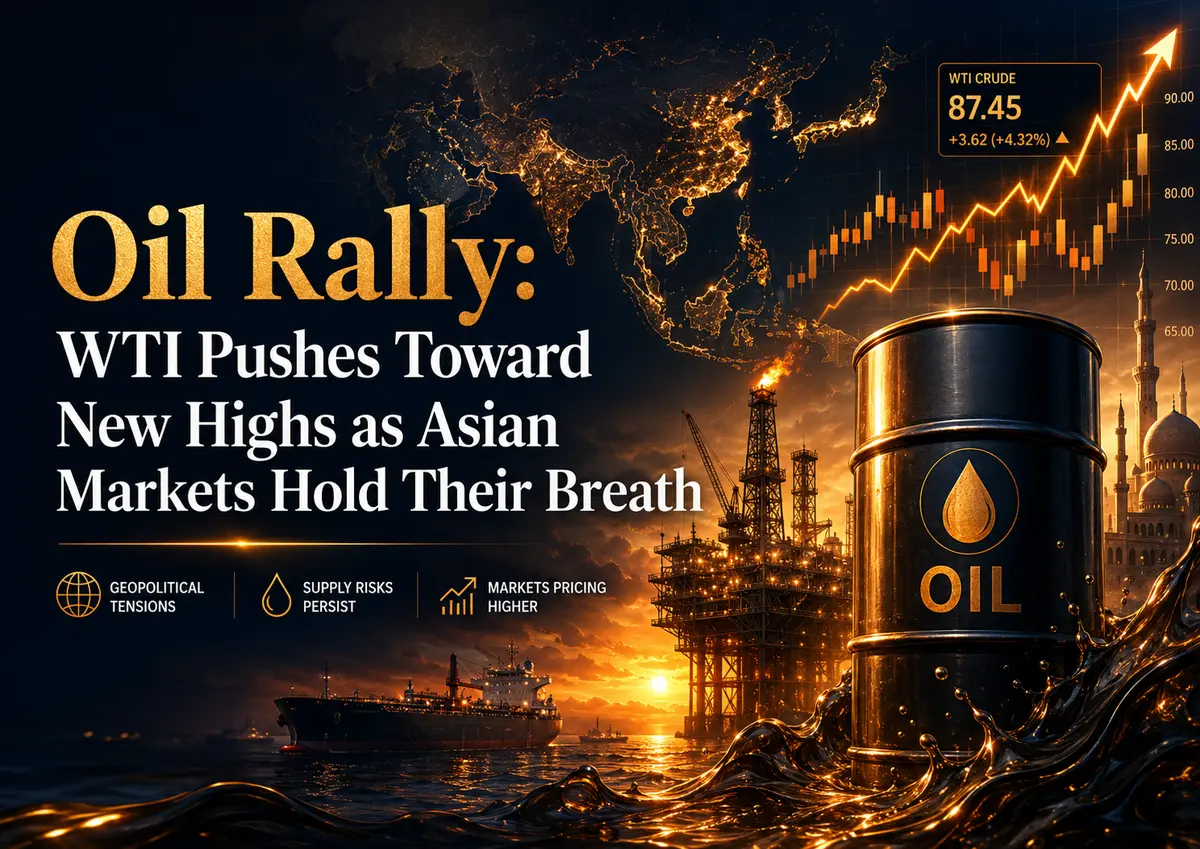
Asian trading opened on Wednesday with an unexpected but entirely understandable surge. WTI ... crude oil futures for September delivery confidently crossed the $85-per-barrel mark, gaining almost a full percentage point. At the time the data was recorded, the price stood at $85.17—and this was only the beginning of a trading session that promised to be intense.
The highest level reached by a barrel was not included in the initial market report, but the fact that oil found support at $77.93 while resistance awaits at $85.74 says a great deal. A range of almost $8 is not merely volatility—it is the nervous twitch of a market trying to determine which way the geopolitical wind is blowing.
Meanwhile, the US Dollar Index edged slightly lower, slipping by a few hundredths of a percentage point to 100.97. This may seem insignificant, but for oil, which is priced in US dollars, even such a microscopic weakening of the American currency matters. It makes the commodity slightly more affordable for holders of other currencies, stimulating demand.
However, investors should not be misled by this modest correction in the dollar. The main story today is not about currency fluctuations, but about events in the Middle East and the mindset of traders who are frantically recalculating their risk exposure.
BZUSD ... , the global benchmark, is keeping pace with its American counterpart. September futures rose by 1.10% to $92.01 per barrel. The spread between the two benchmarks stands at $6.84, remaining within a relatively normal range. However, the fact that both grades are rising simultaneously indicates the global nature of the current rally.
This is not a local story about US oil inventories or wildfires in Canada. It is a story about global security, tankers passing through the Strait of Hormuz, and how many more nights US forces will continue striking Iran.
The Middle Eastern Factor: The Oil Market as a Reflection of War
When discussing the current rise in oil prices, it is impossible to ignore the stage on which the main drama is unfolding. The Middle East is on fire. The US military has conducted strikes against Iranian targets for eleven consecutive nights.
These are not isolated operations. This is systematic military pressure that is changing the balance of power across the region. Every new strike is not merely another line in a military briefing—it is a signal to the market that oil supplies may be at risk.
Iran, in turn, is not remaining passive. Its proxy forces in Yemen, the Houthis, have threatened to completely block shipping routes through the Red Sea and the Bab el-Mandeb Strait.
These are not empty threats. Over recent months, the group has repeatedly attacked commercial vessels, and its rhetoric has now become even more aggressive. Saudi Arabia, the region’s leading oil exporter, is effectively being presented with an ultimatum: either stop supporting certain forces or risk seeing its oil unable to leave its ports.
For the market, this means one thing: the risk premium included in the price of every barrel is rising rapidly. Traders are pricing in not only current disruptions but also the possibility of further escalation that could cut off supplies from the entire Persian Gulf.
That region accounts for approximately 20% of global oil supplies. When such a large volume is placed beneath the sword of geopolitical conflict, prices cannot remain unchanged.
Notably, the market has stopped responding to the usual reassuring statements from producers. Saudi Arabia, the United Arab Emirates, and even Russia continue to speak about stability and their readiness to increase production if necessary.
However, these statements no longer carry the same weight because the market is seeing actual missiles and actual fires at oil refineries. Confidence has been lost, and promises alone will not restore it.
WTI Versus Brent: The American Benchmark Gains Momentum
Why is WTI demonstrating even stronger growth than Brent this time? Traditionally, the European benchmark is considered more sensitive to developments in the Middle East. However, the current situation is somewhat different.
American crude oil, produced in Texas and North Dakota, is physically located farther away from the conflict zone. Logically, it might be expected to rise less sharply. Yet it is actually advancing faster.
First, strong domestic demand in the United States is having an impact. The economy continues to demonstrate resilience despite high interest rates. Gasoline inventories are declining, while the summer travel season is in full swing, with Americans consuming fuel at an intense pace. This domestic factor is providing additional support to WTI prices.
Second, Treasury bond yields also play an important role. When yields rise, the dollar generally strengthens, placing pressure on commodities. At present, however, the dollar has cooled slightly, giving WTI additional room to advance.
Investors are also viewing American crude as a more reliable asset under current conditions because it does not depend directly on the Suez Canal or the Strait of Hormuz. Domestic US logistics may not be perfect, but at least they are not exposed to military attacks from both sides.
The $6.84 price difference between Brent and WTI is more than just a number. It is a reflection of fear. This spread usually stands at around $4–$5, but it has widened because Brent carries an additional geopolitical burden.
Traders are willing to pay a premium to avoid potentially problematic supply routes. At the same time, WTI is not becoming cheaper—its price is also rising because there are few meaningful alternatives to a barrel of crude oil.
Asian Importers: The Quiet Terror of Expensive Oil
While traders in New York and London celebrate rising prices, the atmosphere in Asia is entirely different. For Japan, South Korea, India, and China, expensive oil is like a punch to the stomach.
These countries purchase energy in US dollars, which means that every increase in the price of a barrel damages their trade balances and accelerates inflation.
The Japanese yen, which is already under pressure, now faces an additional reason to weaken. Higher oil prices increase the cost of imports, further damaging an already strained trade balance.
The Bank of Japan is caught between two difficult choices. Raising interest rates to support the currency could damage an already fragile economy. Failing to raise rates, however, could allow the yen to continue falling, making imports even more expensive.
The Indian rupee is also at risk. India imports approximately 80% of the oil it consumes, meaning that any sharp increase in prices quickly becomes a political problem for the government in New Delhi.
Fuel subsidies increase, inflation accelerates, and public dissatisfaction begins to grow. This is before considering the corporate sector, where logistics and production costs are also rising.
Southeast Asia is equally concerned. Indonesia, Thailand, Malaysia, and the Philippines have already experienced pressure on their currencies. The Indonesian rupiah and Thai baht, as previously observed, are weakening amid rising energy prices.
Central banks across the region must balance the need to contain inflation against the desire to avoid damaging exports. This is a delicate task, and expensive oil makes it increasingly difficult.
China may be the only major Asian economy observing the situation with slightly less alarm. Although the Chinese economy is slowing, it still retains a certain degree of flexibility.
China is also actively increasing its strategic oil reserves, purchasing discounted supplies from Russia and Iran, which partially reduces the impact. Nevertheless, even Beijing is not protected from a global rise in oil prices. If crude climbs above $100 per barrel, the Chinese economy could begin to face serious difficulties.
Technical Analysis: The Levels Watching Us
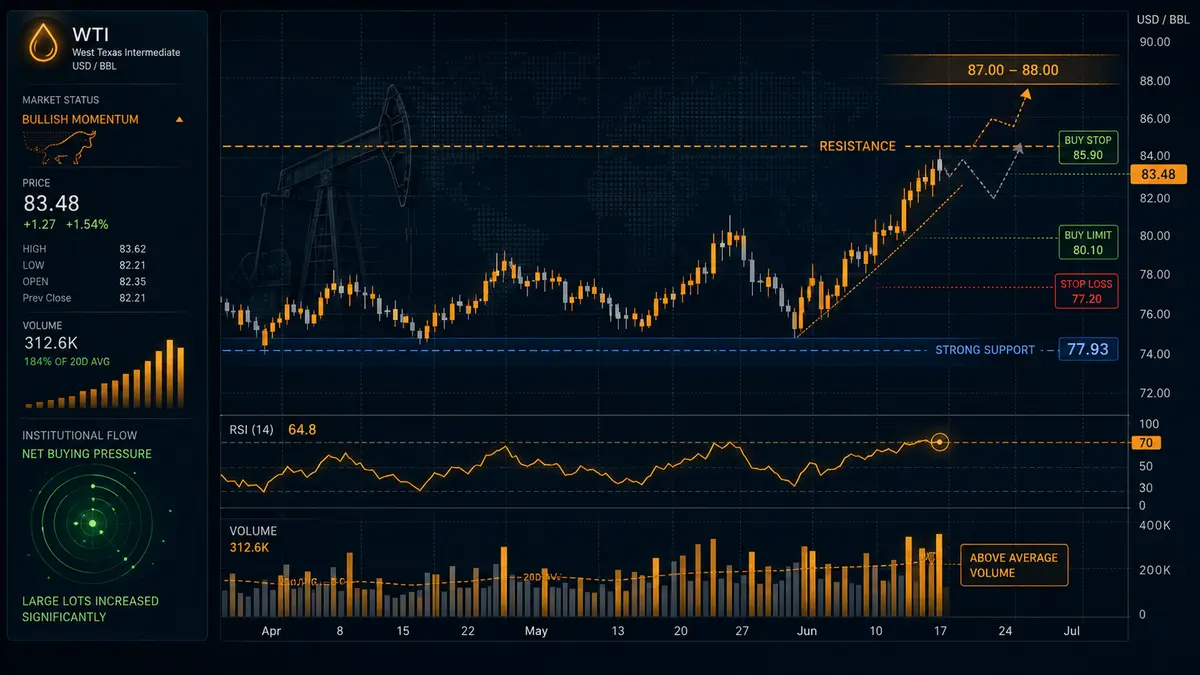
At the time of writing, WTI crude had found support at $77.93. This is not a random figure. The level has been tested several times over recent weeks, and on each occasion it prevented the price from falling further.
Traders have remembered this level and are now placing stop orders slightly above it, preparing to open new buy positions if the price experiences a correction.
Resistance is located at $85.74. This is the peak the market has not yet decisively managed to overcome. If the price consolidates above this level, the path toward $87–$88 could open, potentially triggering additional stop orders and buy orders.
However, a breakout is not a guarantee of success. It is better understood as an invitation to a dance that could attract both bulls and bears.
Technical indicators currently suggest that the market is becoming overbought. The Relative Strength Index, or RSI, is approaching the 70 level, which generally signals the possibility of a correction.
Under conditions of geopolitical turbulence, however, technical analysis often becomes less important. Intense demand for perceived safe-haven assets—and oil is currently behaving like one—can ignore conventional technical signals.
Trading volumes are also currently above average. This suggests that major institutional investors, hedge funds, and physical commodity traders are entering the market, closing spread positions and reallocating capital.
This is not merely speculative excitement among retail traders. Serious money is making a serious bet on further price growth.
The Outlook: What to Expect from the Oil Market in the Coming Weeks
Making forecasts under current conditions is an unrewarding task. There are too many variables and too many potential “black swans” that could emerge without warning. Nevertheless, several trends can still be identified.
First, the conflict in the Middle East is unlikely to end tomorrow. Strikes against Iran are continuing and may persist until either Tehran changes its position or Washington shifts its attention elsewhere.
In either case, the oil market is likely to remain hostage to the situation for several more weeks, if not months. The risk premium will stay elevated, and even minor reports of new strikes or acts of sabotage could push prices higher.
Second, OPEC+ has already indicated that it does not intend to increase production sharply merely to bring prices down. Saudi Arabia, the market’s main balancing force, values its revenues too highly.
The country remembers 2020, when oversupply caused oil prices to collapse below zero. It is therefore likely to proceed cautiously, increasing production quotas only enough to avoid a catastrophic shortage without triggering a market collapse.
This means prices may remain high even if geopolitical tensions ease slightly.
Third, the seasonal factor must be considered. Summer in the Northern Hemisphere represents the period of peak fuel demand. Travel, air conditioning, and agricultural activity all require large amounts of energy.
Inventories are likely to decline, providing further support for prices. Demand may weaken once the summer travel season ends, but this may not happen before October.
Finally, the fourth factor is the US dollar. If the Federal Reserve signals that it is prepared to ease monetary policy toward the end of the year, the dollar could weaken, supporting commodity prices.
However, if US inflation remains elevated, the Federal Reserve may be forced to keep interest rates high. In that case, the dollar would remain strong, placing downward pressure on oil.
The confrontation between these two forces—geopolitics and monetary policy—will determine the market’s trajectory over the coming months.
For now, the bulls remain in control. WTI is holding above $85, while Brent remains above $92. These are significant levels that confirm the market’s readiness for further growth.
However, the bears could awaken at any moment, particularly if signs emerge that the conflict in the Middle East is moving toward de-escalation or that the US economy is beginning to show signs of distress.
In a world where oil has become a geopolitical weapon, there are no truly calm days. Today’s rise is merely another episode in a long and dramatic story that has continued for decades and, judging by current conditions, is unlikely to end in the foreseeable future.


Comments
No comments yet. Be the first to share your thoughts!
Authentication Required
You must be logged in to post a comment.