

Oil Pullback: How the Pause in the US–Iran War Sent Prices Down 5%
Monday Morning: A Breath of Hope or the Calm Before the Storm?
Energy markets opened on Monday with an unexpected sight for traders who had grown accustomed to an uninterrupted rally: red figures across their trading terminals. And the decline was sharp enough to take many market participants’ breath away.
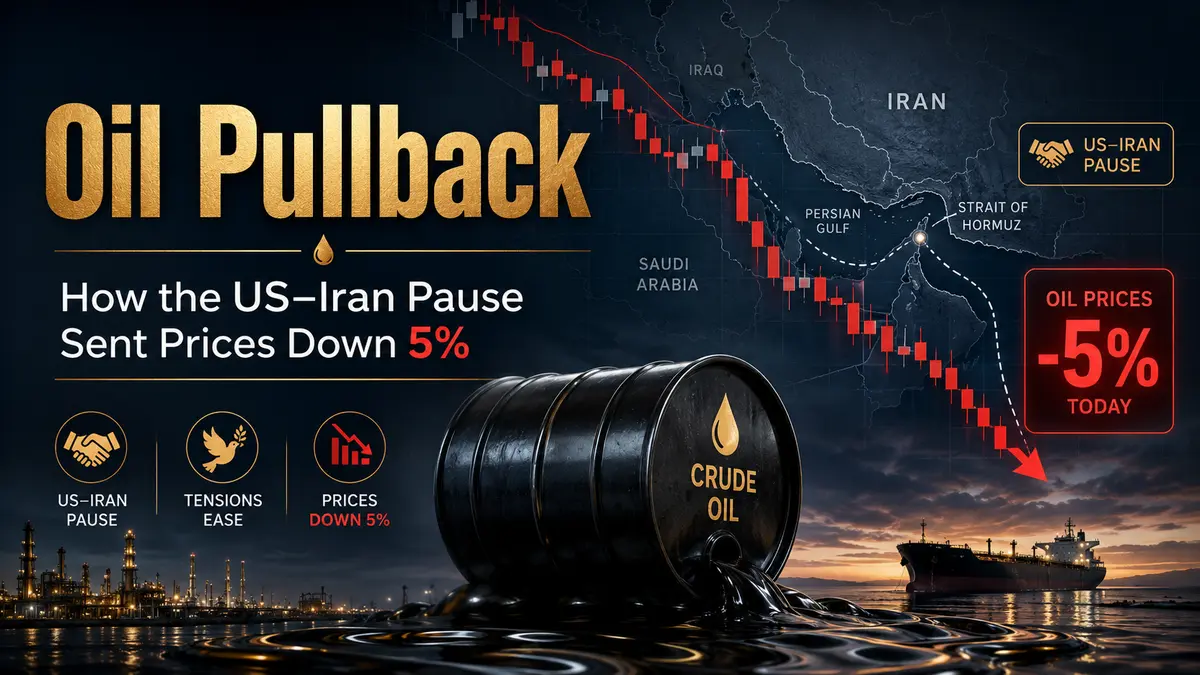
BZUSD ... crude futures plunged 5.5% to $91.44 per barrel, while WTI ... fell 3.1% to $89.31. In a single morning, the geopolitical risk premium that had driven oil prices to multi-month highs the previous week largely evaporated. Only days earlier, analysts had been discussing the possibility of an imminent return to triple-digit oil prices. So why did market sentiment change so dramatically?
The answer lies in the weekend’s developments, which many observers described as a “historic pause.” The United States and Iran, after exchanging military strikes for 13 consecutive nights, unexpectedly announced a suspension of hostilities. Washington said it was giving diplomacy a chance, while Tehran pledged to refrain from retaliatory attacks for as long as the ceasefire remained in effect.
The words “diplomacy” and “negotiations” once again appeared in news headlines, prompting markets that had priced in a prolonged conflict to begin a rapid correction.
However, it is important to understand one thing: a 5% decline was not merely a reaction to political statements. It reflected the enormous amount of fear that had been built into oil prices over the previous several weeks.
There was fear that the Strait of Hormuz, through which approximately 20% of the world’s oil passes, could be blocked. There was also fear that further escalation could disrupt supplies from Saudi Arabia, the United Arab Emirates, and other major producers.
As soon as even the slightest hope emerged that this worst-case scenario might not materialize, the market breathed a sigh of relief and began shedding the excess geopolitical premium.
A Diplomatic Pause: A Genuine Opportunity or an Illusion?
The history of relations between the United States and Iran is full of examples in which escalation was followed by a ceasefire, only for tensions to erupt into conflict once again.
No one knows whether the current pause will prove sustainable or whether it is merely a temporary break that both sides need to regroup. In financial markets, however, the advantage usually belongs to those who are first to position themselves for declining risks. On Monday, that advantage belonged to the bears.
According to IG senior market analyst Tony Sycamore, improving diplomatic prospects—including the possible revival of a previously agreed memorandum regulating shipping through the Strait of Hormuz—became the primary driver behind falling oil prices.
Investors began reducing the geopolitical premium that had appeared justified the previous week but now seemed excessive.
China also played an important role. Reports that Beijing was attempting to revive stalled peace negotiations between Washington and Tehran added to market optimism.
As the world’s largest oil importer, China has substantial economic interests in maintaining stability in the Middle East. Its diplomatic activity is therefore being interpreted by the market as a positive signal that could potentially lead to a longer-term easing of tensions.
Despite these encouraging developments, both the United States and Iran made important qualifications.
US military officials indicated that the pause did not represent the end of military operations. Instead, they described it as a tactical step intended to “assess the effectiveness of diplomatic channels.”
Iranian representatives, meanwhile, emphasized that they were “suspending retaliatory attacks for as long as the US pause remains in effect,” while reserving the right to resume strikes at any moment.
This is not peace. It is a fragile ceasefire that could collapse because of a single careless statement or action.
Shipping Risks: Slow Movement Through Strategic Straits
Even after the fighting subsided, the physical consequences of the conflict remained.
During the weekend, fewer cargo vessels passed through the Strait of Hormuz each day, while traffic through the Bab el-Mandeb Strait slowed following Houthi attacks on Saudi oil facilities.
These are not merely statistical fluctuations. They represent real delays that could eventually develop into supply shortages.
On the one hand, traders are reducing the geopolitical premium. On the other, they continue to monitor vessel traffic closely.
For the moment, the market is coping with the disruptions because of several factors. These include lower Chinese crude oil imports, emergency releases from strategic reserves, and alternative export routes that allow Saudi crude to bypass the Strait of Hormuz.
Ironically, China reduced its oil purchases because of high prices and weak domestic demand.
However, ANZ analysts have warned that these buffers are being depleted quickly. Strategic reserves are no longer as full as they were several months ago, commercial inventories are declining, and alternative routes have limited capacity.
This means that if shipping disruptions continue or intensify, the market could rapidly face a genuine physical shortage.
What Comes Next? Possible Scenarios
The oil market has now entered a period of uncertainty, and this situation is likely to continue until clearer signals emerge.
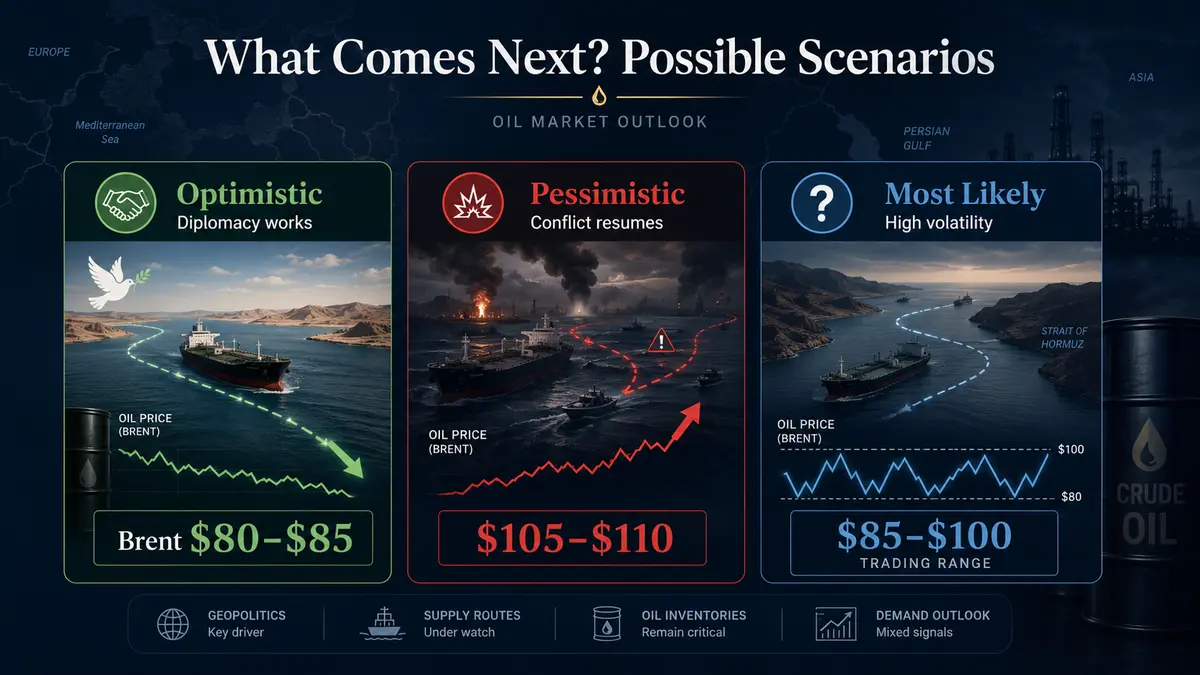
There are three main scenarios for how events could develop.
The first and most optimistic scenario is that negotiations between the United States and Iran begin to produce tangible results. The conflict would gradually move toward a political settlement, while threats to shipping in the Persian Gulf and the Red Sea would diminish.
Under this scenario, oil prices could continue falling, potentially taking Brent crude down to the $80–$85 per barrel range.
The second and most pessimistic scenario is that the pause proves short-lived, diplomacy fails, and military operations resume with renewed intensity.
In that case, oil could not only return to $100 per barrel but also move beyond that level, potentially reaching $105–$110 if supply disruptions become more severe.
The third—and arguably most likely—scenario is an extended period of uncertainty. The conflict would remain unresolved but would not escalate to a critical level.
Prices would fluctuate within a wide range, reacting sharply to every political statement and every change in shipping activity through the strategic straits.
Under this scenario, investors would face a period of elevated volatility in which rapid decision-making and the ability to interpret geopolitical signals would determine success.
ANZ analysts have also noted that the market remains vulnerable to renewed price growth.
US strategic reserves, which have been actively used to stabilize the market, have fallen to their lowest levels in several decades. This means that the government has fewer resources available for emergency intervention.
Should another crisis begin now, the market would not have the same margin of protection it had during the previous disruption.
Market Reaction: Cautious Optimism or a Speculative Move?
The 5% decline in oil prices was not chaotic. It was a relatively orderly correction that could be clearly observed in futures-market activity.
However, it is important to note that even after such a sharp decline, prices remain historically elevated.
Brent continues to trade above $90 per barrel, which is approximately $20–$25 higher than at the beginning of the year. This indicates that the market is still retaining a significant portion of the geopolitical premium despite the temporary pause.
Traders will probably monitor statements from government and military officials closely over the coming days.
Any suggestion that the conflict could resume may trigger another surge in oil prices. Conversely, reports of progress in negotiations could provoke an additional wave of selling.
Interestingly, the US Dollar Index—which often influences oil prices—has remained relatively stable amid the geopolitical drama.
A 0.10% decline in the dollar was not enough to provide meaningful support to oil prices. This suggests that the primary force driving the current market movement is geopolitical expectations rather than currency fluctuations.
Conclusion: The Price of Peace or the Price of War?
On Monday, the oil market chose to believe in diplomacy—at least for one trading session.
The key question is how sustainable that choice will prove to be. The conflict between the United States and Iran has deep historical roots, and a single temporary ceasefire is unlikely to resolve them.
The most probable outcome is a period of high volatility in which prices repeatedly change direction in response to incoming news.
Investors should be prepared for both further declines and sudden upward surges. The geopolitical premium has not disappeared. It has merely decreased temporarily and could return at any moment if events take a turn for the worse.
For oil consumers, particularly in importing regions such as Europe and Asia, the current correction offers short-term relief. However, it should not create a false sense of security.
The world remains unstable, and the oil market continues to be an arena in which the fortunes of entire economies are determined.
The current decline is only one episode in a long and dramatic story. Whether it marks the beginning of the end of the war or merely a pause before another escalation remains an open question.


Comments
No comments yet. Be the first to share your thoughts!
Authentication Required
You must be logged in to post a comment.