

Oil Calm Before the Storm: WTI Stuck at $80.72 as Geopolitics and Central Banks Keep It from Falling—or Rising
Tuesday: The Day Oil Held Its Breath
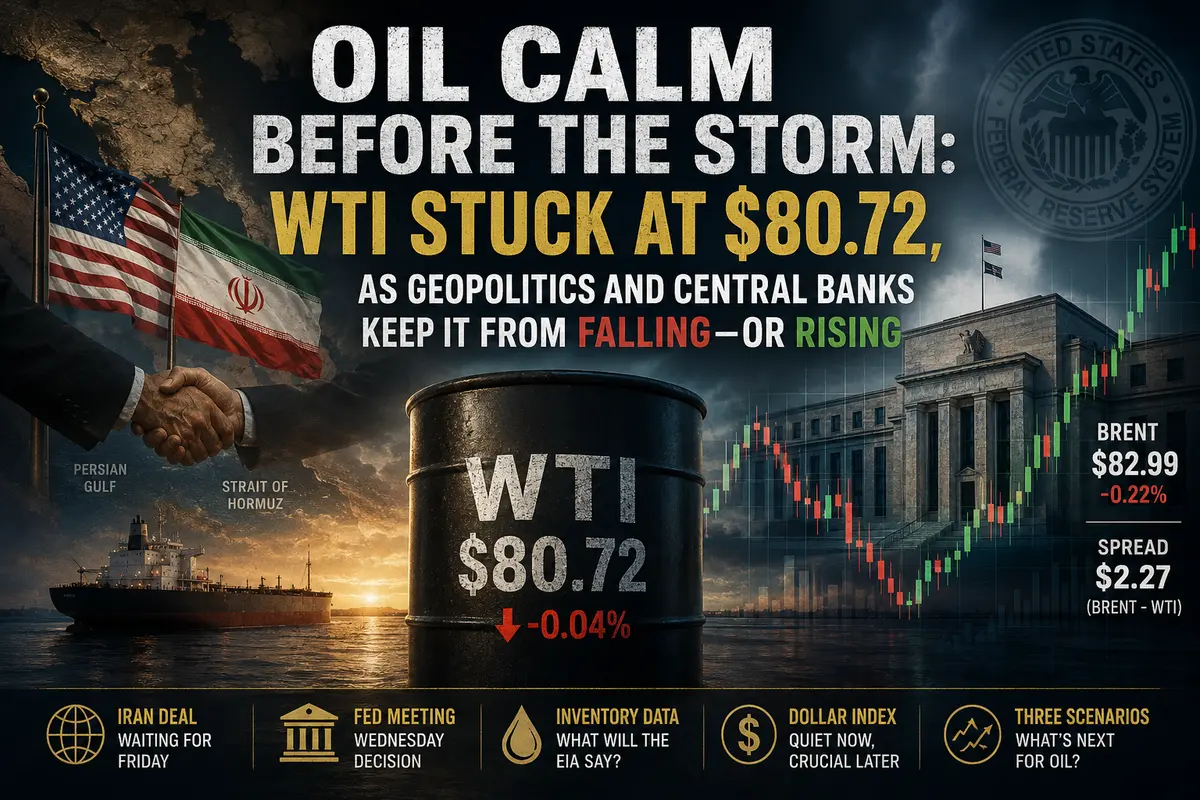
You wake up on Tuesday, open your trading terminal, and see WTI crude trading at $80.72 per barrel. Down just 0.04% over the past few hours. Four hundredths of a percent. That’s not a move—it’s a frozen snapshot. Oil isn’t falling, but it isn’t rising either. It’s simply standing still.
The session low was $79.70, while the recent high stands at $93.64—a peak from which oil has already retreated nearly 14%. Now it is hovering somewhere in the middle, closer to the lower boundary. And no one knows where it goes next.
Brent crude also slipped, falling 0.22% to $82.99 per barrel. The spread between the two benchmarks stands at $2.27, slightly narrower than yesterday but still reflecting the market’s concern over Middle Eastern risks. Brent remains more sensitive to geopolitical developments and commands a premium because it reflects global, rather than purely U.S., supply and demand balances.
But the key story is the pause.
Oil has frozen in place. Why?
Because peace in the Middle East is not yet signed, and the Federal Reserve has not yet spoken.
Let’s take a closer look at what’s behind this calm.
Peace with Iran: The Euphoria Has Faded, Caution Remains
On Monday, oil prices plunged. WTI dropped 4.6%, while Brent fell 4.1%. The catalyst was news of a preliminary peace agreement between the United States and Iran. The prospect of reopening the Strait of Hormuz, bringing Iranian oil back to global markets, and reducing insurance premiums all pushed prices lower.
By Tuesday, however, the initial excitement had faded.
Traders realized that peace is not a signed document yet—it is merely a framework agreement. The official signing ceremony is scheduled for Friday in Switzerland. Until then, anything can happen.
Iranian hardliners could attempt to derail the deal. Israel, which is not a party to the negotiations, could launch a preemptive strike. The United States could harden its stance at the last minute.
As a result, traders are reluctant to sell oil too aggressively. They are waiting for confirmation.
Even if the agreement is signed, implementation will take time. The Strait of Hormuz will not reopen overnight. Tankers will not immediately resume normal operations until any security concerns are addressed, insurers reduce premiums, and energy companies restore contracts and shipping schedules.
Analysts warn that even under a best-case scenario, tanker traffic may not return immediately to pre-conflict levels. Rebuilding confidence and restoring logistics networks takes time.
That is why oil is standing still.
It is waiting.
U.S. Inventory Data: What Will the EIA Say?
On Wednesday, alongside the Federal Reserve meeting, the U.S. Energy Information Administration (EIA) will release its weekly report on crude oil and petroleum inventories.
In recent weeks, inventories have declined due to strong gasoline demand during the summer travel season and reduced imports. If that trend continues, it could provide support for prices despite easing geopolitical tensions.
Analysts expect inventories for the week ending June 12 to show another decline of 2–3 million barrels. A larger drawdown of 4–5 million barrels could trigger a rebound in oil prices. Conversely, an unexpected increase in inventories would add downward pressure.
As often happens, however, the EIA report may take a back seat to developments in the Persian Gulf and signals from the Federal Reserve.
The Federal Reserve Meeting: The Biggest Risk for Oil
The Federal Reserve deserves special attention. Its June 16–17 meeting could change everything.
Markets widely expect the Fed to leave interest rates unchanged. That is not the story.
The real story could be the tone of new Fed Chair Kevin Warsh.
If Warsh delivers a dovish message—suggesting inflation is easing and the Fed can afford patience—the U.S. dollar is likely to weaken. A weaker dollar is generally supportive for oil because crude is priced in dollars. When the dollar falls, oil becomes cheaper for foreign buyers, boosting demand and supporting prices.
If Warsh sounds hawkish—arguing that inflation remains elevated and further tightening remains possible—the dollar could strengthen. A stronger dollar typically weighs on oil because it becomes more expensive for international buyers.
Markets currently assign a 49% probability to a December rate hike, according to CME FedWatch. Just a week ago, that figure was 69%. The decline reflects softer inflation data and optimism surrounding the Iran peace initiative.
If Warsh validates that shift in expectations, oil could find support.
If he pushes back against it, prices could fall further.
Technical Levels: Support and Resistance
Technically, oil sits at a critical crossroads.
-
Support: $79.70, today’s session low.
-
Resistance: $93.64, the recent peak reached before last week’s selloff.
A break below $79.70 could open the door toward $75–76 per barrel. Returning to $93.64 would likely require a major geopolitical shock.
For now, oil remains trapped between these two levels, leaning toward the lower end of the range.
Traders do not want to sell aggressively at $80 because the peace process could fail.
But they are also reluctant to buy because a successful agreement could push prices toward $70–75 per barrel.
This is classic uncertainty.
And it may persist until Friday.
The Dollar: A Quiet but Important Factor
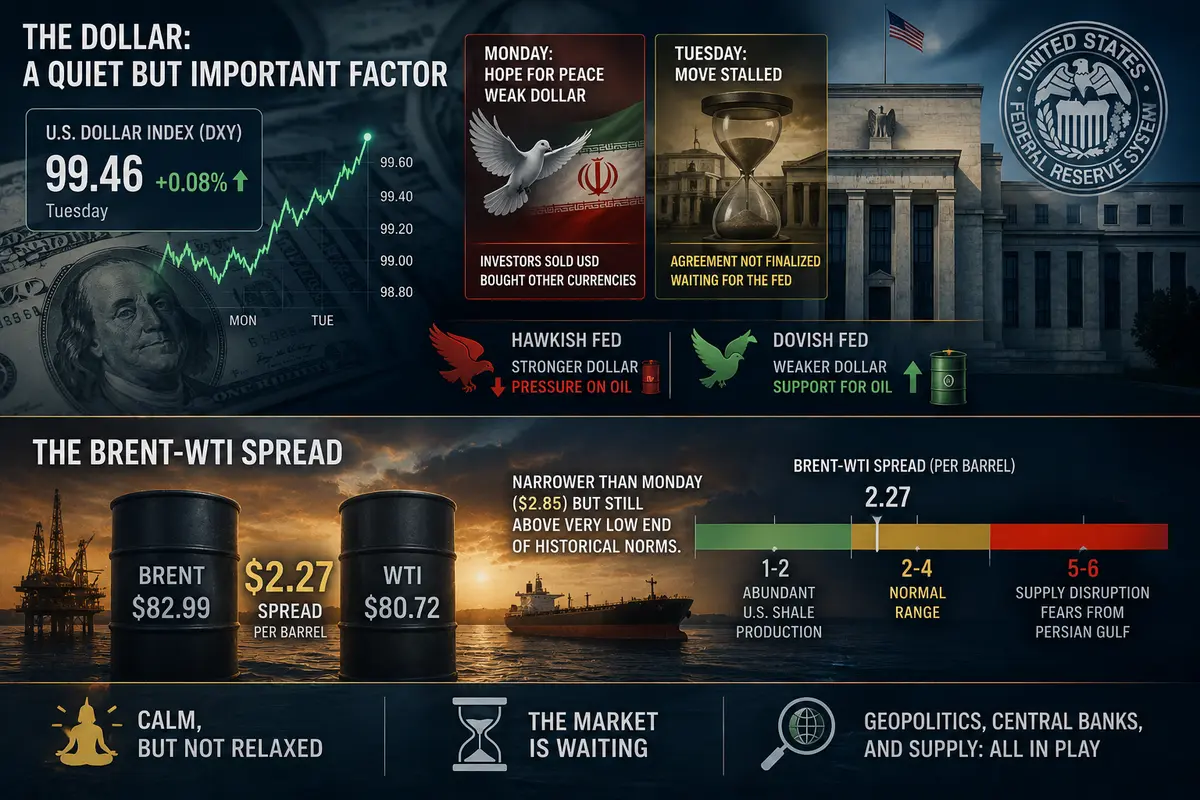
The U.S. Dollar Index (DXY) rose 0.08% on Tuesday to 99.46.
It’s a small move, but it suggests the dollar is attempting to recover after Monday’s decline.
On Monday, the dollar weakened on hopes of peace with Iran. Investors sold dollars and bought euros, pounds, and other currencies that tend to benefit from lower geopolitical risk.
On Tuesday, that move stalled.
Why?
Because investors realized the agreement is not yet finalized.
And because they are waiting for the Federal Reserve.
A hawkish Fed would strengthen the dollar and add pressure on oil.
A dovish Fed would weaken the dollar and support crude prices.
The Brent-WTI Spread
The Brent-WTI spread currently stands at $2.27 per barrel.
That is narrower than Monday’s $2.85, but still above the very low end of historical norms.
In stable market conditions, a spread of $2–4 is generally considered normal. When the spread widens toward $5–6, it often signals fears of supply disruptions from the Persian Gulf. When it narrows toward $1–2, it may indicate abundant U.S. shale production.
Today’s spread suggests a market that is calm—but not relaxed.
The market is waiting.
Outlook: Three Scenarios for Oil
Scenario 1: Bullish for Consumers, Bearish for Oil Bulls
The Iran agreement is signed, the Strait of Hormuz reopens, Iranian exports return to the market, and the Fed delivers a dovish message.
-
WTI falls to $75–78 this week and potentially $70–75 in the coming months.
-
Brent declines toward $78–81.
Scenario 2: Neutral
The agreement is signed, but implementation is delayed. The Fed maintains a neutral stance. The dollar remains stable.
-
WTI trades between $80–85 without a clear trend.
-
Brent fluctuates between $83–88.
Scenario 3: Bearish for Consumers
The agreement collapses. Iran renews threats against the Strait of Hormuz. Oil prices surge.
Even if the Fed sounds hawkish and the dollar strengthens, geopolitics dominates.
-
WTI returns to $90–95.
-
Brent rises toward $95–100.
Personally, after weighing all the factors, I lean toward the first scenario. Too many parties have a strong interest in maintaining peace, and the costs of escalation are extremely high.
That said, it is still a bet.
And bets can be wrong.
Conclusion: Oil Is Waiting
WTI crude is trading at $80.72 per barrel, down just 0.04% on the day.
That’s not movement.
It’s a pause.
The reasons are straightforward:
-
The market is waiting for the Iran peace agreement scheduled to be signed on Friday.
-
The market is waiting for Wednesday’s Federal Reserve decision and inventory data.
WTI remains caught between support at $79.70 and resistance at $93.64, trading closer to the lower end of the range.
Brent stands at $82.99, with a spread of $2.27 over WTI.
Everyone is waiting.
Traders do not want to sell too cheaply because the peace process could fail.
They do not want to buy too aggressively because, if peace holds, oil could fall even further.
The tension is building.
The silence is getting louder.
The next 48 hours—Wednesday’s Fed meeting and inventory data, followed by Friday’s signing ceremony—could determine the direction of oil prices for weeks ahead.
For now, the market remains in a holding pattern.
A heavy, uneasy calm that can feel worse than any storm.
Because during a storm, at least you can act.
In a calm, all you can do is wait.
And waiting is often the hardest part of trading.
And of life.
Especially when billions of dollars are at stake.
And when, outside the window, there is once again hope for peace.
Or war.
No one knows.
Everyone is waiting.
And oil is waiting with them.

Comments
No comments yet. Be the first to share your thoughts!
Authentication Required
You must be logged in to post a comment.