Bar Pipa
We pay for a post of 10$

Trading Signals

joy

EUR/JPY – Cross-Rate Arbitrage, Rate Divergence, and Session Breakdown Patterns
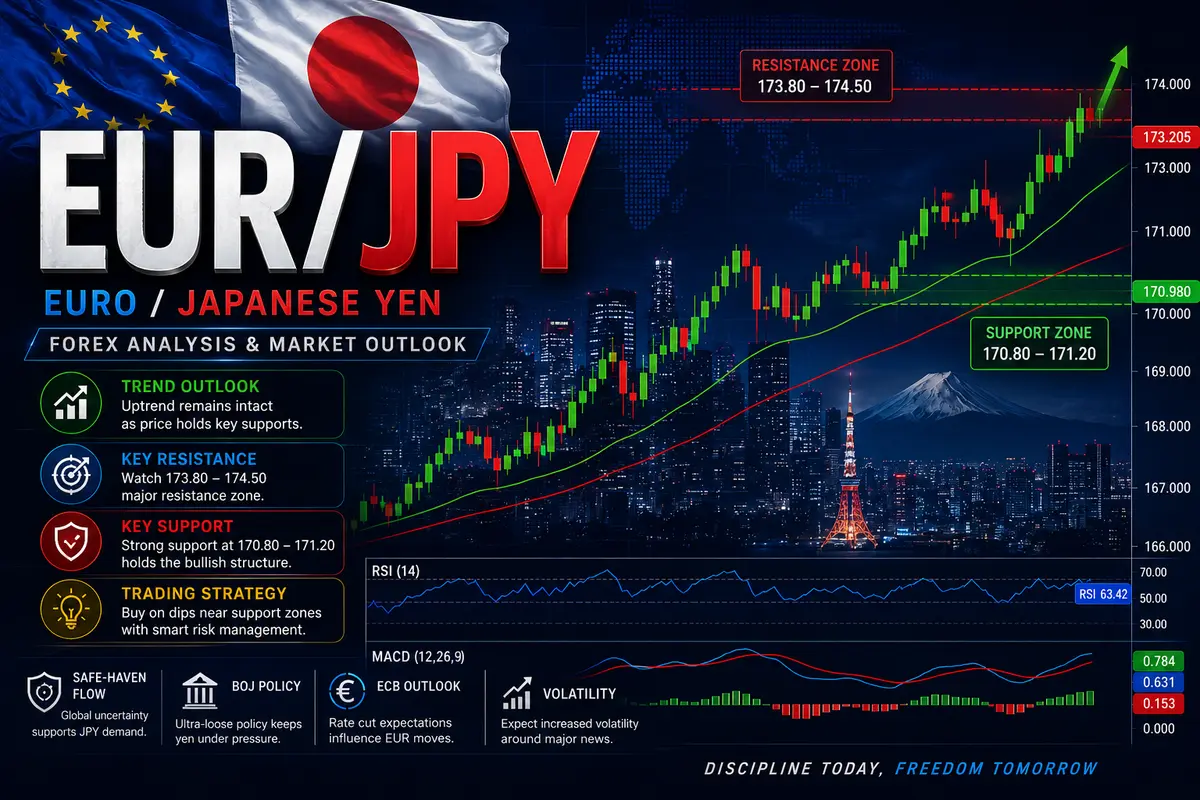
EUR/JPY – Cross-Rate Arbitrage, Rate Divergence, and Session Breakdown Patterns

If GBP/JPY is the erratic, high-octane rocket of the cross-rates, EUR/JPY is its more methodical, structural cousin. Known simply as "The Europy" across global trading desks, this pair blends the massive institutional trade volume of the European Union with the yield-sensitive capital flows of Japan.

It is a favorite among institutional trend-followers because it tends to respect technical levels with cleaner discipline than GBP/JPY, while still offering double the daily pip movement of EUR/USD. However, trading EUR/JPY successfully requires understanding how European Central Bank (ECB) policy directly collides with Bank of Japan (BoJ) operations, and how to spot when cross-rate arbitrage is driving the market.

The Anatomy of the EUR/JPY Engine

Just like any cross-rate, EUR/JPY does not have its own isolated order book running independent of the rest of the market. Its price is mathematically tied to two core pairs: EUR/USD and USD/JPY.

  • The Formula: EUR/JPY=EUR/USD×USD/JPY

When you look at a EUR/JPY chart, you are seeing the net result of that equation playing out in real time.

Understanding the Three Dynamics

  1. The Double Engine (Clean Trend): When EUR/USD is pushing higher and USD/JPY is also expanding to the upside, EUR/JPY experiences explosive, clean bullish runs. The two leg-pairs are working together to flood the market with buying pressure.

  2. The Drag Effect (Choppy Range): If EUR/USD is rallying strongly, but USD/JPY is tumbling because bond yields are dropping, EUR/JPY gets caught in a tug-of-war. Price action becomes messy, wicks get long, and standard breakout trades fail.

  3. The Divergence Opportunity: If EUR/USD is sitting flat in a quiet consolidation, but USD/JPY breaks out on bond market volume, EUR/JPY will follow USD/JPY almost pip-for-pip.

Before placing an order on EUR/JPY, always check both EUR/USD and USD/JPY. If you don't know what the underlying legs are doing, you're trading with a blindfold...
Continue reading...
0
0
joy

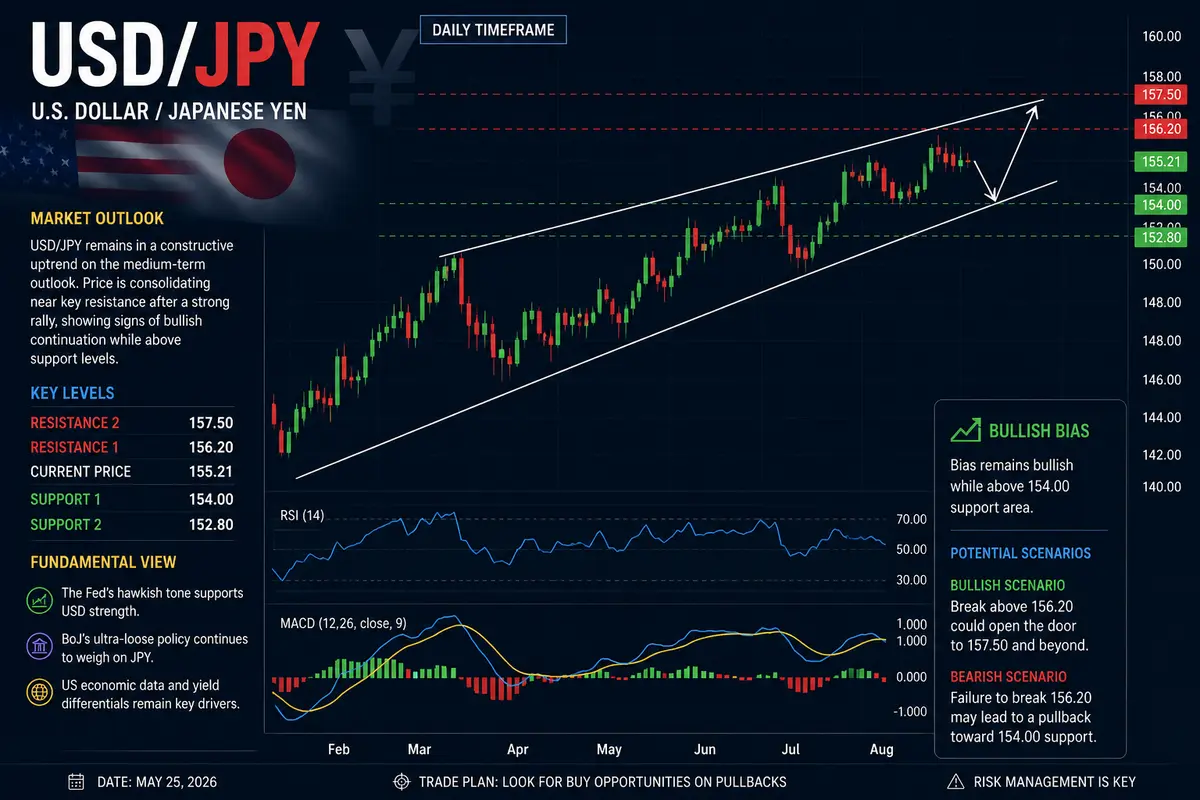
USD/JPY – Yield Differentials, Central Bank Interventions, and Tokyo Asian Ranges

USD/JPY – Yield Differentials, Central Bank Interventions, and Tokyo Asian Ranges

Trading USD/JPY (the Dollar/Yen) requires a fundamental shift in mindset compared to trading European currencies. While pairs like EURUSD ... and GBPUSD ... derive the bulk of their daily volatility from London and New York session openings, USDJPY ... is uniquely positioned as a bridge between Asian institutional liquidity and Western bond market dynamics.

Historically known as one of the cleanest trending assets in the foreign exchange market, USD/JPY can consolidate in tight ranges for days before launching into multi-hundred-pip expansions driven by interest rate expectations, global risk sentiment, and official central bank policy.

The Macro Core: Treasury Yields and Central Bank Policy Divergence

The long-term trend of USD/JPY is rarely determined by chart patterns alone. Instead, it is almost directly tied to the interest rate differential between the United States and Japan, specifically tracked via the US 10-Year Treasury Yield (TNX).

The Mechanics of Yield Divergence

  • The Fed vs. Bank of Japan (BoJ): For decades, the Bank of Japan maintained ultra-low or negative interest rates to combat deflation, while the US Federal Reserve adjusted interest rates to manage domestic growth and inflation.

  • The Yield Correlation: When US 10-Year Treasury yields rise, investors borrow capital in low-yielding Yen to purchase higher-yielding US Dollar assets (the classic "Carry Trade"). This creates massive capital outflows from Japan, driving USD/JPY aggressively higher.

  • Tracking US10Y: If you are trading USD/JPY, keeping a US 10-Year Treasury yield chart open side-by-side is essential. A sharp upward expansion in Treasury yields almost always triggers an immediate bullish push in USD/JPY.

Understanding Bank of Japan Interventions

Because Japan relies heavily on imports for energy and food, an excessively weak Yen increases domestic living costs. When USD/JPY rises too rapidly, the BoJ and Ministry of Finance (MoF) may intervene directly in the foreign exchange market.

  • Intervention Mechanics: Unlike normal market liquidity,...

Continue reading...
0
0
GFATHER

Economic News Events & High-Impact Volatility: Trading Around Institutional Catalysts

Economic News Events & High-Impact Volatility: Trading Around Institutional Catalysts

Economic News Events & High-Impact Volatility: Trading Around Institutional Catalysts

Many retail traders live in fear of high-impact news releases like Non-Farm Payrolls (NFP), Consumer Price Index (CPI), or interest rate announcements from the Federal Reserve. They view these events as random, chaotic gambling windows where slippage destroys accounts.

To central bank algorithms, news releases are not chaotic at all—they are liquidity delivery vehicles.

High-impact macroeconomic news provides the sheer volume required for institutions to reprice assets instantly, clear major liquidity pools, and deliver price across multiple standard deviation expansion targets in minutes rather than days.

The Anatomy of a High-Impact News Event

When a major economic data point drops, the Interbank Price Delivery Algorithm (IPDA) undergoes a three-stage reaction:

1. The Pre-News Drift

During the hours leading up to an event like CPI, market volatility compresses. Spread widens slightly, and price forms a tight range. Traders place buy stop and sell stop orders above and below this range, creating dense clusters of liquidity.

2. The Initial Spike (Judas Swing)

The moment data drops, the algorithm expands spread and rapidly drives price in one direction. This initial surge rarely reflects the actual fundamental outcome of the news. Its primary job is to sweep local stop losses and trigger breakout orders directly into a higher-timeframe Point of Interest (POI).

3. The True Delivered Move

Once the algorithm taps the HTF zone and absorbs the opposing liquidity, price violently reverses and accelerates toward the real target—leaving large Fair Value Gaps in its wake.

Key Macroeconomic Catalysts to Monitor

Not all news events carry equal weight. When planning your trading week, mark these tier-1 events on your calendar:

  • Central Bank Rate Decisions (FED, ECB, BOE): Sets medium-term directional bias and triggers structural trend shifts.

  • Consumer Price Index (CPI) & Personal Consumption Expenditures...

Continue reading...
0
0
GFATHER

Order Blocks & Breaker Blocks: Uncovering True Institutional Footprints

Order Blocks & Breaker Blocks: Uncovering True Institutional Footprints

In classical technical analysis, retail traders spend years learning to buy at double bottoms or sell at double tops. Yet time and time again, price smashes straight through those levels before reversing in the direction you originally anticipated.

Why does this happen? Because double tops and double bottoms aren't institutional reversal points—they are liquidity traps.

To locate true institutional turning points, you need to look at Order Blocks and Breaker Blocks. These are the literal price points where institutions loaded up massive position inventory, leaving behind footprint tracks that algorithms are programmed to return to and defend.

What Is a Valid Institutional Order Block?

An Order Block (OB) isn't just any red candle before a green move, or any green candle before a red move. A high-probability institutional Order Block must fulfill three strict criteria:

  1. Liquidity Sweep: The Order Block candle must have swept liquidity (taken out a previous swing high or low, equal highs, or session extremes) right before the reversal.

  2. Aggressive Expansion: Price must explode away from the Order Block, breaking market structure (BOS) or changing character (CHOCH).

  3. Fair Value Gap (FVG): That explosive push out must leave an unmitigated Fair Value Gap directly above (for bullish OBs) or below (for bearish OBs) the order block.

If a candle did not sweep liquidity or leave an imbalance behind, it is simply a standard candle—not an institutional Order Block.

Bullish Order Block (Demand)

The last down-close (bearish) candle that swept sell-side liquidity immediately before a powerful upward move that broke structural resistance and created an FVG.

Bearish Order Block (Supply)

The last up-close (bullish) candle that swept buy-side liquidity immediately before a sharp downward move that broke structural support and created an FVG.

The Mitigation Process: Why Price...

Continue reading...
0
0
GFATHER

Liquidity Pools & Inducement Mechanics: Reading the Institutional Footprints

Liquidity Pools & Inducement Mechanics: Reading the Institutional Footprints

Liquidity Pools & Inducement Mechanics: Reading the Institutional Footprints

If you’ve ever placed a trade, put your stop loss right where standard technical analysis taught you to put it, and then watched the market drop down to grab your stop before instantly rocketing off in your intended direction... you didn't get unlucky. You were used as liquidity.

Smart money operates under constraints that retail traders never have to consider. A retail trader buying 0.1 lots or 2 contracts gets filled instantly at the current market price. An institution trying to accumulate a $200 million long position in EURUSD ... or BTCUSD ... cannot simply press "market buy." Doing so would cause catastrophic slippage, pushing the price up against themselves before even half their order gets filled.

To fill massive positions without destroying their own entry prices, institutions need an equal and opposite pool of counter-orders. Liquidity Pools and Inducement are the precise mechanical tools algorithms use to create those orders.

The Reality of Liquidity: Buy-Side vs. Sell-Side

In financial markets, every transaction requires a counterparty.

  • When an institution wants to BUY, they need people willing to SELL to them.

  • When an institution wants to SELL, they need people willing to BUY from them.

Where do you find large clusters of opposing orders sitting in the market? Right behind obvious support and resistance levels.

1. Buy-Side Liquidity (BSL)

BSL sits above key swing highs, equal highs (EQH), and major daily resistance levels. It is made up of two things:

  • Stop loss orders from short-sellers (which trigger as market buy orders when hit).

  • Breakout traders placing buy stop orders expecting price to go higher.

When the algorithm pushes price above a major high, it triggers all those buy orders, creating a dense wave of buying liquidity. Institutions use this surge of buying...

Continue reading...
0
0
GFATHER

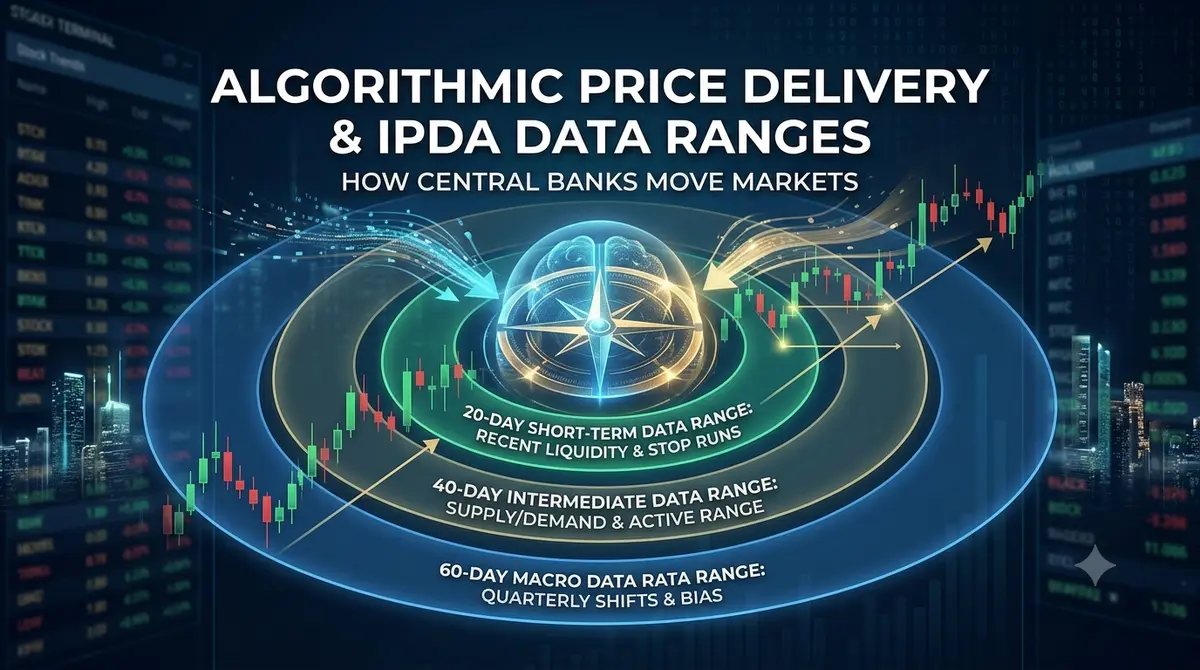
Algorithmic Price Delivery & IPDA Data Ranges: How Central Banks Move Markets

Algorithmic Price Delivery & IPDA Data Ranges: How Central Banks Move Markets

Algorithmic Price Delivery & IPDA Data Ranges: How Central Banks Move Markets

If you’ve ever wondered why price turns around at the exact pip, hour, or minute without touching any traditional indicator on your screen, the answer lies in Algorithmic Price Delivery.

Modern markets aren’t moved by buyers and sellers bidding against each other on a pit floor anymore. They are controlled by the Interbank Price Delivery Algorithm (IPDA)—a centralized computational framework used by tier-1 banks and central financial institutions to reprice assets, seek liquidity, and balance market inefficiencies.

Understanding IPDA removes the guesswork from your trading. You stop treating the market like a random walk and start looking at charts through the lens of scheduled institutional routines.

What Is IPDA?

IPDA stands for the Interbank Price Delivery Algorithm. Its core job is to deliver fair prices efficiently while providing continuous liquidity to institutional players.

Unlike retail traders who think in terms of lines, indicators, or shapes on a screen, IPDA delivers price based on two simple variables:

  1. Time: Price is programmed to reach specific levels at specific times of the day, week, month, and quarter.

  2. Price (Liquidity & Efficiency): IPDA moves price to either sweep liquidity (stop losses resting above swing highs or below swing lows) or rebalance inefficiencies (Fair Value Gaps and unmitigated Order Blocks).

If price is not seeking liquidity, it is seeking efficiency. There is no third state.

The IPDA Look-Back Engine: The 20, 40, and 60-Day Data Ranges

IPDA operates on strict historical time cycles to calculate where current price should be delivered. These cycles are known as IPDA Data Ranges.

To determine where institutions are likely to send price next, the algorithm constantly references three specific look-back windows:

  • 20-Day Look-Back (Short-Term Liquidity): Used to identify recent swing highs/lows for immediate...

Continue reading...
0
0
pixel

Why You Keep Exiting Winning Trades Too Early

Why You Keep Exiting Winning Trades Too Early

Have you ever found yourself in a trade that’s working well, yet you still close it far too soon? Not because your stop loss was hit. Not because the chart broke your setup. Just a tight feeling in the chest, a wave of anxiety, and the quiet fear that it might reverse any second. That feeling does not come from the market. It comes from inside you. And most of the time it means one clear thing—you do not fully trust your own setup.

This is one of the most common and costly patterns among traders who understand charts yet still struggle with consistency. The problem is rarely the strategy. The real issue is the gap between knowing the rules and believing them enough to stay in the trade when it matters most.

What Really Causes Premature Exits?

Many traders blame the market for shaking them out. They talk about stop hunts or sudden volatility. While those things exist, they are rarely the main reason a trader exits early. The deeper cause is internal. When belief in the system is weak, even a normal pullback starts to look dangerous. A single red candle feels like a threat. A routine retracement begins to look like a full reversal. In that moment the mind chooses the temporary relief of closing the position over the discomfort of uncertainty.

This creates a painful cycle. You exit, the trade continues in your original direction, and you watch it reach the target you had planned. The regret that follows only deepens the lack of trust. The next time a similar setup appears, the fear is stronger. Over time the trader starts switching strategies after every few losing trades, searching for a “better” system that will somehow remove the need for patience.

The Psychological Mechanism Behind Early...

Continue reading...
0
0

Fed Chair Warsh’s Testimony, US CPI, and Q2 Bank Earnings Collide With Iran-Driven Oil Risk

Fed Chair Warsh’s Testimony, US CPI, and Q2 Bank Earnings Collide With Iran-Driven Oil Risk

US Markets Weekly  |  13–17 July 2026

Nasdaq 100 29,823.90 (near record highs). USD/CAD 1.4155. USD/CHF 0.8085. Gold $4,111.61 (−2.3% wk). Nat Gas $2.94 (−6.1%). US 10Y 4.56% (+11bps). BTC $64,182 (+4.1%). BNB $576.44. Key events: US CPI Tue 14 Jul · JPM/C/WFC + GS/BAC/MS earnings Tue–Thu · Fed Chair Warsh testimony Thu 16 Jul · Retail Sales + jobless claims Thu.

HIGHEST CONVICTION: Buy Nasdaq 100 on confirmed dips toward 29,200, target 30,700. Q2 bank earnings Tue–Thu are the broadening test. AI-infrastructure uptrend intact. CPI Tuesday is the gate.


Last Week at a Glance · 6–10 July 2026

Nasdaq 100  29,823.90 (+1.6% wk)  near record highs — SK Hynix $26.5B debut + Nvidia + Meta drove AI-capex narrative

BTC  $64,182 (+4.1% wk)  V-shaped recovery from mid-week $57,950 Iran dip — ETF inflows resumed after 10-day outflow streak

US 10Y  4.56% (+11bps)  7-week high — US-Iran strikes fired oil, repriced Fed hike odds to ~64% by year-end

Gold  $4,111.61 (−2.3% wk)  Fed hike bets + dollar strength outweighed haven bid — set for weekly loss despite active conflict

Nat Gas  $2.94 (−6.1% wk)  6-week low — 61 Bcf storage build + Freeport LNG maintenance beginning

USD/CAD  1.4155 (−0.2% wk)  loonie firmed modestly as Brent’s Iran rally offset broad dollar strength

USD/CHF  0.8085 (−0.4% wk)  franc clawed back from 1-year low ~0.8123 on Middle East haven demand

BNB  $576.44 (+2.4% wk)  tracked BTC rebound + new Layer-1 chain announced for HFT and AI-agent use cases


The week of 6–10 July was defined by a fresh US-Iran military exchange that briefly rattled every asset class before markets largely looked through it by Friday. Oil’s Iran-driven spike cut two ways: it lifted Fed rate-hike odds to roughly 64% by year-end, firming the dollar and...

Continue reading...
0
0

Downing Street’s Handover Tests Sterling. ECB September Hike Bets Collide With Iran-Driven Oil. XRP’s CLARITY Act Hearing Ripples Into European Crypto

Downing Street’s Handover Tests Sterling. ECB September Hike Bets Collide With Iran-Driven Oil. XRP’s CLARITY Act Hearing Ripples Into European Crypto

European Markets Weekly  |  13–17 July 2026

EUR/USD 1.1413 (pinned near 1-year lows). GBP/USD 1.3396 (1-year highs). Silver $59.83/oz (−4.5% wk). Brent $71.44 (+5.0% wk). FTSE 100 10,531 (−1.7% wk). German 10Y 3.05% (+10bps). ETH $1,798.74 (+2.7%). DOGE $0.074 (Extreme Fear). Key events: UK Q1 GDP + German ZEW Tue · US CPI Tue · Labour result Fri · CLARITY Act Fri.

HIGHEST CONVICTION: Buy GBP/USD on confirmed dips toward 1.3339, target 1.3589. Structural uptrend intact on BoE hike bets. Friday’s Labour handover is two-way event risk — buy the dip, not the pre-announcement spike.


Last Week at a Glance · 6–10 July 2026

GBP/USD  1.3396 (+0.8% wk)  fresh 1-year highs — BoE hike bets + political risk absorbed

EUR/USD  1.1413 (+0.1% wk)  range 1.1395–1.1459 — near 1-year lows, ECB hike bets vs softer dollar

Brent Crude  $71.44 (+5.0% wk)  best week in a month — US-Iran strikes disrupted Hormuz shipping

Silver  $59.83 (−4.5% wk)  worst week in over a month — Iran oil spike firmed Fed hike odds, dollar

FTSE 100  10,531 (−1.7% wk)  AstraZeneca −6%+ on Wainua failure offset by EasyJet Apollo + Vodafone Niel

German 10Y  3.05% (+10bps)  largest weekly rise in 5 weeks — ECB pricing >30bps further tightening

Ethereum ETH  $1,798.74 (+2.7% wk)  ETF inflows + CLARITY Act positioning

Dogecoin DOGE  $0.074 (−1.2% wk)  Extreme Fear (score 20) — late-week bounce tracked BTC/ETH


The week of 6–10 July was dominated by two forces pulling in opposite directions: a renewed US-Iran military exchange that sent oil sharply higher and revived Fed inflation concerns, and a domestic UK political transition that traders had been progressively pricing in for weeks. GBP/USD was the standout European performer, reaching one-year highs as investors concluded that Starmer’s resignation carried less lasting...

Continue reading...
0
0

China Q2 GDP Test. BOJ & MOF Yen Intervention Watch. XRP’s CLARITY Act Hearing. The Asian Session’s Week Ahead

China Q2 GDP Test. BOJ & MOF Yen Intervention Watch. XRP’s CLARITY Act Hearing. The Asian Session’s Week Ahead

USD/JPY 161.35 near 40-year low. AUD/USD 0.6952. Copper $6.30/lb — tariff resolved. Hang Seng 24,259. LTC $43.98 (Extreme Fear). XRP $1.083 into CLARITY Act hearing Friday. Key events: US CPI Tuesday 14 Jul · China Q2 GDP Wednesday 15 Jul · XRP CLARITY Act Friday 17 Jul.

HIGHEST CONVICTION: Buy the Hang Seng on confirmed dips toward 23,900, target 25,100. China Q2 GDP Wednesday is the confirmation gate. The index defended 24,000 all week despite Friday’s AI-lockup tech selloff.


Last Week at a Glance · 6–10 July 2026

USD/JPY  161.35 (−0.3% wk)  yen whipsawed near 40-year low — Thursday spike to 162.5 on Iran strikes reversed on FM Katayama pension-fund remarks

AUD/USD  0.6952 (+0.5% wk)  firmed on broad dollar softness and resilient commodities

Copper  $6.30/lb (+2.5% wk)  US confirmed phased tariff: 15% Jan 2027, rising to 30% 2028 — binary overhang resolved

Hang Seng  24,259 (+1.2% wk)  defended 24,000 all week despite Friday AI-lockup tech selloff

Litecoin LTC  $43.98 (−0.3% wk)  range-bound, Extreme Fear persists (sentiment score 23)

XRP  $1.083 (−1.8% wk)  held $1.07–$1.10 zone — traders positioning ahead of CLARITY Act hearing


The week of 6–10 July was dominated by a fresh US-Iran military exchange that sent oil sharply higher mid-week and added a geopolitical premium across FX and commodities before easing on reports both sides would continue negotiations. USD/JPY spent the week oscillating near its weakest level in roughly four decades, with Thursday’s spike toward 162.5 reversing sharply on Friday after FM Katayama signalled fresh pension-fund support for domestic assets. Copper’s binary tariff overhang finally resolved with Washington confirming a phased 15%-then-30% structure. The Hang Seng defended 24,000 despite Friday’s AI-related lockup expiry tech selling. XRP held key support just above $1.07 heading into this week’s pivotal regulatory hearing.


...

Continue reading...
0
0
Navigation menu
instaforex banner