
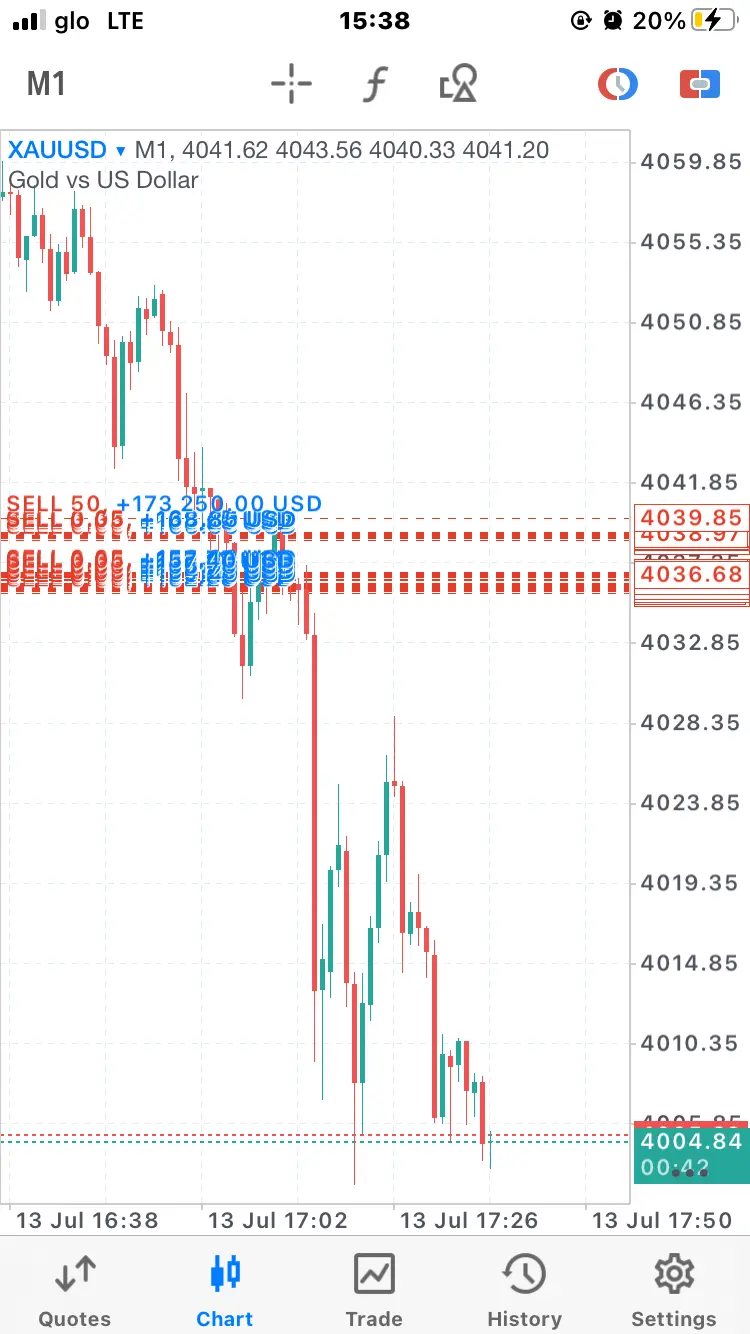
Algorithmic Price Delivery & IPDA Data Ranges: How Central Banks Move Markets
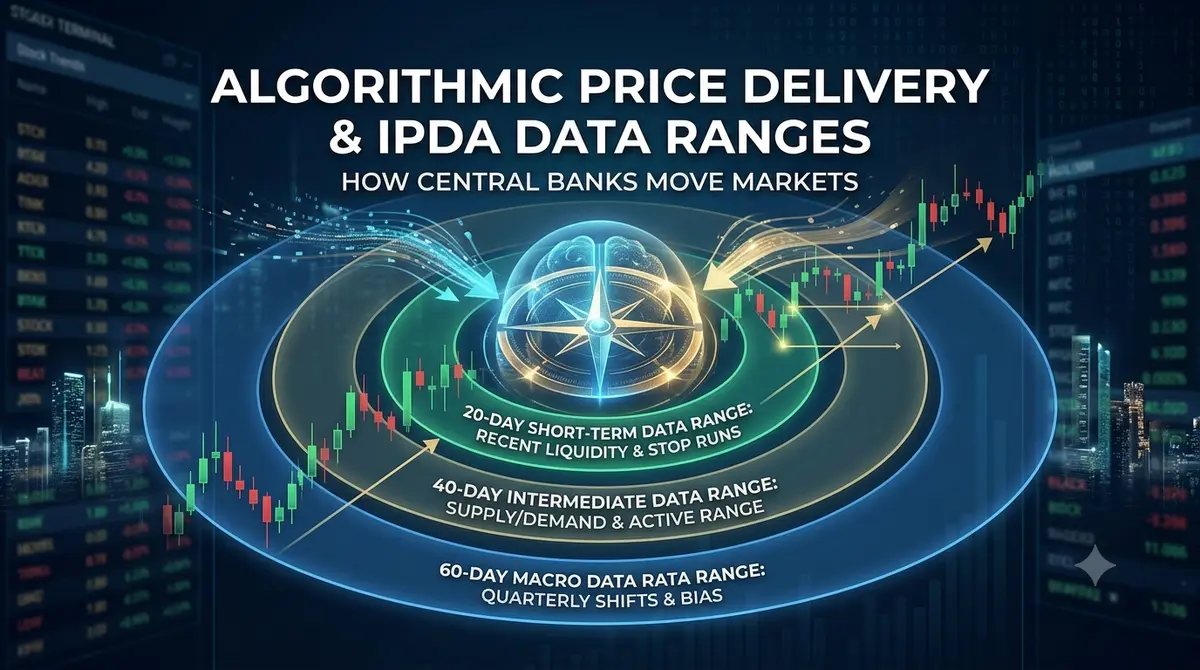
Algorithmic Price Delivery & IPDA Data Ranges: How Central Banks Move Markets
If you’ve ever wondered why price turns around at the exact pip, hour, or minute without touching any traditional indicator on your screen, the answer lies in Algorithmic Price Delivery.
Modern markets aren’t moved by buyers and sellers bidding against each other on a pit floor anymore. They are controlled by the Interbank Price Delivery Algorithm (IPDA)—a centralized computational framework used by tier-1 banks and central financial institutions to reprice assets, seek liquidity, and balance market inefficiencies.
Understanding IPDA removes the guesswork from your trading. You stop treating the market like a random walk and start looking at charts through the lens of scheduled institutional routines.
What Is IPDA?
IPDA stands for the Interbank Price Delivery Algorithm. Its core job is to deliver fair prices efficiently while providing continuous liquidity to institutional players.
Unlike retail traders who think in terms of lines, indicators, or shapes on a screen, IPDA delivers price based on two simple variables:
-
Time: Price is programmed to reach specific levels at specific times of the day, week, month, and quarter.
-
Price (Liquidity & Efficiency): IPDA moves price to either sweep liquidity (stop losses resting above swing highs or below swing lows) or rebalance inefficiencies (Fair Value Gaps and unmitigated Order Blocks).
If price is not seeking liquidity, it is seeking efficiency. There is no third state.
The IPDA Look-Back Engine: The 20, 40, and 60-Day Data Ranges
IPDA operates on strict historical time cycles to calculate where current price should be delivered. These cycles are known as IPDA Data Ranges.
To determine where institutions are likely to send price next, the algorithm constantly references three specific look-back windows:
-
20-Day Look-Back (Short-Term Liquidity): Used to identify recent swing highs/lows for immediate stop runs and short-term rebalancing.
-
40-Day Look-Back (Intermediate Trend): Defines the active trading range and helps identify major order blocks and liquidity pools.
-
60-Day Look-Back (Macro Direction): Establishes the overarching institutional bias and major quarterly shifts in smart money accumulation or distribution.
When price approaches a 60-day low that aligns with a 20-day liquidity sweep and an unmitigated 4-hour demand zone, you aren’t just looking at a chart pattern—you are looking at a programmed algorithmic execution point.
+---------------------------------------------------------------------------------+
|                            IPDA DATA RANGE ENGINE                               |
|                                                                                 |
|  [ 60-Day Data Range ] ---> Establishes Macro Expansion & Quarterly Shift       |
|  [ 40-Day Data Range ] ---> Identifies Active Range, Supply/Demand Pools        |
|  [ 20-Day Look-Back  ] ---> Targets Immediate Stops & Intra-Month Rebalancing   |
|                                                                                 |
|  Current Price ---> Seeks either: 1. Old Highs/Lows (Liquidity)                 |
|                                   2. Unfilled Inefficiencies (FVGs/OBs)         |
+---------------------------------------------------------------------------------+
The Interbank Delivery Cycle: The 4 Phases
The algorithm moves price through a perpetual four-phase cycle. Learning to recognize which phase the market is currently in keeps you from trading on the wrong side of institutional order flow:
-
Accumulation: IPDA holds price in a tight consolidation zone, usually during low-volume sessions (like the Asian session). Here, institutions quietly stack position orders without moving the market price.
-
Manipulation (The Trap): The algorithm deliberately drives price out of the accumulation range in the opposite direction of the true intended move. This sweeps liquidity, triggers retail breakout orders, and clears out stop losses.
-
Distribution / Expansion: Once liquidity is secured, IPDA aggressively accelerates price in the true direction. This is where large candle spreads, Fair Value Gaps, and structural breaks occur.
-
Re-Accumulation / Redistribution: Price slows down, forms a secondary range or deep pullback, and preps for the next expansion phase.
Applied Mechanics: Integrating IPDA into Your Workflow
To trade in harmony with algorithmic price delivery, combine IPDA cycles with your daily chart routines:
-
Forex: Trace back 20, 40, and 60 trading days on your Daily chart. Mark the highest high and lowest low within those ranges. These levels represent the absolute primary targets for institutional liquidity runs.
-
Indices & Futures: Pay strict attention to the 9:30 AM EST New York opening bell. The algorithm routinely uses the initial 15 to 30 minutes of the NY session to run a Manipulation phase (sweeping pre-market liquidity) before executing the true expansion for the day.
-
Crypto: Because crypto markets run 24/7 without traditional central bank mechanics, IPDA principles manifest heavily around weekly and monthly opens. Mark the previous week’s high/low and monitor how algorithms sweep these levels during Monday session volatility.
The Algorithmic Execution Formula
-
Check the IPDA Data Range: Look back 20, 40, and 60 days to identify whether price is sitting at a historical high/low or an unmitigated macro gap.
-
Identify the Cycle Phase: Is the market consolidating (Accumulation) or spiking past an established high/low (Manipulation)?
-
Wait for Time-of-Day Alignment: Only enter trades during high-volume Killzone hours (London Open or New York Open) when algorithmic execution rates peak.
-
Target Pure Liquidity: Always place your profit targets directly at opposing session highs/lows or unmitigated higher-timeframe order blocks—the exact places IPDA is programmed to deliver price next.

Comments
No comments yet. Be the first to share your thoughts!
Authentication Required
You must be logged in to post a comment.