

Asia Under Pressure: How Trump’s New Tariffs and $100 Oil Sent Regional Currencies Tumbling
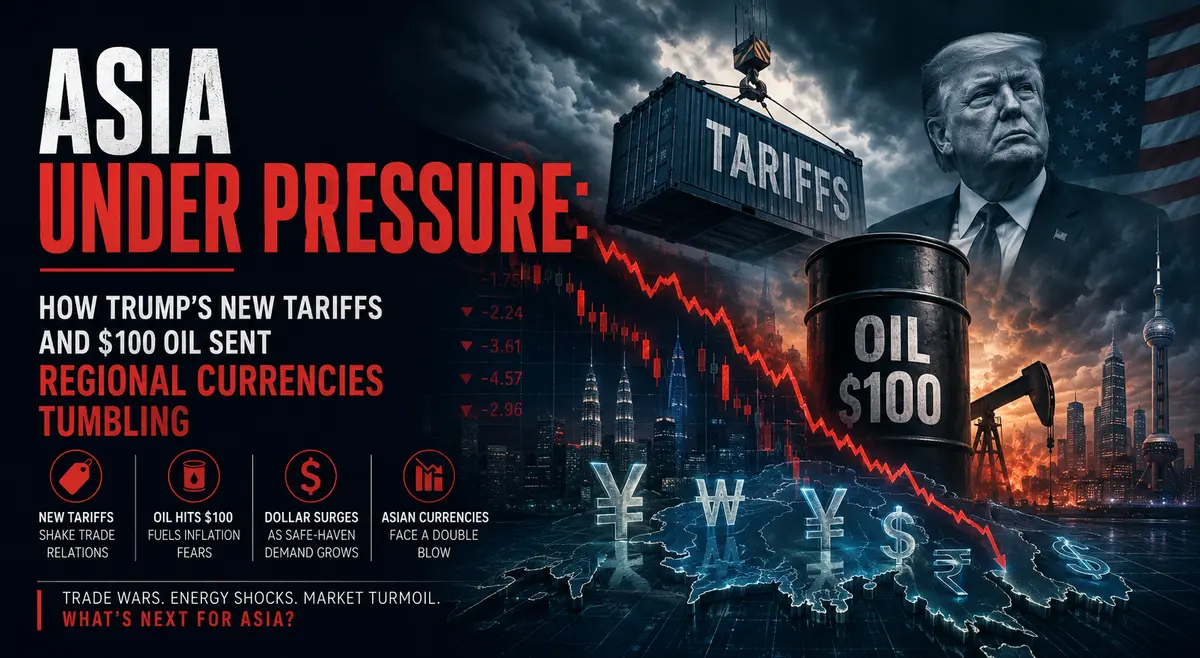
The Return of the Trade Wars: Tariffs Take Effect and Markets Shudder
Friday began with a severe hangover for Asian currencies. The new tariff regime, announced by President Donald Trump with his characteristic fanfare, came into force, and the consequences were immediate. The temporary 10% tariffs that had served as a warning are now history, replaced by new rates of 10% and 12.5% on imports from 60 trading partners. Almost all US imports are now subject to these levies, apart from a narrow list of exempt products, including oil, gas, and certain food items.
For Asia, the world’s primary manufacturing hub and a major supplier of goods to the United States, this represents a serious blow. The US Dollar Index remains close to a three-week high, and this is no coincidence. Investors are moving into the US currency, viewing it as a safe haven amid growing uncertainty.
However, tariffs are not the only issue. Inflation expectations, fuelled by these measures and the recent surge in oil prices, are forcing markets to reconsider their forecasts for US interest rates. This reassessment is working against Asian currencies.
Benchmark Treasury yields have reached fresh multi-month highs, with the yield on 10-year bonds rising above 4.7%. Thirty-year yields remain firmly above 5%. This means that borrowing costs in the United States are increasing, making the dollar even more attractive to investors seeking higher returns.
Asian currencies, which were already under pressure, are now facing a double blow: a stronger dollar and growing uncertainty surrounding global trade.
The Energy Shock: When Oil Becomes a Weapon
Tariffs are only half of the story. The other half is oil, which has once again broken through the psychologically important level of $100 per barrel.
This is not simply another price spike. It is the result of actual military action. Attacks by Iran-backed Houthi forces on Saudi oil tankers in the Red Sea, combined with renewed US strikes on Iranian targets, are creating a genuine threat to energy supplies from one of the world’s most strategically important regions.
For Asian economies, most of which are net oil importers, this is a potential catastrophe. Every additional dollar added to the price of a barrel increases import costs, worsens trade balances, and accelerates inflation. When tariffs that make exports to the United States more expensive are added to the equation, the economic pressure becomes almost unbearable.
Analysts at OCBC, one of the region’s leading banks, noted that currency markets had remained surprisingly calm despite these shocks. However, this calm may be deceptive. It resembles the quiet before a storm, as a prolonged oil shock could quickly revive market volatility.
When that happens, the dollar is likely to benefit even further from its status as a safe-haven currency. As a net exporter of energy, the United States is in a favourable position. Higher oil prices strengthen the dollar because they intensify inflation concerns and encourage the Federal Reserve to maintain a restrictive monetary policy.
The Yen on the Brink: 163.8 and No Relief in Sight
The Japanese yen JPYUSD ... deserves particular attention. It continues to balance on the edge of a precipice, trading near a 40-year low of approximately 163.8 yen per dollar.
This is happening despite reports that the Bank of Japan may accelerate the pace of interest-rate increases. Markets do not appear to believe that even faster monetary tightening will be sufficient to reverse the trend.
On Thursday, the US Treasury Department once again expressed concern about excessive volatility in the yen and called on Japan to continue normalising its monetary policy. This is an important signal because the United States rarely intervenes in the currency affairs of its allies.
Even this pressure, however, has failed to support the yen. The currency continues to fall because the underlying fundamental forces are too powerful.
OCBC stated that interventions alone would probably be insufficient to fundamentally change the yen’s role as a funding currency. The term “funding currency” refers to the practice of investors borrowing in yen at low interest rates and investing the proceeds in higher-yielding assets denominated in other currencies.
As long as Japanese interest rates remain low compared with those in the United States and Europe, this flow is likely to continue, placing persistent pressure on the yen. A sustainable recovery would require more than a one-off intervention. It would require a systematic acceleration of interest-rate increases, something the Bank of Japan does not yet appear ready to deliver.
The South Korean Won: Retreating After a Rally
KRWUSD ... The South Korean won, which reached an approximately two-and-a-half-month high earlier in the week, has also weakened. This reversal demonstrates that even strong economic data cannot protect a currency from global pressure.
South Korea is one of the world’s most open economies and is heavily dependent on exports. When trade wars intensify and oil prices rise, the Korean economy finds itself at the centre of the storm.
Earlier this year, the won strengthened thanks to robust semiconductor export data and hopes for a recovery in the global economy. Those hopes are now colliding with a harsh new reality.
Trump’s tariffs make Korean products less competitive in the US market, while expensive oil increases production costs. This double blow could force the Bank of Korea to reconsider its monetary-policy plans.
Investors who previously bought the won in anticipation of further appreciation are now closing their positions and taking profits. This creates additional pressure on the currency and could lead to further weakness unless external conditions improve.

China Waits: The Politburo as the Last Hope
The CNYCNH ... exchange rate has remained virtually unchanged, which almost appears miraculous against the backdrop of widespread weakness among Asian currencies.
However, this stability is deceptive. Investors have simply paused ahead of the Politburo meeting scheduled for next week. Much depends on the outcome of this meeting: whether new economic stimulus measures will be announced, how Beijing will respond to the trade tariffs, and what will happen to the yuan.
China has long been balancing the need to support economic growth against its desire to preserve the stability of its national currency.
On the one hand, a weaker yuan helps exporters by making their products cheaper in international markets. On the other hand, an excessively weak yuan could trigger capital outflows and create additional inflationary pressure.
Under current conditions, with oil prices rising and trade tensions escalating, finding the correct balance is becoming increasingly difficult.
Analysts expect that the Politburo may announce new measures to support the economy, potentially including interest-rate cuts or increased government spending. However, these measures could weaken the yuan and intensify inflationary pressure.
Chinese authorities will therefore have to proceed very carefully to avoid triggering another wave of market volatility.
The Australian and New Zealand Dollars: Stabilisation After the Shock
AUDUSD ... The Australian and NZDUSD ... New Zealand dollars, both closely connected to commodity markets, stabilised after sharp overnight losses.
This provides some relief, but it does not change the fact that both currencies remain under pressure. Australia and New Zealand are major commodity exporters, and rising oil prices have a mixed effect on their economies.
On the one hand, more expensive energy commodities increase export revenues from coal and natural gas. On the other hand, they raise import costs and contribute to higher inflation.
Both countries are also heavily dependent on trade with China. Should the Chinese economy slow because of tariffs and expensive oil, Australian and New Zealand exports would suffer.
Investors are therefore closely monitoring developments in both Asia and the United States, and any change in the situation could trigger a new wave of volatility.
The Federal Reserve and Inflation: The Central Question for Markets
At the centre of all these developments stands the US Federal Reserve.
Investors are becoming increasingly concerned that rising import costs and energy prices could force the Fed to adopt a cautious approach to monetary-policy easing. This means that interest rates may remain elevated for longer than previously expected, supporting the dollar and placing additional pressure on Asian currencies.
The continued rise in Treasury yields is a clear indicator of these expectations. When yields increase, the dollar tends to strengthen because investors prefer US assets that offer higher returns.
Asian currencies, which generally provide lower yields, become less attractive, contributing to their depreciation.
Commenting on the situation, OCBC emphasised that a sustained oil shock could quickly revive market volatility and support a broader rally in the dollar.
As a net energy exporter, the United States benefits from higher oil prices, while Asian economies suffer. This fundamental difference is likely to continue placing pressure on regional currencies in the weeks and months ahead.
Conclusion: Asia Enters a Zone of Turbulence
Friday became the day when all of the market’s fears materialised in concrete figures.
Trump’s tariffs, oil at $100 per barrel, and rising Treasury yields have created a perfect storm for Asian currencies. The yen is near a 40-year low, the won is retreating after its recent gains, the yuan is frozen as investors wait for policy signals, and the Australian and New Zealand dollars are struggling to remain afloat.
In this environment, Asian central banks have only a limited range of tools available. Foreign-exchange interventions may provide temporary relief, but they cannot change the fundamental trend.
For currencies to strengthen sustainably, underlying economic conditions must improve. Under conditions of trade conflict and expensive oil, such an improvement currently appears unlikely.
Investors are now focused on the upcoming Politburo meeting in China and the Federal Reserve’s next decisions. These two events could set the tone for the coming months.
Should China announce large-scale stimulus measures and the Fed signal that interest-rate cuts are approaching, Asian currencies could receive some relief. At present, however, both scenarios appear unlikely. The European Central Bank, which left interest rates unchanged on Thursday, has also failed to provide additional optimism.
Markets appear to be preparing for a prolonged period of weakness in Asian currencies. As always, those who can adapt to these conditions more quickly are likely to benefit.
Everyone else will have to endure the storm and hope that it is neither too long nor too destructive. Judging by the current situation, however, calm conditions are unlikely to return to Asia’s currency markets anytime soon.

Comments
No comments yet. Be the first to share your thoughts!
Authentication Required
You must be logged in to post a comment.