

SK hynix’s American Dream: How the Korean Giant Could Take Over Intel’s Ohio Fab
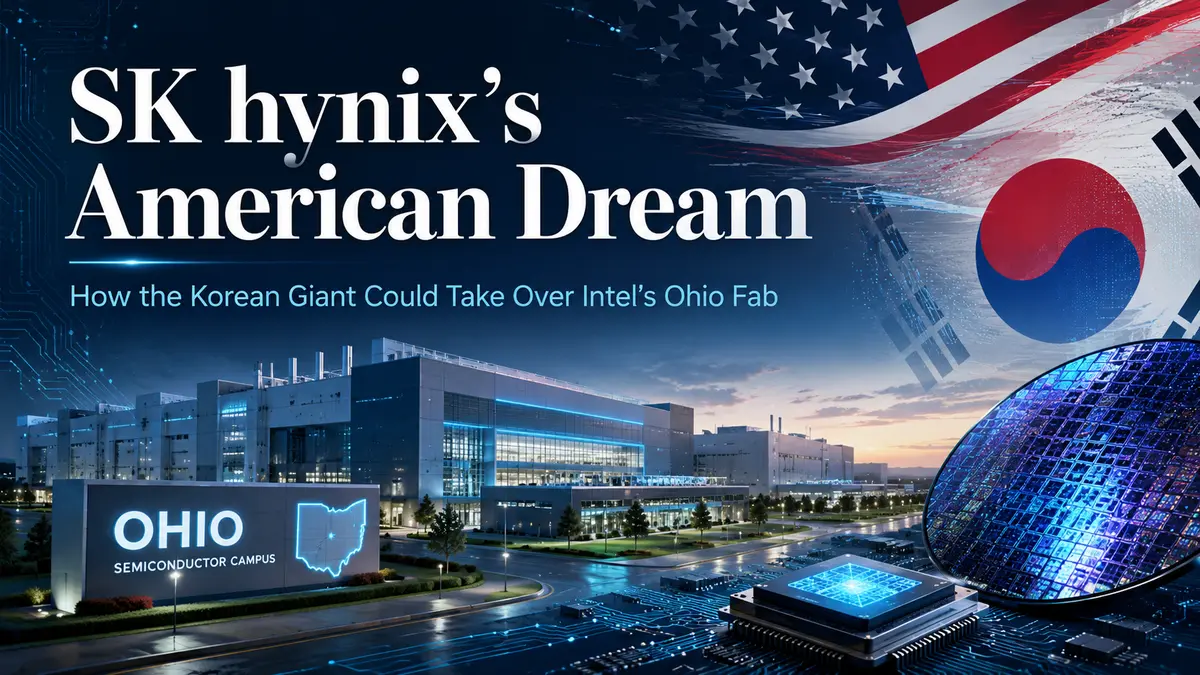
Ohio Emerges as a New Hub for Korean Chips
When Intel began construction of its massive campus in New Albany, Ohio, in 2022, the project looked like the return of an iconic American manufacturer to its home soil after decades of expanding production overseas. Four hundred hectares of land, enough space for eight semiconductor fabrication plants, and promises of hundreds of billions of dollars in investment were all supposed to symbolize the revival of the American semiconductor industry. However, as often happens, reality introduced some harsh adjustments.
Today, four years later, this ambitious project is hanging by a thread, and its future may end up in the hands of a competitor: South Korea’s SK hynix. Negotiations over a possible acquisition of the Ohio campus are reportedly taking place behind closed doors. Although the potential purchase price remains closely guarded, the very possibility of such a transaction has shaken the markets and prompted analysts to reconsider the balance of power within the global semiconductor industry.
For SK hynix, this would not simply be another deal aimed at increasing production capacity. It would be a strategic move capable of completely transforming the company’s position in the US market while also satisfying growing political pressure from Washington. For several years, the US administration has urged semiconductor manufacturers to move production facilities to American soil and reduce their dependence on Asian manufacturing. SK hynix appears ready to answer that call—not by building an entirely new factory from scratch, but by purchasing infrastructure that is already close to completion.
Interestingly, the Korean company already has experience working with former Intel assets. In 2020, SK hynix agreed to acquire Intel’s NAND flash memory business for $9 billion, making it the largest transaction in the company’s history. Now, another piece of Intel’s former empire may be up for grabs. This time, however, the potential acquisition involves production facilities designed for logic chips, which SK hynix could potentially convert for memory manufacturing. That would represent an entirely different level of complexity and introduce a new set of technological challenges.
Intel: From Ambition to Heavy Losses in Four Years
To understand why Intel may be prepared to part with a facility it recently described as its most important project of the decade, it is necessary to examine the American giant’s financial reports. Intel’s foundry business, which was supposed to become a major growth driver and a competitor to TSMC, has been suffering enormous losses. The division lost $2.2 billion last year and another $2.4 billion in the first quarter of the current year. These are figures capable of alarming even the most experienced investors.
How did this happen? The main reasons were delays and technological problems. Intel promised customers access to advanced manufacturing processes but failed to introduce them on schedule. Major chip designers such as NVDA ... , AAPL ... , and AMD ... evaluated those promises and chose to continue working with TSMC, which had consistently delivered high-quality products on time.
As a result, Intel’s foundry division became trapped in a vicious circle: no customers meant no revenue, no revenue meant less money for development, and weaker development prospects meant even fewer customers.
Intel is now being forced to reconsider its plans. The opening of the Ohio facility has been postponed until the end of the decade, somewhere between 2030 and 2031. Considering that building a semiconductor factory is far from a quick process even under ideal conditions, many experts doubt that these revised deadlines will be met.
Selling the asset may therefore appear to be the only reasonable way for Intel to reduce its losses and raise money that can be redirected toward other, more promising business areas.
It is also noteworthy that Intel recently appointed former SK hynix CEO Lee Seok-hee as executive vice president responsible for its foundry division. This appointment can be interpreted in several ways. It may be an attempt to bring in an experienced specialist to rescue the business, or it may represent preparation for an asset transfer overseen by someone who knows both companies extremely well. It could also be both at the same time.
SK hynix: An American Appetite and Global Ambitions
For SK hynix, acquiring the Ohio facility would provide an opportunity to solve several problems at once.
First, it would help satisfy Washington’s political demands. The US administration has made no secret of its desire to establish a complete domestic semiconductor production cycle, from chip design to advanced packaging. US Commerce Secretary Howard Lutnick recently called on BC94.L ... and SK hynix to build factories in the United States. Korean companies are being forced to respond because the American market is simply too important to ignore.
Second, SK hynix is already building an advanced memory-chip packaging facility in Indiana with a budget of almost $4 billion. That facility is expected to begin operations in 2028. Packaging, however, is only the final stage of the production process. Without wafer manufacturing in the United States, the supply chain remains incomplete.
Acquiring the Ohio campus could allow SK hynix to close this gap and create a complete semiconductor production chain from beginning to end on American soil.
Third, buying the facility would offer a faster way to increase production capacity. Constructing a new semiconductor fab from scratch in the United States requires years of bureaucratic approvals, environmental assessments, construction work, and employee recruitment.
By acquiring an existing campus that already has the necessary infrastructure and utility connections, SK hynix could reportedly reduce the development period to approximately five years. In an industry where time is money, such savings could be invaluable.
SK hynix shares responded to reports of the negotiations by climbing 8.4%, reaching their highest level in almost two weeks. This significantly exceeded the performance of the KOSPI200.KS ... index, which rose 5.6% on the same day.
Investors clearly interpreted the potential deal as a positive signal. Rather than remaining passive, the company appears to be actively expanding, entering new markets, and strengthening its position in the global semiconductor race.
The Geopolitical Context: Who Will Outmaneuver Whom?
Behind this corporate drama lies a much larger geopolitical struggle. The United States has spent years attempting to reduce its dependence on Asian manufacturing, particularly on Taiwan, which remains the world’s leading center for advanced semiconductor production.
Tensions with China, the possibility of an invasion of Taiwan, and continuing trade conflicts are all pushing Washington to establish a stronger domestic manufacturing base.
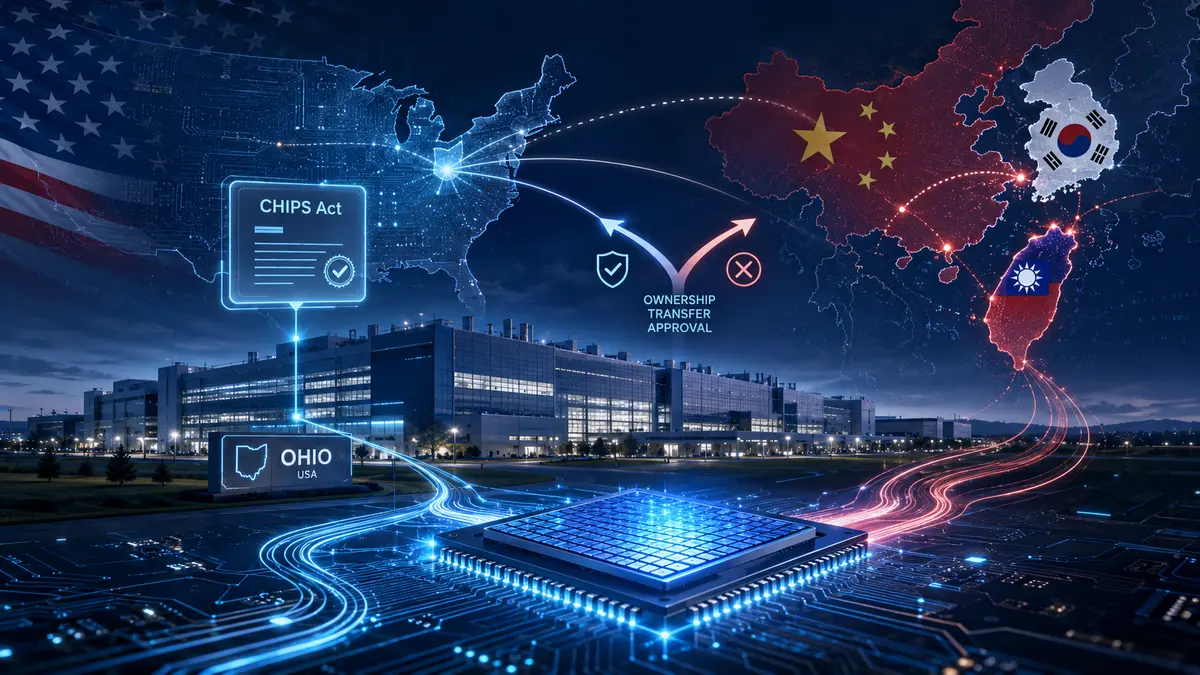
The CHIPS and Science Act, passed in 2022, provides billions of dollars in subsidies to companies building semiconductor facilities in the United States. Intel was promised government support for its Ohio project, but even those incentives were not enough to protect the development from delays and operational problems.
Should the plant be transferred to SK hynix, an important question would arise: would the subsidies remain available to the new owner, or would Washington insist that the funds stay with Intel?
On the other hand, the US administration generally welcomes any semiconductor manufacturer prepared to establish production capacity on American soil. From Washington’s perspective, the name on the factory sign may be less important than ensuring that chips are manufactured within the country.
Because SK hynix is based in South Korea, one of Washington’s most important allies in Asia, the company would probably receive the necessary regulatory approvals. SK Group Chairman Chey Tae-won has already stated that the company is prepared to consider additional locations for manufacturing facilities in the United States.
However, there is another side to the issue. China is a major market for SK hynix and may respond negatively to the company’s growing presence in the United States. Beijing has previously introduced restrictions affecting Korean manufacturers when they supported American semiconductor policies.
SK hynix will therefore have to maintain a careful balance between the two superpowers. That balancing act would become even more difficult should the Ohio acquisition go ahead.
Technological Challenges: Conversion and Integration
Even if SK hynix successfully negotiates the purchase of the facility, the company will face equally complex technological challenges.
The Ohio plant was originally designed to manufacture logic chips using Intel’s production processes. SK hynix, by contrast, specializes primarily in memory products such as DRAM and NAND, which require substantially different manufacturing technologies.
Converting the factory to memory production would involve far more than simply replacing equipment. It would require changes to the entire infrastructure, including chemical and gas delivery systems, ultrapure water systems, environmental controls, and cleanroom configurations.
Employees would also need to be trained in new manufacturing processes. The conversion could take years and require hundreds of millions of dollars in additional investment. During that period, parts of the facility could remain idle and generate no revenue.
There is, however, an alternative approach. SK hynix could initially use the factory to manufacture products based on technologies it has already mastered and gradually increase production volumes while converting other production lines.
The company could also reach an agreement with Intel to retain part of the facility for logic-chip manufacturing, preserving some of the existing equipment and workforce. This approach could reduce downtime and allow SK hynix to begin recovering its investment more quickly.
Another important consideration is how the facility would fit into SK hynix’s advanced-packaging strategy. The company’s Indiana plant is being developed to package high-bandwidth memory chips used in artificial intelligence systems, servers, and supercomputers.
Combining advanced packaging with domestic wafer production would create a vertically integrated supply chain. This could become a significant competitive advantage for SK hynix in the rapidly expanding market for AI hardware.
Investors: Do They Support the Deal?
As already noted, the market reacted positively to reports of the negotiations. SK hynix shares climbed 8.4%, and that reaction was not accidental. Investors tend to favor companies that are growing, expanding, and entering new markets.
Acquiring a manufacturing facility in the United States would not represent expenses alone. It would also constitute a major investment in the company’s future.
Nevertheless, several questions remain unanswered. How much would SK hynix be prepared to pay for the campus? Intel has reportedly invested approximately $28 billion in the first phase of construction.
The final sale price would almost certainly be considerably lower, since buyers rarely pay full value for an unfinished asset associated with significant losses. Even so, a transaction valued at between $10 billion and $15 billion would require an enormous amount of capital.
How would SK hynix finance the acquisition? The company has substantial financial resources, but they are not unlimited. It may need to borrow money or issue additional shares. A new share offering could dilute the ownership stakes of existing shareholders.
However, should the acquisition provide SK hynix with improved access to the US market and subsidies under the CHIPS Act, the investment could pay off over the long term.
Investors are also evaluating the strategic implications. SK hynix has traditionally been the world’s second-largest memory-chip manufacturer after Samsung. Acquiring a US production facility could help it narrow the gap, diversify its risks, and reduce its vulnerability to geopolitical disruptions in Asia.
Such changes could make the company more resilient and more attractive as a long-term investment.
Conclusion: A New Stage in the Global Semiconductor Race
A potential deal between SK hynix and Intel involving the Ohio facility would become one of the most important developments in the semiconductor industry in recent years.
It would demonstrate that even giants such as Intel are not protected from failure and may be willing to sell strategic assets in order to survive. It would also show that Korean semiconductor manufacturers are no longer merely catching up with their competitors—they are actively expanding their presence in the American market.
For both companies, this would be a complicated but potentially necessary step. Intel would receive funds that could help protect its foundry division from further losses. SK hynix would gain a nearly completed platform for expansion in the United States and an opportunity to meet Washington’s political expectations.
The United States, meanwhile, would gain another major semiconductor manufacturer operating on its territory, strengthening national security and reducing dependence on imported chips.
For now, the industry must wait for official announcements. Negotiations are still continuing, and, as is always the case with transactions of this scale, there is no guarantee that an agreement will ultimately be reached.
Nevertheless, the fact that such a deal is even being discussed demonstrates that the semiconductor industry is changing before our eyes—and the pace of that transformation is only likely to accelerate.
The next several years will reveal which companies emerge as the winners of this global race and which are left behind. One thing, however, is already certain: the semiconductor industry will not be boring for anyone.





Comments
No comments yet. Be the first to share your thoughts!
Authentication Required
You must be logged in to post a comment.