

Oil Breaks Above $90: The Middle East Is on Fire Again
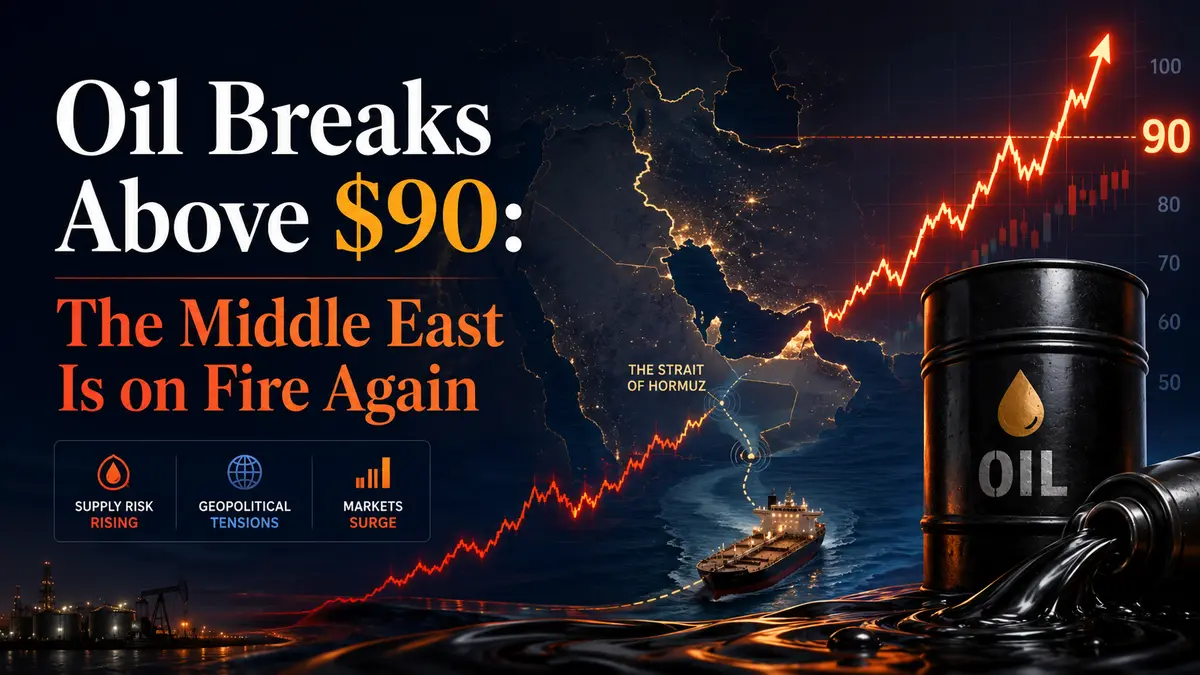
Monday in the Commodity Market: Oil Jumps 3%
The first day of the week began with a powerful surge in the oil market. Brent BZUSD ... crude futures jumped 3%, breaking through the psychologically important level of $90 per barrel and reaching $90.75. This was their highest level in more than five weeks. US West Texas Intermediate crude was not far behind, gaining 2.5% to reach $83.85 per barrel.
The reason for such a sharp move was not technical factors or inventory data, but the escalation of the military conflict between the United States and Iran, which entered a new and more dangerous phase over the weekend.
The conflict in the Middle East has already been underway for several weeks, but the events of the past weekend marked a turning point. The United States Central Command, or CENTCOM, confirmed that it carried out new strikes against Iranian targets on Sunday evening.
This was not simply another military operation. It was a response to an Iranian attack on a US base in Jordan that killed at least two American service members and injured many others. For the United States, this represented the crossing of a red line, and the response came quickly.
The most alarming development, however, is not the individual strikes themselves, but their geographical scope and intensity. According to reports, the US military is attacking a broader range of targets inside Iran rather than limiting its operations to border areas. Iran, in turn, has intensified its attacks on neighbouring Gulf states.
The conflict is no longer localised and is beginning to spread across the entire region.
The Strait of Hormuz: A Vital Artery Under Threat
The Strait of Hormuz remains at the centre of the military confrontation. It is a strategically important waterway through which approximately 30% of the world’s seaborne oil passes. Control over the strait is therefore a critical element of the confrontation.
CENTCOM stated that its latest strikes were intended to systematically suppress Iranian military capabilities being used to attack vessels in the strait.
The escalation of hostilities between the United States and Iran is causing serious concern. Shipping through the Strait of Hormuz remains severely disrupted and is operating at only a fraction of its pre-war level.
This is more than just a statistic. It represents actual barrels of oil that are failing to reach consumers. Every day that traffic through the strait remains disrupted, the market loses access to millions of barrels, and prices react to the shortage immediately.
Iran has repeatedly threatened to close the strait. Although it has not completely blocked the route, its actions have already caused significant disruption. Insurance companies are raising premiums for vessels travelling through the region, while many shipowners are avoiding the route altogether. This increases both delivery times and transportation costs.
All these factors are reflected in the price of oil in the form of a geopolitical risk premium.
The April Ceasefire: A Fragile Peace Has Collapsed
The current escalation represents the most serious deterioration in US-Iranian relations since the April ceasefire agreement.
Only a few months ago, the two sides reached a ceasefire with the mediation of third countries. At the time, it appeared that the conflict had been frozen and that the parties might return to diplomatic negotiations.
Those hopes have proved illusory.
Peace talks between the two sides appear to have reached a complete deadlock. Neither Washington nor Tehran is showing any willingness to compromise. Instead, both sides are strengthening their positions on the battlefield, apparently believing that only military force can produce results.
For the markets, this means that the conflict is likely to continue and may become even more intense. The geopolitical premium embedded in oil prices will continue to rise, especially if there are signs that oil shipments through the Strait of Hormuz could be completely halted.
The Market Is Pricing in Risk: What Comes Next?
Oil prices have already reacted strongly to the escalation. The main question now is what happens next.
Several scenarios are possible, and each would lead to a different price environment.
The first scenario is that the conflict remains at its current level of intensity. In this case, oil will probably remain close to $90 per barrel or move slightly higher, but dramatic price spikes are unlikely. Markets would gradually adapt to the new reality and fully price it in.
The second scenario involves further escalation and the direct participation of additional countries. If allies of either the United States or Iran enter the conflict, oil prices could rise significantly higher, potentially reaching $100 per barrel or more. This would indicate a genuine threat to global energy supplies.
The third scenario is a diplomatic resolution. Although this currently appears unlikely, it cannot be ruled out entirely. If the two sides return to the negotiating table, oil prices could correct lower. Even in that case, however, a complete return to pre-conflict price levels should not be expected.
For now, markets appear to be leaning towards the second scenario. Investors are pricing in elevated geopolitical risk, and the oil market continues to move higher.
What Does This Mean for the Global Economy?
High oil prices are always a problem for the global economy, but the impact is particularly significant under current conditions.
Inflation in developed economies has slowed, but it remains above central bank targets. Rising energy prices could reignite inflation and force central banks to return to tighter monetary policy.
For Europe, which is a net importer of energy, higher oil prices are especially painful. The eurozone economy is already struggling with weak growth, and an additional blow to the incomes of consumers and producers could make the situation worse.
For energy-importing Asian economies such as Japan, South Korea and India, high oil prices mean greater import costs and a deterioration in their trade balances.
The United States, as a major energy exporter, benefits to some extent from rising prices. However, excessively high oil prices also create risks for the US economy, particularly ahead of elections.
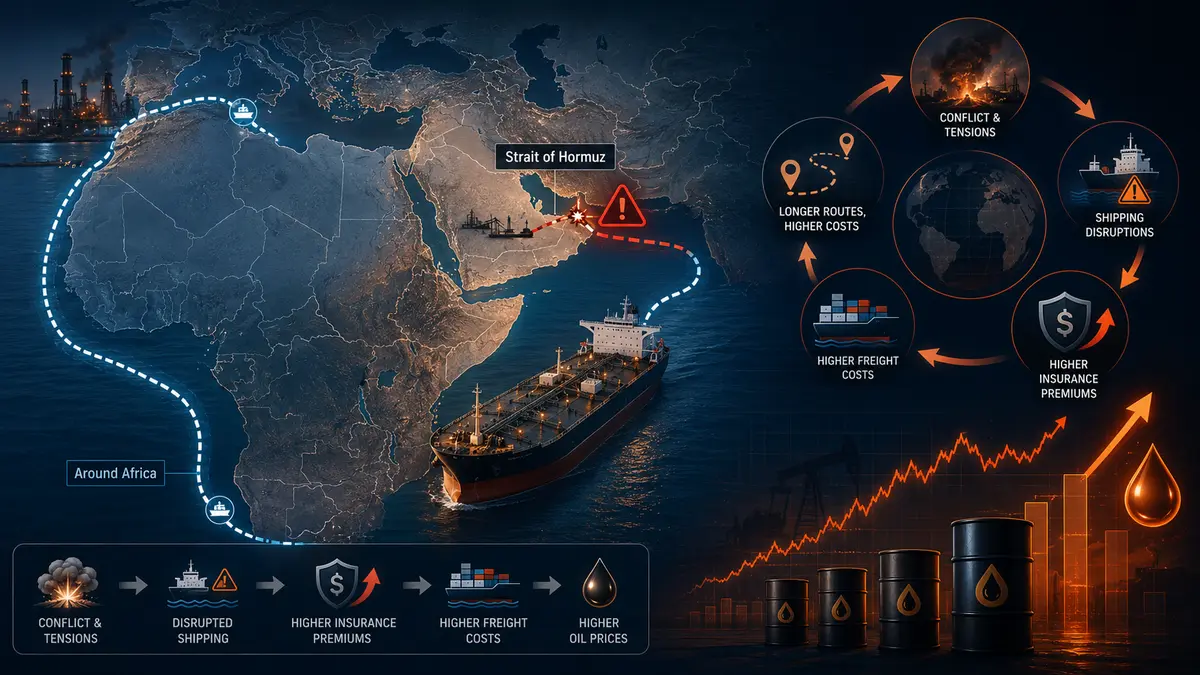
Shipping Disruptions and Insurance Premiums
Shipping through the Strait of Hormuz is a separate but closely connected issue.
Even though the strait formally remains open, insurance companies have already increased premiums for vessels passing through the region. This raises the cost of transporting oil, and those additional expenses are ultimately reflected in the final price.
Many shipowners are choosing to avoid the Strait of Hormuz and redirect their vessels around Africa. This adds weeks to delivery times and significantly increases freight costs.
As a result, even when physical oil supplies are not directly interrupted, higher logistics costs make oil more expensive.
This creates a vicious cycle: conflict leads to shipping disruptions, shipping disruptions cause insurance premiums to rise, higher insurance costs increase transportation expenses, and rising transportation costs push oil prices higher. Higher prices then increase Iran’s oil revenues, potentially providing it with additional resources to continue the conflict.
Impact on Other Markets
The effects of rising oil prices are not limited to the energy market. They influence nearly every other asset class.
XAUUSD ... Gold, traditionally viewed as a safe-haven asset, is also rising amid geopolitical uncertainty. The currencies of energy-exporting countries are strengthening, while the currencies of oil-importing economies are weakening.
Equity markets are responding negatively to higher oil prices, particularly the shares of companies that depend heavily on transportation and logistics. Airlines, shipping companies and consumer goods producers may all suffer from rising fuel costs.
Investors are moving towards defensive assets such as gold, government bonds and the Swiss franc. The US dollar is also strengthening because it remains the world’s primary safe-haven currency.
What Should Investors Expect?
For investors, the current situation is a classic example of geopolitical risk becoming the market’s primary driver. During such periods, fundamental factors move into the background, while prices are increasingly determined by fear and uncertainty.
Short-term traders may attempt to profit from increased volatility, but this is a high-risk strategy. Oil prices can move sharply in either direction depending on the latest battlefield developments.
A single statement about a possible ceasefire could send prices tumbling, while one report of a new military strike could push them dramatically higher.
Long-term investors should evaluate how persistently high oil prices may affect their portfolios. Shares of energy companies are likely to continue performing strongly, while companies that depend heavily on affordable energy may come under pressure.
Oil has broken above $90, and this may only be the beginning.
The conflict in the Middle East shows no signs of easing. As long as it continues, oil prices are likely to remain elevated. The only question is how high they will go.
If the escalation continues, oil could reach approximately $100 per barrel within the next few weeks. If diplomacy ultimately prevails, the market is likely to experience a downward correction.
One thing, however, can be said with confidence: uncertainty will remain the defining feature of the oil market for a long time. Investors should be prepared for every possible scenario.

Comments
No comments yet. Be the first to share your thoughts!
Authentication Required
You must be logged in to post a comment.