

Asian Currencies Pause in Anticipation as the Won Surges Ahead on Reforms

Monday on the Currency Markets: The Calm Before the Storm
The first trading day of the week on Asian currency markets was marked by cautious anticipation. Most regional currencies remained within narrow trading ranges, as though listening closely to events unfolding thousands of kilometres away. Investors faced a difficult choice: on the one hand, the US dollar is receiving safe-haven support amid the escalating conflict in the Middle East; on the other hand, declining US Treasury yields and expectations that the Federal Reserve will keep its policy unchanged are putting pressure on the currency.
The US Dollar Index stabilised at 100.73 after briefly strengthening at the beginning of the session. However, this calm may be deceptive, as a busy week lies ahead, featuring central bank meetings and the release of key economic data across Asia. Markets are preparing for possible surprises.
The Dollar and the Middle East: A Game on Two Fronts
Geopolitics continues to be the primary driver of currency markets. The conflict between the United States and Iran has entered its ninth consecutive night of air strikes. Brent crude oil prices have risen sharply, automatically intensifying concerns about global inflation. Should energy supplies be disrupted, fuel prices could soar, affecting consumers and manufacturers worldwide.
For the US dollar, this situation is a double-edged sword. On the one hand, rising oil prices support the dollar because the United States is a major energy exporter, and higher oil prices improve the country’s trade balance. On the other hand, elevated oil prices could force the Federal Reserve to reconsider its monetary policy if inflation begins to accelerate.
For now, however, markets are pricing in the continuation of the Fed’s current policy at its meeting on 29 July. Federal funds futures indicate an 85.6% probability that interest rates will remain unchanged. This is a relatively high figure, suggesting that investors believe the central bank will pause further monetary tightening.
However, Cleveland Federal Reserve President Beth Hammack introduced a note of scepticism on Friday. She warned that further policy tightening could be justified if inflation remains persistent. Her comments served as a reminder that the Fed is not bound by any commitments and may change course if inflation data deteriorates.
The Japanese Yen: No Changes During the Holiday
The Japanese market was closed on Monday as the country observed Marine Day. As a result, trading activity involving the yen was subdued. The USDJPY ... pair remained virtually unchanged at 162.36 yen. The currency is still trading near a forty-year low, with no signs of a reversal so far.
The reason for the yen’s weakness is well known: the enormous interest-rate gap between the United States and Japan. While the Federal Reserve maintains high interest rates and the Bank of Japan only cautiously discusses the possibility of policy normalisation, the dollar remains more attractive to carry traders. They borrow yen at low interest rates, invest in higher-yielding dollar-denominated assets and earn the difference. This flow of capital continues to place pressure on the yen.
Investors are waiting for new signals from the Japanese authorities. Last month, the government spent record amounts on currency interventions, but the effect proved temporary. Attention is now focused on the Bank of Japan: will the regulator finally decide to raise interest rates, or will it continue delaying action and allow the yen to weaken further?
The Chinese Yuan: Interest Rates Left Unchanged
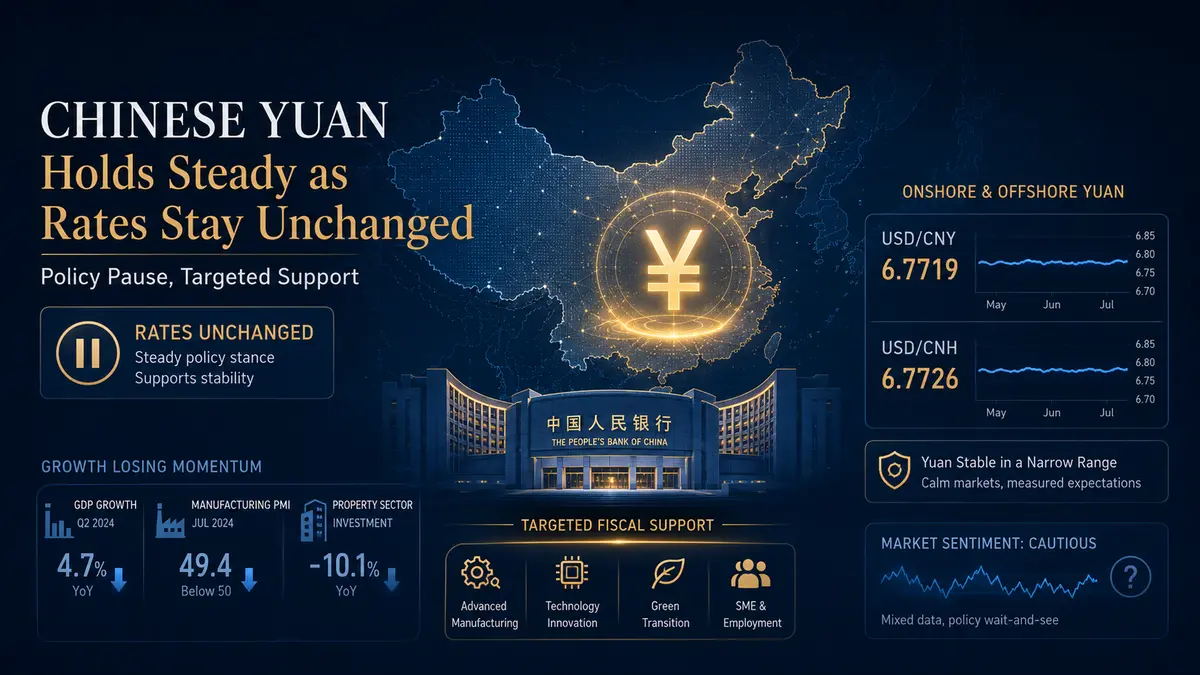
The Chinese yuan also remained virtually unchanged. The USDCNY ... pair held at 6.7719, while the offshore USDCNH ... rate stood at 6.7726. Markets expected the People’s Bank of China to leave its benchmark lending rates unchanged, and the regulator did not disappoint.
The decision followed weak second-quarter GDP data released last week. China’s economy is growing more slowly than expected, and many investors had anticipated additional stimulus measures from the authorities. Beijing, however, appears to prefer targeted fiscal support rather than broad monetary easing. This means that the central bank is unlikely to cut interest rates sharply or significantly increase the money supply. Instead, funds will be directed towards specific sectors of the economy.
This approach has both advantages and disadvantages. On the one hand, it helps prevent the economy from overheating and avoids creating excess liquidity that could flow into speculative markets. On the other hand, it may not provide sufficiently rapid support for the economy amid global uncertainty.
The yuan therefore remains in a state of uncertainty. It is not strengthening because the Chinese economy remains weak, but it is not weakening significantly either because the authorities are preventing a sharp decline. Markets are waiting for new signals from Beijing, and additional support measures may be announced next week.
The South Korean Won: Reforms Begin to Bear Fruit
The most interesting development on Monday involved the South Korean won. The USDKRW ... pair fell by 0.3% to 1,482.76, allowing the won to outperform all its regional counterparts. The move was driven by ambitious foreign-exchange market reforms announced by the South Korean government on Sunday.
These measures could represent a turning point for the Korean currency. Beginning in January 2027, foreign investors will be permitted to trade the won and conduct transfers through pre-registered overseas institutions without opening domestic Korean-won accounts. Settlements will be processed through a new round-the-clock network operated by the Bank of Korea.
In effect, South Korea is opening its currency to global markets. This initiative continues the country’s previous reforms: last month, South Korea introduced round-the-clock won trading. The process is now becoming even more liberal, as foreign investors will be able to trade the won without completing complicated registration procedures in South Korea.
What does this mean? First, broader international use of the won. Second, increased foreign capital inflows. Third, greater currency liquidity. In theory, all these factors should support the won and make it more resilient to external shocks.
Markets reacted positively to the reforms. Even amid widespread global uncertainty, the won is appreciating, attracting increased investor attention.
Australia, Singapore and Malaysia: Modest Changes
Other Asian currencies recorded only minor movements. The Australian dollar strengthened slightly, with the USDAUD ... pair falling by 0.1% to A$0.6990. This represents a moderate recovery following its recent decline, although the move does not appear particularly convincing.
The Singapore dollar and Malaysian ringgit also strengthened slightly, although their gains were minimal at approximately 0.1% each. The Taiwan dollar also posted a modest increase. Overall, regional currencies are showing highly restrained movements as markets wait for new signals.
In Focus: Central Banks and Economic Data
This week, markets will closely monitor several important events. The Bank of Indonesia will hold its policy meeting on Wednesday. Citi analysts expect the regulator to maintain its benchmark interest rate at 5.75%. Should this forecast prove accurate, it would indicate that Indonesia is continuing to follow a cautious policy despite inflationary pressure.
Towards the end of the week, South Korea will release its second-quarter GDP figures, while Singapore will publish new inflation data. These figures will provide additional guidance on the region’s economic momentum. Strong results could support local currencies, while weaker figures could intensify the pressure on them.
In addition, the European Central Bank will hold its policy meeting on Thursday. Although this event concerns another region, its outcome could affect global market sentiment and, consequently, Asian currencies. The new Prime Minister of the United Kingdom is also expected to officially take office, representing another political development that could generate volatility.
What Comes Next?
Asian currencies are currently in a state of tense equilibrium. Geopolitical risks are pushing the dollar higher, while expectations of a Federal Reserve pause and declining Treasury yields are placing pressure on it. Under these circumstances, regional currencies are struggling to establish a clear direction.
The won demonstrates that reforms can become a powerful market driver, but other currencies require a more significant catalyst to break out of their current ranges. This catalyst could come from inflation data, central bank decisions or new geopolitical developments.
For now, markets remain frozen in anticipation. Trading ranges are narrow, activity is subdued, and investors prefer not to take unnecessary risks. However, this calm is likely to be temporary. New signals are expected in the coming days, and they could determine the direction of currency movements for the weeks ahead.

Comments
No comments yet. Be the first to share your thoughts!
Authentication Required
You must be logged in to post a comment.