

WTI Oil Moves Higher as Asian Trading Boosts Buyer Confidence

Friday’s Opening: Black Gold Is Back in Demand
Friday’s oil market opened with a confident move higher. August WTI crude oil futures WTI ... on the New York Mercantile Exchange gained nearly 1% and are trading at $79.68 per barrel. This is not merely a random price fluctuation. The rise is supported by several clear factors that are encouraging investors to regain confidence in the oil market.
Notably, the increase is taking place against the backdrop of a stable US dollar. The USD Index remained unchanged on Friday at 100.57. This means that currency movements are not putting pressure on oil, allowing the market to respond to other, more fundamental signals. At present, these signals suggest that demand for energy remains strong while supply is facing significant risks.
Let us examine what is driving prices higher and why BZUSD ... Brent crude, contrary to expectations, is moving lower.
Technical Outlook: The Bulls Advance
Technical indicators on Friday present a fairly optimistic picture for oil buyers. Support is located at $72.61. The price rebounded from this level some time ago and is now trading significantly above it. Resistance stands at $81.27, and breaking through this level will be the next major challenge for the bulls.
The current price of $79.68 is only around $1.50 below resistance. This creates an interesting situation: the market has approached an important threshold, and if buyers manage to overcome it, oil could receive a fresh upward impulse. Otherwise, a correction and another test of lower levels may follow.
The session high has not yet been updated, leaving room for further growth during the trading day. Traders are closely watching whether WTI can consolidate above $80—a psychologically important level that has acted as a significant barrier in recent weeks.
The Gap Between Brent and WTI: What Does the Spread Tell Us?
One notable feature of today’s trading is the divergent movement of the two global benchmark crude grades. WTI is up 0.92%, while September Brent futures are down 0.75% at $84.86 per barrel. The price difference between the contracts, known as the spread, stands at $5.18 in Brent’s favor. However, this figure could have been even wider had Brent not declined.
Such dynamics are unusual and deserve closer attention. Brent and WTI generally move in the same direction, although the scale of their movements may differ. Today, however, US crude is becoming more expensive while the European benchmark is losing value. What does this mean?
One possible explanation involves domestic factors in the United States. Inventory or drilling activity data may have been stronger than expected, supporting WTI prices. Brent, meanwhile, could be under pressure because of concerns about European demand or because investors are shifting from the more expensive Brent contract into cheaper WTI in anticipation of a narrowing spread.
Another possible explanation is geopolitics. The conflict in the Middle East may be affecting Brent more strongly because the European market is more dependent on supplies from the region. Even if actual supply disruptions have not yet begun, the risk alone may be prompting some traders to reduce their Brent positions. WTI, which is more closely linked to the domestic US market, is therefore performing more confidently.
In any case, a spread of $5.18 remains within a normal range. Historically, it has fluctuated between $2 and $10, placing the current figure somewhere in the middle. However, if the divergent movement continues, it could signal deeper changes in the oil market.
Why Oil Is Rising: Three Key Factors
Let us examine exactly what is behind WTI’s morning advance. At least three powerful drivers are currently at work. Each of them could push prices higher on its own, but together they are creating substantial pressure on sellers.
The first and most obvious factor is geopolitics. Tensions between the United States and Iran continue to escalate, creating genuine risks for oil supplies from the region. Iran has repeatedly threatened to close the Strait of Hormuz. Although these threats have not yet been carried out, the possibility alone is keeping the market on edge. Investors are pricing a risk premium into oil, and the longer the conflict continues, the larger that premium may become.
The second factor is US inflation data. Softer figures released this week have reduced expectations of further monetary policy tightening. This means that the dollar could remain weaker, which traditionally supports commodity prices. Even though the USD Index is stable today, the fact that it is not strengthening is working in oil’s favor.
The third factor is technical. Oil had been consolidating within a narrow range for several days following its previous advance, and buyers now appear ready to attempt another move higher. The $79 level was tested several times, with buyers stepping in on each occasion. When support proves this resilient, it often leads to an upside breakout.
The Asian Session: A Quiet but Important Signal
Asian trading is often underestimated and regarded merely as a prelude to the more active European and US sessions. In this case, however, Friday morning’s rise is an important signal. It shows that Asian investors, who are usually more cautious, are prepared to buy oil at current levels.
This is particularly significant given the developments in other market sectors. Asian currencies are under pressure because of geopolitical tensions, equity markets are showing signs of nervousness, and gold is delivering mixed performance. Against this backdrop, rising oil prices indicate that fundamental supply-and-demand factors are outweighing broader market anxiety.
It is also important that oil is advancing despite the relatively stable US dollar. A stronger USD Index could have placed pressure on crude prices. Instead, the dollar remains unchanged, allowing oil to move according to its own market-specific factors.
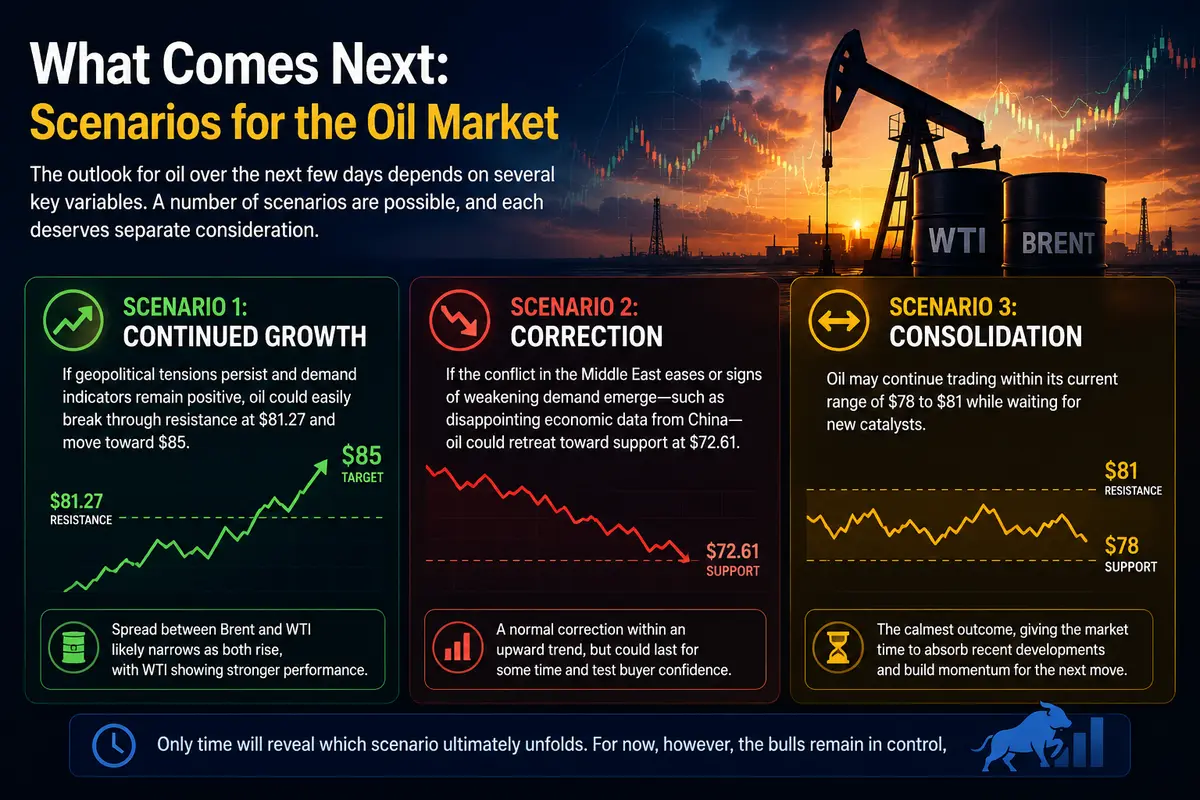
What Comes Next: Scenarios for the Oil Market
The outlook for oil over the next few days depends on several key variables. A number of scenarios are possible, and each deserves separate consideration.
The first scenario is continued growth. If geopolitical tensions persist and demand indicators remain positive, oil could easily break through resistance at $81.27 and move toward $85. In this case, the spread between Brent and WTI would likely begin to narrow, as both benchmarks would rise but WTI would deliver stronger performance.
The second scenario is a correction. If the conflict in the Middle East begins to ease or signs of weakening demand emerge—such as disappointing economic data from China—oil could retreat toward support at $72.61. This would not necessarily be a disaster, but rather a normal correction within an upward trend. Nevertheless, it could continue for some time and reduce buyers’ enthusiasm.
The third scenario is consolidation. Oil may continue trading within its current range of $78 to $81 while waiting for new catalysts. This would be the calmest outcome, giving the market time to absorb recent developments and build momentum for its next move.
Only time will reveal which scenario ultimately unfolds. For now, however, the bulls remain in control, and the morning advance represents their attempt to extend the upward trend.
Conclusion: Cautious Optimism
WTI’s Friday advance during the Asian trading session is an encouraging signal for the market. It demonstrates that investors are prepared to buy oil despite geopolitical risks and instability across other financial markets. Technical levels support this optimism: the price remains within an ascending channel, while support continues to hold firmly.
The divergent movement of WTI and Brent adds intrigue but does not change the broader picture. The oil market remains one of the most dynamic and attractive markets for investors. Demand remains high, supply is exposed to risks, and geopolitical developments are only intensifying these imbalances.
Over the next few days, investors should closely monitor news from the Middle East, oil inventory data, and comments from Federal Reserve officials. Any of these developments could become a catalyst for the market’s next major move. For now, however, the market is looking upward—and it has every reason to do so.


Comments
No comments yet. Be the first to share your thoughts!
Authentication Required
You must be logged in to post a comment.