

Taiwan’s Stock Market in the Red: A Day of Contrasts and Record Declines
Introduction: The End of Moderate Optimism
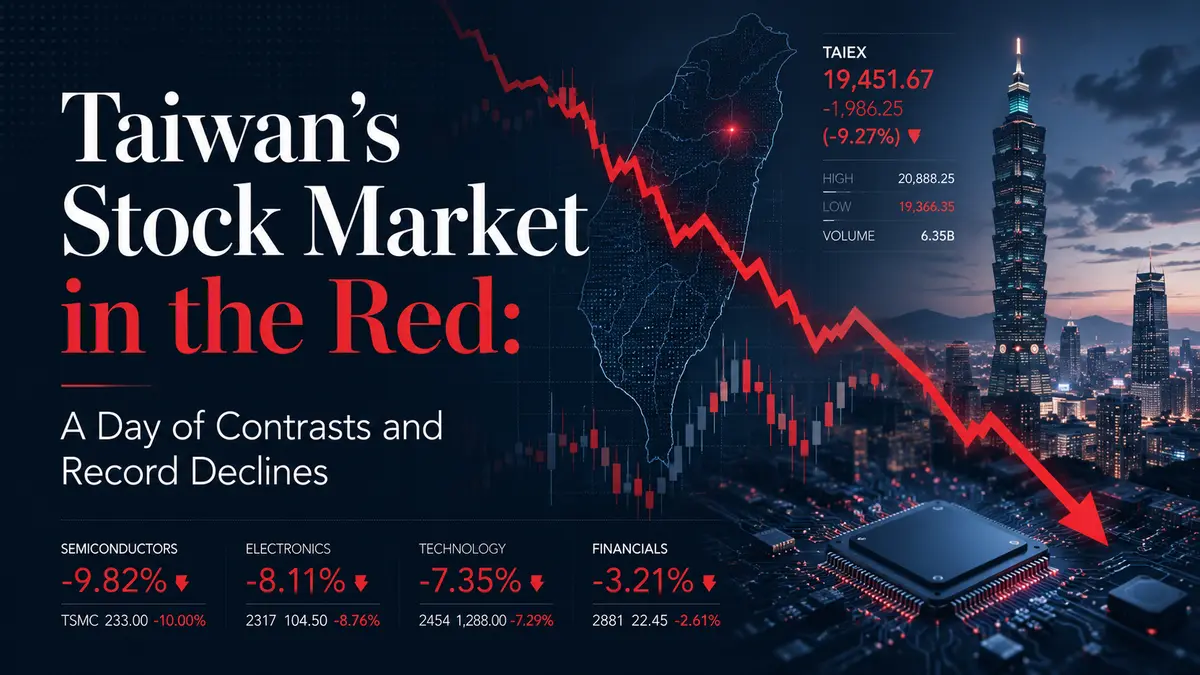
Wednesday marked a reversal for Taiwan’s stock market after two days of moderate gains. The Taiwan Weighted Index fell by 1.42%, reflecting negative sentiment across the optoelectronics and machinery sectors. This was the market’s most significant decline in several days and signaled a return of caution among investors.
Against the backdrop of global uncertainty caused by geopolitical tensions in the Middle East and mixed signals from the Federal Reserve, investors chose to lock in profits and reduce their exposure to risk. However, as is often the case in Taiwan’s stock market, several companies still delivered impressive gains despite the broader decline.
Shares of Ene Technology Inc, Mospec Semiconductor Corp, and Hocheng Corp surged by approximately 10%, reaching their maximum daily gains. Meanwhile, Excel Cell Electronic Co Ltd, Holy Stone Enterprise Co Ltd, and Yeong Guan Energy Technology Group Co Ltd were among the biggest decliners, with the latter falling to a new all-time low.
In this article, we will examine the day’s key developments, assess the impact of external factors, and consider where Taiwan’s stock market may be heading in the coming days.
Top Gainers: Who Benefited in a Falling Market
Ene Technology Inc: Up 9.99%
Shares of Ene Technology Inc were among the most notable exceptions during the broader market decline. The stock rose by 9.99% to TWD 39.65, reaching the maximum permitted daily gain. This impressive increase indicates strong investor interest in the company.
Ene Technology Inc specializes in the production of electronic components. The company may have benefited from continued strength in certain areas of the electronics industry despite the overall decline in the index.
Mospec Semiconductor Corp: Up 9.96%
Shares of Mospec Semiconductor Corp increased by 9.96% to TWD 75.10. This was also close to the maximum gain the stock could record during a single trading session.
Mospec manufactures semiconductor components, and its strong performance reflects continued demand for products in this sector despite the broader uncertainty.
Hocheng Corp: Up 9.92%
Shares of Hocheng Corp rose by 9.92% to TWD 28.80. The company specializes in the production of construction materials and household products.
Hocheng’s gains may have been connected to expectations of a recovery in the construction sector or to corporate developments that did not receive widespread media coverage.
Top Decliners: Who Suffered the Most
Excel Cell Electronic Co Ltd: Down 9.97%
Shares of Excel Cell Electronic Co Ltd led the market decline, falling by 9.97% to TWD 55.10. This sharp decrease reflects investor pessimism toward the electronics sector.
The decline may have been caused by expectations of weaker demand, increasing competition, or disappointing financial results.
Holy Stone Enterprise Co Ltd: Down 9.94%
Shares of Holy Stone Enterprise Co Ltd fell by 9.94% to TWD 815.00. This was another substantial decline, indicating significant selling pressure on the company’s stock.
Holy Stone manufactures electronic components and faces many of the same challenges as other companies operating in this sector.
Yeong Guan Energy Technology Group Co Ltd: New All-Time Low
Shares of Yeong Guan Energy Technology Group Co Ltd declined by 9.92% to TWD 5.54, reaching a new all-time low. This dramatic fall reflects serious concerns about the company’s position.
Yeong Guan operates in the energy technology industry, and the decline may have been caused by negative corporate developments or a broader downturn in the sector.
Key Sectors: What Dragged the Market Lower
Optoelectronics Under Pressure
The optoelectronics sector was one of the main contributors to the index’s decline. This industry is highly sensitive to global demand for electronics, and any negative economic signals can quickly affect its performance.
The weakness in optoelectronics may have been connected to expectations of lower demand for consumer electronics, increasing competition, or disappointing financial results from major companies.
Machinery Sector Moves Lower
The machinery sector also recorded negative performance. This industry depends heavily on investment in manufacturing and infrastructure, both of which are sensitive to macroeconomic conditions.
The decline in machinery stocks may have been caused by concerns about slowing economic growth or reduced investment activity.
Other Sectors
Although news reports specifically highlighted the optoelectronics and machinery sectors, the 1.42% decline in the index suggests broader market pressure. Other industries may also have suffered losses, although their declines were less significant.
The Impact of External Factors
Geopolitical Tensions
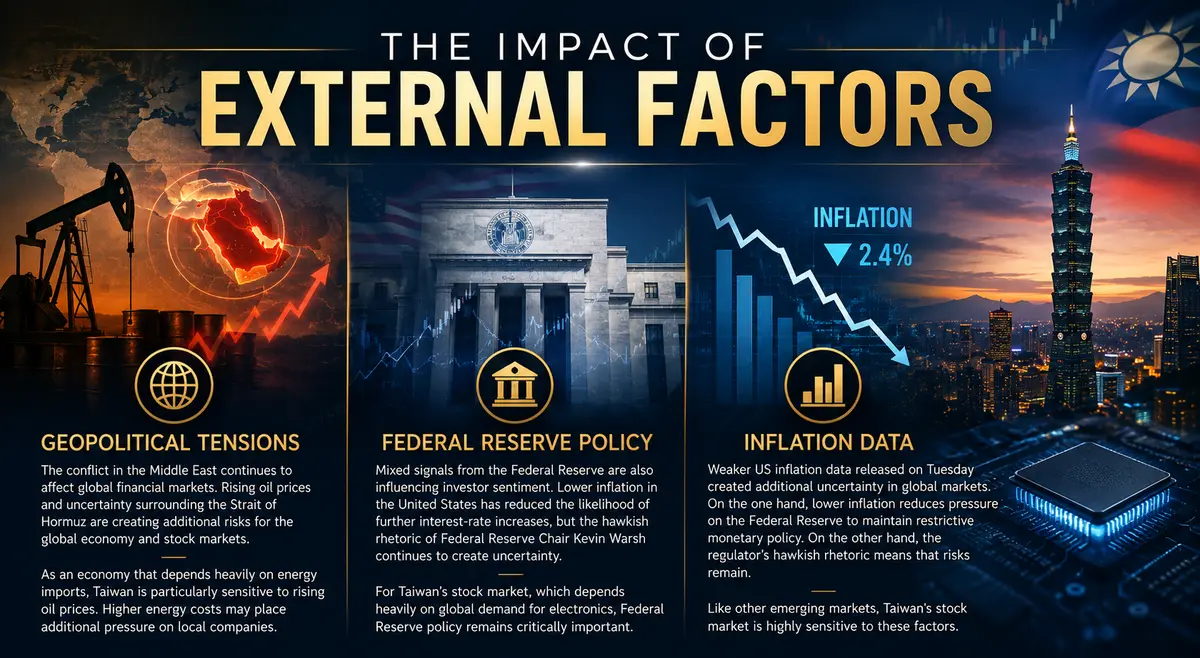
The conflict in the Middle East continues to affect global financial markets. Rising oil prices and uncertainty surrounding the Strait of Hormuz are creating additional risks for the global economy and stock markets.
As an economy that depends heavily on energy imports, Taiwan is particularly sensitive to rising oil prices. Higher energy costs may place additional pressure on local companies.
Federal Reserve Policy
Mixed signals from the Federal Reserve are also influencing investor sentiment. Lower inflation in the United States has reduced the likelihood of further interest-rate increases, but the hawkish rhetoric of Federal Reserve Chair Kevin Warsh continues to create uncertainty.
For Taiwan’s stock market, which depends heavily on global demand for electronics, Federal Reserve policy remains critically important.
Inflation Data
Weaker US inflation data released on Tuesday created additional uncertainty in global markets. On the one hand, lower inflation reduces pressure on the Federal Reserve to maintain restrictive monetary policy. On the other hand, the regulator’s hawkish rhetoric means that risks remain.
Like other emerging markets, Taiwan’s stock market is highly sensitive to these factors.
Commodity Market Reaction
Oil Continues to Rise
WTI WTI ... crude oil futures increased by 0.48% to $79.72 per barrel, while Brent crude gained 0.76% to $85.37 per barrel. Higher oil prices continue to support the energy sector but create risks for economies that depend on energy imports.
Gold Declines
Gold XAUUSD ... futures fell by 0.80% to $4,037.00 per ounce. The decline in gold reflects lower inflation expectations and continued pressure from interest rates.
The US Dollar Weakens
US Dollar Index DX-Y.NYB ... futures declined by 0.11% to 100.60. A weaker dollar provides some relief for emerging markets, but it is not sufficient to offset other negative factors.
What This Means for Investors
Short-Term Volatility
Taiwan’s stock market continues to experience high volatility. Investors should be prepared for sharp movements in both directions.
Short-term traders may find opportunities to profit from this volatility, but the associated risks also remain high.
Long-Term Prospects
From a long-term perspective, Taiwan’s stock market remains attractive. Taiwan is a key participant in the global semiconductor industry, and its economy continues to expand.
Investors may consider current market corrections as potential opportunities to enter high-quality assets at more attractive prices.
Diversification as a Strategy
Diversification remains a fundamental principle for investors. Spreading risk across different sectors and asset classes helps reduce dependence on any single factor.
Particular attention may be given to industries that benefit from current global trends, including semiconductors, technology, and renewable energy.
Conclusion: A Day of Contrasts
Wednesday was a day of contrasts for Taiwan’s stock market. The Taiwan Weighted Index fell by 1.42%, reflecting broad pressure caused by global uncertainty. Nevertheless, several companies still delivered impressive gains despite the overall market decline.
Shares of Ene Technology Inc, Mospec Semiconductor Corp, and Hocheng Corp surged by approximately 10%, demonstrating that growth opportunities can still emerge in a falling market. At the same time, Excel Cell Electronic Co Ltd, Holy Stone Enterprise Co Ltd, and Yeong Guan Energy Technology Group Co Ltd were among the biggest decliners, with the latter reaching a new all-time low.
External factors—including geopolitical tensions, Federal Reserve policy, and inflation data—continue to influence Taiwan’s stock market. Rising oil prices are creating risks for the economy, while uncertainty surrounding interest rates is contributing to continued volatility.
For investors, this is a time for caution and careful asset selection. Short-term market movements may offer profitable opportunities, but they require disciplined risk management. Long-term prospects remain positive, although success will depend on selecting the right industries and companies.
Taiwan’s stock market remains one of the most important markets in Asia, and its future performance will continue to be shaped by both domestic and international factors.


Comments
No comments yet. Be the first to share your thoughts!
Authentication Required
You must be logged in to post a comment.