

Asian Currencies Under Pressure: The Dollar Advances as the Yen Fights for Survival

Introduction: Monday Begins with a Sell-Off
The new trading week began with an all-too-familiar scenario for Asian currencies: the dollar strengthened, regional currencies weakened, and investors sought refuge in U.S. assets. Rising U.S. Treasury yields and geopolitical tensions surrounding Iran created a perfect storm for emerging-market currencies and even some developed-market currencies.
However, amid this sea of red, one exception has captured the attention of market participants. The Japanese yen, which until recently was considered the weakest performer among G10 currencies, is unexpectedly showing signs of life. Renewed speculation about possible asset repatriation by the world’s largest pension fund is giving the yen hope of some relief.
What is driving the markets this Monday morning? What factors are prompting investors to flee Asian assets, and why has the yen suddenly become the center of attention? Let us unravel this complex combination of geopolitics, monetary policy, and hopes for a Japanese miracle.
The Dollar on Top: Why the U.S. Currency Continues to Rise
Inflation Fears and Interest Rate Expectations
The dollar’s strengthening on Monday is not a coincidence but the logical result of developments over the past few days. Investors are seriously concerned that inflation may remain elevated for much longer than previously expected. Geopolitical factors are only intensifying these concerns.
The upcoming testimony of Federal Reserve Chair Kevin Warsh before Congress and the U.S. inflation data scheduled for release on Tuesday have become the main events setting the tone for trading. Markets are looking for any indication of how long the Fed intends to keep interest rates elevated.
The rise in U.S. Treasury yields is a direct result of these expectations. When investors believe that interest rates will remain high, they demand higher yields on bonds. This, in turn, makes dollar-denominated assets more attractive and strengthens the currency.
Geopolitics as a Source of Support for the Dollar
Renewed missile exchanges between the United States and Iran have added another layer of uncertainty to the markets. Tehran issued a new warning about the possible closure of the Strait of Hormuz, shocking energy markets and intensifying inflation expectations.
For the dollar, this creates a double advantage. First, geopolitical instability traditionally increases demand for the U.S. currency as a safe-haven asset. Second, the threat of the strait being closed pushes oil prices higher, potentially fueling inflation and forcing the Fed to maintain a restrictive policy stance.
The Iranian factor is therefore working in the dollar’s favor, even though it is simultaneously creating problems for the global economy. This is one of the paradoxes of the modern foreign exchange market: problems in other countries often become an advantage for the U.S. currency.
The Yen: Light at the End of the Tunnel or Another False Hope?
Katayama’s Comments: The Spark That Created Hope
The yen returned to the spotlight on Monday, and for good reason. Japanese Finance Minister Satsuki Katayama made a statement that many interpreted as a potential turning point for the Japanese currency. She expressed a desire to encourage public pension funds, including the Government Pension Investment Fund, or GPIF, to increase their investments in Japanese financial assets.
These are not merely words. The GPIF is the world’s largest pension fund, managing approximately $1.5 trillion in assets. Any change in its investment strategy could have an enormous effect on the currency markets.
Markets reacted immediately to the statement, and the yen received a powerful boost on Friday. The USD/JPY pair rose slightly on Monday, partially recovering, but remained well below the highs recorded last week.
The Potential Scale of Repatriation: Breathtaking Numbers
Tony Sycamore, a market analyst at IG, made an interesting calculation that quickly circulated across traders’ terminals. If Katayama’s remarks lead to actual changes in the pension funds’ asset allocations, they could trigger yen purchases worth between ¥12 trillion and ¥30 trillion, depending on the scale of the rebalancing.
To put this into perspective, ¥12 trillion is approximately $80 billion. That is an enormous amount, potentially large enough to reverse the currency market trend on its own. Meanwhile, ¥30 trillion is nearly $200 billion. Such volumes could do more than merely support the yen—they could trigger sustained appreciation.
For now, however, these are only figures and assumptions. Investors are trying to determine whether the GPIF will genuinely revise its strategy and how quickly such changes could take place. Similar proposals have been discussed in the past, but they have not always resulted in concrete action.
The Bank of Japan: Cautious Optimism or Hidden Skepticism?
An Upgrade to the Growth Forecast
Another important development for the yen is the news that the Bank of Japan is considering raising its growth forecast for fiscal year 2026. This appears to signal that the central bank is seeing positive changes in the economy.
At the same time, it is important to note that the Bank of Japan continues to warn about upside inflation risks. The effects of the weaker yen and sustained investment related to artificial intelligence are offsetting lower energy costs. This means that inflationary pressure could remain elevated even if energy prices cool somewhat.
For the yen, this sends a mixed signal. On the one hand, stronger growth forecasts and inflation risks could encourage the Bank of Japan to act more decisively in normalizing monetary policy, supporting the currency. On the other hand, persistently high inflation means that the yen’s real value, after adjusting for inflation, continues to decline.
The Late-July Meeting: Should Markets Expect a Surprise?
The Bank of Japan’s next monetary policy meeting will take place on July 30–31. This event will be a critical test for the yen. If the central bank demonstrates a willingness to raise rates further or sends clear signals that it intends to accelerate policy normalization, the yen could receive a powerful boost.
However, many investors remain skeptical about this possibility. The Bank of Japan is known for its cautious approach and its reluctance to make abrupt decisions that could disrupt the fragile economic balance. The most likely outcome is another decision to leave rates unchanged, accompanied by the usual language about being prepared to act if necessary.

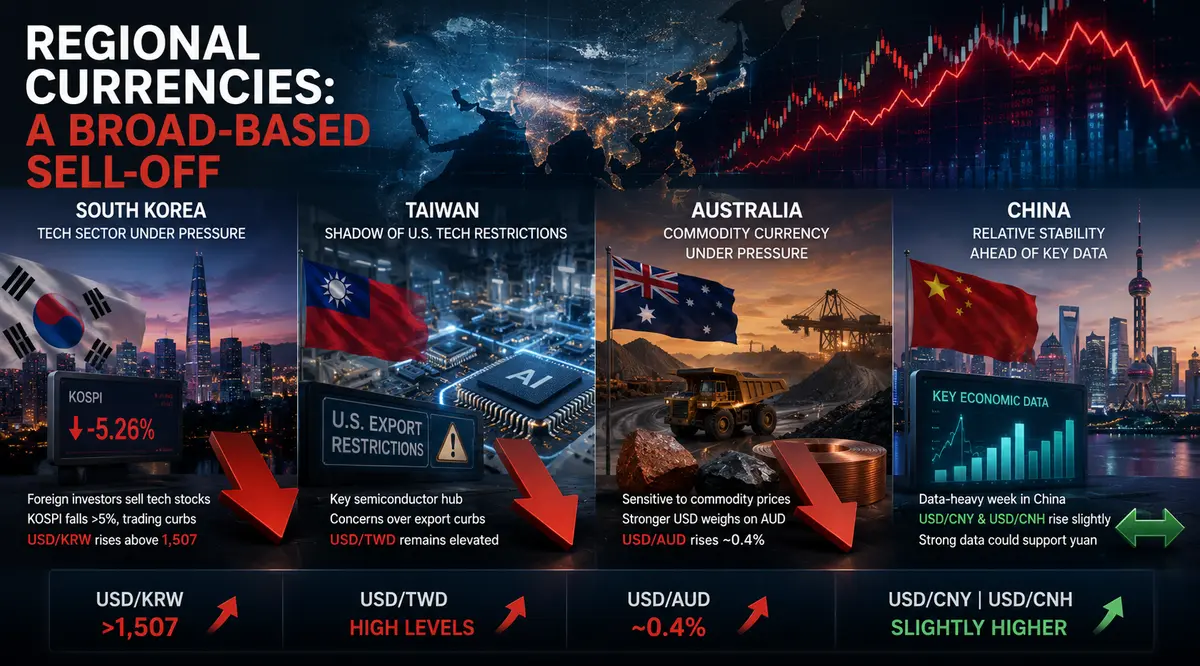
Regional Currencies: A Broad-Based Sell-Off
South Korea: The Technology Sector Comes Under Pressure
The South Korean won was among the biggest losers on Monday. The USD/KRW pair rose by approximately 0.6% to above 1,507, reflecting significant pressure on the currency.
There are several reasons for this. First, foreign investors continue to sell technology stocks. South Korea’s technology market is highly sensitive to global sentiment, and when investors move away from risk, Korean equities are often among the first assets to be sold.
Second, trading uncertainty in the Korean market reached such an extreme level that temporary restrictions were introduced on the KOSPI after the index fell by more than 5%. This warning signal has added further pressure to the won.
Taiwan: The Shadow of U.S. Technology Restrictions
The Taiwan dollar also remains under pressure. The USD/TWD pair is trading at elevated levels, and the main reason is the same: foreign capital is flowing out of technology markets.
Taiwan is one of the world’s key semiconductor manufacturing hubs, and any reports concerning possible restrictions on technology exports or rising trade tensions between the United States and China immediately affect the market. Investors prefer to reduce their exposure to Taiwanese assets until the regulatory outlook becomes clearer.
Australia: A Commodity Currency Under Pressure
The Australian dollar also weakened, with USD/AUD rising by approximately 0.4%. The Australian currency is traditionally sensitive to commodity prices. Although iron ore and coal prices remain relatively stable, the broader strengthening of the U.S. dollar is weighing on the currency.
Concerns about a slowdown in the Chinese economy have created additional pressure. China is Australia’s largest trading partner, and any signs of cooling in the Chinese economy tend to affect the Australian dollar.
China: Relative Stability Ahead of Key Data
The Chinese yuan proved relatively resilient. Both USD/CNY and the offshore USD/CNH pair rose only slightly despite the dollar’s broader strengthening.
The reason is that investors are preparing for a data-heavy week in China. Asia’s largest economy is set to publish several key indicators, and the results will determine the yuan’s next move.
If the data is strong, the yuan could receive support even as the dollar continues to strengthen. If the figures disappoint, pressure on the currency will intensify.
The Interaction of Market Forces: How Geopolitics, Interest Rates, and Sentiment Form a Single Pattern
The Iranian Factor and Its Global Impact
The Strait of Hormuz, through which approximately 20% of the world’s oil passes, has once again become a major source of tension. Tehran’s warning that it could close the strait, combined with renewed missile exchanges with the United States, is creating extreme volatility in energy markets.
For Asian countries, many of which are major oil importers, this represents a serious problem. Higher energy prices increase import costs, weaken trade balances, and create inflationary pressure. All these factors negatively affect national currencies.
At the same time, the Iranian factor benefits the dollar by generating demand for safe-haven assets. In other words, the problems faced by some countries become an advantage for the United States—a classic example of how global crises tend to strengthen the dollar.
Interest Rate Expectations as the Main Driver
Inflation expectations and, consequently, expectations regarding Federal Reserve policy remain the defining forces in the foreign exchange market. Every new indication that inflation may remain elevated pushes the dollar higher and places additional pressure on Asian currencies.
Chair Kevin Warsh’s testimony before Congress and Tuesday’s inflation figures will be the key catalysts this week. If Warsh signals that the Fed is not prepared to ease policy and the inflation data disappoints the market, the dollar could receive another upward boost.
Capital Flows and Their Impact
The reduction in investment in Asia’s technology sector, driven by concerns about an artificial intelligence bubble and trade restrictions, is an important source of pressure on regional currencies. South Korea and Taiwan are particularly vulnerable to this sentiment. Until global investors return to Asian technology stocks, their currencies are likely to remain under pressure.
At the same time, the Japanese yen could receive support from the potential repatriation of pension fund assets. For now, this factor remains speculative, but even speculation can alter the balance of power in the market.
What Comes Next: Scenarios for Asian Currencies
Base-Case Scenario: Current Trends Continue
The most likely scenario is that the current trends will continue. The dollar will remain strong amid elevated interest rates and geopolitical risks, Asian currencies will stay under pressure, and the yen will continue balancing between hopes of pension asset repatriation and the fundamental pressure created by interest rate differentials.
Under this scenario, the Japanese currency may receive short-term boosts from statements by government officials. However, a sustainable reversal would require something more significant—concrete action from the Bank of Japan or an actual change in the GPIF’s investment strategy.
An Optimistic Scenario for the Yen and Asia
If the Bank of Japan demonstrates resolve at its late-July meeting, raises interest rates, and sends a clear signal that the tightening cycle will continue, the yen could receive a powerful boost.
In this case, pressure on other Asian currencies could also ease, as improved sentiment toward the yen may spread across the region.
A renewed interest in Asian technology stocks could provide additional support. If concerns about an AI bubble prove exaggerated, capital outflows from the region may slow, supporting local currencies.
A Pessimistic Scenario: Further Weakness
If the Bank of Japan disappoints the markets while U.S. inflation data exceeds expectations, the dollar could receive another major boost. This would lead to further weakness across Asian currencies, including the yen.
Under this scenario, USD/JPY could break above the 163 level and continue moving higher, while other Asian currencies would also suffer losses. Intervention by the Japanese authorities would become more likely, although experience suggests that its effect would be temporary.
Conclusion: A Time of Uncertainty and Opportunity
Monday’s trading in Asian currency markets reflected the broader uncertainty affecting the global economy. The dollar is strengthening amid geopolitical risks and inflation expectations, placing pressure on regional currencies. However, amid this widespread pessimism, there is one source of hope: the Japanese yen, which could receive structural support from the potential repatriation of assets by the world’s largest pension fund.
The South Korean won, the Taiwan dollar, and the Australian currency are under pressure from capital outflows and concerns about slowing economic growth. The Chinese yuan remains relatively stable as investors await key economic data that could become a catalyst for its next move.
Investors are now in wait-and-see mode. They are awaiting the Federal Reserve chair’s testimony and the inflation data that will determine the dollar’s next direction. They are waiting for the Bank of Japan’s meeting and hoping for a policy change that could support the yen. They are also waiting to see whether the repatriation of pension assets becomes a reality or remains another unfulfilled hope.
The Asian currency market is currently a battlefield where global and local forces, geopolitics and economics, fear and hope all collide. In this battle, there are no guaranteed winners—only those who can correctly assess the risks and adapt quickly to changing conditions.
For those following the foreign exchange markets, this week promises to be tense and potentially even historic. Sometimes, it is precisely during periods of maximum uncertainty that new trends emerge—trends capable of reshaping the balance of power for years to come.

Comments
No comments yet. Be the first to share your thoughts!
Authentication Required
You must be logged in to post a comment.