

The Dollar Holds Steady Amid Tensions Around Iran
Introduction: The Thursday When Geopolitics Met Monetary Policy
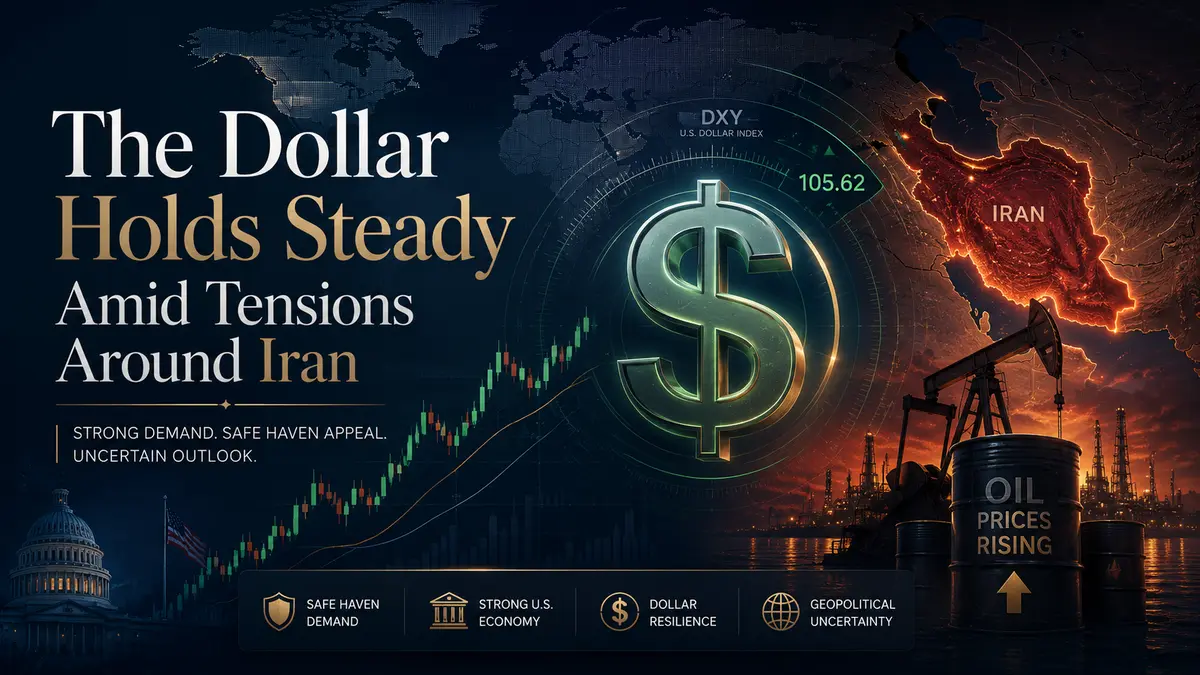
Thursday. The Asian trading session opens, and investors across the region are watching their screens with a sense of tense anticipation. The U.S. dollar has stabilized, but this is not calm — it is the calm before the storm. The resumption of U.S. military actions against Iran has created a new wave of uncertainty, while the minutes of the Federal Reserve’s June meeting, published the previous day, showed that policymakers were sharply divided over further interest rate hikes.
The dollar index settled at 100.760 points after a volatile overnight session. At first, the renewed military confrontation between the United States and Iran supported the dollar as a safe-haven asset. Then the Fed minutes, which revealed disagreements within the regulator, triggered a sharp reversal. Still, the dollar remained near its recent 13-month highs.
The Chinese yuan was almost unchanged after restrained June inflation data. The consumer price index rose by 1% year-on-year, falling short of the 1.1% forecast. The producer price index, by contrast, climbed to a four-year high of 4.1% due to high energy and raw material prices.
The Japanese yen remained near 40-year lows, keeping markets on edge as they awaited possible currency intervention by the government. Tokyo has been warning for several weeks about excessive speculation against the yen, but markets continue to ignore these warnings.
Most Asian currencies traded in narrow ranges. The Australian dollar edged slightly higher, the South Korean won remained stable, and the Singapore dollar and Indian rupee were almost unchanged. Markets froze while waiting for new signals.
Let’s break down what is really happening in currency markets, why the dollar remains stable amid a geopolitical crisis, and how the Fed minutes affected investor expectations.
Geopolitical Background: Iran Back in the Spotlight
The Resumption of U.S. Military Actions Against Iran
The main theme on Thursday is the resumption of U.S. military actions against Iran. President Donald Trump stated that the ceasefire with Iran was now over, and the United States carried out several strikes against the Middle Eastern country.
This was the continuation of a conflict that began after the collapse of a peace agreement on Wednesday. Iran’s Revolutionary Guards struck U.S. military facilities in Bahrain and Kuwait, and the United States responded with military strikes on Iranian targets.
The conflict has now entered a new phase — a phase of full-scale military confrontation. For markets, this means the return of fear and uncertainty.
Market Reaction: The Dollar as a Safe-Haven Asset
In times of geopolitical uncertainty, the dollar traditionally acts as a safe-haven asset. Investors move into the dollar because it is considered the most stable and liquid currency.
On Thursday, the dollar stabilized at 100.760 points. This reflects demand for the U.S. currency during a crisis.
However, the Fed minutes published the previous day revealed disagreements within the regulator. This created uncertainty about the future of monetary policy and limited the dollar’s growth.
Oil Prices: Rising Amid the Conflict
Oil prices rose by more than 5% on Wednesday, reaching a two-week high. This happened due to concerns about potential supply disruptions from the region.
On Thursday, oil prices continued to remain elevated. The resumption of U.S. military actions against Iran creates risks for oil supplies, as the Strait of Hormuz is a critical route for energy exports.
Rising oil prices strengthen inflation concerns, which could force the Fed to maintain a restrictive policy in the coming months.
Fed Minutes: Disagreements Within the Regulator
What the Minutes Showed
The minutes of the Fed’s June meeting, published on Wednesday, showed that policymakers were significantly divided over the need for further interest rate hikes.
Some Fed members believe that inflation remains too high and requires further policy tightening. Others think that the economy is beginning to slow and that additional rate hikes could harm growth.
This creates uncertainty about the future of monetary policy. Investors do not know whether the Fed will raise rates this year or take a pause.
Impact on the Dollar
The Fed minutes had a mixed impact on the dollar. On the one hand, Fed members identified inflation as a key problem, which supports hawkish expectations and strengthens the dollar.
On the other hand, disagreements within the regulator create uncertainty, limiting the dollar’s growth. Investors do not want to open large positions until it becomes clear where the Fed is heading.
As a result, the dollar stabilized at 100.760 points, remaining close to its recent 13-month highs.
The Chinese Yuan: Stability Amid Inflation Data
June Inflation Data
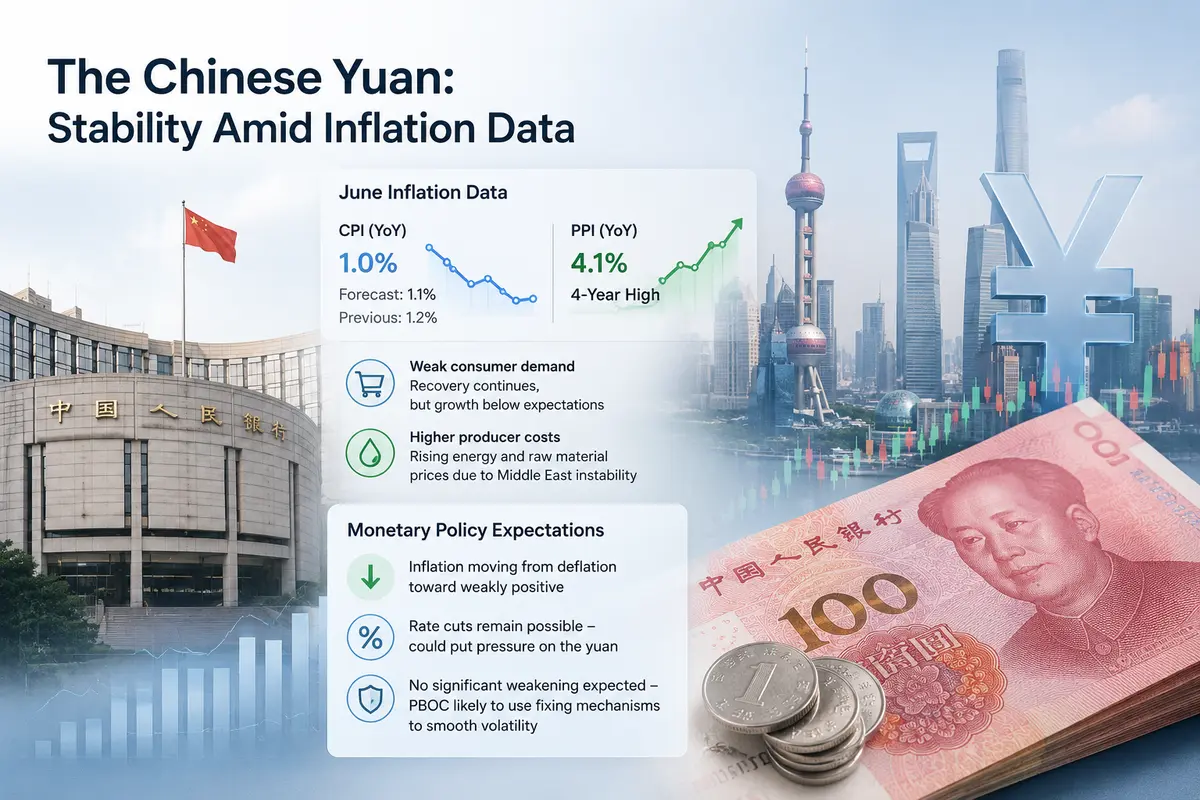
The Chinese yuan was almost unchanged on Thursday after restrained June inflation data. The consumer price index rose by 1% year-on-year, falling short of the 1.1% forecast and slowing from 1.2% in the previous month.
This data points to continued weakness in consumer spending and demand in China. The country’s economy continues to recover, but the pace of growth remains below expectations.
The producer price index, by contrast, rose to a four-year high of 4.1%. This reflects rising producer costs caused by high energy and raw material prices, driven by instability in the Middle East.
Monetary Policy Expectations
ING analysts noted that inflation data is moving away from a state close to deflation toward weakly positive inflation. Such a level of inflation is unlikely to prevent the People’s Bank of China from using monetary policy measures if necessary.
This means that interest rate cuts in China remain possible. If the People’s Bank of China decides to cut rates, this will put pressure on the yuan.
However, ING does not expect a significant weakening of the yuan in the coming months. Chinese authorities are likely to continue using fixing mechanisms to smooth volatility.
The Japanese Yen: 40-Year Lows and the Risk of Intervention
The Yen Remains Under Pressure
The Japanese yen remained near 40-year lows on Thursday, despite a slight strengthening against the dollar. The USD/JPY pair fell by 0.1% but remained at levels not seen since 1986.
The persistent weakening of the yen kept markets on alert for possible currency intervention by Tokyo. Japanese officials have repeatedly warned about excessive speculation against the yen, but markets continue to ignore them.
Reasons for Yen Weakness
The main reason for the yen’s weakness remains the interest rate gap between the United States and Japan. The Fed keeps rates at elevated levels, while the Bank of Japan has only just begun raising rates.
Investors continue to borrow in cheap yen and invest in higher-yielding dollar assets. This creates sustained pressure on the yen.
Risk of Intervention
The risk of intervention remains high. Japanese authorities have been warning for several weeks about the possibility of intervention, and if the yen continues to fall, they may decide to act.
However, intervention is only a temporary measure. For the yen to strengthen over the long term, something more is needed — a change in the Bank of Japan’s monetary policy and a narrowing of the interest rate gap.
Other Asian Currencies: The Calm Before the Storm
The Australian Dollar
The Australian dollar edged slightly higher on Thursday. Australia is sensitive to commodity prices, and rising oil prices may support its currency.
However, the Australian dollar is also sensitive to global risks. If the conflict in the Middle East continues to escalate, the Australian dollar may come under pressure.
The South Korean Won
The South Korean won remained stable amid increased volatility in the local stock market. The KOSPI, which has risen by more than 30% this year, began to correct, putting pressure on the won.
The Singapore Dollar and the Indian Rupee
The Singapore dollar and the Indian rupee were almost unchanged. These currencies are also waiting for new signals from the Fed and the geopolitical situation.
What Comes Next: Scenarios for the Dollar and Asian Currencies
Conflict Escalation
If the conflict between the United States and Iran continues to escalate, the dollar may strengthen as a safe-haven asset. Asian currencies, including the yuan, yen, and won, may weaken.
Oil prices may rise even further, increasing inflation concerns and supporting the dollar.
Conflict De-Escalation
If the situation stabilizes, the dollar may weaken, while Asian currencies may recover. Investors would return to riskier assets, supporting emerging-market currencies.
Fed Minutes as a Long-Term Factor
The Fed minutes revealed disagreements within the regulator, creating uncertainty about the future of monetary policy. If the Fed continues to signal a hawkish stance, the dollar will remain strong. If it shifts toward a dovish stance, the dollar may weaken.
Conclusion: The Dollar at the Center of the Geopolitical Storm
The dollar stabilized on Thursday amid the resumption of U.S. military actions against Iran and disagreements within the Fed. The dollar index settled at 100.760 points.
The Chinese yuan was almost unchanged after restrained inflation data. The Japanese yen remained near 40-year lows, keeping markets on edge.
The Fed minutes showed disagreements among policymakers over further rate hikes. However, concerns about rising inflation, driven by higher oil prices amid the conflict, continue to support hawkish expectations.
Most Asian currencies traded in narrow ranges while waiting for new signals. Markets froze, awaiting developments in the Middle East and further signals from the Fed.
The dollar remains at the center of the geopolitical storm. Its fate will depend on how events in the Middle East develop and how the Fed responds to new challenges. Asian currencies, including the yuan and yen, will follow the dollar, increasing or easing pressure depending on the direction of its movement.

Comments
No comments yet. Be the first to share your thoughts!
Authentication Required
You must be logged in to post a comment.