

WTI Oil Rises in Asian Trading: Is There Life Above $69?

Introduction: A Friday Morning That Started in the Green
Friday. Morning in Asia. Traders in Singapore, Tokyo, and Shanghai open their terminals and see a pleasant picture: WTI crude is back in the green. Futures for August delivery are rising to $69.11 per barrel, gaining 0.61% compared with the previous session’s close. Yes, the increase is not breathtaking, but after several weeks of volatility and declines, even such a modest gain feels like a breath of fresh air.
What is behind this movement? Over the past few weeks, the oil market has looked like a roller coaster: news from Iran, hawkish rhetoric from the Fed, inventory data, dollar fluctuations — all of this created chaos in which traders lost their bearings. But today, on this Friday, oil has found the strength to move higher.
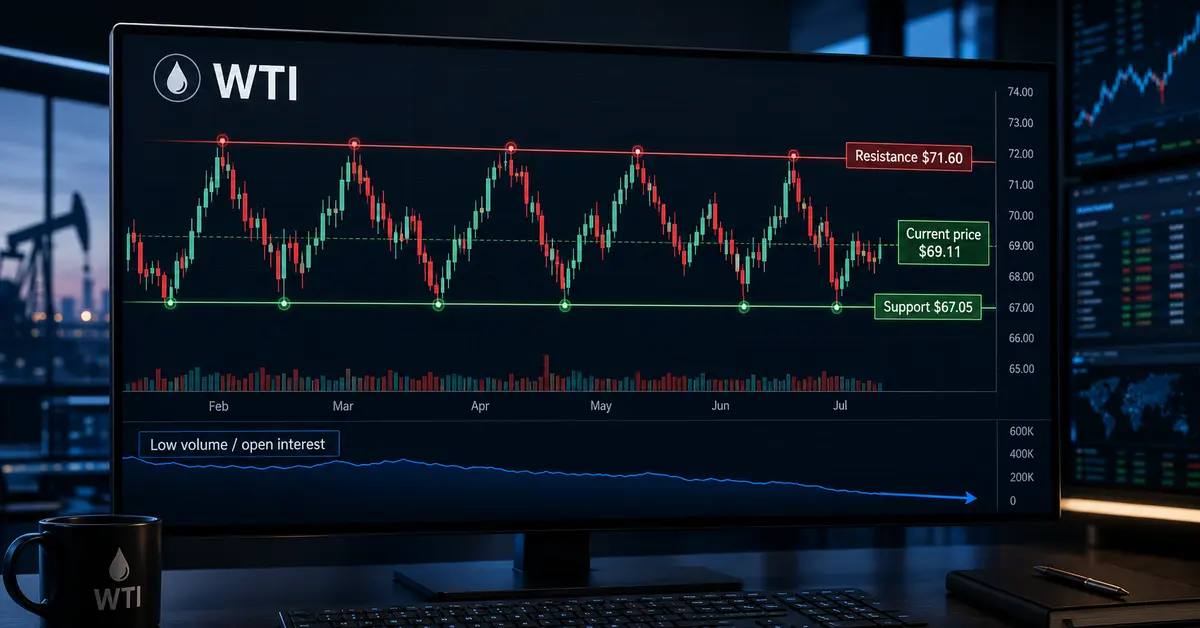
Resistance is located at $71.60 per barrel. Support is at $67.05. The main battle is taking place between these two levels. And while the price remains closer to the lower boundary than the upper one, it is too early to speak of a trend reversal. Still, any upward movement, even 0.6%, gives hope to those who believe in a recovery in the oil market.
Interestingly, WTI’s rise is accompanied by a similar move in Brent. September Brent crude futures rose by 0.72% to $72.32 per barrel. The spread between Brent and WTI is $3.21 per barrel, which is within the normal historical range. The markets are moving in sync, suggesting that the growth factors are global rather than local.
So what exactly is pushing oil higher this Friday morning? Let’s take a closer look.
Macroeconomic Background: A Weak Dollar, Strong Oil
The Dollar Index Falls — Oil Gets Support
One of the classic factors influencing oil prices is the exchange rate of the dollar. Oil is traded in dollars, and when the U.S. currency weakens, oil becomes cheaper for holders of other currencies. This increases demand and pushes prices higher.
On Friday, the USD Index futures contract, which tracks the dollar against a basket of six major currencies, fell by 0.03% to 100.59 points. This is a minor decline, but it comes after the dollar recently reached 13-month highs. Even a small downward correction in the dollar gives oil an additional boost.
It is worth noting that the dollar’s decline on Friday is linked to expectations ahead of U.S. labor market data. Investors do not want to hold large dollar positions before the release of key figures, and this creates temporary weakness in the U.S. currency. Oil is taking advantage of this pause to move higher.
However, this factor should not be overestimated. A move of 0.03% is almost a statistical margin of error. The main movement in oil is not so much due to the dollar as to other factors, which we will examine below.
Expectations for Labor Market Data and Their Impact on Commodities
The main event on Friday is the release of U.S. nonfarm payrolls data for June. These figures may become decisive for markets in the coming weeks. If the data is strong, the Fed will receive another argument in favor of raising rates. And high rates mean a strong dollar and weak oil. If the data comes in weaker than forecast, the dollar may weaken, while oil may continue to rise.
For now, markets are in waiting mode, and this creates room for maneuver. Oil is using this moment of uncertainty to recover part of its losses. But once the data is released, the direction of movement may change sharply.
Analysts expect job growth to slow, but the U.S. labor market has repeatedly surprised with its resilience. If the figures once again exceed forecasts, the dollar will strengthen, and oil may return to support at $67.05 or even lower. If the data is weak, oil may test resistance at $71.60.
In this context, the current rise in oil looks more like a cautious attempt to get ahead of events than a confident trend reversal. Traders are taking positions before an important event, hoping that the data will work in their favor.
The Geopolitical Factor: Iran and a Peaceful Pause
Progress in Negotiations — Lower Risks, But No Panic
Another factor supporting oil on Friday is news from Switzerland, where talks between the United States and Iran are continuing. According to reports, the parties have made some progress in seeking a permanent ceasefire. This reduces geopolitical risks and lowers the risk premium in oil prices.
At first glance, lower risks should put downward pressure on oil. Peace in the Middle East means fewer threats to supply, more oil on the market, and therefore lower prices. But in this case, a different logic is at work.
Progress in negotiations is being perceived as a sign of stability, which is positive for the global economy. And a stronger economy means higher demand for oil. In addition, reduced geopolitical risks weaken the dollar as a safe-haven asset, which also supports oil.
Of course, risks cannot be completely ignored. Iran continues to threaten to close the Strait of Hormuz, and this threat remains real. But as long as negotiations continue, traders prefer to focus on positive signals rather than negative ones.
The Strait of Hormuz: The Calm Before the Storm?
The Strait of Hormuz remains the main point of tension in the Middle East. Around 20% of the world’s oil passes through this narrow maritime corridor. Any threat of its blockade causes oil prices to jump, and Iran understands this perfectly well.
Despite progress in negotiations, Iranian officials continue to remind everyone of their trump card. This is a classic tactic: keeping opponents under pressure even while sitting at the negotiating table.
Markets are treating these threats with caution. They are not ignoring them, but they are not panicking either. As long as negotiations continue, and as long as there are no real signs of escalation, oil prices remain relatively stable. But any breakdown in negotiations could trigger a sharp jump in prices.
In this context, the current rise in oil can be seen as a reflection of optimism about the talks. Traders believe the parties may be able to reach an agreement, creating a positive backdrop for commodity markets.
Technical Picture: Levels and Trends
Support at $67.05 and Resistance at $71.60
Technical analysis is an important part of any market discussion. For WTI crude, the key levels are currently $67.05 as support and $71.60 as resistance. These levels were determined based on recent lows and highs, and they serve as reference points for traders.
Support at $67.05 is a level that oil has tested several times in recent weeks. Each time, it rebounded from it, which indicates its psychological importance. If the price falls below this level, it could trigger a new wave of selling.
Resistance at $71.60 is the level that oil has tried to break through but has so far failed to overcome. If the price can consolidate above this mark, it will open the way to higher levels, possibly toward $75 and above.
The current price of $69.11 is roughly in the middle of this range. This means the market has room to move in either direction. Traders will closely watch which of these boundaries is broken first.
Volumes and Open Interest
Trading volumes and open interest also provide useful information. In recent weeks, volumes have been below average, indicating indecision among market participants. Many traders prefer not to open large positions until the macroeconomic situation becomes clearer.
Open interest in oil futures has declined from March highs, reflecting a broader retreat from risky assets. Institutional investors are reducing their positions while waiting for clearer signals from the Fed and economic data.
The current rise on low volumes is not the most reliable signal. It may be driven by short covering rather than a real inflow of new capital. For sustainable growth, higher volumes and rising open interest are needed.
Brent vs. WTI: What the Price Difference Says
A Spread of $3.21 per Barrel: Normal or Abnormal?
The price difference between Brent and WTI on Friday is $3.21 per barrel. This is within the normal historical range, but the dynamics are worth watching.
Usually, Brent trades at a premium to WTI because of its higher quality and broader supply geography. A premium of $3–4 per barrel is considered normal. If the premium narrows to $2 or less, it may signal weakness in global demand. If it widens to $5 or more, it may indicate local supply problems.
At the moment, the $3.21 premium suggests that markets are relatively balanced. There are no serious distortions and no panic. This supports a cautiously optimistic mood.
Brent Is Rising Faster Than WTI: What Does It Mean?
On Friday, Brent is rising faster than WTI — 0.72% versus 0.61%. This is a small but telling divergence. It may indicate that global demand looks more resilient than U.S. demand.
Brent is an international benchmark, and its price is sensitive to global factors: demand in Asia, the situation in the Middle East, and OPEC+ policy. WTI is more focused on the domestic U.S. market and inventories in Cushing.
Brent’s faster growth may mean that investors expect an improvement in global economic prospects. If this trend continues, the Brent premium over WTI may widen, which would be an additional bullish signal for the entire oil market.
Fundamental Factors: Supply and Demand
Oil Inventories: What the Numbers Say
Last week, U.S. oil inventory data showed an unexpected decline, which supported prices. Commercial inventories fell more than expected, pointing to strong demand or reduced supply.
The seasonal factor also plays a role. Summer is a period of increased fuel demand in the United States due to road travel. Refineries operate at full capacity, processing crude oil into gasoline and diesel. This creates additional demand and supports prices.
However, the long-term inventory trend remains uncertain. OPEC+ continues to control production, but there are signs that some member countries are exceeding their quotas. This creates a risk of excess supply in the market.
The Role of OPEC+ in Price Formation
OPEC+ continues to play a key role in managing the oil market. The cartel and its allies control a significant share of global production, and their decisions directly affect prices.
In recent months, OPEC+ has extended production cuts to support prices. But the effectiveness of this strategy is being questioned. Production in some countries, especially Russia and Iraq, exceeds quotas, creating additional supply in the market.
In addition, the United States continues to increase production, partly offsetting OPEC+ cuts. American shale oil producers respond quickly to price changes, and at current levels they may increase output, limiting price growth.
In this context, the current rise in oil looks fragile. It could easily be erased by news of rising production or declining demand.
Conclusion: $69 Is Not a Victory, But It Is a Step Toward One
WTI crude futures rose during Asian trading on Friday, but the 0.61% increase is more of a cautious move than a confident surge. The price of $69.11 is in the middle of the range between support at $67.05 and resistance at $71.60, and the market is clearly waiting for new signals.
A weak dollar, progress in Iranian negotiations, and expectations for U.S. labor market data all create a favorable backdrop for oil. But these same factors can easily reverse, putting oil under pressure again.
The Dollar Index fell by 0.03% to 100.59 points, but this decline is too small to speak of a trend reversal. The Fed continues to signal a tight policy stance, and if employment data comes in strong, the dollar may strengthen, pushing oil back toward support at $67.05.
Brent is rising faster than WTI, which points to global optimism, but the $3.21 spread remains within the normal range. The oil market remains in a state of balance that could be disrupted in either direction.
Traders will closely watch U.S. labor market figures. They will become the next key signal for the oil market. If the data is weak, oil may test resistance at $71.60. If it is strong, support at $67.05 may come under threat.
For now, oil continues its cautious climb. $69.11 is not a victory, but it is a step toward one. The main thing is to maintain momentum and consolidate above current levels. After that, perhaps $75 will not be far away. But that is another story.

Comments
No comments yet. Be the first to share your thoughts!
Authentication Required
You must be logged in to post a comment.