

IHI Surges: Morgan Stanley Says “Buy” as Japan’s Industrial Defense Giant Prepares for a Breakout
Tuesday: The Day an Old Industrial Conglomerate Suddenly Became Interesting
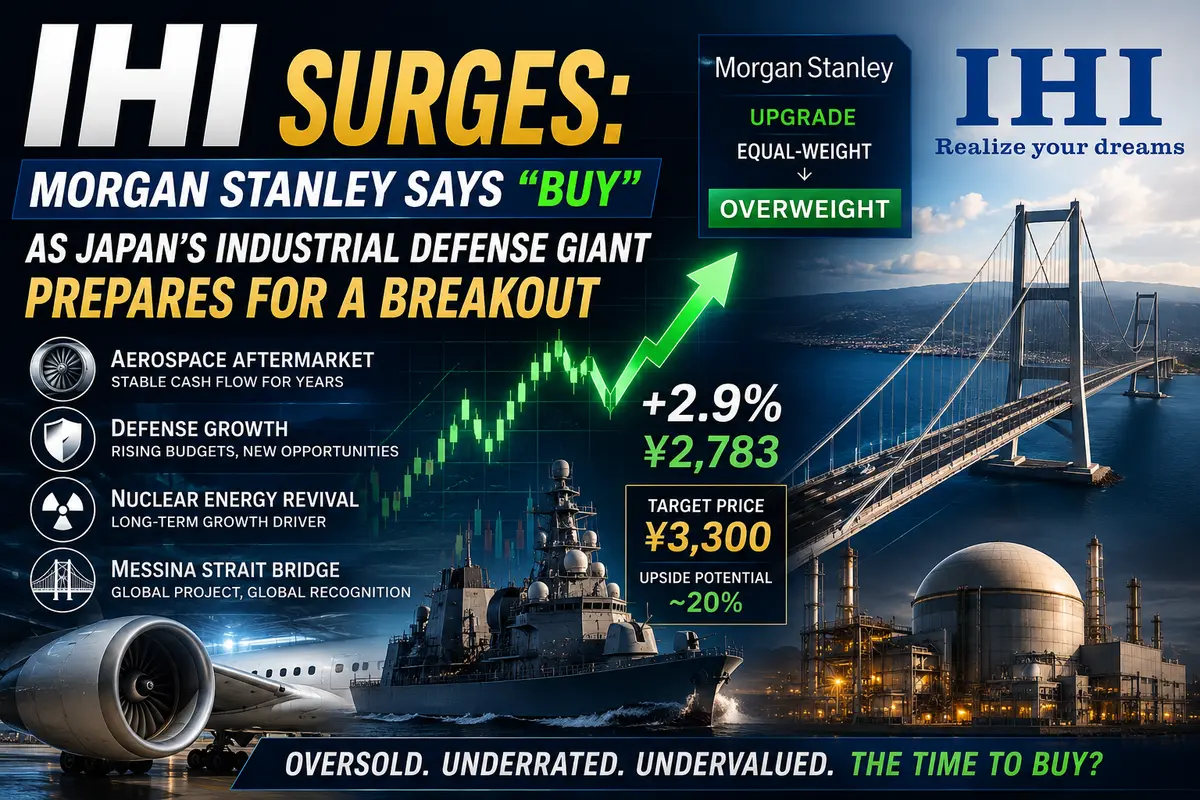
On Tuesday morning, while the Japanese market was digesting the Bank of Japan’s rate decision and preparing for the upcoming Federal Reserve meeting, one stock stood out from the crowd. Shares of IHI Corporation jumped 2.9% to ¥2,783.
Does that sound modest? Perhaps. But for a company that has lost more than 40% of its value over the past 52 weeks—from a high of ¥4,698 to a low of ¥2,069—even a 2.9% gain is noteworthy.
What happened?
Morgan Stanley, one of the world’s most influential investment banks, upgraded IHI from “Equal-weight” to “Overweight” and raised its price target to ¥3,300 from ¥3,150.
In simple terms, Morgan Stanley believes IHI shares have been heavily oversold, that the recent decline was driven by external factors—particularly tensions in the Middle East—rather than company-specific problems, and that now presents an attractive buying opportunity.
The bank described its investment thesis as “growth at a discount.” In other words, IHI offers solid growth prospects, but its shares are trading at depressed valuations due to temporary concerns.
What are those growth prospects? Three major themes:
-
Civil aerospace aftermarket services
-
Defense
-
Nuclear energy
The civil aerospace aftermarket business provides recurring revenue for years as aircraft engines require ongoing maintenance, repairs, and replacement parts. Defense spending is rising in Japan and globally. Nuclear energy is experiencing a resurgence as countries seek reliable, low-carbon power sources.
There is also a political catalyst.
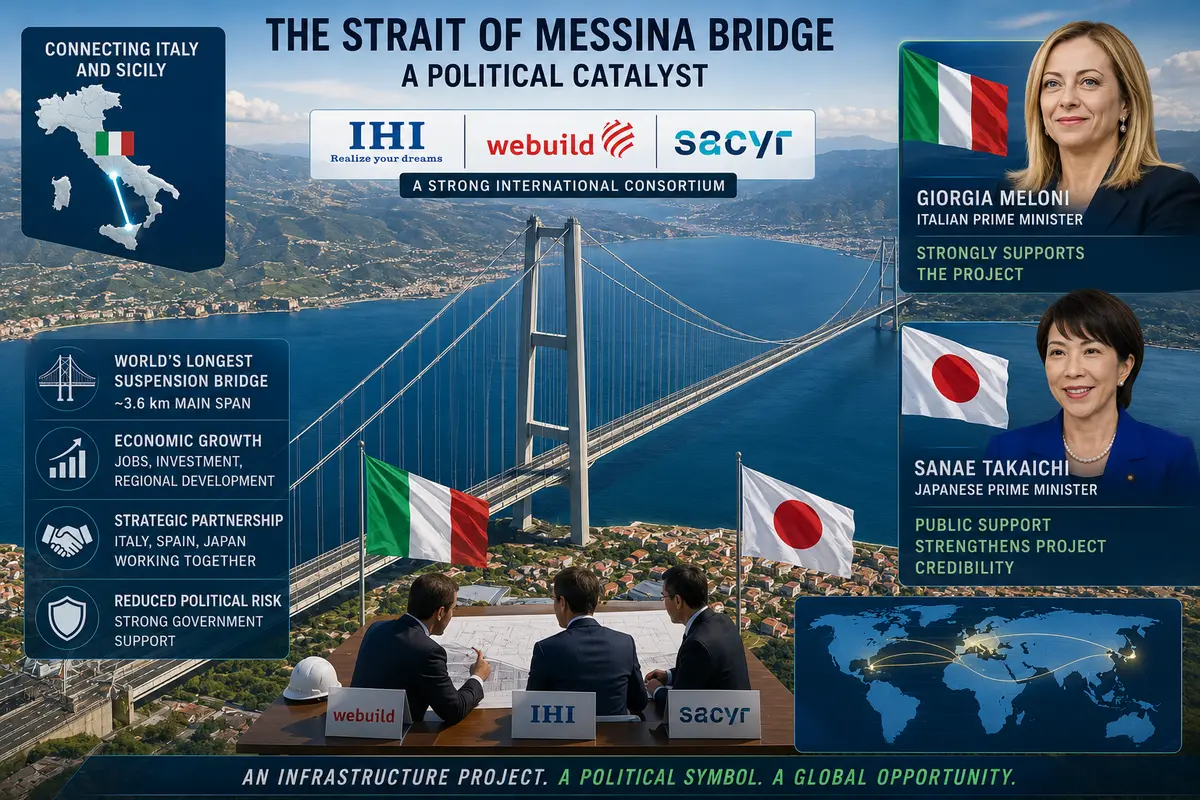
Japanese Prime Minister Sanae Takaichi has publicly supported the Strait of Messina Bridge project. IHI is involved in the consortium alongside Italy’s Webuild and Spain’s Sacyr. The project is more than infrastructure—it represents international recognition of Japanese engineering expertise.
So the key questions are: Who is IHI, why has Morgan Stanley become interested now, and does the stock still have room to run?
What Is IHI and Why Does It Matter to Japan?
IHI Corporation is one of Japan’s oldest and largest industrial conglomerates.
Founded in 1853, when Japan was only beginning its industrial transformation, the company was originally known as Ishikawajima-Harima Heavy Industries. It built ships, bridges, engines, and many of the industrial assets that helped modernize the country.
Today, IHI operates across four major business segments:
Civil Aerospace
IHI manufactures critical aircraft-engine components, including combustion chambers, turbine blades, and control systems.
Its major customers include General Electric, Pratt & Whitney, and Rolls-Royce.
The aftermarket business—parts replacement, maintenance, and technical support—generates stable cash flow because aircraft remain in service for decades.
Defense
IHI produces naval vessels, submarines, munitions, and fighter aircraft engines.
As Japan expands its defense budget amid rising regional tensions, the company is positioned to benefit from increasing procurement and modernization programs.
Nuclear Energy
The company supplies reactors, heat exchangers, and safety systems for nuclear power plants.
Following the Fukushima disaster, Japan’s nuclear sector stagnated. However, policymakers are increasingly reconsidering nuclear power due to energy security concerns, high fossil-fuel costs, and decarbonization goals.
Infrastructure
IHI builds bridges, tunnels, locks, and other major infrastructure projects.
Its most ambitious current undertaking is the Strait of Messina Bridge linking mainland Italy with Sicily. If completed, it would become the longest suspension bridge in the world.
This business diversification gives IHI resilience. When aviation weakens—as it did during 2020—defense and energy can help offset the decline. Conversely, strength in aerospace can support results during slower periods elsewhere.
The downside is complexity. Conglomerates are often difficult for investors to value. By upgrading the stock, Morgan Stanley is effectively signaling which parts of the story deserve attention.
Why Did Morgan Stanley Upgrade the Stock?
Morgan Stanley’s bullish view rests on three primary arguments.
1. Aerospace Aftermarket Expansion
Global aviation continues recovering from the pandemic.
Passenger traffic in Asia is growing, airlines are increasing flight activity, and aircraft engines require continuous maintenance and repairs.
Because IHI maintains long-term relationships with leading engine manufacturers, the company benefits from recurring, high-quality revenue streams.
2. Defense Growth
Japan’s government is aggressively expanding defense spending.
This includes both new equipment procurement and modernization of existing systems.
As a key supplier to Japan’s Self-Defense Forces, IHI is positioned to win contracts that could generate revenue for many years.
3. Nuclear Energy Revival
Japan is gradually reassessing its post-Fukushima energy strategy.
Rising energy costs, carbon-reduction goals, and concerns over energy security are encouraging policymakers to support reactor restarts and long-term nuclear investment.
IHI possesses both the technology and expertise needed to capitalize on this trend.
Morgan Stanley also notes that recent share-price weakness, driven by concerns surrounding Middle Eastern tensions, has created an attractive entry point.
In the bank’s view, the market reaction was excessive because IHI has limited direct exposure to those geopolitical events.
The Strait of Messina Bridge: A Political Catalyst
The Strait of Messina Bridge deserves special attention.
This is not merely an infrastructure project—it is a political symbol.
The bridge would connect mainland Italy with Sicily. The project has been debated for decades but repeatedly delayed by political disagreements, environmental opposition, and funding challenges.
Recently, however, momentum has returned.
Italian Prime Minister Giorgia Meloni has strongly backed the project, and Japanese firms, including IHI, have become important participants.
IHI is part of a consortium that includes Italy’s Webuild and Spain’s Sacyr.
If construction proceeds as planned, the bridge would become the world’s longest suspension bridge, providing both financial benefits and significant prestige for IHI.
Public support from Prime Minister Sanae Takaichi further strengthens the project’s credibility. When Japan’s government openly supports a major overseas project involving a Japanese company, it sends a powerful signal to international markets.
For investors, that potentially reduces political risk.
Financial Performance: What the Numbers Say
IHI’s fiscal 2026 outlook calls for record-level revenue and profit to be maintained.
Growth is expected to be driven by:
-
Civil aerospace engines
-
Defense
-
Nuclear energy
In fiscal 2025, revenue reached approximately ¥1.5 trillion (around $10 billion), while net profit totaled roughly ¥80 billion (about $550 million).
Net margins were approximately 5%, a respectable figure for a heavy industrial company.
Management forecasts:
-
Revenue growth of 5–7%
-
Profit growth of 10–12%
These projections are relatively conservative and incorporate risks such as slower global growth, currency fluctuations, and geopolitical uncertainty.
Morgan Stanley believes actual performance could exceed guidance if defense contracts accelerate, nuclear projects gain momentum, or the Strait of Messina Bridge progresses on schedule.
Technical Analysis: Has the Selloff Gone Too Far?
Over the past 52 weeks, IHI shares have traded between ¥2,069 and ¥4,698.
That represents a decline of more than 55% from the peak.
Contributing factors include:
-
Weakness in the broader Japanese market
-
Middle East-related concerns affecting industrial stocks
-
Yen strength, which pressures exporters
-
Potential company-specific concerns
Morgan Stanley argues the decline has been excessive relative to fundamentals.
The stock appears to have found support around ¥2,069 and has since rebounded toward ¥2,783.
The next major resistance level is around ¥3,300—the bank’s updated target price.
A sustained move above that level could open the path toward ¥3,500 and beyond.
Meanwhile, the Relative Strength Index (RSI) sits near 40, suggesting neither overbought nor oversold conditions and leaving room for additional upside.
Comparison With Competitors
IHI competes with several major Japanese industrial firms, including:
-
Mitsubishi Heavy Industries
-
Kawasaki Heavy Industries
-
Hitachi Zosen
Mitsubishi Heavy Industries is larger and more diversified but trades at a higher valuation, with a price-to-earnings ratio around 25 compared with roughly 18 for IHI.
Kawasaki Heavy Industries also commands a richer valuation, while Hitachi Zosen remains a more specialized player.
Relative to peers, IHI appears inexpensive—a key factor behind Morgan Stanley’s renewed interest.
Global Market Backdrop: Positive Momentum From the U.S.
Asian markets received a boost from Wall Street earlier this week.
U.S. equities rallied strongly, with the S&P 500 gaining 1.7% and the Nasdaq rising 3.1%.
Investors interpreted recent geopolitical developments as reducing risk and easing inflation concerns, leading to strong performance in growth and technology stocks.
That improved global sentiment helped support Japanese industrial names, including IHI.
Investors reluctant to buy U.S. stocks near record highs are increasingly looking toward undervalued opportunities in Japan.
What Comes Next?
The next major catalyst is the upcoming Federal Reserve meeting.
A more dovish stance could strengthen the yen and modestly pressure Japanese exporters. However, IHI’s investment case is driven more by domestic demand and long-term contracts than by short-term currency movements.
A more hawkish outcome, on the other hand, could weaken the yen and support Japanese equities.
Investors will also closely monitor developments surrounding the Strait of Messina Bridge. Any confirmation that construction remains on schedule could provide additional support for the stock.
Bottom Line: Why Investors Should Watch IHI
IHI is not a fashionable startup, a semiconductor company, or a biotech story.
It is an established industrial business—reliable, diversified, and often overlooked.
Yet those characteristics can make for attractive investments during uncertain periods.
The company has three long-term growth engines:
-
Aerospace aftermarket services
-
Defense
-
Nuclear energy
It also has exposure to one of the world’s most ambitious infrastructure projects in Italy.
Morgan Stanley believes the shares are significantly oversold and that the current price of around ¥2,783 fails to reflect the company’s intrinsic value.
Its new target price of ¥3,300 implies nearly 20% upside from current levels.
Risks remain. The global economy could slow, geopolitical tensions could intensify, and the Strait of Messina project could face new delays.
But for long-term investors, those risks appear manageable relative to the potential reward.
With Wall Street recovering, Asian markets stabilizing, and Morgan Stanley turning bullish, IHI’s 2.9% rally may prove to be more than just a one-day move.
The coming weeks could reveal whether this is merely a rebound—or the beginning of a much larger recovery.

Comments
No comments yet. Be the first to share your thoughts!
Comments only for logged-in users.