

Gold Surges 2%: Peace with Iran Turns Everything Upside Down
Monday: The Day Everyone Was Waiting For
When Asian markets opened on Monday morning after the weekend, traders saw something that made them rub their eyes in disbelief. Gold, which had been hovering near 11-week lows around $4,000 just a week ago, suddenly surged higher.
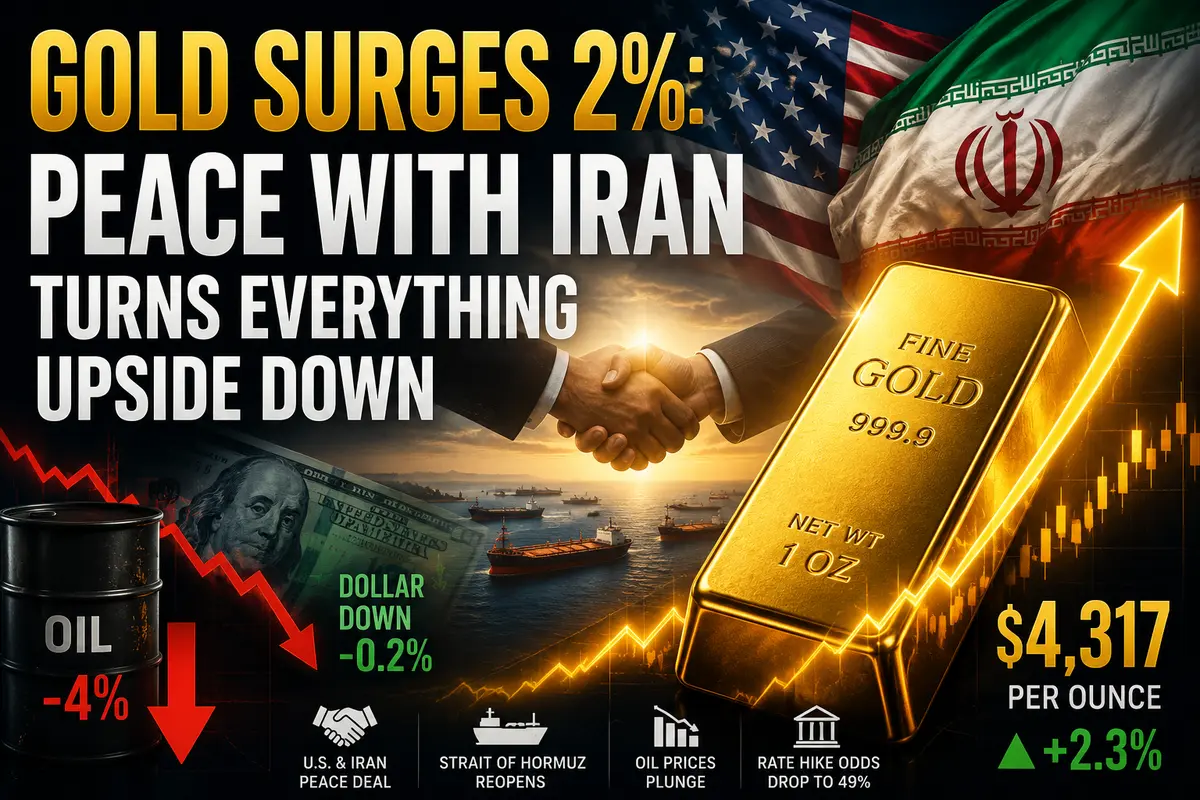
Within a few hours, gold jumped 2.3%. Spot prices climbed to $4,317 per ounce, while futures rose to $4,338.
What happened? Isn’t gold supposed to fall on news of peace?
After all, gold is traditionally considered a safe-haven asset. When peace breaks out and risks decline, investors usually sell gold and move into riskier assets. That’s how it has worked during wars and crises for the past 50 years.
But this conflict was different.
Throughout months of fighting in the Middle East, gold behaved paradoxically. It didn’t rise when missiles were flying—it fell. Markets weren’t focused on the war itself, but on its consequences for inflation and interest rates.
Expensive oil = higher inflation = higher Federal Reserve rates = weaker gold.
A simple, albeit twisted, logic.
Now that the United States and Iran have reportedly reached a temporary peace agreement, that logic has reversed:
Peace = cheaper oil = lower inflation = lower interest rates = stronger gold.
Gold is finally pricing in what it failed to reflect during months of conflict.
A Framework Peace Agreement Changes the Narrative
On Sunday, U.S. and Iranian officials reportedly announced that they had reached a framework peace agreement.
Not a complete settlement. Not a permanent solution. Not a comprehensive accord.
But enough to halt military operations.
The agreement reportedly includes:
-
A ceasefire
-
The lifting of the U.S. blockade on Iran
-
Most importantly, the reopening of the Strait of Hormuz to commercial shipping
Pakistani Prime Minister Shehbaz Sharif, apparently involved as a mediator or close observer, stated that the official signing is scheduled to take place in Switzerland on Friday.
That leaves four days before formal ratification.
Four days during which either side could still change course.
Markets, however, decided not to wait.
Oil plunged.
Brent crude dropped more than 4% to roughly $84 per barrel.
WTI fell below $80.
The U.S. dollar weakened, with the DXY Index slipping 0.2%.
And gold surged 2.3%.
Many investors believe this could be only the beginning.
Why Did Gold Rise Instead of Fall?
To understand this apparent contradiction, we need to look at how gold behaved throughout the entire Middle East conflict.
In March, when Iran and Israel exchanged their first strikes, gold fell.
In April, when the United States targeted Iranian facilities, gold fell again.
In May, when Iran threatened to close the Strait of Hormuz, gold declined once more.
Each time, analysts asked the same question:
“How can gold be falling? A Middle East war is supposed to be a classic bullish catalyst for gold.”
But the market kept saying no.
Because investors were watching oil.
Every escalation pushed oil prices higher.
Higher oil meant higher inflation.
Higher inflation implied higher interest rates.
Higher rates strengthened the dollar.
And a stronger dollar typically weakens gold.
The chain reaction was long—but consistent.
Gold lost because war meant expensive oil.
Now the chain has reversed.
Peace means cheaper oil.
Cheaper oil lowers inflation expectations.
Lower inflation expectations reduce pressure on the Federal Reserve.
A more dovish Fed weakens the dollar.
And a weaker dollar supports gold.
The logic isn’t direct—but it is coherent.
As a result, gold is finally making up for lost ground, rising 2.3% in a single day.
The same traders who were panic-selling gold a week ago are now scrambling to buy it back.
Oil Crashes, Rate Expectations Retreat
Let’s look at the numbers.
Brent crude traded around $84 per barrel on Monday morning, down more than 4% on the day and nearly 12% below last week’s highs near $95.
For oil, which typically moves 1–2% per day, a 12% drop over several days is nothing short of a shockwave.
The main reason is the reopening of the Strait of Hormuz.
Iran, which had threatened to block this vital shipping route, has reportedly agreed to allow free navigation.
Tankers can move again.
Insurance premiums are falling.
Saudi Arabia, Iraq, the UAE, Kuwait, and Qatar can export oil without disruption concerns.
In addition, lifting restrictions on Iran could allow Iranian oil exports to return more fully to global markets.
Iran produces roughly 3 million barrels per day, and greater export access could add substantial supply, placing additional pressure on prices.
For gold, lower oil prices are doubly positive:
-
Inflation expectations decline.
-
The U.S. dollar weakens.
And gold traditionally benefits from both developments.
Interest-rate futures reacted immediately.
Just a week ago, traders assigned a 69% probability to a Federal Reserve rate hike in December.
That probability reportedly fell to 49%.
Nearly half the market no longer expects another rate increase.
Some traders have even begun pricing in rate cuts during 2027.
For gold, that is among the most supportive developments in months.
The Dollar Weakens—But Doesn’t Collapse
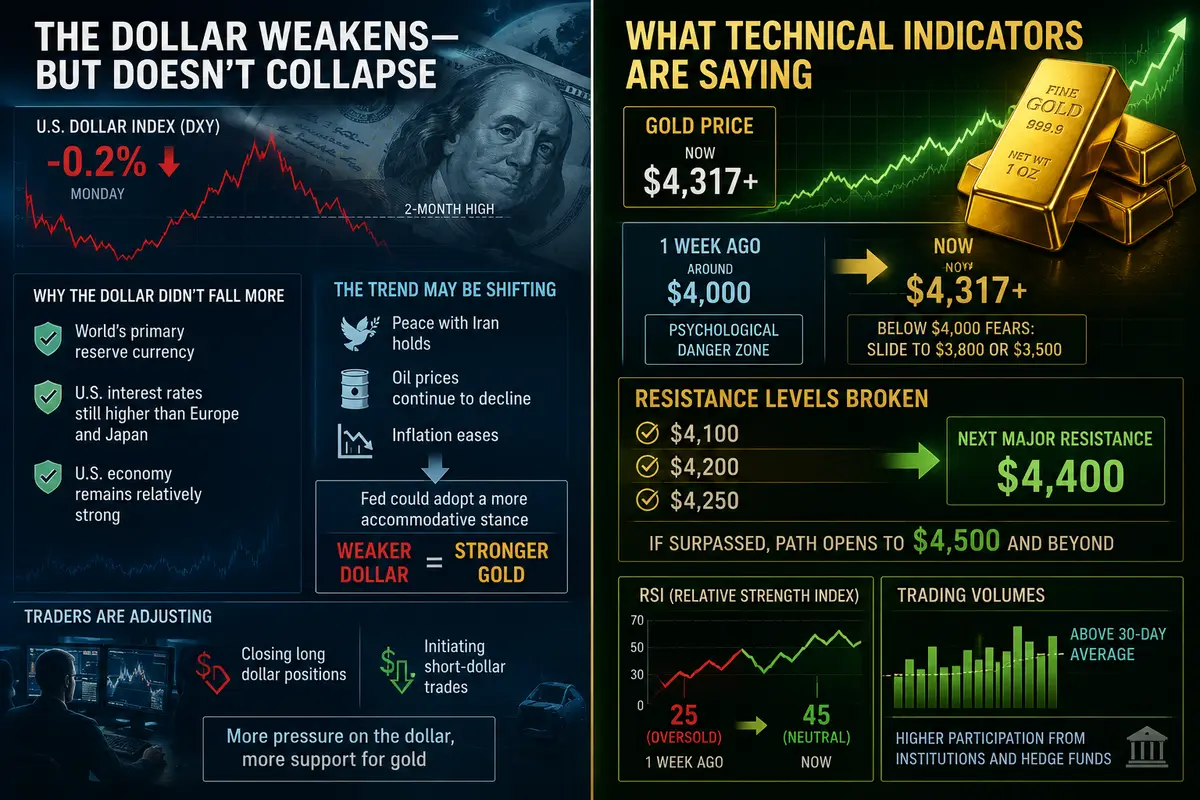
The U.S. Dollar Index (DXY) fell 0.2% on Monday.
Not dramatic, but meaningful.
The index pulled back from two-month highs reached last week.
Why didn’t the dollar fall more sharply?
Because it remains the world’s primary reserve currency.
Because U.S. interest rates are still higher than those in Europe and Japan.
Because the U.S. economy remains relatively strong.
Nevertheless, the trend may be shifting.
If peace with Iran holds, if oil continues to decline, and if inflation eases, the Federal Reserve could eventually adopt a more accommodative stance.
That would likely mean a weaker dollar and stronger gold.
Many traders who spent the spring betting on dollar strength are now closing positions.
Some are even initiating short-dollar trades, adding further pressure on the currency and support for gold.
What Technical Indicators Are Saying
Technically, gold looks significantly healthier than it did a week ago.
Just seven days ago, it was trading near $4,000—a level many investors viewed as a psychological danger zone.
There were fears that a break below $4,000 could trigger a slide toward $3,800 or even $3,500.
Now gold is trading above $4,300.
It has broken through multiple resistance levels:
-
$4,100
-
$4,200
-
$4,250
The next major resistance lies near $4,400.
If that level is surpassed, the path toward $4,500 and beyond could open up.
The Relative Strength Index (RSI), which was reportedly near oversold territory around 25 a week ago, has rebounded to approximately 45.
That places it in neutral territory, leaving room for further upside.
Trading volumes are also elevated relative to the past 30 days.
This suggests participation from larger institutional investors and hedge funds, not just retail traders.
Three Possible Scenarios Going Forward
The next key date is Friday, when the agreement is expected to be formally signed in Switzerland.
Scenario 1: Successful Signing
If the agreement is finalized, gold could receive another boost, potentially targeting the $4,400–$4,450 area.
Scenario 2: Delays or Complications
If the signing is postponed, a correction becomes possible.
However, a return to $4,000 appears unlikely given the amount of positive news already priced in.
Scenario 3: Agreement Collapses
If negotiations break down entirely, markets could quickly reverse course.
Oil would likely rebound.
Inflation concerns would return.
Gold could once again come under pressure.
Other Key Events This Week
Beyond geopolitics, several major central-bank events are scheduled.
Federal Reserve Meeting (June 16–17)
Rates are expected to remain unchanged.
However, investors will focus closely on the Fed’s economic projections and “dot plot.”
A more dovish outlook would likely support gold.
A hawkish surprise could trigger a pullback.
Bank of Japan Meeting
Markets expect a rate increase to 1%, marking the first meaningful positive-rate environment in many years.
A stronger yen could weaken the dollar and indirectly support gold.
Bank of England Meeting
Rates are expected to remain unchanged, making the meeting largely neutral for precious metals.
Silver and Platinum Are Rising Even Faster
Gold isn’t the only winner.
Silver jumped 3.3% to $70.24 per ounce.
Platinum gained 3.2% to $1,776.60.
Why are they outperforming?
Unlike gold, both metals benefit from industrial demand as well as investment demand.
A reduction in geopolitical risks improves the outlook for global economic growth and industrial activity.
Silver also tends to act as a more affordable alternative to gold for retail investors.
When gold becomes expensive, smaller investors often shift toward silver, amplifying its gains.
Platinum has its own unique drivers, particularly in the automotive sector.
Despite the transition toward electric vehicles, platinum remains important in catalytic converters for hybrid and conventional vehicles.
Lower oil prices could slow EV adoption at the margin by making gasoline-powered transportation relatively more attractive, indirectly supporting platinum demand.
Conclusion: Gold Is Making a Comeback
The long-anticipated peace process between the United States and Iran now appears closer than ever.
Markets reacted immediately:
-
Oil fell sharply.
-
The dollar weakened.
-
Expectations for future Fed rate hikes declined.
-
Gold surged 2.3%.
Technically, gold has broken through several important resistance levels and is preparing to challenge the $4,400 area.
Fundamentally, the environment appears increasingly favorable:
-
Lower oil prices
-
Softer inflation pressures
-
A potentially more accommodative Federal Reserve
-
A weaker U.S. dollar
Risks remain.
The peace process could fail.
Inflation could return.
The Fed could surprise markets.
But on Monday morning, investors chose optimism over fear.
And gold responded accordingly.
Because even in a world where market logic seems upside down, old truths sometimes return:
War can be bad for gold.
Peace can be good for gold.
Just not immediately—and not always in the way people expect. But good nonetheless. Now, at least, it’s good.

Comments
No comments yet. Be the first to share your thoughts!
Comments only for logged-in users.