
Gold Under Siege: How New Bombings in Iran Have Cornered the Metal
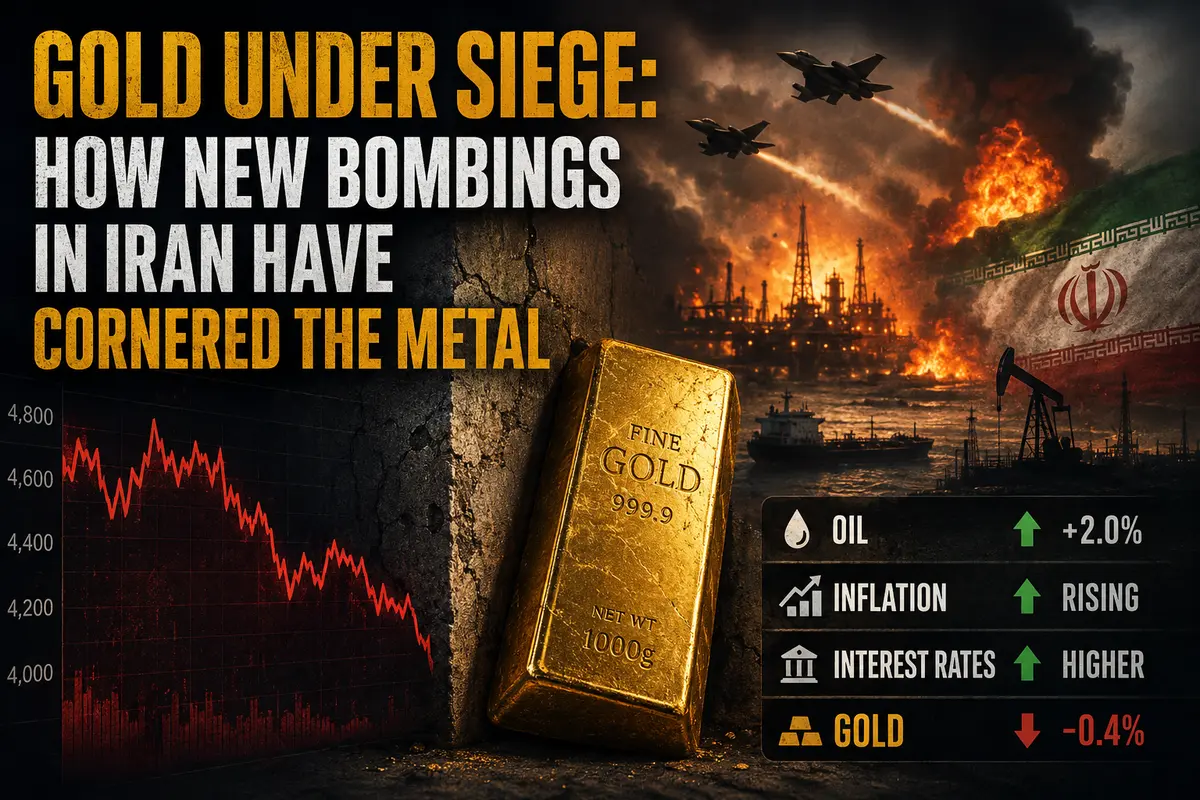
Thursday’s Asian trading session brought another wave of pain for gold. Spot prices slipped 0.4% to $4,438 per ounce, while futures followed, falling to $4,467. Silver plunged nearly 1%, and platinum lost 0.7%. Precious metals are under pressure once again, and the culprit is an old familiar force — war. Not the war itself, but its economic consequences, which the market has learned to price in with ruthless precision. New U.S. strikes on Iran — the second this week — once again triggered the chain reaction: “oil rises → inflation rises → interest rates rise → gold falls.” And as long as that chain remains intact, gold will stay trapped.
Ten Days in a Box: Gold Cannot Break the Walls
Since mid-May, spot gold has been stuck in a range between $4,400 and $4,600 per ounce. Ten days. For an asset capable of moving hundreds of dollars in a single session, that is an eternity. Gold keeps crashing into invisible walls like a fly against glass, unable to break either higher or lower.
The reason for this paralysis is both simple and painful. The market is being torn between two opposing forces. On one side, geopolitical uncertainty — war, strikes on Iran, the blocked Strait of Hormuz — should push gold higher as a safe-haven asset. On the other side, the inflationary consequences of that same war — expensive oil, rising prices, and the threat of higher rates — should push gold lower, because high interest rates make holding a non-yielding metal unattractive.
On Thursday, the second force prevailed. New U.S. strikes on Iranian targets pushed oil prices roughly 2% higher. Oil climbed again, and inflation expectations climbed with it. Rising inflation expectations strengthen the belief that the Federal Reserve will not cut rates — and may even raise them again before year-end. For gold, which generates no interest income, that is a death sentence.
Second Strike in a Week: What Happened This Time
Reports of fresh U.S. strikes on targets inside Iran emerged early Thursday morning. It was already the second such incident this week. On Monday, American forces had bombed missile launcher positions and vessels in southern Iran. Now — again. Washington’s official position remains that the strikes are defensive in nature and that the ceasefire still stands. But markets hear explosions, not words.
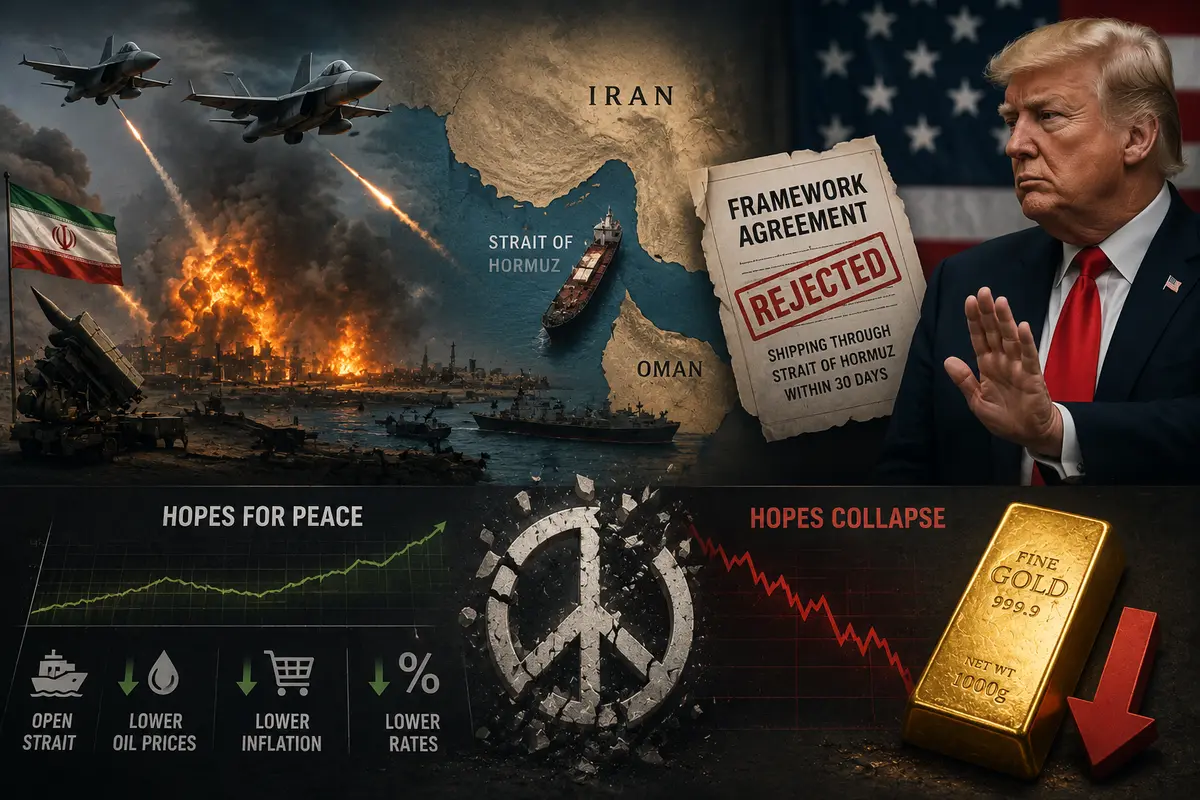
Donald Trump added fuel to the fire on Wednesday. He broadly rejected recent reports about a framework agreement that would have restored shipping through the Strait of Hormuz within thirty days. He also dismissed the idea that Iran and Oman could jointly oversee passage through the strait. For markets, this was a clear signal: a peaceful resolution is not merely delayed — it may not happen at all in the foreseeable future.
That shattered the fragile optimism that had supported gold earlier in the week. Gold had been rising on hopes for peace, because peace would mean reopening the strait, lower oil prices, easing inflation, and a reduced threat of higher interest rates. Now, as hopes for peace collapse, gold is falling. A paradox that has become the new normal: for gold, peace turned out to be more beneficial than war.
Strait of Hormuz: A Slow Reopening That Changes Nothing
The Strait of Hormuz remains the central focus. On one hand, reports indicate a gradual resumption of oil tanker traffic. That is a positive signal which, in theory, should lower oil prices and support gold. But there is a catch: oil flows through the strait remain well below pre-war levels.
That means the global oil market is still facing a supply deficit. The slow reopening of the strait is not enough to compensate for lost volumes. Oil prices remain elevated even when they temporarily pull back. Inflationary pressure has not disappeared — it has merely stopped accelerating. And for gold, that is bad news, because the threat of tight monetary policy remains alive.
PCE on the Horizon: The Data Gold Fears Most
Beyond geopolitics, Thursday’s market focus is also on the release of the April PCE inflation index. This is the Federal Reserve’s preferred inflation gauge, and it will heavily influence expectations for future interest rates.
Previous April inflation data released earlier this month showed a sharp increase in price pressures. If the PCE report confirms that picture, markets will become even more convinced that the Fed will need to keep rates high — or possibly raise them further before year-end. That would deliver another blow to gold. If, however, the PCE unexpectedly shows cooling inflation, gold could finally get some breathing room.
But until the data is released, traders are bracing for the worst. Fears about the inflationary impact of the Iran conflict are increasing bets that the Fed will maintain a hawkish stance. And gold, which traditionally performs poorly in high-rate environments, continues to suffer.
Silver and Platinum: A Double Blow
Silver fell 0.9% on Thursday, while platinum dropped 0.7%. Both metals are suffering from the same forces affecting gold, but with an additional burden. Silver has a dual identity — both a safe-haven and an industrial metal. As a defensive asset, it suffers from the threat of higher rates. As an industrial metal, it suffers from the uncertainty that war creates for the global economy.
Platinum is even more dependent on industrial demand, especially from the automotive sector. Automakers facing expensive oil and supply chain disruptions are cutting production. Demand for catalytic converters is weakening — and with it, demand for platinum.
How Much Longer Will This Torture Last?
Gold remains trapped in its range, with no clear escape in sight. To break above the upper boundary, the market would need a major positive shock — for example, an unexpected slowdown in inflation in the PCE data, or a genuine breakthrough in negotiations with Iran that reopens the Strait of Hormuz and crushes oil prices. To break below the lower boundary, it would take a negative shock — accelerating inflation that forces the Federal Reserve to seriously discuss further rate hikes.
Until one of those happens, gold is likely to remain boxed in. Ten days could turn into fifteen, twenty, or thirty. For traders, that is agonizing, but for the broader market it is a normal response to extreme uncertainty. Gold does not know where to go because the world does not know how the Iran conflict will end. And while diplomats and military forces continue their game, the yellow metal will keep bouncing inside its narrow corridor, unable to make a decisive move either upward or downward.
Thursday brought no answers. Perhaps Friday will. Or perhaps next week, next month, or next year. The conflict with Iran has taught markets one thing: certainty will remain elusive for a long time. And gold will have to live with that.
Comments
No comments yet. Be the first to share your thoughts!
Comments only for logged-in users.