

Hawks in Washington, Calm in Asia: The Dollar Holds Firm While the Aussie Loses Ground
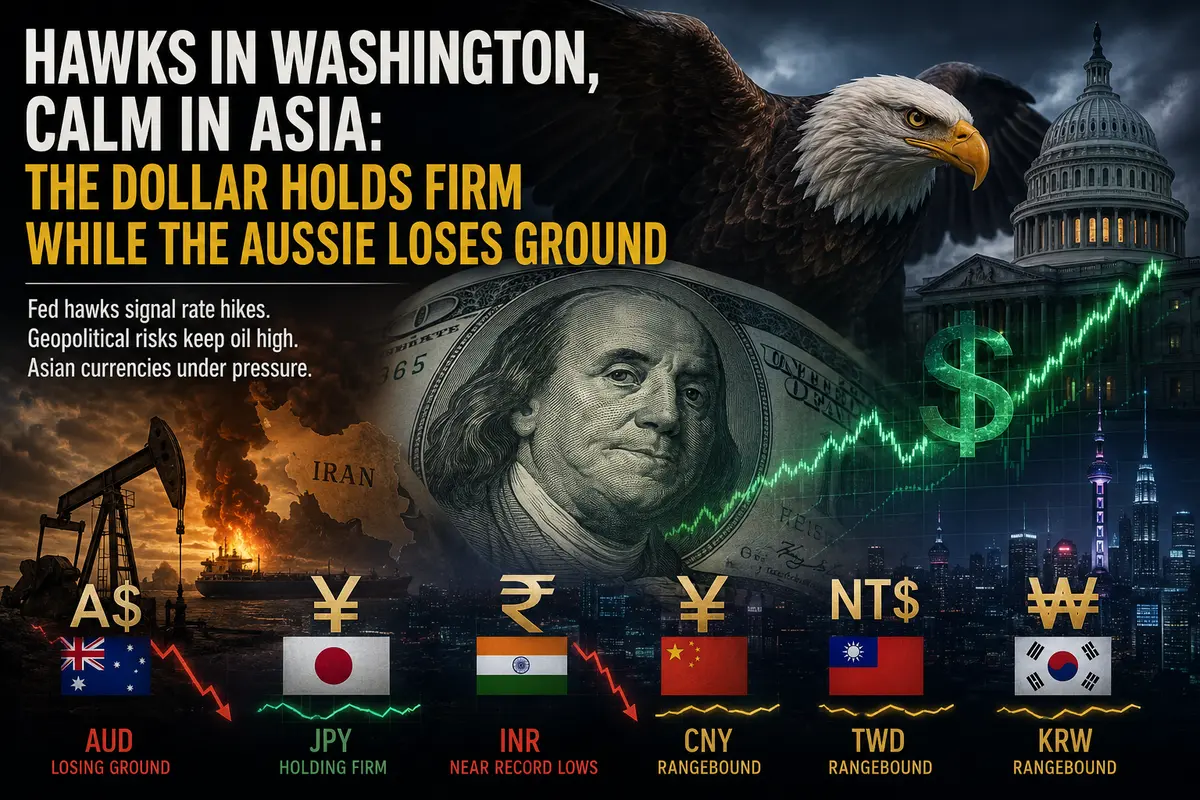
Thursday’s Asian trading session unfolded under the shadow of what the Federal Reserve released the previous evening. The minutes from April’s Fed meeting — anticipated with a level of tension rivaling that of Big Tech earnings reports — did not disappoint those betting on a hawkish turn. The document confirmed what markets had been whispering about for weeks: the hawks inside the Fed are spreading their wings, and the idea of further rate hikes is no longer fringe speculation. The dollar, sensing renewed strength, stabilized near six-week highs, while Asian currencies — with the exception of the yen — retreated into defensive mode. The Australian dollar, meanwhile, suffered a particularly sharp blow from an unexpected source: its own labor market.
Fed Minutes: The Hawks Step Out of the Shadows
Reading Fed minutes is always an exercise in decoding. Dry language conceals dramatic clashes of opinion, cautious hints, and diplomatically softened disagreements. But the April document was surprisingly candid. More and more officials on the Federal Open Market Committee now acknowledge the possibility of raising interest rates. This is not merely a shift in tone — it is a tectonic change in the monetary landscape, one that would have seemed unthinkable just a few months ago.
The reason behind this shift is simple and ominous: inflation. The very inflation the Fed vowed to keep near two percent refuses to cool. On the contrary, it has accelerated sharply over the past two months. The chief culprit is oil. Supply disruptions caused by the war against Iran have driven energy prices to levels that ripple through the cost of everything — from gasoline and airfare to grocery baskets. This is supply-side inflation, the most troublesome kind for central banks because it cannot be fought effectively through traditional demand cooling. Yet judging by the minutes, the Fed appears prepared to act even under these conditions.
The minutes’ reference to readiness for “some further policy tightening” should inflation remain persistently above target sounded like a warning shot — and not one fired into the air, but directly along the dollar’s trajectory. Markets immediately interpreted the signal: if rates rise further, the dollar will become even more attractive to global investors. And this would occur at a time when the world economy is already struggling under the weight of expensive oil and geopolitical instability. Add to that the upcoming appointment of Kevin Warsh as Fed Chair — a figure known for his hardline monetary views — and the outlook becomes even darker for emerging markets.
Trump, Iran, and Mixed Signals
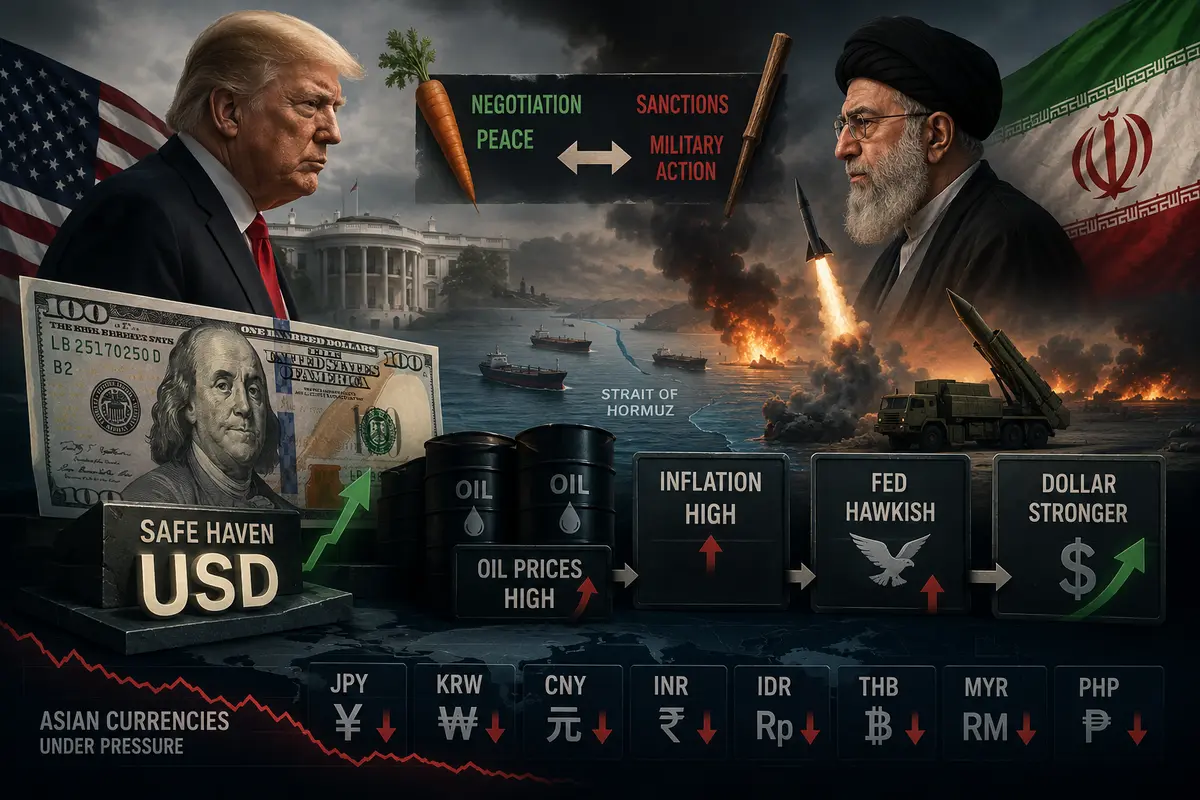
While the Fed hardens its rhetoric, the White House continues its familiar game of oscillating between threats and promises of peace. Earlier this week, Donald Trump spoke of progress in negotiations with Iran, briefly raising hopes for de-escalation. But by Wednesday, the tone had changed. The president warned that military action could resume if Tehran failed to accept the terms of a peace agreement soon. It is the classic carrot-and-stick strategy, keeping oil markets in a state of permanent tension.
For the dollar, this uncertainty is a gift. In times of geopolitical turmoil, the U.S. currency traditionally benefits as a safe haven. Investors alarmed by the prospect of another escalation in the Strait of Hormuz prefer to hold dollars rather than the currencies of countries more dependent on energy imports. A prolonged confrontation with Iran implies persistently high oil prices; high oil prices imply sustained inflation; sustained inflation implies a hawkish Fed; and a hawkish Fed implies a stronger dollar. The chain of cause and effect unfolds with ruthless logic, and Asian currencies are falling one by one under its weight.
Australian Dollar: A Blow from the Rear
The AUD/USD pair fell by half a percent on Thursday, and the decline came directly after data few in Australia had expected. The labor market — long regarded as an island of stability amid the turbulent global economy — finally showed cracks. Unemployment unexpectedly climbed to its highest level in four and a half years, while total employment declined. It is not a catastrophe, but it is a clear cooling signal that caught analysts off guard.
For the Reserve Bank of Australia, the figures are almost a relief. After previously raising rates by seventy-five basis points, the central bank had already hinted that it wanted to pause and assess the effects of its tightening campaign. Weak employment data only reinforce that stance. If the labor market is cooling, wage-driven inflationary pressure may ease, reducing the urgency for further hikes. But for the Australian dollar, the implication was straightforward: the interest rate differential with the United States is unlikely to widen in Australia’s favor. Investors who had positioned for aggressive RBA tightening began unwinding those trades. The aussie plunged.
The war with Iran added further pressure. Although Australia is a major commodity exporter, its economy still depends heavily on global growth conditions. A prolonged conflict weighing on world growth is hardly supportive for Australian exports. And the aussie — often viewed as a proxy for global risk appetite — is suffering on two fronts: domestic weakness and external threats.
Yen Holds Firm, Rupee Slides, Yuan Stalls
Against this backdrop, the Japanese yen appeared relatively resilient. USD/JPY stabilized following stronger-than-expected trade balance data. Exports to both the United States and China increased, delivering a larger surplus than analysts had forecast. Imports also surged, driven by purchases of semiconductors and electronics needed for AI infrastructure development. But markets viewed the figures positively. Combined with improving business activity indices in both manufacturing and services, the picture that emerges is of an economy continuing to demonstrate resilience despite global turbulence.
Meanwhile, the Indian rupee continues its painful slide. USD/INR remains near record highs, with the psychologically important level of 97 rupees per dollar looming dangerously close. The Reserve Bank of India appears to be trying to slow the decline, but its room for maneuver is limited. As long as oil remains above $100 per barrel and foreign investors continue pulling capital out of the country, the rupee is likely to stay under pressure.
The Chinese yuan, Taiwan dollar, and South Korean won traded in narrow ranges with little overall movement. Yet the calm may prove deceptive. Tensions in the Taiwan Strait, Trump’s remarks about reconsidering weapons supplies to Taipei, and nervousness surrounding the semiconductor sector after Samsung’s failed negotiations with labor unions all contribute to an atmosphere that could ignite at any moment.
Asian markets on Thursday appeared frozen in anticipation. The dollar, fueled by hawkish Fed minutes and geopolitical uncertainty, continues to dominate. The Australian dollar is sinking under the weight of domestic weakness. The yen remains supported by strong economic data. The rupee hovers on the edge of a historic breakdown. This is not calm — it is the silence before the storm. And whether the thunder comes from the Strait of Hormuz, Washington, or Beijing, nobody knows yet. But almost nobody doubts anymore that it is coming.

Comments
No comments yet. Be the first to share your thoughts!
Authentication Required
You must be logged in to post a comment.