

What are Dividends: A Comprehensive Guide to Corporate Profit Sharing

At its core, a dividend is a tangible reward for your financial trust. It is the portion of a company’s net profit distributed to its shareholders as a return on their investment. When you buy shares in a publicly traded company, you become a fractional owner. If that company generates surplus cash, the board of directors must decide whether to reinvest that money back into the business or return a portion of it directly to you. When they choose the latter, they issue a dividend.
Understanding how dividends work, the different forms they take, and what they signal about a company’s financial health is essential for navigating the global stock market.
Types of Dividends: How Companies Reward Shareholders
Not all dividends are created equal. Depending on a company’s cash flow, strategic goals, and capital structure, it may choose to distribute wealth in several different ways.
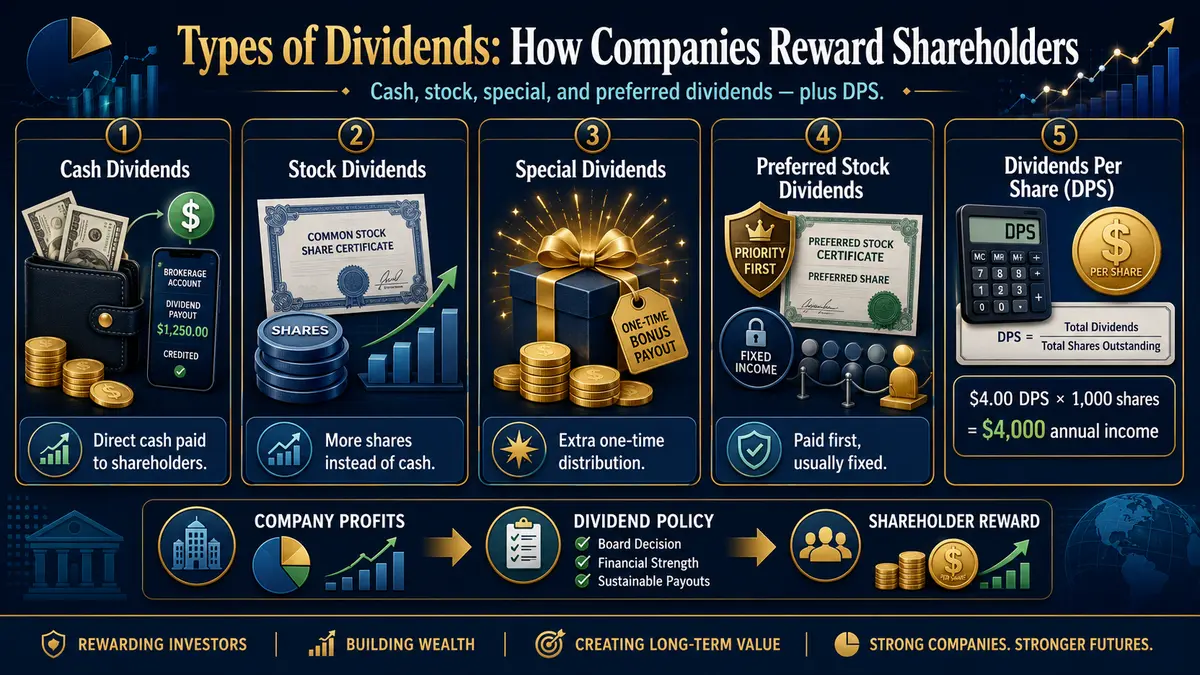
Cash Dividends: The Traditional Payout
This is the most common and universally recognized form of profit sharing. The company simply deposits cash directly into shareholders’ brokerage accounts.
Cash dividends provide a predictable stream of passive income, making them highly attractive to long-term investors and retirees. For example, global consumer giants like Coca-Cola COLA.NE ... and Johnson & Johnson JNJ ... have built their reputations on paying reliable, consistently growing cash dividends every quarter, regardless of broader economic volatility.
Stock Dividends: Growing Your Share Count
Instead of paying cash, a company may issue additional shares to its existing investors, distributed proportionally based on their current holdings. Also known as a “scrip dividend,” this method allows a company to reward its shareholders while conserving its cash reserves for internal projects or debt reduction. While a stock dividend increases your total number of shares, it does not immediately increase the overall value of your investment, as the company’s total market capitalization is simply divided into smaller, more numerous pieces. However, as the company grows over time, holding more shares can significantly compound your wealth.
Special Dividends: The One-Time Windfall
Special dividends are extraordinary, non-recurring payouts made on top of the company’s regular dividend schedule. These usually occur when a company experiences an unexpected financial windfall — such as selling off a major subsidiary, winning a massive lawsuit, or accumulating an unusually large stockpile of cash that it cannot efficiently deploy. A prime example is the global wholesale retailer Costco COST ... , which is famous for maintaining a modest regular dividend but occasionally surprising its investors with massive special dividends, sometimes paying out $10 to $15 per share in a single day to distribute excess cash.
Preferred Stock Dividends: The Priority Payout
When a company issues both common and preferred stock, preferred shareholders enjoy a legally binding priority status. Preferred dividends are usually fixed at a specific percentage and must be paid out in full before any common shareholders receive a dime. Because of this fixed, predictable yield, preferred stock behaves much like a corporate bond. Financial institutions like JPMorgan Chase frequently issue preferred shares to raise capital while offering investors a highly stable, albeit capped, income stream.
Dividends Per Share (DPS): Measuring the Impact
Dividends Per Share (DPS) is a vital metric that represents the total dollar amount a company pays out for every individual share over a 12-month period. It translates the company’s macro-level profit distribution into a micro-level reality for the investor. For instance, if a company declares a total annual dividend of $4.00 per share and you own 1,000 shares, you can project a reliable $4,000 in annual passive income.
Dividend Payout Ratios: Striking the Right Balance
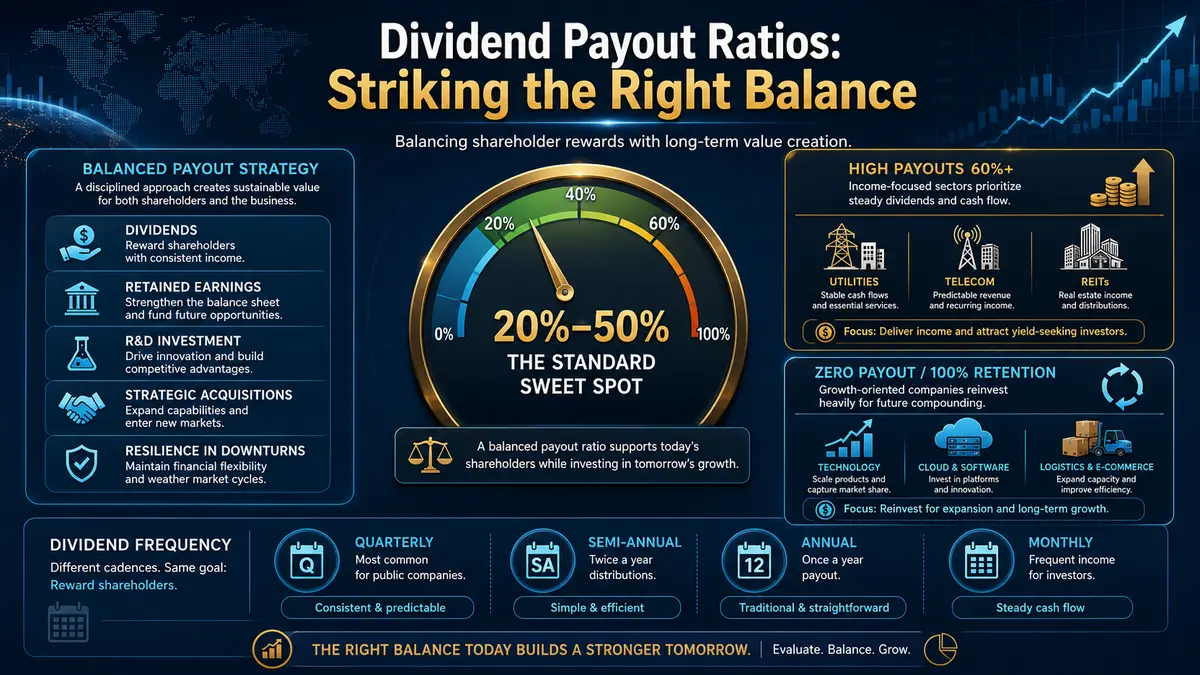
A company cannot survive if it gives all its money away, but it may anger investors if it hoards cash unnecessarily. The Dividend Payout Ratio — the percentage of net income distributed to shareholders — reveals a company’s fundamental financial strategy.
The Standard 20% to 50% Range
Generally, mature, consistently profitable companies aim to pay out between 20% and 50% of their net earnings. This “sweet spot” allows the company to reward shareholders generously while retaining enough capital to fund research and development, acquire competitors, or weather economic downturns. Apple AAPL ... and Microsoft MSFT ... , for instance, generate staggering amounts of cash but maintain relatively low payout ratios to ensure they always have capital for technological innovation.
High Payouts vs. Complete Retention
There is no universal rule for payout ratios, as different industries have different requirements:
-
High Payouts (Over 60%): Telecommunications companies (like Verizon VZ ... ), utility providers, and Real Estate Investment Trusts (REITs) often pay out the vast majority of their earnings. In the US, REITs are actually legally required to distribute at least 90% of their taxable income to shareholders.
-
Zero Payouts (100% Retention): Fast-growing technology startups and aggressive growth companies rarely pay dividends. Historically, companies like Amazon AMZN ... have chosen to reinvest 100% of their profits back into expanding their logistics networks and cloud computing dominance, prioritizing massive stock price appreciation over immediate cash payouts.
The Role of Dividend Frequency
The rhythm of dividend payments varies by region and corporate culture. While most major US corporations pay dividends quarterly, many European global heavyweights (like LVMH LVMHF ... or Nestlé NSRGF ... ) prefer a semi-annual or annual schedule. Additionally, some specialized income funds and real estate trusts pay dividends monthly, which is highly sought after by investors relying on their portfolios for living expenses.
Why Dividends Matter to Global Investors
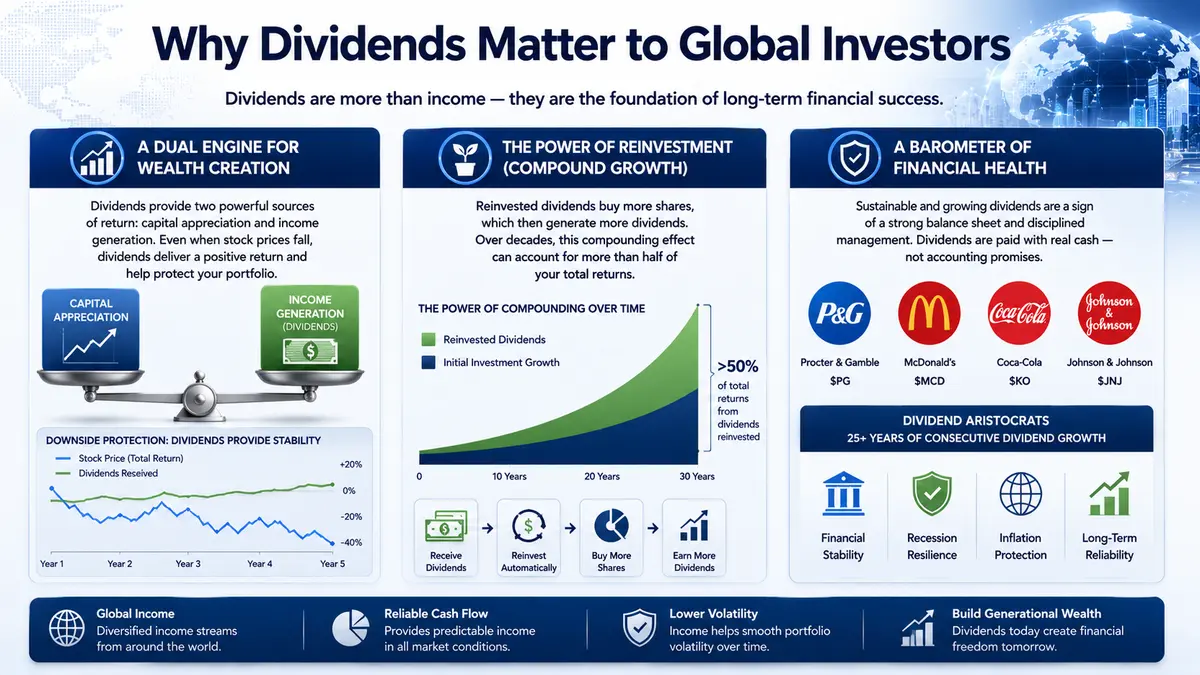
Dividends are far more than just a pleasant bonus; they are a critical engine for long-term wealth creation.
A Dual Engine for Wealth Creation
Investing in dividend-paying stocks provides a two-pronged approach to wealth: capital appreciation (the stock price going up) and income generation (the dividend). Even during bear markets or prolonged economic stagnation when stock prices fall, dividends provide a positive, tangible return that cushions the blow to an investor’s portfolio.
The Power of Reinvestment (Compound Growth)
When investors choose not to spend their cash dividends and instead use them to automatically buy more shares of the company, they unlock the mathematical magic of compound interest. Over a 20- or 30-year horizon, reinvested dividends often account for more than half of the total returns generated by the global stock market.
A Barometer of Financial Health
Dividends act as a polygraph test for a company’s balance sheet. While earnings can be manipulated through clever accounting, cash dividends cannot be faked — the money must actually be in the bank. Companies that have successfully raised their dividends for 25 consecutive years or more are known globally as Dividend Aristocrats (e.g., Procter & Gamble PG ... or McDonald’s MCD ... ). Investors view these companies as bastions of financial stability, capable of surviving recessions, inflation, and global crises.
The Warning Signs: Why Companies Cut or Suspend Dividends
While a growing dividend is a sign of strength, a dividend cut is often a glaring red flag. When a board of directors makes the painful decision to reduce or entirely eliminate a dividend, it is usually driven by severe internal or macroeconomic pressures.
-
Declining Profitability: If a company’s core business model is disrupted and earnings plummet, maintaining a high dividend becomes mathematically impossible without draining the company’s cash reserves.
-
Cash Flow and Liquidity Crises: A company might look profitable on paper but lack the actual “free cash flow” needed to write checks to shareholders. Cash flow is oxygen, and without it, the dividend is the first thing to be cut.
-
Macroeconomic Shocks and Uncertainty: During unprecedented global crises, even the strongest companies will suspend dividends out of an abundance of caution. For example, during the onset of the 2020 pandemic, global giants like The Walt Disney Company DIS ... and Boeing BOE.L ... entirely halted their dividends to hoard cash and survive the economic lockdown.
-
Massive Capital Requirements: Sometimes a cut is strategic rather than desperate. A company might reduce its dividend to redirect billions of dollars into a massive acquisition, build new manufacturing plants, or transition to a new industry (such as legacy automakers shifting capital to build electric vehicles).
-
Crushing Corporate Debt Loads: If a company has borrowed too heavily and interest rates rise, the cost of servicing that debt skyrockets. Companies are legally obligated to pay their bondholders and creditors before their shareholders. If debt becomes overwhelming, the dividend must be slashed to avoid bankruptcy.
Ultimately, a company’s dividend policy is a balancing act between rewarding the investors of today and securing the business operations of tomorrow.














Comments
No comments yet. Be the first to share your thoughts!
Authentication Required
You must be logged in to post a comment.