

The Correlation Between the Dollar and Oil Has Hit a Historic Record Amid War
Why the Market Has Entered an Unusual Phase
Until recently, the idea that the US dollar and oil prices could rise almost in perfect sync seemed nearly absurd to most market participants. For decades, the global financial system operated under a different logic: a stronger dollar typically pressured commodities lower, while expensive oil was often associated with a weaker American currency. This relationship was considered one of the market’s unwritten rules.
But the current conflict in the Middle East has not simply disrupted that pattern — it has effectively turned it upside down.
Over the past several weeks, global markets have been pushed into a state of exceptional tension. The military escalation involving Iran and the disruption of critical shipping routes have triggered a serious shock throughout the global energy system. The Strait of Hormuz is not just another point on the map. A massive share of the world’s oil exports passes through this narrow corridor. Any threat to navigation in the region immediately alarms investors because they understand that the consequences extend far beyond a local conflict.
Oil Prices Are Rising on Fears of Supply Shortages
Against this backdrop, Brent crude prices have surged dramatically. A nearly 45% increase in just a few months is no ordinary market fluctuation — it is the kind of move typically seen during periods of global crisis.
What makes this rally especially important is that oil is not climbing because the global economy suddenly needs more energy. In fact, many economies are slowing down. The main driver is fear — fear that physical supply could become severely constrained.
Whenever traders believe that oil flows may be disrupted, prices begin to include a “risk premium.” The higher the probability of further escalation, the larger that premium becomes. As a result, oil prices are currently being shaped less by traditional supply-and-demand dynamics and more by geopolitical anxiety.
Why the Dollar Is Rising Alongside Oil
The most remarkable development, however, is happening in the currency market.
Historically, oil and the US dollar usually moved in opposite directions. The explanation was straightforward. Since oil is priced globally in dollars, a stronger American currency makes crude more expensive for buyers using other currencies. That often reduces demand and puts downward pressure on oil prices.
For decades, this inverse relationship was viewed as a natural law of the market.
Today, that model has broken down.
Investors are now aggressively buying both oil and the dollar at the same time. At first glance, this may appear contradictory, but in reality it reflects classic crisis-era capital behavior.
During periods of war and global uncertainty, the dollar once again becomes the world’s primary safe-haven asset. Despite ongoing discussions about de-dollarization, the US currency remains the ultimate shelter during moments of panic. Capital flows into dollars not because the American economy is flawless, but because no real alternative exists on a comparable scale.
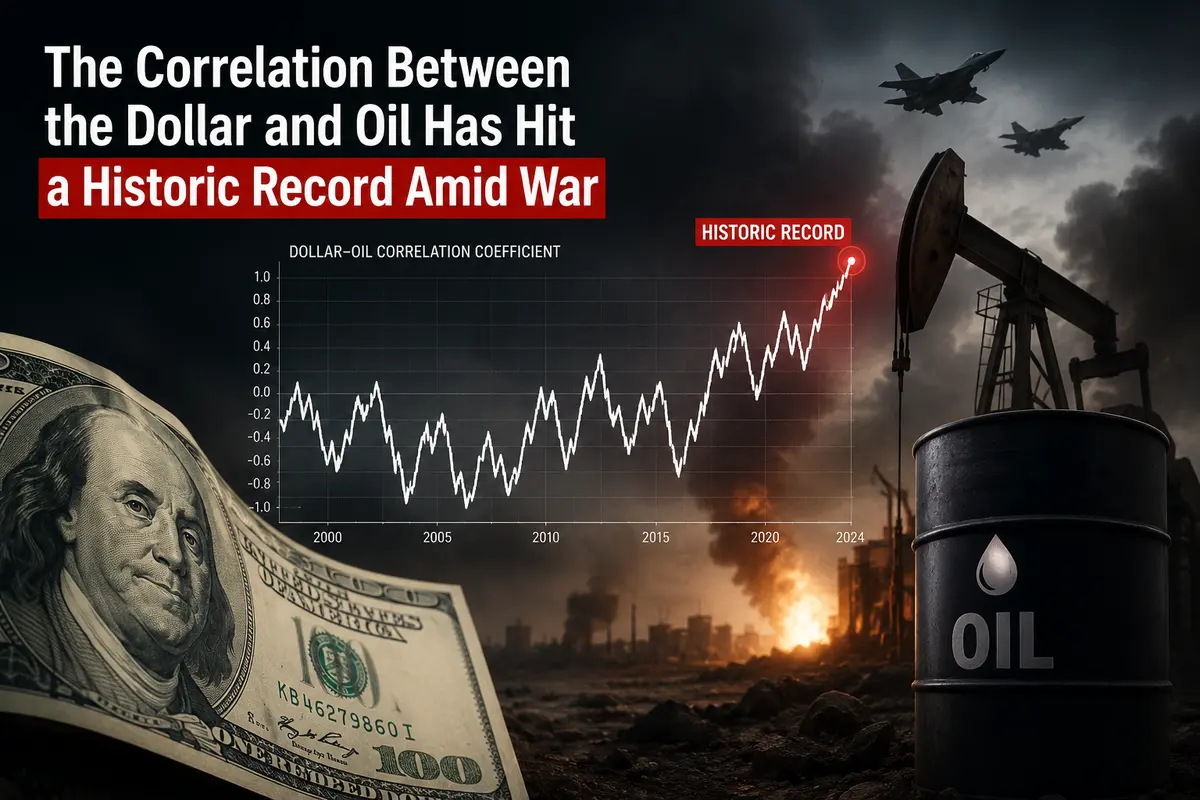
This creates a highly unusual situation. Oil is rising because markets fear supply shortages, while the dollar is rising because markets fear global instability. The same geopolitical shock is simultaneously driving both assets upward. That is precisely why the correlation between oil and the dollar has reached historic highs.
Geopolitics Has Overtaken Economics
At the moment, markets are reacting less to economic reports and more to political headlines. Just a year ago, investors focused heavily on inflation data, Federal Reserve policy, employment figures, and GDP growth. Now those indicators have largely moved into the background.
A single statement from Tehran or Washington can shift prices more dramatically within hours than an entire package of macroeconomic data.
This highlights an important psychological aspect of financial markets. Markets are always emotional to some degree, but during military conflicts emotional reactions become dominant. Investors stop thinking primarily about long-term valuation and begin focusing on capital preservation.
As a result, momentum trading intensifies, volatility increases, and many traditional market relationships begin to collapse.
Why Currency Markets Have Become More Difficult
This environment is particularly challenging for currency traders. Traditional valuation models are becoming far less reliable. Normally, exchange rates are driven by factors such as interest rate differentials, economic growth, inflation, and trade balances. But when oil becomes the market’s central driver, many of those traditional signals lose influence.
The pressure is especially severe for countries that rely heavily on imported energy. Expensive oil weakens their trade balances, fuels inflation, and places additional strain on central banks. Europe, Japan, and many developing economies are already experiencing the consequences of the energy shock.
The longer tensions persist in the Middle East, the more these economic pressures are likely to intensify.
What the United States Gains From the Crisis
For the United States, the situation is complicated and somewhat paradoxical.
On one hand, expensive oil hurts American consumers through higher gasoline and transportation costs. On the other hand, the dollar continues to benefit from its status as the world’s dominant reserve currency and primary safe-haven asset.
In times of crisis, investors buy US Treasuries, move capital into dollar-denominated assets, and reduce exposure to riskier markets. This creates strong and sustained demand for the US currency even while oil prices remain elevated.
The current crisis has also exposed the fragility of the global energy system. Despite years of discussion about green energy transitions, electric vehicles, and reduced dependence on fossil fuels, the global economy remains deeply dependent on Middle Eastern oil supplies.
Any threat to shipping routes in the region immediately affects prices worldwide.
Why This New Market Reality Is Dangerous
In many ways, the current situation is not just about one regional conflict. It is a reminder of how deeply geopolitics and finance are interconnected. Modern financial markets are no longer driven purely by economic fundamentals. Increasingly, they are reacting to military risks, diplomatic confrontations, and competition over strategic resources.
The key question now is how long this abnormal correlation can continue.
If the conflict drags on and supply risks remain elevated, oil and the dollar may continue moving higher together. But if tensions begin to ease, markets could gradually return to the more traditional pattern where a stronger dollar once again puts pressure on commodity prices.
For now, however, investors are operating in a world where geopolitics has largely overtaken economics. And that is what makes the current moment so extraordinary: markets are no longer pricing assets primarily through economic fundamentals — they are pricing the probability of the next geopolitical shock.

Comments
No comments yet. Be the first to share your thoughts!
Comments only for logged-in users.