

Taiwan’s Market Stalls on the Edge of Zero: A Day That Changed Nothing
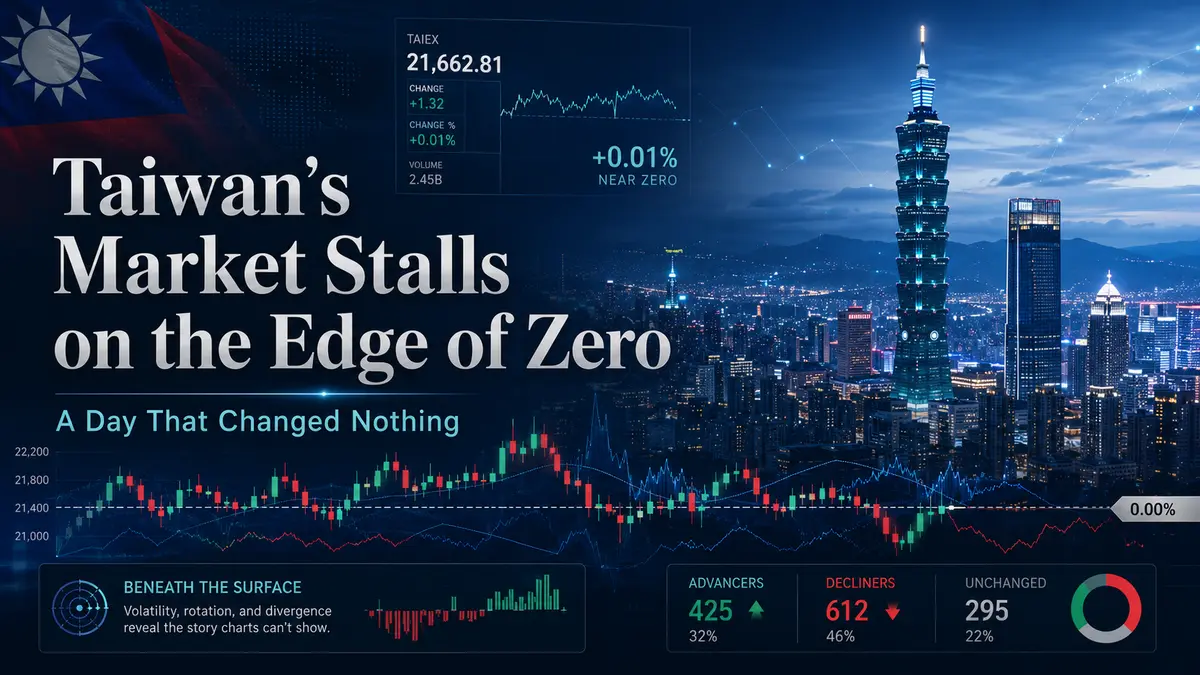
Friday on the Taiwan Stock Exchange: A Decline of Just Hundredths of a Percent
Taiwan’s stock market ended Friday’s trading session with an almost imperceptible move lower. The Taiwan Weighted Index lost just 0.01%—such an insignificant amount that it could easily be dismissed as a rounding error, were it not for the drama concealed behind it. This microscopic decline masked major sectoral shifts, record-breaking rallies in some stocks, and plunges to historic lows in others. In other words, it was a day when the market as a whole went nowhere, even though almost everything imaginable was happening beneath the surface.
Trading presented a classic picture of opposing forces. Shares in the glass manufacturing and plastics sectors dragged the market lower, while other industries attempted to keep it afloat. The battle ultimately ended in a draw, with the index remaining virtually unchanged. Yet behind this statistical tie was genuine chaos, as some companies soared while others plunged into the abyss. That was perhaps the most interesting feature of the day’s trading session.
The Top Three Performers: Who Pulled Ahead?
Against the backdrop of overall index stagnation, three companies posted impressive gains, with all three rising by exactly 10%. This may not have been a simple coincidence. Such synchronized performance suggests that common market factors were at work, or that the stocks simply reached their daily price increase limits at the same time.
Lee Chi Enterprises, a manufacturer of bicycle components, gained 1.10 points to close at 12.10. This 10% increase pushed the shares to new levels. The company, which specializes in producing bicycle parts, may have benefited from growing interest in green mobility or from the announcement of new contracts.
Giant Manufacturing, the internationally renowned bicycle producer, delivered an even more impressive move. Its shares climbed 8 points to 88.00, also representing a 10% increase. For a large and established company such as Giant, a one-day gain of 10% is an exceptional event. The rally may have been connected to a major order, expansion into a new market, or simply favorable market conditions amid broader interest in green technologies.
The third company among the day’s leaders was Hung Ching Development & Construction. Although the construction company appears to be facing challenges in terms of its fundamental performance, its shares surged by 9.99% to 49.55. This was not merely a strong gain—it also represented a new 52-week high. Such a move is unusual for the construction sector, which is generally highly sensitive to macroeconomic conditions. Investors may have received information about new infrastructure projects or potential government support for the construction industry.
The Day’s Biggest Losers: Falling to Historic Lows
While some companies celebrated victory, others experienced a genuine nightmare. Tonlin Department Store led the decline, with its shares plunging by 10% to 24.30. This was the sharpest fall of the day, indicating that the company faced significant selling pressure. Department stores and traditional retail chains around the world are currently struggling with competition from online retailers, but a 10% decline in a single session likely points to company-specific problems.
Formosa Sumco Technology, a producer of semiconductor materials, also ended the session in negative territory, although its decline was slightly less dramatic. The company’s shares lost almost 10% and closed at 471.00. This is particularly noteworthy because the technology sector is generally considered more resilient. In this case, internal factors may have played a role, such as disappointing financial results or weaker demand for the company’s products.
The most dramatic story of the day, however, was the collapse of Yeong Guan Energy Technology Group. This was more than an ordinary decline—it was a fall to an all-time low. The company’s shares dropped by 9.92% to 5.54, representing not merely a correction but a break below multi-year lows. For an energy company that might normally be expected to benefit from high energy prices, such a decline appears almost catastrophic. The company may be facing serious financial difficulties, may have lost a major customer, or may simply have been overvalued by the market in the past and is now undergoing a painful correction.
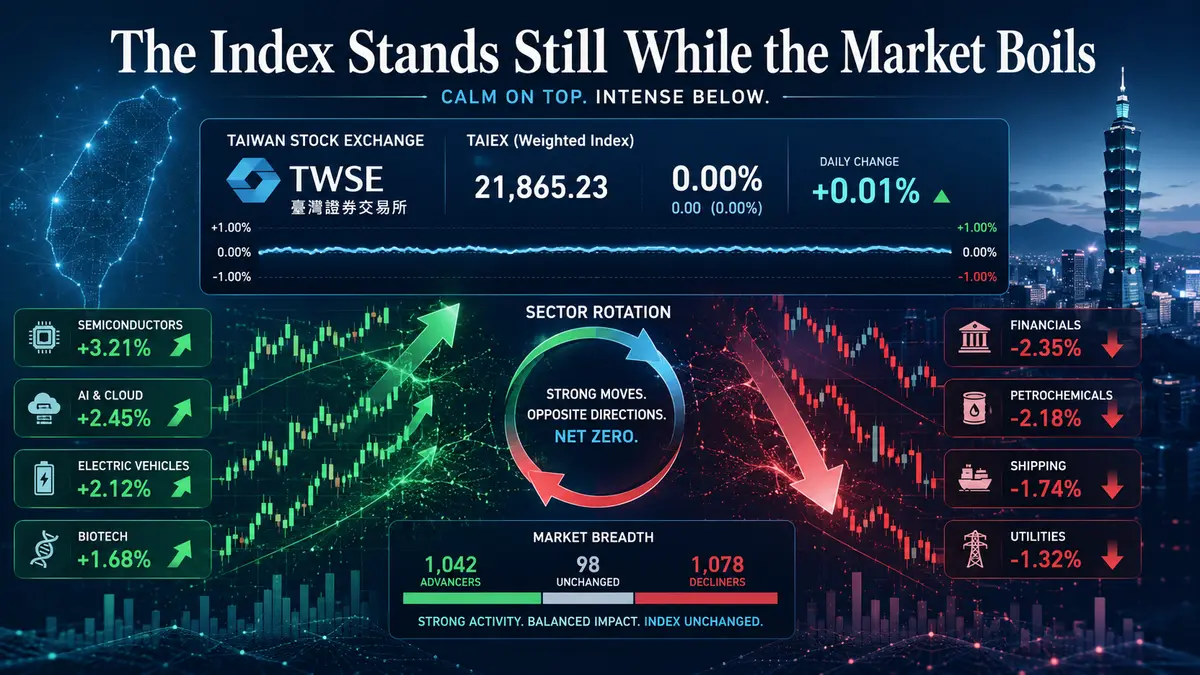
The Index Stands Still While the Market Boils
The main paradox of the day was that, despite such a wide range of price movements—including 10% rallies and 10% declines—the index itself finished almost unchanged. This is a classic sign of a market at a turning point: some sectors are rising, others are falling, and their movements are offsetting one another.
This often happens when investors rotate capital from one sector into another while the total amount of money in the market remains relatively stable. It may indicate that the market is searching for new growth drivers and has not yet determined the direction of its next major move.
According to the available data, the number of declining stocks on the Taiwan Stock Exchange exceeded the number of stocks that closed higher. However, the provided statistics showed zero values for both categories, which appears to be either a technical error or a feature of the calculation method. In reality, if some stocks rose while others fell, the number of advancing and declining securities could not both have been zero. Most likely, the difference between the two figures was insignificant, contributing to the index’s near-zero overall change.
External Conditions: What Is Happening in Other Markets?
While the Taiwanese market remained frozen in uncertainty, several notable developments took place in other markets. West Texas Intermediate crude oil futures for August delivery rose by 0.18% to $79.09 per barrel. Brent BZUSD ... crude gained 0.07% to reach $84.29. This continued the trend observed in recent days: oil prices remain influenced by geopolitical risks, but without experiencing sharp movements.
XAUUSD ... Gold, by contrast, moved slightly lower. August gold futures declined by 0.05% and traded at $3,989.95 per ounce. Although the decline was minimal, it suggests that investors were not yet prepared to actively purchase safe-haven assets despite ongoing geopolitical tensions.
In the currency market, the Taiwan dollar weakened slightly against the US dollar. The USDTWD ... pair rose by 0.22% to 32.34. This reflected the broader weakness of Asian currencies amid a modest strengthening of the US dollar. Meanwhile, the TWDCNY ... exchange rate remained unchanged at 0.21.
US Dollar Index futures USDEUR ... fell by 0.01% to 100.56, indicating that the dollar remained close to its recent levels. Overall, the external environment for the Taiwanese market could be described as neutral. There were no major obstacles preventing the market from moving higher, but there were also no strong catalysts capable of driving growth.
What Comes Next? Prospects for the Taiwanese Market
The current stagnation of the Taiwan Weighted Index is not necessarily a negative sign. Markets often pause after periods of significant movement in order to absorb recent developments and build momentum for the next major move. The only question is which direction that move will take.
Taiwan’s market is heavily dependent on the global technology cycle. Semiconductors, electronics, and electronic components form the foundation of Taiwanese exports. As long as global demand for these products remains strong, the market should remain relatively confident. However, signs of an economic slowdown—particularly in China or the United States—could place serious pressure on Taiwanese equities.
Geopolitical factors also remain important. Taiwan is at the center of attention among the world’s major powers, and any deterioration in relations between China and the United States could trigger increased volatility in the Taiwanese market. For now, the situation remains relatively calm, but investors should not become complacent.
Particular attention should be paid to the strongest-performing companies, including Giant Manufacturing and Lee Chi Enterprises. Their 10% gains may indicate that investors are beginning to rotate toward green technologies and sustainable mobility. Should this trend continue, individual sectors may deliver impressive performance even while the broader market remains stagnant.
At the same time, Yeong Guan Energy’s decline to an all-time low serves as a reminder that even expanding industries have their underperformers. Investors should remain cautious and carefully analyze the fundamental performance of each company rather than simply following broader sector trends.
Conclusion: A Day That Changed Nothing but Revealed a Great Deal
Friday on the Taiwan Stock Exchange was a day when the index barely moved, yet dramatic events unfolded beneath the surface. Ten-percent rallies, equally sharp declines, and the setting of both new highs and historic lows all occurred within a single session, while the final market result remained close to zero.
This serves as a reminder that the market is not merely a collection of numbers. It reflects complex processes taking place throughout the economy and in the minds of investors. Behind every movement in a share price are someone’s hopes and fears, and these emotions can sometimes produce completely unexpected results.
The Taiwanese market remains in a state of anticipation. It is waiting for new signals from the global economy, geopolitical developments, and corporate earnings reports. Once those signals appear, the index will begin to move again. For now, however, it remains still—like a chess player considering the next move. The future of millions of investors may depend on how successful that move ultimately proves to be.

Comments
No comments yet. Be the first to share your thoughts!
Authentication Required
You must be logged in to post a comment.