

Tencent Raises Billions: Massive Bond Demand Sends Shares Up 5%
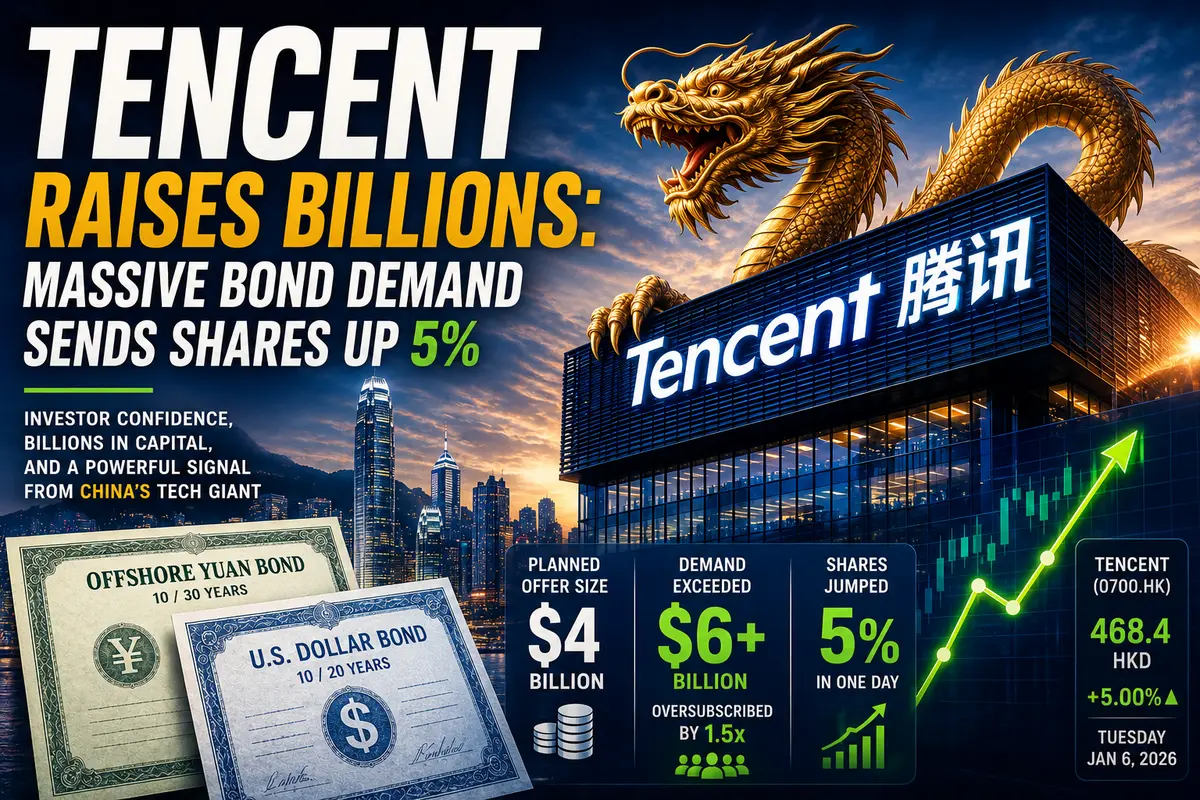
On Tuesday morning, something happened on the Hong Kong Stock Exchange that many had anticipated, but few expected on such a scale. Shares of Tencent—the company that means as much to China as Google, Facebook, and Amazon combined mean to America—jumped 5%. The stock reached HK$468.4 per share.
A 5% move for a giant like Tencent, whose market capitalization is measured in hundreds of billions of dollars, is more than just a green arrow on a chart. It represents billions of dollars in added market value in a single day.
What caused such optimism? Bonds. At first glance, they seem like ordinary debt securities. But these were anything but ordinary.
Tencent entered the market with a dual-currency offering—in U.S. dollars and offshore Chinese yuan. The company aimed to raise about $4 billion. Instead, it received orders exceeding $6 billion.
Investors were willing to lend Tencent more than $6 billion. That is trust. That is confidence. And it is a signal the market finds difficult to ignore.
Let’s take a closer look at what happened, why investors lined up to buy these bonds, and what it means for Tencent, China’s technology sector, and global markets as a whole.
The Dry Numbers Behind an Ocean of MoneyLet’s start with the details, because in finance, that’s often where the most interesting part of the story lies.
Tencent offered investors two types of bonds:
Offshore yuan-denominated bonds with maturities of 10 and 30 years.
U.S. dollar-denominated bonds with maturities of 10 and 20 years.
A fairly standard structure for a large multinational company seeking long-term financing.
What was not standard was the market’s reaction.
Demand for the yuan-denominated bonds reached 20.5 billion yuan, or approximately $3.02 billion at current exchange rates. Demand for the dollar-denominated bonds exceeded...
