

Tencent Raises Billions: Massive Bond Demand Sends Shares Up 5%
When China’s Internet Dragon Goes Hunting
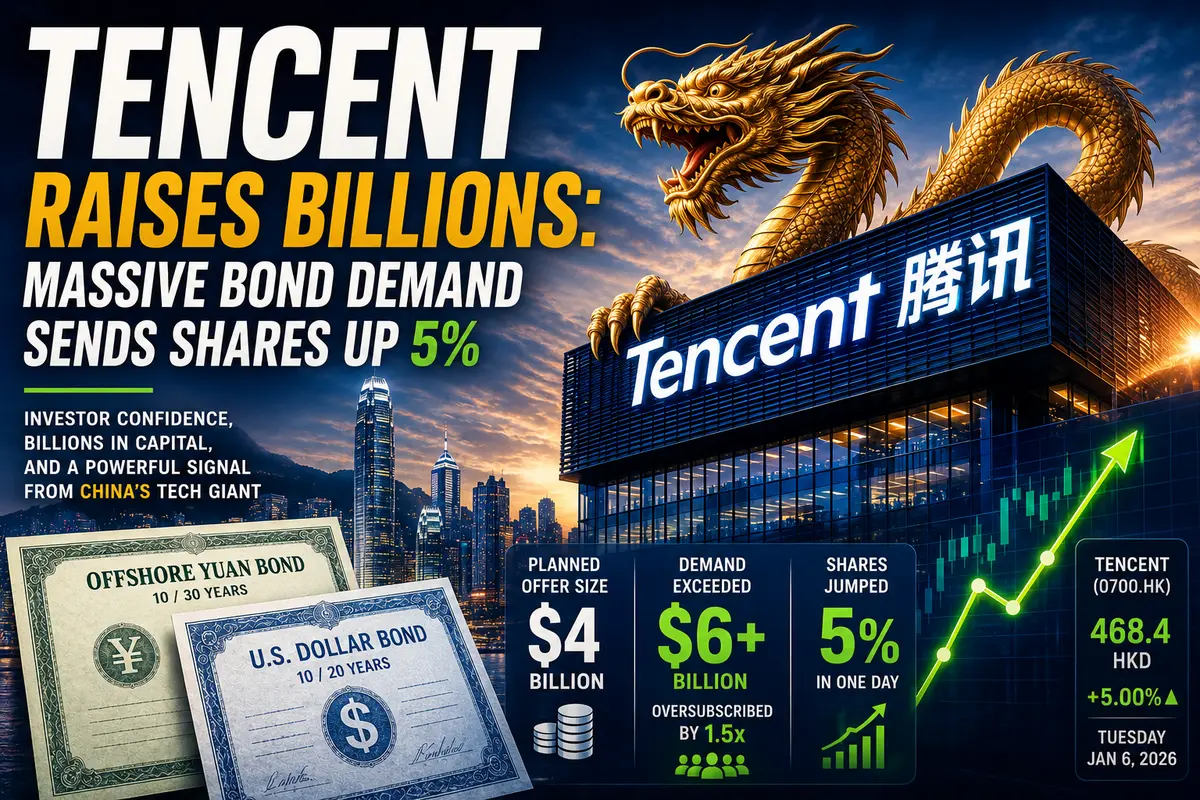
On Tuesday morning, something happened on the Hong Kong Stock Exchange that many had anticipated, but few expected on such a scale. Shares of Tencent—the company that means as much to China as Google, Facebook, and Amazon combined mean to America—jumped 5%. The stock reached HK$468.4 per share.
A 5% move for a giant like Tencent, whose market capitalization is measured in hundreds of billions of dollars, is more than just a green arrow on a chart. It represents billions of dollars in added market value in a single day.
What caused such optimism? Bonds. At first glance, they seem like ordinary debt securities. But these were anything but ordinary.
Tencent entered the market with a dual-currency offering—in U.S. dollars and offshore Chinese yuan. The company aimed to raise about $4 billion. Instead, it received orders exceeding $6 billion.
Investors were willing to lend Tencent more than $6 billion. That is trust. That is confidence. And it is a signal the market finds difficult to ignore.
Let’s take a closer look at what happened, why investors lined up to buy these bonds, and what it means for Tencent, China’s technology sector, and global markets as a whole.
The Dry Numbers Behind an Ocean of Money
Let’s start with the details, because in finance, that’s often where the most interesting part of the story lies.
Tencent offered investors two types of bonds:
-
Offshore yuan-denominated bonds with maturities of 10 and 30 years.
-
U.S. dollar-denominated bonds with maturities of 10 and 20 years.
A fairly standard structure for a large multinational company seeking long-term financing.
What was not standard was the market’s reaction.
Demand for the yuan-denominated bonds reached 20.5 billion yuan, or approximately $3.02 billion at current exchange rates. Demand for the dollar-denominated bonds exceeded $3 billion.
In total, Tencent received more than $6 billion in orders against an expected issuance size of roughly $4 billion.
In other words, every dollar Tencent wanted to borrow was oversubscribed by about 1.5 times. Investors were effectively competing for the opportunity to lend money to the Chinese internet giant.
Why?
Because Tencent is more than just a company. It is a symbol. One of the few Chinese corporations recognized around the world.
WeChat, its flagship super-app, serves more than a billion users. Tencent Games is the world’s largest video game publisher and owns Riot Games (creator of League of Legends) while holding significant stakes in Epic Games (Fortnite) and Activision Blizzard.
Add Tencent Music, Tencent Video, WeBank, and investments in Tesla, Snap, Spotify, and hundreds of other companies, and the list becomes almost endless.
Lending money to Tencent is, in some respects, like lending money to a sovereign entity. The probability of default is considered extremely low. The company generates tens of billions of dollars in annual revenue, maintains substantial cash reserves, and benefits from the strategic importance it holds within China’s economy.
At the same time, Tencent offers attractive yields.
Initial guidance for the dollar bonds was reportedly set at approximately 80 basis points above U.S. Treasury yields for the 10-year tranche and 90 basis points above Treasuries for the 20-year tranche.
With Treasury yields currently around 4.5%–5%, investors are looking at annual returns in the range of roughly 5.3%–5.9% in U.S. dollars.
For securities carrying relatively low credit risk, that is an attractive proposition.
The yuan-denominated bonds are a different story. They are aimed at investors who want exposure to the Chinese currency but either cannot or prefer not to access mainland China’s domestic bond market directly.
Offshore yuan markets in Hong Kong, Singapore, and London provide an alternative route into China’s currency ecosystem without requiring direct interaction with mainland regulators.
Why Were Investors So Eager?
This brings us to the key question: why was demand so strong?
After all, it is 2026. U.S. interest rates remain elevated, the dollar is strong, and geopolitical tensions between China and the West have not disappeared.
The answer lies in Tencent’s unique position.
Despite the challenges of recent years—including regulatory pressure, a slowing Chinese economy, and the aftereffects of the pandemic—Tencent continues to grow.
Its gaming division remains a global leader. WeChat is no longer just a messaging app; it is an ecosystem that combines payments, social networking, mini-programs, and government services.
In 2025, Tencent reported revenue growth of 8% and net profit growth of 10%.
At a time when many technology companies around the world are cutting jobs and freezing investment plans, Tencent continues to hire and expand.
Investors also see Tencent as a hedge against two major risks dominating global markets today:
-
Escalating geopolitical conflict in the Middle East.
-
The possibility of a U.S. recession.
Tencent derives most of its revenue from China. And despite its challenges, China continues to grow faster than most developed economies.
Exports remain strong, domestic demand is gradually recovering, and policymakers continue to support growth through credit expansion and fiscal stimulus.
While the U.S. and Europe struggle with inflation and high interest rates, China is pursuing a different economic path.
Tencent is one of the primary beneficiaries of that path.
Where Will the Money Go?
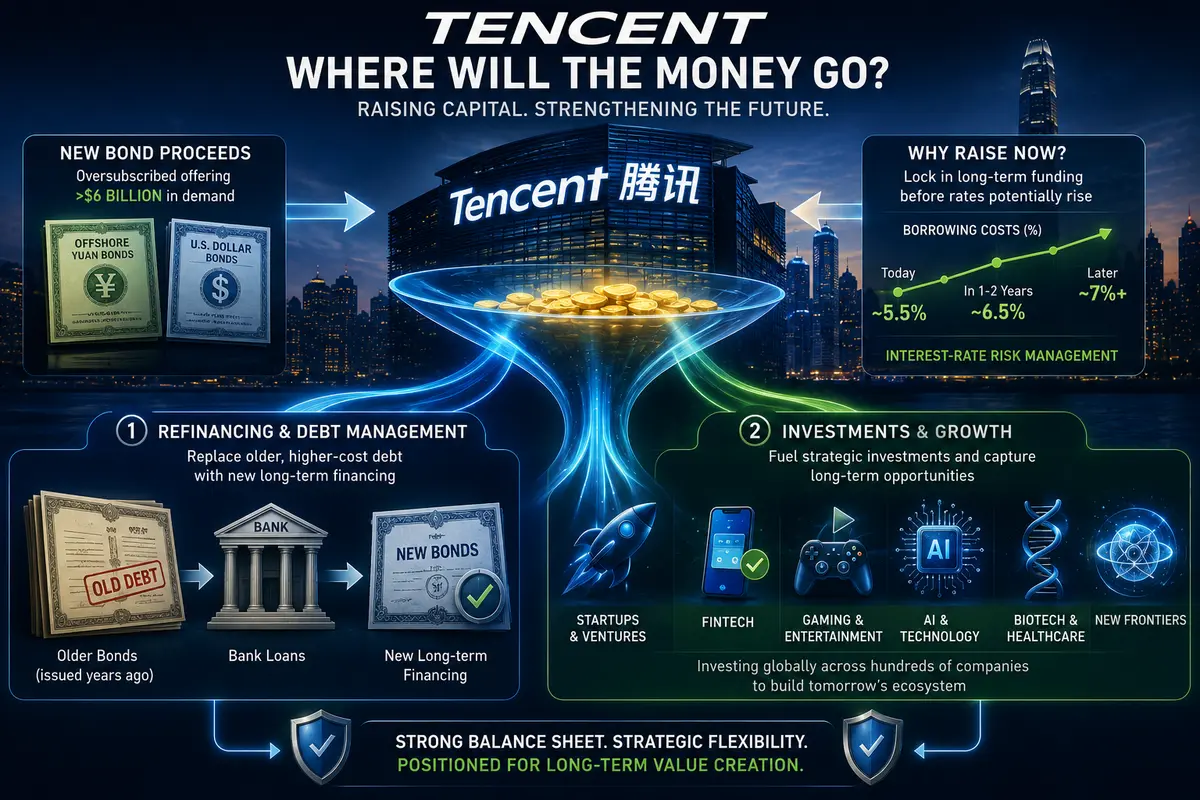
As is customary in bond prospectuses, Tencent stated that the proceeds will be used for general corporate purposes, including refinancing existing debt.
In practical terms, that means replacing older obligations with new financing.
Like any major corporation, Tencent carries debt. Some of it consists of bonds issued years ago, while some comes from bank loans.
The company appears eager to secure long-term funding now, even at higher rates than were available several years ago.
Why refinance when rates are higher?
Because Tencent may believe rates could rise further.
If borrowing costs are expected to increase over the next one to two years, locking in financing today at around 5.5% may prove preferable to borrowing later at 6.5% or even 7%.
This is a classic example of interest-rate risk management.
Beyond refinancing, Tencent also requires capital for investment.
The company remains one of the world’s most active technology investors, holding stakes in hundreds of startups across sectors ranging from fintech and gaming to biotechnology and artificial intelligence.
As valuations fell during the high-rate environment of 2024–2025, Tencent increased its investment activity, acquiring stakes in promising businesses at discounted prices.
Now, as markets stabilize and interest in AI, quantum computing, and advanced materials accelerates, Tencent wants to maintain ample liquidity for future opportunities.
Market Reaction: Shares Rise, Confidence Returns
Tencent’s 5% share price jump was not merely a reaction to the bond sale.
It also reflected a broader reassessment of Chinese technology companies by investors.
The past three years have been extremely difficult for the sector.
Beijing’s regulatory crackdown—including restrictions on gaming, antitrust investigations, and campaigns against what officials described as the “disorderly expansion of capital”—erased hundreds of billions of dollars in market value from companies such as Tencent, Alibaba, and Baidu.
Add geopolitical tensions, U.S. sanctions, delisting concerns, and deteriorating relations between Washington and Beijing, and the picture becomes even more challenging.
But the winds may be shifting.
Chinese policymakers appear increasingly focused on supporting private enterprise. New initiatives have been launched to encourage private-sector growth, some restrictions have been relaxed, and approvals for new gaming titles have resumed.
Investors who fled Chinese equities two years ago are beginning to return.
Slowly. Carefully. But they are returning.
The overwhelming demand for Tencent’s bonds may be the clearest evidence yet.
Comparing Tencent with Alibaba, Baidu, and PDD
Other Chinese technology giants also benefited from the improved sentiment.
-
Alibaba rose roughly 2%.
-
Baidu gained around 1.5%.
-
PDD Holdings advanced approximately 2.5%.
Yet Tencent outperformed them all.
Why?
Because Tencent is arguably the most diversified and least externally dependent of China’s major technology companies.
Alibaba faces slowing consumer demand and intense competition from PDD and Douyin. Baidu spent years searching for a new growth engine after its dominance in internet search peaked, although its AI investments are now showing promise.
PDD continues to face regulatory and reputational challenges.
Tencent, meanwhile, enjoys three powerful revenue streams:
-
Gaming
-
Advertising
-
Financial services
And on top of that, it owns an enormous investment portfolio worth hundreds of billions of dollars.
When markets become nervous, investors seek quality.
Tencent is often viewed as quality with a capital “Q.”
The Currency Angle: Why Issue Bonds in Both Yuan and Dollars?
One particularly noteworthy aspect of the deal is Tencent’s decision to issue bonds in both U.S. dollars and offshore yuan.
This was no accident.
Dollar bonds appeal to international investors—U.S. pension funds, European insurers, and Middle Eastern sovereign wealth funds.
They can invest, earn income, and manage portfolios without worrying about currency conversion.
Yuan bonds appeal to investors who believe in the long-term strength of China’s currency.
By issuing debt in both currencies, Tencent broadens its investor base and reduces dependence on any single funding market.
If demand for dollar bonds weakens because of rising U.S. rates, yuan demand can compensate.
If the yuan weakens, dollar bonds remain attractive.
It is a sophisticated diversification strategy.
It also reinforces Tencent’s image as a truly global company—one capable of raising capital in multiple currencies and across multiple markets.
Risks: What Could Go Wrong?
No investment story is complete without discussing risk.
Tencent is a strong company, but it is not immune to challenges.
1. Regulatory Risk
China’s government remains difficult to predict.
The same authorities that support the private sector today could impose new restrictions tomorrow.
The gaming crackdown of 2021–2022 demonstrated that even Tencent is not beyond the reach of policy intervention.
2. Economic Risk
China’s recovery remains slower than many would like.
The property sector continues to struggle, consumer confidence remains fragile, and youth unemployment remains elevated.
A weaker economy would inevitably affect Tencent’s revenue growth.
3. Geopolitical Risk
Relations between the United States and China remain tense.
Potential tariffs, investment restrictions, and technology sanctions could create additional headwinds for Tencent.
4. Competitive Risk
Tencent faces competition not only from Western firms such as Apple, Google, and Meta, but also from domestic rivals.
ByteDance continues to capture advertising budgets, while AI startups could eventually challenge Tencent in areas where it currently enjoys strong positions.
Investors buying Tencent bonds understand these risks.
Apparently, however, they consider them manageable.
Otherwise, they would not have submitted more than $6 billion in orders.
What Are Analysts Saying?
Major investment banks such as Morgan Stanley, Goldman Sachs, and JPMorgan generally view Tencent as a blue-chip name and a core holding for many portfolios.
Recent analyst reports highlight several positive trends:
-
Accelerating growth in gaming.
-
Double-digit expansion in advertising supported by AI integration.
-
Gradually improving profitability in cloud services.
The consensus target price for Tencent shares is around HK$550.
That implies approximately 17% upside from current levels.
Some bullish analysts project targets of HK$600 or even HK$650.
From that perspective, Tuesday’s 5% rally may be only the beginning.
Not everyone agrees.
Skeptics point out that Chinese equity markets remain sluggish, capital continues to flow toward higher-yielding Western assets, and Tencent’s valuation—trading at roughly 20 times earnings—is above historical averages.
As always, the truth likely lies somewhere in the middle.
Why Should Investors Around the World Care?
Someone reading this article in Moscow, Almaty, Minsk, London, or New York might ask:
“What do Tencent’s bonds have to do with me?”
The answer is simple.
Tencent has become a barometer of confidence in China.
When Tencent successfully raises billions of dollars and attracts overwhelming demand, it signals that international investors still believe in China’s future.
And confidence in China matters because China remains the world’s second-largest economy and one of the most important drivers of global demand.
A growing China supports commodity exporters, manufacturers, infrastructure projects, and international trade across continents.
When Tencent’s bond offering is oversubscribed by more than 50%, it is more than a corporate finance story.
It is a message to global markets:
China remains open for business. Chinese champions remain investable. And Asia continues to play an increasingly important role in the global economy.
Of course, there is another side to the argument.
Tencent’s success could also be part of a broader asset bubble. Overvalued Chinese assets, like overvalued American technology stocks, could eventually correct sharply.
For now, however, the market is voting “yes.”
Conclusion
Tencent shares rose 5% on Tuesday after extraordinary demand for the company’s bond offering exceeded supply by more than one and a half times.
The company planned to raise approximately $4 billion but received more than $6 billion in orders.
The strong response reflects investor confidence in Tencent’s financial strength, business model, and long-term prospects despite ongoing regulatory, economic, and geopolitical risks.
The proceeds will be used primarily for refinancing existing debt and supporting general corporate activities, including future investments.
Other Chinese technology giants such as Alibaba, Baidu, and PDD also gained, but Tencent clearly emerged as the focal point of investor attention thanks to its diversification, stability, and global reach.
Risks remain. China’s policy environment is unpredictable. Economic recovery is uneven. U.S.-China relations remain strained.
Yet investors appear willing to accept those risks in exchange for yields of 5–6% in U.S. dollars and exposure to one of the world’s most influential technology companies.
Monday and Tuesday delivered a clear message:
Interest in China is returning.
Not with the explosive enthusiasm of 2020 or the broad-based optimism of 2018, but it is returning.
And Tencent stands among the biggest beneficiaries of that renewed confidence.

Comments
No comments yet. Be the first to share your thoughts!
Comments only for logged-in users.