

Pound and Euro Regain Ground: The Dollar Takes a Breather, but It’s Too Early to Relax
Tuesday: A Day of Consolidation
After Friday’s frenzy, when the U.S. dollar surged on the back of strong U.S. employment data and technology stocks tumbled, dragging risk assets down with them, Tuesday brought something traders call consolidation. No sharp moves, no panic, no euphoria—just a cautious recovery after the storm.
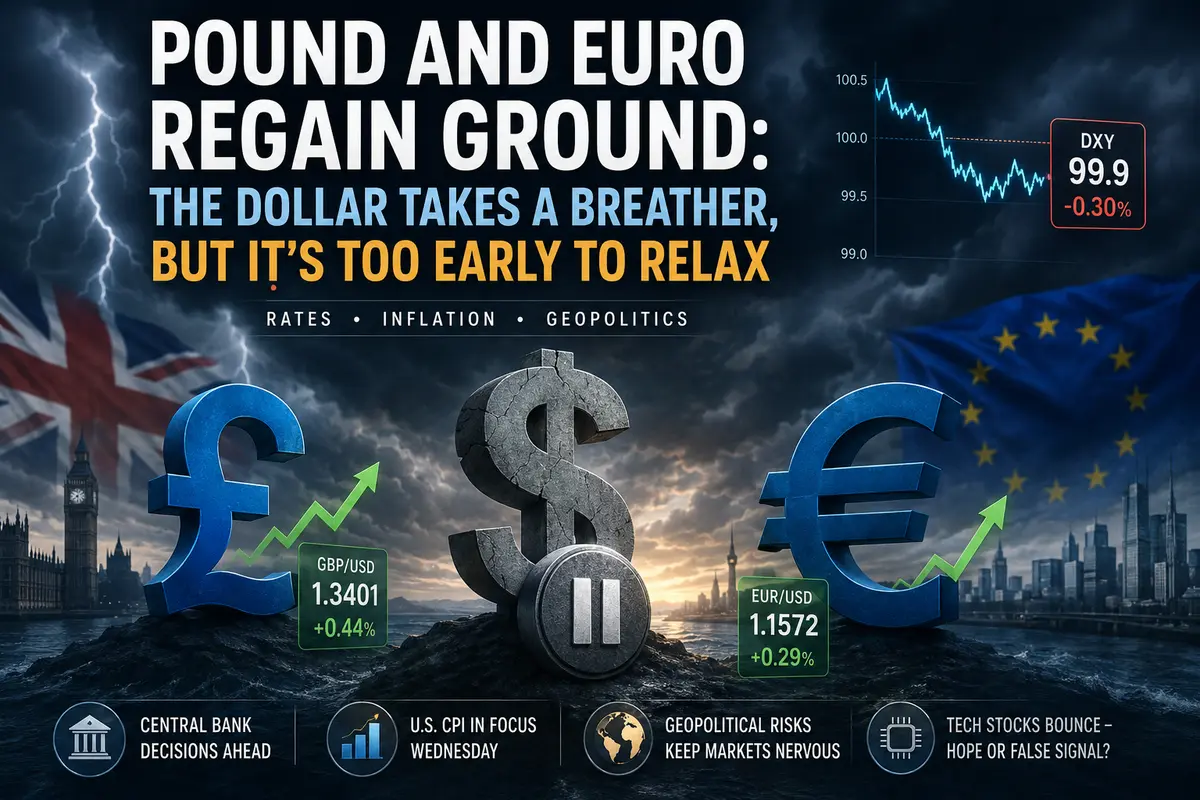
Sterling gained 0.44% against the dollar, reaching 1.3401. The euro added 0.29%, climbing to 1.1572. Both currencies recovered part of the losses suffered on Friday when the dollar strengthened to two-month highs. Yet no one is celebrating. This is not a victory—it is merely a pause.
The U.S. Dollar Index, which rose above 100.2 on Friday, retreated to 99.9 on Tuesday. Just 0.3% lower, but symbolically below the psychologically important 100 level. That number encapsulates the uncertainty of the current market environment. The dollar remains strong, but its rally has stalled. The euro and pound are trying to catch their breath, but every step higher remains difficult.
What is behind this calm?
First, the absence of fresh catalysts. Both the Federal Reserve and the European Central Bank have entered their pre-meeting blackout periods ahead of next week’s policy meetings. Policymakers are not giving speeches, granting interviews, or hinting at future actions. Markets are left alone with the data—and on Tuesday there was little data capable of changing the narrative.
Second, a partial rebound in technology stocks. South Korean chipmakers Samsung and SK Hynix, which plunged 8–10% on Monday, bounced back 5–11% on Tuesday. That helped calm investors’ nerves globally. Because the pound and euro are sensitive to global risk sentiment, the stabilization in equity markets gave them room to recover.
Third, surprisingly strong Chinese trade data. Exports rose 19.4% in May, while imports jumped 27.4%. This suggests the world’s second-largest economy may be showing signs of revival. For the euro and pound, both closely linked to China through trade channels, this is encouraging news.
Still, investors should not become complacent. The fundamental pressures weighing on European currencies have not disappeared. U.S. interest rates remain high and could rise further. The dollar continues to serve as the world’s primary safe haven amid ongoing tensions in the Middle East. Meanwhile, the eurozone and UK economies are hardly shining.
The Dollar Has Paused, Not Surrendered
The key story is not the rise in the pound and euro—it is the pause in the dollar’s advance. The DXY index, which reached a two-month high of 100.21 on Friday, slipped back below 100 on Tuesday. However, traders view this as a technical correction rather than a trend reversal.
Why did the dollar rally in the first place? The reasons remain intact.
Strong U.S. labor market data—172,000 new jobs created in May—reinforced the view that the Federal Reserve is in no hurry to cut rates. In fact, markets are now pricing roughly a 70% probability of a rate hike at the December meeting. Higher rates mean a stronger dollar, and that formula still works.
The dollar is also benefiting from an unexpected source: foreign central bank activity. Federal Reserve data show that foreign official holders have reduced their holdings of U.S. Treasury securities by another $71 billion since early May. This points to currency intervention across Asia. In simple terms, Asian central banks are selling Treasuries and buying dollars to support their own currencies. Demand for the dollar rises as a result.
Analysts at ING believe the 99.80 area on the Dollar Index could act as short-term support before another upward move later this week. In other words, the current weakness is viewed as a pause rather than a reversal. The dollar may simply be gathering strength for its next leg higher.
If that assessment proves correct, Tuesday’s gains in the pound and euro may be temporary. Once fresh U.S. inflation data are released on Wednesday, the dollar could reassert itself with renewed momentum.
Pound Sterling: Risk-Sensitive but Lacking Domestic Drivers
Sterling rose to 1.3401 on Tuesday. Yet the move was driven less by the strength of the UK economy and more by temporary dollar fatigue and improved sentiment in global equity markets.
The Bank of England is expected to remain on hold through the summer. Markets currently price only around 21 basis points of rate cuts by September. This means the interest-rate gap between the U.S. and the UK remains substantial. Rate differentials are one of the most important drivers of exchange rates. As long as U.S. rates remain higher, the dollar is likely to stay in demand.
The pound does have one advantage: its sensitivity to risk assets. Historically, sterling tends to rise when investors are willing to take risk and fall when they seek safety. Tuesday’s rebound in technology stocks therefore provided support.
However, that same sensitivity creates vulnerability. If Wednesday’s U.S. CPI data and Thursday’s producer price figures come in stronger than expected, risk appetite could quickly deteriorate. In that case, sterling may come under renewed pressure.
ING continues to target the 1.3300 area for GBP/USD this week, while a renewed dollar rally could bring 1.3200 into view. That suggests the current 1.3400 level may represent the top of the short-term range rather than the beginning of a new uptrend.
The Euro: Caught Between German Industry and ECB Policy
The euro climbed to 1.1572, yet it still appears uncertain. The single currency faces two major challenges: a weak eurozone economy and uncertainty surrounding the European Central Bank.
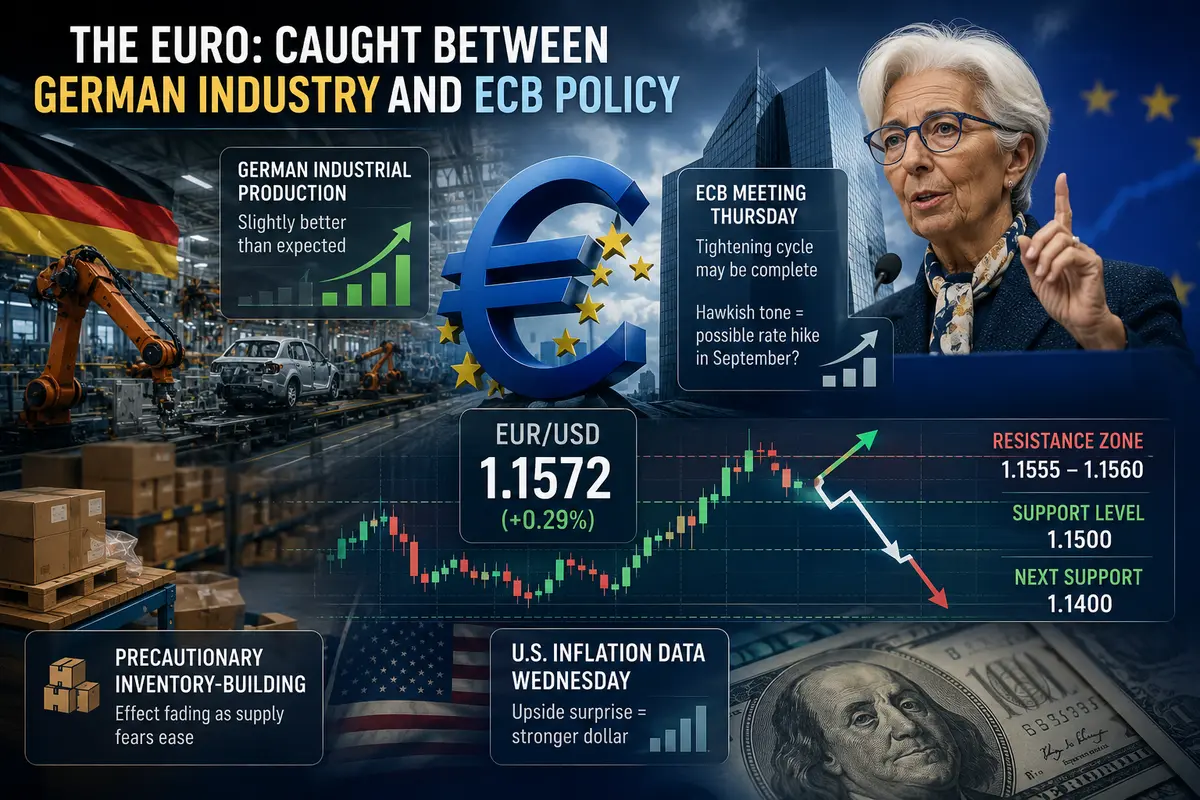
German industrial production data released Tuesday morning came in slightly better than expected. However, ING analysts caution against excessive optimism. Economic activity in the eurozone could weaken in the coming months as the effects of precautionary inventory-building fade. Companies stocked up on goods amid fears of supply disruptions linked to Middle East tensions. Once that effect dissipates, orders may decline.
The most important event for the euro this week is Thursday’s ECB meeting. It will be the first gathering since the central bank signaled that its tightening cycle may be complete. The key question is the tone of the communication.
If Christine Lagarde and her colleagues adopt a hawkish stance and hint at a possible additional rate increase in September, the euro could receive some short-term support.
However, before that story can develop, EUR/USD must first navigate Wednesday’s U.S. inflation report. If inflation surprises to the upside, the dollar could strengthen sharply, undermining any potential support from the ECB.
From a technical perspective, 1.1500 is now a crucial support level. A break below it would expose 1.1400 and lower. On the upside, the short-term range appears capped around 1.1555–1.1560, meaning the current level near 1.1572 is already close to resistance.
Rates, Inflation, and the Calm Before the Storm
The foreign-exchange market is currently driven by three factors:
-
Interest-rate expectations
-
Inflation
-
Safe-haven demand
Interest Rates
Markets have largely shifted toward a hawkish Federal Reserve outlook. A December rate hike is increasingly viewed as the base case. In contrast, the Bank of England and ECB are either easing policy or preparing to do so. The widening policy gap favors the dollar.
Inflation
All eyes are on Wednesday’s U.S. CPI report. Consensus forecasts point to a modest slowdown compared with April, though inflation is still expected to remain above the Fed’s 2% target.
If inflation matches expectations, the dollar is likely to remain supported. If inflation exceeds forecasts, the dollar could strengthen further. A downside surprise may trigger a correction, but it may not be a lasting one.
Flight to Safety
The Middle East remains the primary source of geopolitical anxiety. The ceasefire between Iran and Israel reached on Monday is holding for now, but signs of fragility are already visible.
As long as investors fear renewed escalation, they are likely to favor the dollar as the world’s premier safe-haven currency. The euro and pound are not safe havens; they are risk-sensitive currencies and could suffer accordingly.
Technology Stocks: A Fragile Source of Hope
The rebound in technology stocks deserves special attention because it helped support both the euro and the pound on Tuesday.
After the sharp selloff on Friday and Monday, when chipmakers lost 8–10% in a single session, investors saw an opportunity to buy at lower prices.
SK Hynix rose 10.6% on Tuesday after falling 8% the previous day. Samsung gained 5.4% after a 10.2% decline. The broader KOSPI index surged 8%, one of the strongest one-day moves in its history.
For currencies, this matters because the euro and pound often act as proxies for global risk sentiment. They tend to rise when investors feel confident and decline when fear dominates. The recovery in technology stocks may indicate that panic has peaked—but whether the rebound is durable remains to be seen.
Outlook for the Coming Days: CPI and the ECB
Two major events lie ahead:
-
Wednesday: U.S. Consumer Price Index (CPI)
-
Thursday: ECB meeting and U.S. Producer Price Index (PPI)
Scenario 1: Base Case (50% Probability)
U.S. inflation comes in broadly in line with expectations. The ECB adopts a neutral or slightly dovish tone. The dollar continues to strengthen, while GBP/USD tests 1.3300 and EUR/USD falls toward 1.1500 or lower.
Scenario 2: Bullish for the Euro and Pound (30% Probability)
U.S. inflation undershoots forecasts. Markets scale back expectations for Fed tightening. The dollar weakens. The ECB strikes a hawkish tone and hints at a possible September hike. GBP/USD advances toward 1.3500, while EUR/USD rises toward 1.1650.
Scenario 3: Bearish for the Euro and Pound (20% Probability)
U.S. inflation exceeds expectations. Markets become convinced that the Fed will raise rates in December. The dollar climbs to fresh highs. GBP/USD falls toward 1.3200 and EUR/USD toward 1.1400. The probability of this outcome is increasing as oil prices rise and geopolitical tensions intensify.
My assessment leans toward a combination of the first and third scenarios. U.S. inflation is unlikely to deliver a significant downside surprise. Elevated energy prices, a strong labor market, and resilient consumer demand continue to exert upward pressure on prices. If so, the dollar is likely to remain supported, while the pound and euro could revisit 1.3300 and 1.1500 before the end of the week—or even lower if CPI data come in particularly strong.
Bottom Line
The pound and euro rose on Tuesday, but the move resembles a drowning swimmer briefly breaking the surface for air. It does not mean the swimmer has been rescued. It simply means there is time for one more breath before the next wave arrives.
The dollar has paused, but its core drivers remain intact: higher interest rates, a stronger economy, and safe-haven demand. The recovery in technology stocks provided support for the pound and euro, but that support remains fragile and could disappear quickly.
Tomorrow’s U.S. inflation report could change everything.
For now, currency markets are frozen in anticipation. Traders have trimmed short positions in the pound and euro ahead of key events, unwilling to take excessive risks. But once the data arrive, a new battle will begin.
Until then, there is only silence—a calm, tense silence before the storm.
The Dollar Index remains below 100 but appears ready to move higher. Sterling is holding above 1.3400 while recognizing that the level may prove temporary. The euro is trying to cling to 1.1570, yet the ground beneath it feels increasingly unstable.
Tomorrow will bring more clarity. Today, we simply watch and wait.
Because in the foreign-exchange market, as in boxing, sometimes the best punch is the one you never throw.

Comments
No comments yet. Be the first to share your thoughts!
Authentication Required
You must be logged in to post a comment.