

Oil’s Powerful Surge: WTI Targets $89 as Brent Nears $97
Asian Trading Begins with Oil and Fire
23.07.2026 Thursday’s Asian trading session began with the oil market once again reminding everyone who is in charge. September WTI ... crude oil futures on the New York Mercantile Exchange climbed confidently to $88.56 per barrel, gaining nearly 2% during the session. This is more than just an increase—it is a serious breakout attempt, especially considering that prices were trading at significantly lower levels only recently. At the time the data was recorded, WTI was up 1.99%, and this was only the beginning of what promised to be a heated trading day.
The session high, which was not specified in the initial market report, may have already touched or even exceeded the psychologically important $89 level. However, the figures appearing on trading terminals represent more than just numbers. They reflect the fear, greed, and geopolitical turmoil that have gripped the world.
$Brent crude, the global oil benchmark, is keeping pace with its American counterpart. September Brent futures rose by 2.42%, reaching $96.35 per barrel. The spread between the two benchmarks widened to $7.79—a significant signal that the market is assessing supply risks differently across regions.
Meanwhile, the U.S. Dollar Index continued its gradual decline, falling by 0.14% to 100.81. This is also supporting oil prices. When the dollar weakens, commodities denominated in the U.S. currency become more affordable for buyers using other currencies. Demand increases, and prices move higher.
However, today’s main story is not the dollar. The real story is the Middle East—tankers, missiles, and relentless strikes that are reshaping the global landscape.
A Geopolitical Storm: When Oil Becomes a Weapon
To understand why oil prices are rising so confidently, we must once again look at the epicenter of global events: the Middle East.
The U.S. military has reportedly carried out strikes against Iranian targets for eleven consecutive nights. This is more than a demonstration of force—it is systematic pressure that is changing the balance of power across the region.
Iran, in turn, is not standing aside. Its proxy forces, including Yemen’s Houthis, have been threatening for weeks to completely block shipping through the Red Sea and the Bab el-Mandeb Strait. These are not merely verbal threats—they are carrying out attacks. Oil tankers traveling along this route are becoming targets, and this is no longer a theoretical risk. It is a reality.
As a result, the market is pricing in not only current disruptions but also the possibility of further escalation that could restrict supplies from the entire Persian Gulf. This region accounts for approximately 20% of the world’s oil supply.
When such a large volume of oil is placed under the threat of war, prices cannot remain unchanged. They are likely to continue rising until either the conflict is resolved or an alternative source of supply becomes available.
There is another side to the situation. The conflict in the Middle East is also disrupting air travel, increasing demand for maritime transportation and, consequently, marine fuel. Everything is interconnected, and every disruption influences another part of the global economy.
The world is becoming increasingly fragmented, and the oil market is finding itself at the center of this chaos.
Interestingly, Brent is showing stronger growth than WTI. The spread between the two benchmarks has widened to $7.79. This indicates that the market views the risks to European and Asian supplies as more severe than those facing the United States.
Brent is more sensitive to developments in the Middle East, and traders are prepared to pay a premium to secure their supplies. WTI, on the other hand, is geographically protected because it is produced in places such as Texas and North Dakota, far from the conflict zone.
Nevertheless, even WTI cannot ignore the global trend. The world is interconnected, and oil is a global commodity.
Technical Outlook: The Levels That Could Determine Everything
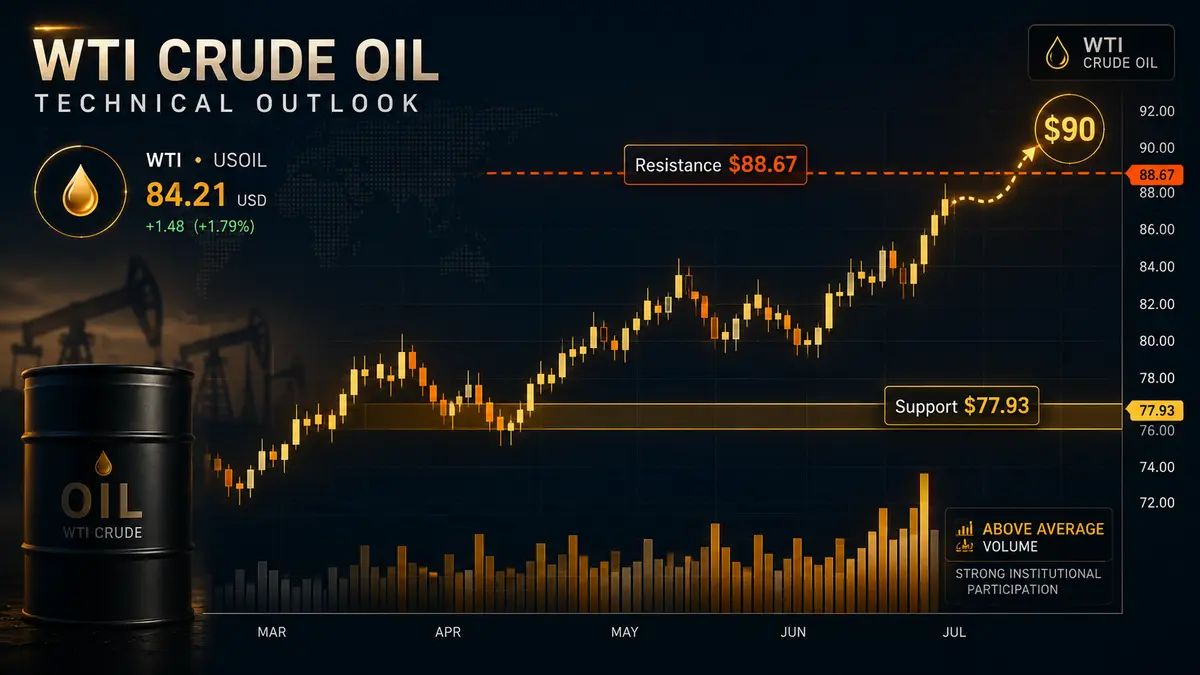
At the time of writing, WTI had established support at $77.93 per barrel. This is not a random figure. The market has tested this level several times in recent weeks, and each time it prevented prices from falling further.
Traders remember this level and are now placing stop orders slightly above it, preparing to enter new long positions in the event of a pullback.
Resistance is located at $88.67 per barrel. This is the peak that the market has not yet been able to overcome decisively. Should the price consolidate above this level, the path toward $90 could open.
The $90 level is psychologically important and could trigger a new wave of buying. Technical indicators currently suggest that the market is overbought, but during periods of geopolitical turbulence, technical analysis often takes a back seat.
Trading volumes are currently above average, indicating that major institutional players are entering the market. They are not merely speculating on the latest headlines. They appear to be building longer-term positions based on expectations of further price growth.
This makes the current trend more sustainable than an ordinary speculative rally.
Fundamental Factors: Supply and Demand
Oil prices are not rising solely because of the war. Several fundamental factors are also supporting the market.
First, demand remains strong. The summer season in the Northern Hemisphere is traditionally a period of peak fuel consumption. Americans travel, Europeans go on holiday, and Asian economies operate at full capacity. Air conditioners run continuously, factories remain active, and aircraft continue flying. All of this requires energy.
Second, U.S. crude oil inventories are falling more quickly than expected. Data from the American Petroleum Institute showed an unexpected decline in inventories, adding further momentum to the rally.
Traders saw evidence of an actual shortage in the market—not merely a potential one—and this pushed prices higher.
Third, OPEC+ continues to control production. Saudi Arabia and Russia, two of the alliance’s most important members, are maintaining discipline in complying with their production quotas.
They have no interest in causing the market to collapse, as they require high oil prices to balance their national budgets. Even if they have the technical capacity to increase production, they are unlikely to do so until prices rise further.
Finally, investment funds are increasing their long positions. After several weeks of uncertainty, they have identified a clear buying signal and have begun entering the market aggressively.
This is strengthening the upward momentum and making the rally increasingly self-sustaining.
What Comes Next: Possible Market Scenarios
The main question is how high oil prices could rise.
Should the conflict in the Middle East continue to escalate and regional supplies become restricted, oil could reach $100 per barrel within the coming weeks. This is not an unrealistic scenario. It is a genuine risk that some of the world’s largest investment banks are already incorporating into their models.
There is, however, an alternative scenario. Should signs of de-escalation emerge—such as ceasefire negotiations or a change in Iran’s position—prices could quickly correct lower.
The oil market is extremely sensitive to political news, and any positive development could trigger widespread profit-taking.
Nevertheless, considering the current momentum and the persistence with which the parties involved continue their military operations, the first scenario appears more likely. Prices could continue rising, and the Federal Reserve may be forced to take this development into account when making monetary policy decisions.
Inflation driven by expensive oil could encourage the Fed to keep interest rates elevated for longer than many market participants would prefer. This, in turn, would create additional risks for the global economy.
Conclusion: Oil as a Reflection of the World
The rise in oil prices during the Asian trading session is not merely a speculative story. It reflects genuine changes taking place around the world.
The global environment is becoming increasingly dangerous, and the resources that support modern life are becoming more expensive. We have grown accustomed to cheap energy, but that era may now be coming to an end.
Investors purchasing oil today are betting that elevated prices will remain with us for an extended period. They recognize that geopolitical risks are not disappearing, that OPEC+ has no intention of significantly increasing production, and that demand remains resilient.
This is not simply a short-term price impulse. It may represent a structural shift capable of redefining the global energy landscape for years to come.
WTI, Brent, and other commodities all reflect the nature of our time—a period in which the old rules no longer work and the new ones have yet to be written.
Amid this chaos, oil remains king, dominating the global stage regardless of whether we like it or not.
Watch the charts, follow the news, and remember: there are no quiet days in the oil market. Today’s rally is merely another episode in this endless drama.


Comments
No comments yet. Be the first to share your thoughts!
Authentication Required
You must be logged in to post a comment.