

Oil Roller Coaster: WTI Falls Again as Markets Speculate on an Iran Deal
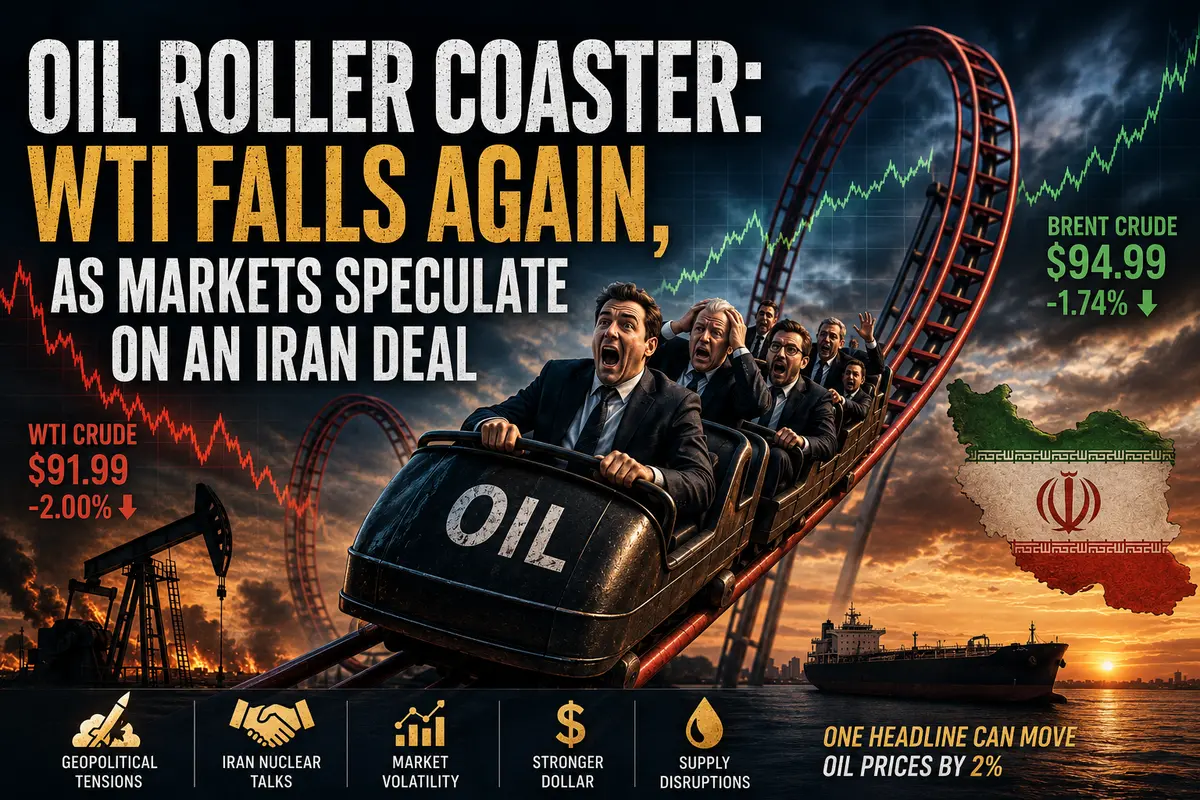
Wednesday’s Asian oil trading session opened in negative territory. July WTI futures dropped by as much as two percent, falling to $91.99 per barrel. Brent followed the U.S. benchmark lower, declining 1.74% to $94.99. After several days of nervous swings between fear and hope, the market appears ready to believe in a positive outcome again — at least for the duration of one Asian session. Yet this decline, much like the previous rally, lacks conviction. It resembles another turn on a roller coaster where every rise is followed by a drop, and every drop by another rise. And one man seems to be operating the ride — Donald Trump, whose statements about negotiations with Iran continue to keep oil traders in a state of permanent uncertainty.
Two Percent Down: Why Oil Is Falling Today
A two-percent drop in WTI during a single session is a move worth noticing. But to understand it, context matters. The day before, oil prices climbed on reports of U.S. strikes in southern Iran, which undermined hopes for a quick peace agreement. Today prices are falling. Why? Because despite the strikes, negotiations are still ongoing. Diplomats remain at the table. Trump says progress is being made. Iranian officials, while denying that a deal is close, have not walked away from talks. And the market, which panicked over bombs on Monday, is slowly regaining faith in diplomacy on Tuesday and Wednesday.
This is largely a psychological move. Fundamentally, nothing has changed. The Strait of Hormuz remains partially closed to normal shipping. Oil supplies from the region are still disrupted. Freight insurance premiums remain elevated. But the market is tired of being afraid. Traders are looking for any excuse to justify profit-taking after the previous rally, and continued negotiations provide exactly that excuse.
It is also important that the decline is happening on relatively low trading volumes. The Asian session is not the most liquid period for oil markets. Major players from London and New York have not entered the market yet. Once they do, the direction could easily change. For now, Asian traders left to themselves have chosen the downside.
Technical Picture: Caught Between Support and Resistance
The levels traders are watching paint a clear picture of a market trapped in a tightening range. Support at $90.93 held during today’s selloff. Prices bounced from that level, preventing bears from extending the decline. Resistance at $104.45 looms far above, reminding traders of the days when oil challenged triple-digit territory. The current drama is unfolding between these two extremes.
The three-dollar gap between Brent and WTI is another indicator worth watching. The spread has narrowed to exactly three dollars. At the height of the crisis, it reached seven to eight dollars. The shrinking spread suggests the market no longer sees a catastrophic difference in oil availability between regions. The geopolitical premium embedded in Brent — the global benchmark most sensitive to Middle Eastern supplies — is gradually evaporating. This does not mean the conflict is over. It means the market has adapted to the new reality and is no longer panicking.
The Dollar Is Rising Again: Pressure on Commodities
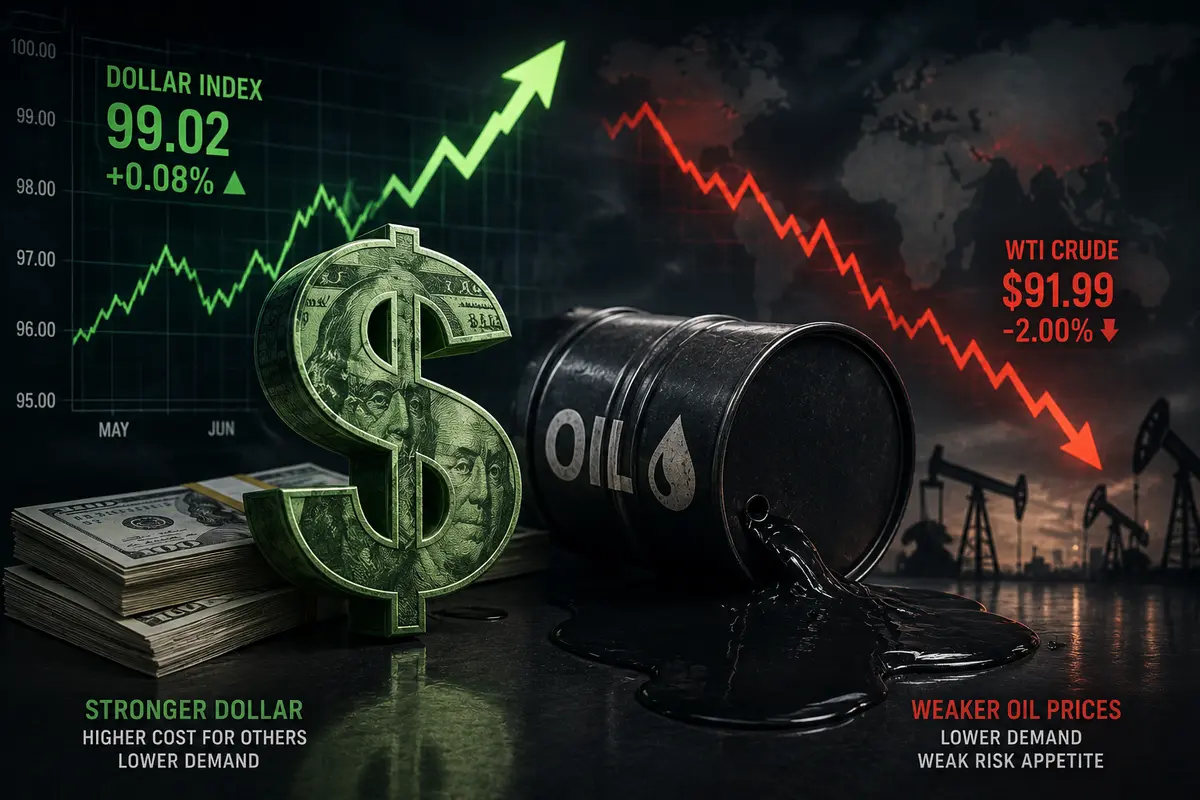
The U.S. dollar index edged up by 0.08% on Wednesday to 99.02. The move is modest, but the direction is telling. The dollar is once again attracting demand as a safe-haven asset amid ongoing geopolitical uncertainty. And a stronger dollar always creates additional pressure on oil prices. Oil is traded in dollars, and when the U.S. currency strengthens, a barrel becomes more expensive for holders of other currencies, reducing demand and pushing prices lower.
Still, the relationship is not mechanical. At different times, oil and the dollar can move together or in opposite directions. Right now, we are seeing the classic inverse correlation: the dollar rises while oil falls. This suggests that macroeconomic and geopolitical forces are dominating the market rather than oil-specific fundamentals. Traders are not trading supply and demand balances — they are trading overall risk appetite. And that appetite is currently weak.
Negotiations, Bombs, and Roller Coasters
The pattern of recent days has looked like this: news of progress in negotiations sends oil lower; news of strikes or failed talks sends oil higher. It may seem counterintuitive, but the logic is straightforward. Peace means the reopening of shipping lanes, restoration of supplies, and lower prices. War means continued shortages, elevated prices, and inflationary pressure.
The problem is that the headlines are contradictory and confusing. Over the weekend, Trump spoke about a memorandum that was “mostly agreed.” On Monday, U.S. forces struck Iranian targets. On Tuesday, negotiations resumed. On Wednesday, the market is once again hoping for peace. This sequence perfectly illustrates the nature of the current crisis. It is not linear — it pulses. And every pulse triggers a one-and-a-half to two percent swing in oil prices.
For traders, this is both an opportunity and a curse. An opportunity because volatility creates profit potential. A curse because predicting the next headline is impossible. This is no longer analysis — it is roulette. And many traders prefer to stay away from that roulette wheel, reducing positions and moving into cash.
The Global Balance: The Supply Deficit Has Not Disappeared
Despite all the focus on geopolitics, the fundamental picture should not be forgotten. And that picture is clear: the global oil market remains undersupplied. The Strait of Hormuz, through which a significant share of Middle Eastern oil flows, is still operating under restrictions. Alternative routes cannot fully compensate for the missing volumes. Inventories in developed economies are shrinking. Demand, especially from Asia, is recovering.
This means that even if a peace agreement were signed tomorrow, oil would not instantly collapse back to pre-crisis levels. It would take weeks, if not months, to restore normal shipping operations, bring insurance premiums back down, and refill depleted storage facilities. During that time, prices would remain higher than they were before the conflict. Brent falling below $100 is not a return to normality — it is merely a pullback from extreme levels.
So far, Wednesday has brought no major surprises to oil markets. WTI is hovering around $92, while Brent remains below $95. A month ago, such prices would have seemed catastrophically high; today they feel like a temporary relief rally. The market is waiting — for news from Doha, where negotiations continue; for U.S. inflation data due on Friday; for signals from the Federal Reserve. And while it waits, it continues to swing within a narrow range, frightened by every headline and encouraged by every hint of peace. The oil roller coaster continues — and for now, there is no end in sight.

Comments
No comments yet. Be the first to share your thoughts!
Authentication Required
You must be logged in to post a comment.