

Oil Crash and Exxon’s Decline: How Diplomacy Wiped Out the Geopolitical Premium in a Single Day
Monday Morning: An 8% Collapse and the Disappearance of the Geopolitical Premium
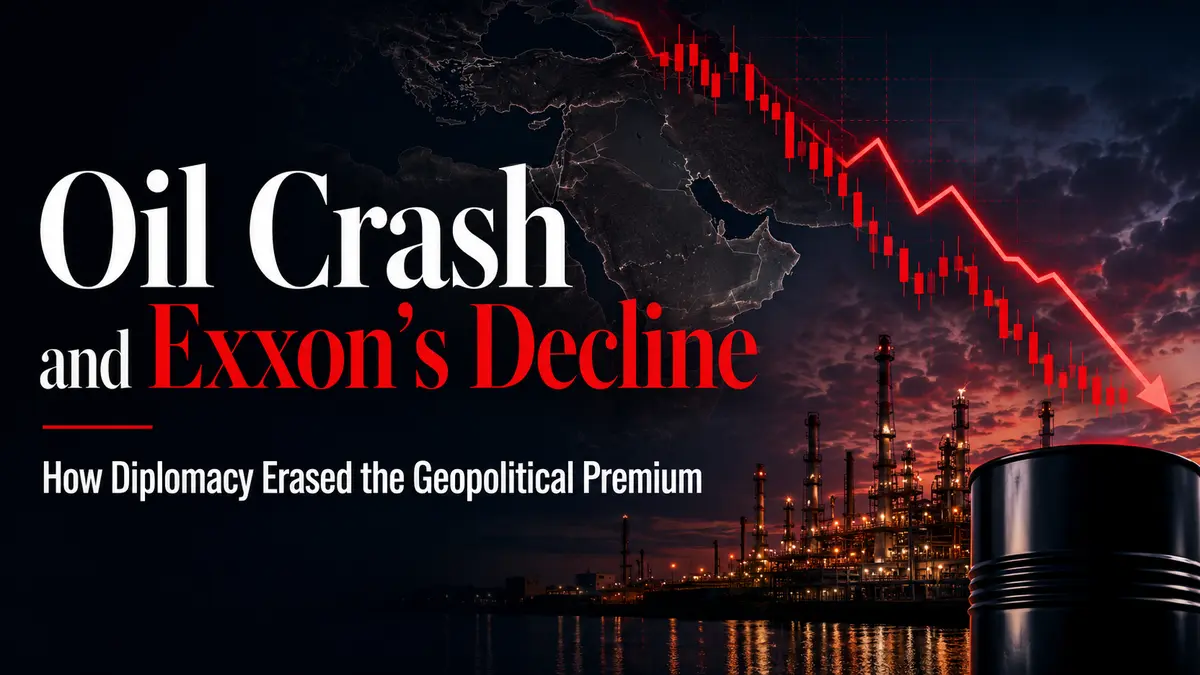
Monday morning began with a rude awakening for XOM ... shareholders. Shares of America’s largest oil company fell by nearly 3% in premarket trading, but this decline was only the tip of the iceberg. The main blow came from oil prices: Brent crude plunged by more than 8%, falling to approximately $90 per barrel. Within hours, the geopolitical premium that had driven oil prices up by more than 50% this year—and made Exxon Mobil shares some of the most attractive on the market—had evaporated.
The reason for this dramatic reversal was a series of weekend developments that fundamentally changed the geopolitical landscape. The United States and Iran, which had exchanged military strikes for the previous 13 nights, unexpectedly announced a suspension of hostilities. President Trump is reportedly open to resuming diplomatic negotiations, while Tehran has halted its retaliatory operations and is simultaneously holding talks through Oman on restoring shipping through the Strait of Hormuz. This turn of events was more than just another news headline—it destroyed the foundation supporting elevated oil prices.
The market reacted immediately. For months, the geopolitical premium had been the primary driver of rising oil prices. The conflict in the Middle East, the threat of a blockade of the Strait of Hormuz—through which approximately 20% of the world’s oil passes—and Houthi attacks on tankers had all been priced into each barrel. Once hopes for a diplomatic settlement emerged, that premium disappeared like morning mist. For Exxon Mobil, whose business model is directly dependent on commodity prices, this represented a serious blow.
Moment of Truth: Earnings Approach as Forecasts Begin to Shift
The decline in Exxon Mobil shares is particularly significant because it comes just ahead of the company’s quarterly earnings report, scheduled for July 31. Markets had expected strong results based on the elevated oil prices that prevailed throughout most of the second quarter. Exxon Mobil had previously indicated that higher liquids prices could increase quarterly upstream earnings by between $3.5 billion and $3.9 billion. Margins in the chemicals segment were also expected to improve. However, all these forecasts were based on market conditions that have now changed considerably.
Analysts, including experts from GJRTX ... and CITI.TO ... , had already established relatively cautious price targets of between $155 and $157 per share, leaving the stock with only a limited margin of safety in the event of a macroeconomic reversal of this scale. An 8% decline in oil prices in a single day makes these forecasts even more vulnerable. Investors are beginning to recalculate Exxon Mobil’s expected earnings, and those revisions are not working in the company’s favor.
If high oil prices were the primary driver of Exxon Mobil’s share-price growth this year, their decline could lead to a broader reassessment of the entire company. Considering that the stock has already traded within a wide 52-week range of $105.53 to $176.41, the current movement could mark the beginning of a deeper correction. All of this is occurring just as investors prepare for an earnings release that will now be evaluated against a significantly altered market environment.
An Industry-Wide Decline: Every Major Oil Company Is Feeling the Pressure
Exxon Mobil’s decline is not an isolated event. The entire oil sector is under pressure following the collapse in commodity prices. Competitors such as Chevron and BP are facing similar challenges. This is an industry-wide trend reflecting fundamental changes in supply-and-demand expectations.
Chevron, which is also heavily dependent on oil prices, is showing similar market dynamics. BP, the British energy giant with a greater focus on refining and retail operations, has not escaped the decline either. Investors holding shares in oil companies are now reassessing their portfolios and reallocating capital toward sectors that could benefit from lower energy prices.
The industry-wide nature of the sell-off emphasizes that Exxon Mobil’s problems are not related to internal factors but are instead the result of an external shock. The company has not made major management mistakes, nor has it encountered scandals or regulatory difficulties. It has simply found itself at the center of a geopolitical reversal that has changed the rules of the game for the entire industry. Under these circumstances, even strong fundamentals cannot fully protect the stock from falling.
The Broader Market: A Sharp Contrast Between Energy and Other Sectors
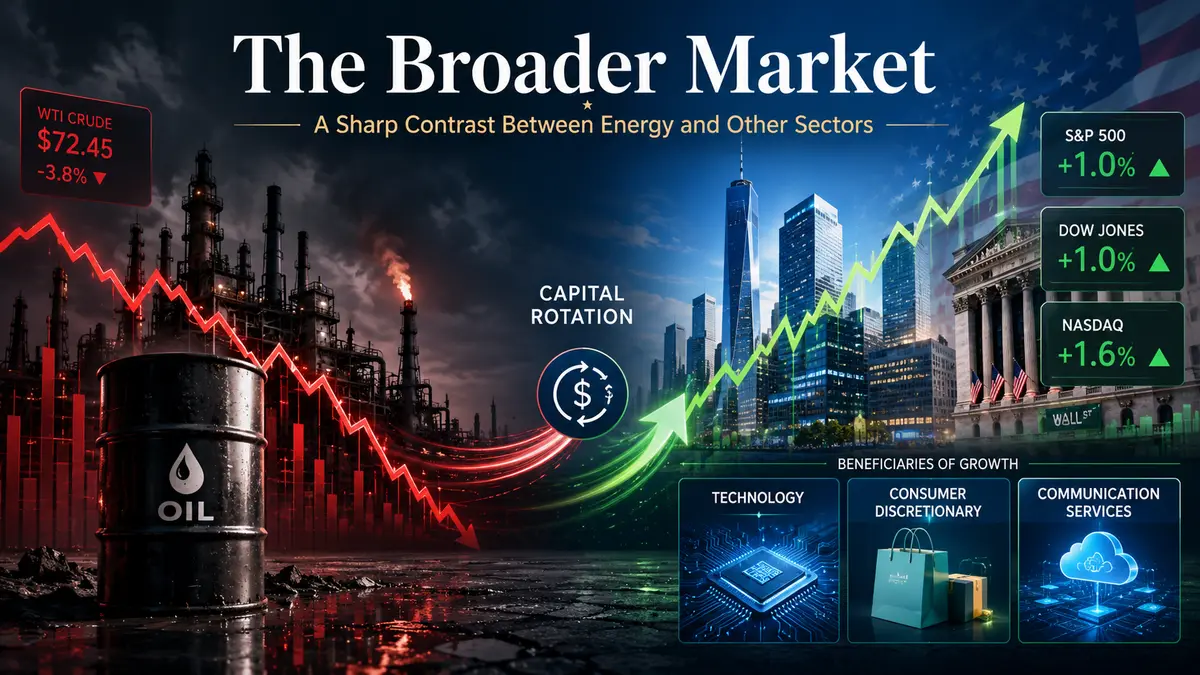
Interestingly, Exxon Mobil’s decline is occurring against the backdrop of a strong rally in the broader US stock market. The S&P 500 is gaining nearly 1.0%, the Dow Jones is rising by approximately 1.0%, and the Nasdaq is advancing by around 1.6%. As concerns about inflation driven by high oil prices begin to ease, investors are actively buying shares in consumer and technology companies.
This contrast reflects a direct flow of capital out of energy stocks and into other sectors. Lower oil prices reduce inflationary pressure, which is particularly important for consumer-oriented businesses that are heavily affected by energy costs. Cheaper gasoline leaves consumers with more disposable income, potentially supporting demand for goods and services.
The technology sector also benefits from cheaper oil. Lower inflation expectations could make the Federal Reserve more inclined to ease monetary policy. This would mean cheaper financing for technology companies, many of which rely on borrowed capital to fund research and development.
We are therefore witnessing a classic capital rotation: investors are leaving the energy sector, which benefited from high oil prices, and moving into industries that stand to gain from lower energy costs. Exxon Mobil has become one of the principal losers in this reallocation.
Risk Assessment: What Lies Ahead for Exxon Mobil in the Coming Days and Weeks
The current decline in Exxon Mobil shares raises an important question: is this merely a short-term correction, or is it the beginning of a longer-term downward trend? The answer depends on several factors, including future geopolitical developments, Federal Reserve decisions, and the release of the company’s quarterly financial results.
If the ceasefire between the United States and Iran proves durable and negotiations concerning the Strait of Hormuz are successful, oil prices could remain at lower levels. In that case, Exxon Mobil would face significant challenges because its profitability is directly linked to elevated commodity prices.
However, if the conflict resumes or new geopolitical risks emerge, oil prices could recover quickly, allowing Exxon Mobil shares to regain lost ground. The market is currently operating under conditions of extreme uncertainty, and movements in either direction could be sharp and unpredictable.
Investors are also eagerly awaiting Exxon Mobil’s quarterly earnings report. If the company delivers strong results despite the decline in oil prices at the end of the quarter, the report could provide support for the stock. However, if the results disappoint, the decline may continue.
Analysts, including experts from Goldman Sachs and Citi, have already lowered their price targets to between $155 and $157, leaving limited upside potential even after the correction. This suggests that many investors may already be pricing in a deterioration in the company’s fundamental performance.
Conclusion: The Decline as a Reminder of the Oil Market’s Fragility
The fall in Exxon Mobil shares amid collapsing oil prices is a powerful reminder of just how fragile the oil market can be. Geopolitical developments that may initially appear distant from the financial world can instantly transform market conditions and destroy forecasts that took months to construct.
As one of the world’s largest oil companies, Exxon Mobil has found itself at the center of this storm. Its shares, which had been among the market’s strongest performers this year, are now facing substantial pressure. Although the company continues to possess strong fundamentals, the current situation demonstrates that even the best businesses are not protected from external shocks.
Investors who hold Exxon Mobil shares or are considering purchasing them should be prepared for elevated volatility. The coming days and weeks will be decisive. Whether Exxon Mobil can recover or continues to decline will depend on geopolitical developments, Federal Reserve decisions, and the company’s quarterly financial results.
One thing is certain: the oil market and the shares of energy companies will remain among the most volatile and unpredictable areas of the financial markets for the foreseeable future. Anyone seeking to navigate this environment successfully must be prepared for every possible turn.




Comments
No comments yet. Be the first to share your thoughts!
Authentication Required
You must be logged in to post a comment.