

Gold in a Trap: Caught Between the Iranian Crisis and Suffocating Interest Rates
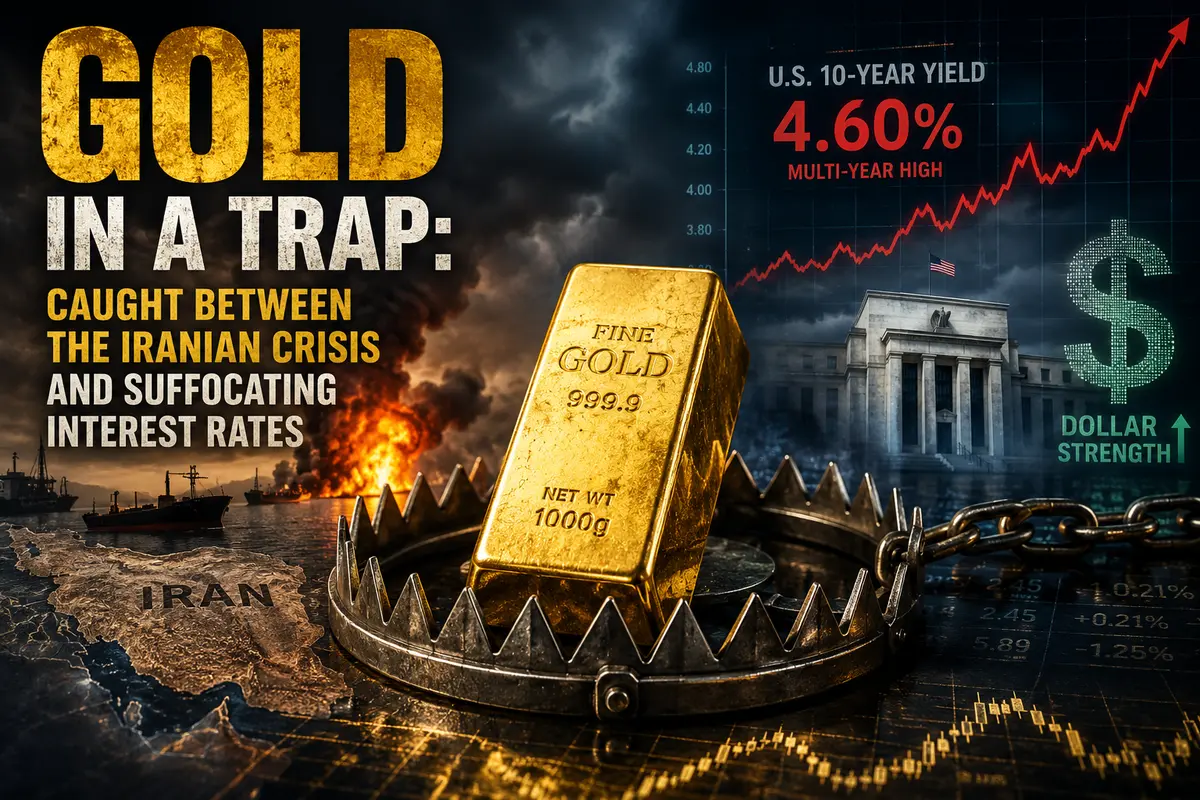
Gold has frozen. It’s a strange, almost unnatural state for an asset that for centuries symbolized movement — either a panicked flight to safety or a violent collapse driven by profit-taking. But Wednesday’s Asian session showed a market that seemed paralyzed. Spot gold hovered around $4,488 per ounce, futures near $4,490 — neither rising nor falling, but holding its breath. Gold, which by all logic should be soaring amid a war disrupting oil supplies and fueling geopolitical chaos, instead lingers near its lowest levels since early April. And within this paradox lies perhaps the most important story of today’s financial world — the story of how timeless truths stop working when monetary policy and inflation fears enter a deadly collision.
Why War Hasn’t Sent Gold Prices Soaring
To understand the drama surrounding the yellow metal, one must rewind the tape and remember how gold behaved during previous geopolitical crises. Escalation in the Middle East, the closure of the Strait of Hormuz, warships facing each other at close range — any one of these headlines would once have triggered a massive gold rally. Investors would have rushed into bars and coins, driving prices toward historic highs. But now, when President Trump and Vice President Vance report progress in peace negotiations and gold barely reacts, it becomes clear: the market no longer dances to the tune of geopolitics the way it once did.
The reason is that the current conflict with Iran is not just a war — it is a war that generates inflation. And inflation, once an old friend of gold, has returned wearing a more dangerous face. Traditionally, rising prices benefited gold because people bought it to protect themselves against the erosion of paper currencies. But today’s inflation is not the result of loose monetary policy. It is a supply shock. Oil prices are rising not because central banks printed too much money, but because tankers physically cannot pass through combat zones. This is cost-push inflation — crude, primitive, and brutal. And the central banks’ response is equally crude and brutal: higher interest rates. And higher rates kill gold.
Opportunity Cost: The Invisible Killer of Precious Metals
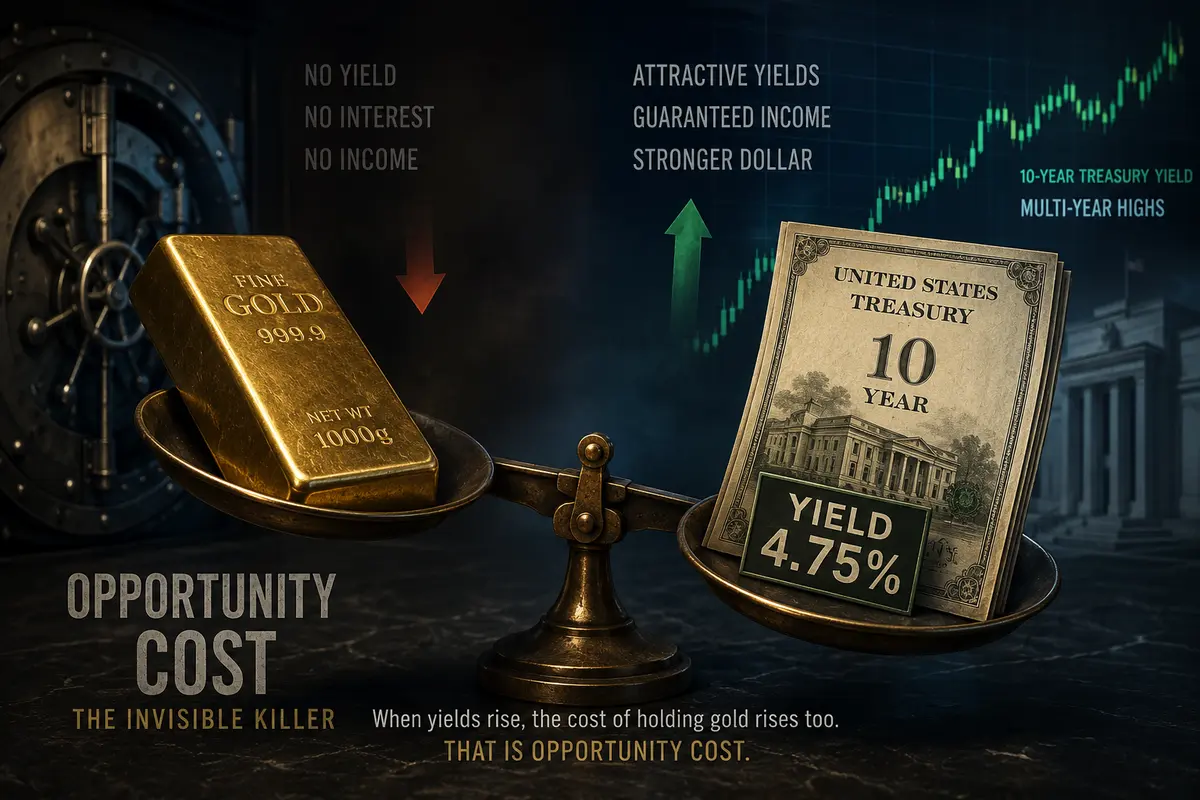
Here lies the mechanism most devastating to gold bulls. Gold generates no yield. It pays no interest, no dividends, no coupons. It is simply a piece of metal sitting in a vault, waiting for its moment. When interest rates are near zero, that hardly matters. Holding gold carries little cost because the alternatives — bonds or deposits — yield almost nothing either. But when U.S. Treasury yields surge to multi-year highs, as they have over the past two weeks, the equation changes dramatically.
An investor reviewing a portfolio looks at gold and sees an asset that produces no income whatsoever. Then the same investor looks at ten-year Treasuries and sees yields that finally appear attractive after years of stagnation. The choice suddenly seems obvious. Why hold a barren metal when guaranteed dollar-denominated income is available — especially in a currency that is strengthening on its own? This is what economists call opportunity cost. And when central banks around the world signal their willingness to keep rates elevated — or even raise them further — gold falls into a long-term structural trap.
The massive selloff in global bond markets, which eased somewhat this week but left yields near multi-year highs, became a disaster for gold. Bonds, which traditionally compete with gold for conservative capital, suddenly began offering real, tangible returns. Money flowed toward them, leaving gold deprived of its usual inflows.
The Suffocating Dollar and a Broken Compass
Another nail in the coffin of the gold rally has been the continued strengthening of the U.S. dollar. The dollar index, which advanced this week, has weighed heavily on the broader metals market. The relationship is direct and almost physical: gold is priced in dollars, and when the dollar rises, gold becomes more expensive for holders of other currencies. An investor holding rupees, yuan, or yen must spend more of their weakening currency to buy the same ounce of gold. Demand falls — and so does price.
But even the dollar is not the main villain in this story. Gold’s biggest problem today is its loss of direction. It no longer knows what to respond to. Geopolitics screams “buy,” while monetary policy screams “sell.” Inflation fears say “gold is protection,” but rising rates say “bonds are better protection.” In this cacophony, gold has frozen, having lost its traditional compass.
The statements by Trump and Vance about progress in negotiations with Iran — remarks that under different circumstances could have crushed prices by reducing the geopolitical risk premium — now pass almost unnoticed. The market simply does not believe negotiations will quickly restore oil supplies. At the same time, it does not believe inflation will retreat on its own without aggressive central bank action.
Silver and Platinum: Sparks of Life in the Ashes
Against this backdrop of golden lethargy, other precious metals have shown faint signs of life. Silver gained three-tenths of a percent, climbing to nearly $74 per ounce. Platinum remained steady around $1,925. These are modest moves, but they stand out against the broader paralysis.
Unlike gold, silver has a dual nature. It is not only a precious metal but also an industrial one, meaning its price can receive support from factors unrelated to monetary policy — such as demand from solar panel manufacturers or electronics producers. Platinum, meanwhile, traditionally correlates with the automotive sector, and any news about recovering industrial production can move its price independently of interest rates.
Yet even these sparks are insufficient to ignite a true rally across precious metals. The headwinds from the dollar and bond yields remain overwhelming. Investors who once viewed gold as a safe harbor are now discovering that the harbor itself has been flooded by a monetary tsunami. Capital is flowing into cash, short-term bonds, and anything else capable of generating yield immediately rather than at some uncertain point in the future.
Gold is stuck in a range — and it may remain there for a long time. As long as central banks keep interest rates elevated, as long as bond yields compete aggressively with precious metals for investor attention, and as long as the dollar strengthens on expectations of tighter Federal Reserve policy, gold will struggle to attract buyers. Geopolitical flare-ups may trigger short-term rallies, but the fundamental picture remains bleak.
Gold is waiting for its moment. But that moment will come only when central banks begin easing policy and bond yields start to decline. Until then, the yellow metal will remain hostage to interest rates, helplessly watching the world burn in an oil-fueled fire while investors walk past, choosing paper yields over eternal shine.

Comments
No comments yet. Be the first to share your thoughts!
Authentication Required
You must be logged in to post a comment.