

Gold Climbs Back Above $4,000 as Geopolitical and Inflation Risks Push Prices Higher
Monday: The Precious Metal Returns to the Spotlight
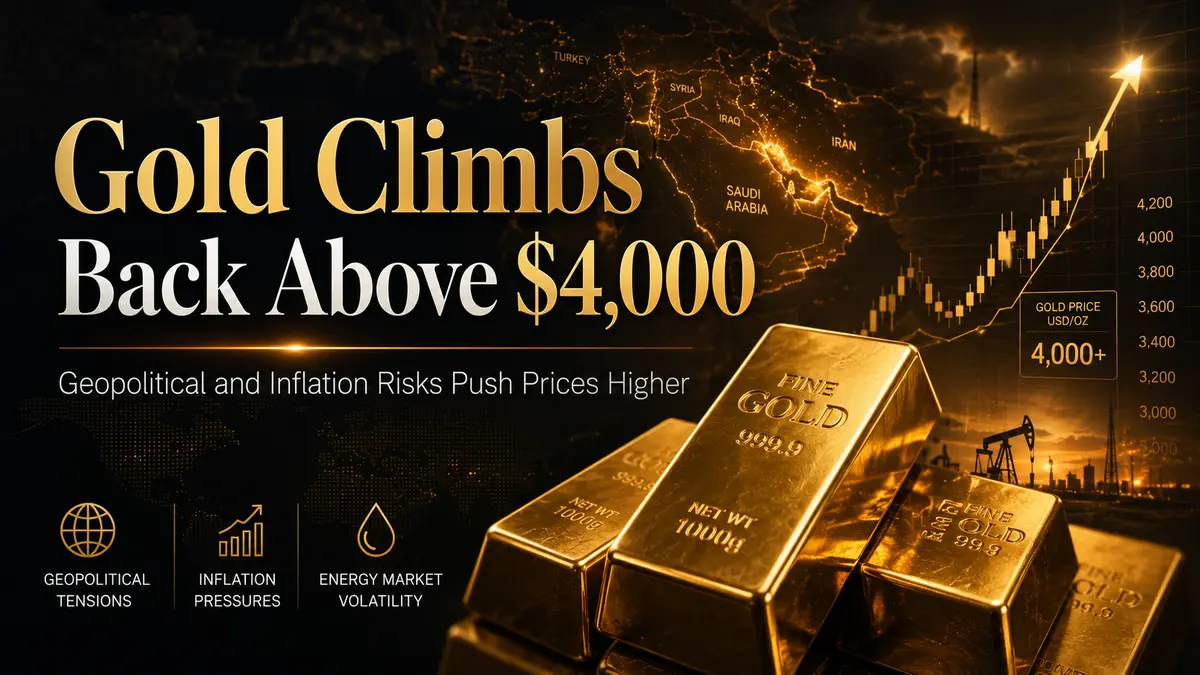
XAUUSD ... Gold began the new trading week with solid gains. Prices of the precious metal climbed back above the psychologically important level of $4,000 per ounce, rising by 0.4% to $4,024.72. Gold futures performed even more strongly, gaining 0.5% to reach $4,029.87.
The recovery came after gold closed 0.2% lower on the previous Friday. The market has once again shifted its attention to geopolitical risks, which remain the main driving force behind demand for safe-haven assets. The conflict in the Middle East continues to escalate, prompting investors to seek protection in gold.
Silver also advanced, with XAGUSD ... rising by 0.9% to $56.93 per ounce. Platinum, however, declined by 0.2% to $1,594.30. This mixed performance suggests that investors are choosing gold as the most reliable safe-haven asset amid geopolitical uncertainty.
The Middle East: Escalation and Signs of Diplomacy
The situation in the Middle East remains tense. The United States continues to carry out strikes on Iranian targets, while President Donald Trump warned Tehran that it would “pay” for the deaths of three American service members in recent days. This tough statement leaves little doubt that Washington has no intention of backing down.
Regional uncertainty has been intensified by a threat from Yemen’s Iran-backed Houthi movement to impose a naval blockade on Saudi Arabia. This poses a serious risk to shipping in the Red Sea, one of the world’s key routes for energy supplies. In response, the Saudi-led military coalition has strengthened measures to protect maritime traffic.
However, there are also signs of hope for a diplomatic resolution. Iran said that mediators were discussing proposals aimed at de-escalating the conflict. Reuters reported on a proposed 10-day suspension of strikes, easing concerns about an immediate escalation. Markets breathed a sigh of relief, although only cautiously. The conflict has already continued for five months, and any ceasefire could prove temporary.
For gold, this situation provides an ideal backdrop. Geopolitical risks support demand for safe-haven assets, while the possibility of a diplomatic settlement prevents prices from surging uncontrollably without allowing them to fall significantly.
Inflation Risks: Expensive Oil Complicates the Fed’s Position
The conflict in the Middle East continues to drive up the prices of energy products and other commodities. This creates a difficult dilemma for investors. On the one hand, rising oil prices support gold as a hedge against inflation. On the other hand, they may force the Federal Reserve to tighten monetary policy, which usually puts pressure on gold.
The Federal Reserve is widely expected to leave interest rates unchanged at its meeting next week. However, investors will closely monitor the central bank’s comments for indications of how rising energy prices could affect its inflation outlook.
Swap markets are still pricing in at least one interest-rate increase before the end of the year. This is happening even though the latest US economic data points to slowing growth. Should inflation accelerate because of higher oil prices, the Fed may be forced to act more aggressively, which would represent a serious headwind for gold.
For now, gold is successfully balancing these conflicting forces. Geopolitical risks are supporting prices, while expectations of tighter monetary policy are limiting further gains. Volatility, however, is likely to persist.
Expert Forecasts: A More Challenging Environment for Gold
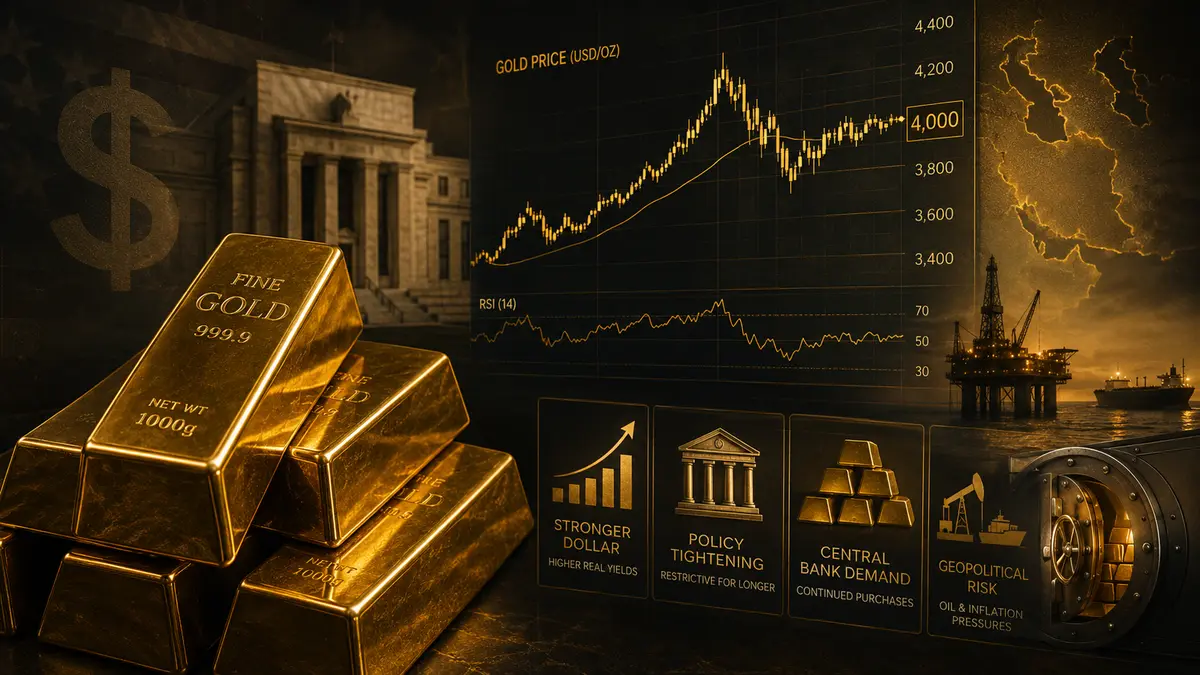
Afdal Rahman, Executive Director of Wealth Management at OCBC, offered a balanced outlook for gold. According to him, the precious metal’s strong rally is now facing a more challenging macroeconomic environment. Rising real yields, a stronger US dollar and increasingly hawkish interest-rate expectations are weighing on investor demand.
He noted that renewed tensions in the Persian Gulf could keep oil prices, inflation expectations and the US dollar volatile in the short term. This is likely to maintain pressure on gold until expectations of tighter monetary policy begin to weaken.
However, there is also a positive factor. Continued purchases by central banks should provide long-term support for the precious metal. Central banks in many countries, particularly in Asia, continue to increase their gold reserves as they diversify their assets and reduce their dependence on the US dollar.
In recent weeks, gold has traded within a relatively narrow range near $4,000 per ounce. This follows a 14% decline in the second quarter, its worst quarterly performance since 2013. The recovery has so far been slow but steady.
What Comes Next?
Gold remains one of the most popular safe-haven assets in an environment of geopolitical uncertainty. The conflict in the Middle East continues, and investors are looking for reliable ways to preserve their capital. At the same time, they must take inflation risks and possible Federal Reserve actions into account.
The short-term outlook for gold will depend on several key factors. The first is the development of the conflict in the Middle East. Should the escalation continue, gold may extend its gains. However, if a genuine prospect of a ceasefire emerges, prices could experience a downward correction.
The second factor is inflation data and comments from the Federal Reserve. If the regulator signals that further monetary tightening is possible, gold could come under pressure. If the Fed maintains a cautious tone, prices may remain near their current levels.
The third factor is central-bank purchasing. This continues to provide important long-term support for gold, regardless of short-term price fluctuations.
For now, gold is holding firmly above $4,000, which is already a significant achievement. In a world where uncertainty has become the new normal, the precious metal continues to perform its historic role of preserving value during difficult times. Demand for gold is therefore likely to remain strong for the foreseeable future.

Comments
No comments yet. Be the first to share your thoughts!
Authentication Required
You must be logged in to post a comment.