

Gas Cools Down, Oil Swings Wildly: What Is Happening in the Energy Market on Friday

Friday Morning: Gas Prices Fall as Investors Search for an Explanation
Friday’s European trading session began with what many analysts described as an “expected correction” in the natural gas market. August natural gas futures on the New York Mercantile Exchange fell to $2.88 per million British thermal units, losing 1.06% during the session. The decline may appear relatively modest, but at a time when geopolitical tensions are reaching new heights and oil has recently continued its rally, even such a correction raises numerous questions.
At the time the data was recorded, natural gas had found support at $2.831, while resistance was located at $2.951. This relatively narrow range indicates uncertainty and indecision among market participants.
Why is natural gas becoming cheaper while oil continues to demonstrate impressive growth? The answer lies in several key factors that are affecting the energy market simultaneously but influencing its individual segments in different ways.
First, it is important to understand that natural gas is not oil. It has its own price dynamics, market drivers, and trading seasons. While oil is currently reacting to a geopolitical shock caused by developments in the Middle East, natural gas is more dependent on storage levels, weather conditions, and current industrial demand.
In addition, profit-taking is currently taking place in the natural gas market. Gas prices had risen over the previous several weeks, prompting many traders to lock in their gains, which resulted in a modest price decline. This is a classic market movement that is not necessarily linked to any direct change in fundamental conditions.
Despite the decline, however, the broader trend remains positive, and many analysts expect natural gas prices to continue rising over the coming months.
Natural Gas: Support and Resistance Levels
The technical levels currently being monitored by traders are more than just numbers. The support level at $2.831 represents an important psychological threshold. If the price remains above this level, the market is likely to stay within its broader upward trend. However, if natural gas breaks below this support, a deeper correction toward $2.70 could follow.
Resistance at $2.951 represents the ceiling that natural gas has attempted, but failed, to overcome in recent days. For the upward movement to continue, the price must consolidate above this level, which could open the way toward new highs.
For now, the market continues to fluctuate as investors wait for new signals, including US storage data, weather forecasts for the coming weeks, and news from Europe, where demand for natural gas is traditionally high.
Trading volumes are currently moderate, indicating that major institutional investors are in no hurry to open new positions. They prefer to wait for clearer signals before placing significant bets. Given the high volatility that could emerge at any moment, this appears to be a reasonable approach.
WTI Crude Oil: A Sharp 3.42% Decline
The biggest surprise on Friday came from the oil market. September WTI ... crude oil futures plunged by 3.42%, falling to $89.04 per barrel.
The decline, which occurred against the backdrop of a generally weaker US dollar, looks particularly dramatic following the recent oil rally. What caused such a sharp drop?
As is often the case, the explanation is complex.
First, traders began taking profits. Oil prices had risen for several consecutive weeks, climbing above $95 per barrel, and many market participants decided to secure their gains in anticipation of a correction.
Second, unofficial reports emerged suggesting that the conflict in the Middle East could begin to ease. Although negotiations over a ceasefire between Israel and Hamas remain far from completion, they have created some hope of de-escalation. This has reduced the geopolitical risk premium built into oil prices.
Third, US crude oil inventory data showed a small increase, disappointing investors who had expected stockpiles to decline. This also placed downward pressure on prices.
Despite Friday’s decline, however, the underlying fundamentals remain relatively strong. Global oil demand continues to grow, while supply remains constrained, particularly amid persistent geopolitical uncertainty.
The decline in crude oil prices also affected other energy commodities, including heating oil, which fell by 3.08% to $4.21 per gallon. This once again demonstrates how closely interconnected energy markets are: a decline in one commodity can quickly pull others lower.
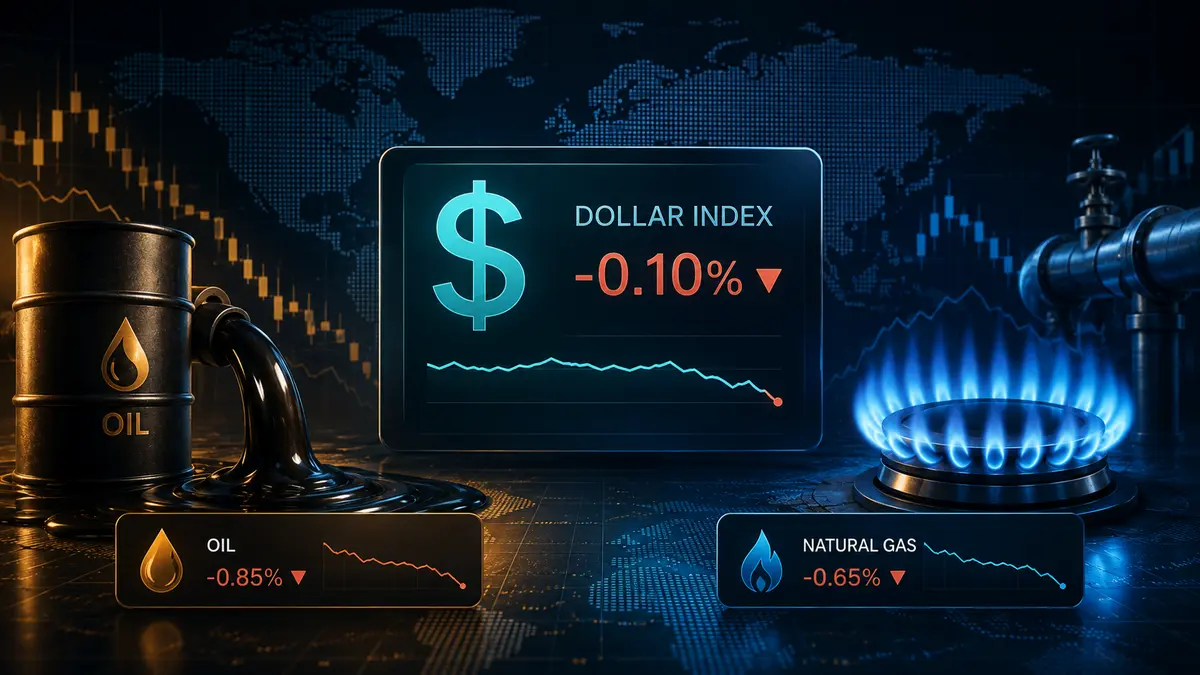
The US Dollar: A Slight Weakening
The US Dollar Index, which measures the value of the US currency against a basket of six major currencies, declined by 0.10% to 101.18. This was a relatively small but still meaningful movement.
When the dollar weakens, it usually supports commodity prices, including oil and natural gas. However, this relationship did not fully operate during Friday’s session. Both oil and gas declined despite the weaker dollar.
This suggests that internal market factors were more influential than external currency movements. Investors focused primarily on profit-taking and reports of a possible ceasefire in the Middle East rather than on fluctuations in the US dollar.
Nevertheless, the weakening dollar remains an important signal. If this trend continues, it could support energy prices over the coming weeks. For this to happen, however, fundamental factors such as supply and demand must also remain favourable for further growth.
What to Expect from Energy Markets in the Coming Days
The next several days are likely to be eventful. Investors will closely monitor weekly US natural gas storage data. If inventories come in below expectations, this could trigger another upward movement in prices.
Weather forecasts will also play an important role. A hot summer in the United States typically increases demand for natural gas used to generate electricity for air conditioning, which could provide additional support for prices.
For the oil market, geopolitics remains the most important factor. If tensions in the Middle East escalate, oil prices could begin rising again. Conversely, if genuine progress is made in ceasefire negotiations, crude oil may continue its downward correction.
Given the high level of uncertainty, many analysts recommend remaining cautious and avoiding impulsive decisions.
Central bank meetings should also be closely monitored. The US Federal Reserve continues to pursue a restrictive monetary policy, which supports the dollar. If the Fed signals that interest-rate cuts may be approaching, the dollar could weaken, providing support for commodity markets.
Conclusion: A Correction or the Beginning of a New Trend?
The decline in natural gas and crude oil futures on Friday can be interpreted in different ways.
On the one hand, it may simply represent a technical correction following an extended rally. On the other hand, it could mark the beginning of a deeper downturn if geopolitical risks continue to decline.
However, given the current geopolitical environment and persistently strong demand for energy, the first scenario appears more likely. The markets may simply have paused to reassess existing risks, with prices potentially recovering over the coming days.
Investors should be prepared for elevated volatility and avoid making decisions based on emotion. Energy markets have always been unpredictable, and the current situation is no exception.
It is essential to analyse fundamental factors, follow the latest developments, and remember that periods of calm in financial markets rarely last for long. Friday’s correction is simply a reminder that even during the hottest periods, the energy market can suddenly cool down.


Comments
No comments yet. Be the first to share your thoughts!
Authentication Required
You must be logged in to post a comment.