
Bar Pipa
We pay for a post of 10$

ETF

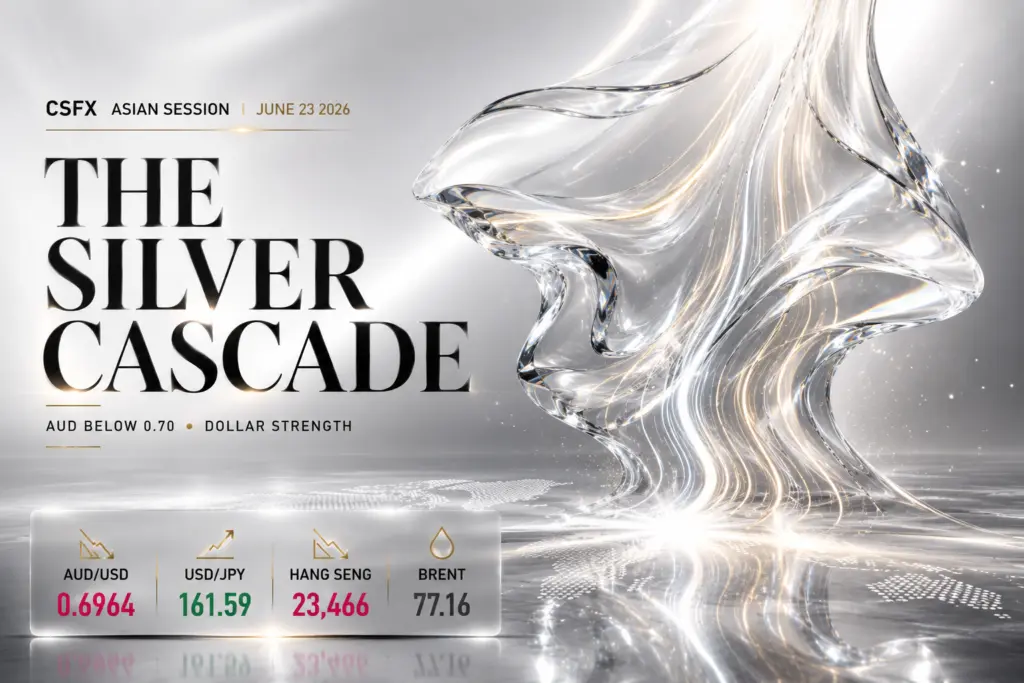
ASIAN SESSION · TUESDAY 23 JUNE 2026 AUD/USD Just Broke Below 0.70. The Hang Seng Is Down 1.68%. And Iran-US Talks in Switzerland Are Showing Encouraging Progress
ASIAN SESSION · TUESDAY 23 JUNE 2026 AUD/USD Just Broke Below 0.70. The Hang Seng Is Down 1.68%. And Iran-US Talks in Switzerland Are Showing Encouraging Progress

Three things happening simultaneously in Tuesday’s session: AUD/USD has broken a floor it hasn’t tested since the March conflict lows. The Hang Seng is sliding on China-specific headwinds that the Iran diplomacy story can’t rescue. And USD/JPY at 161.59 is sitting at a 1986-era high with Tokyo’s intervention rhetoric getting louder by the day. Thursday’s US Core PCE ties all of it together.

Tuesday's Asian session opens in the immediate aftermath of the first high-level US-Iran diplomatic exchange in Switzerland, where Qatar and Pakistan mediators reported “encouraging progress” on Monday before lower-level technical talks began today. That language is doing what diplomacy-adjacent language always does to markets: Brent has slid 1.4% to $77.16, continuing its gradual unwind from conflict-era highs above $100. Copper is firm at $6.31 per pound on the theory that a world moving away from war has more appetite for the industrial metals that build things. And the broader risk picture is split in exactly the way this kind of session usually is — good news on one front, bad news on another, and a dollar that doesn't care about either.

The AUD/USD break below 0.7000 to 0.6964 is the session's dominant story. That number is the pair's lowest since the conflict-era energy shock in March. The mechanism is a dual squeeze: a DXY near 100.93 — a 13-month high — as markets price roughly 40 basis points of additional Fed tightening by year-end, up from 20 basis points a week ago; and softer risk appetite from the Hang Seng's 1.68% decline and China demand uncertainty, which weighs on Australia's commodity-export story. The forward look matters: ANZ is projecting Australian underlying CPI to edge higher in May and unemployment to fall to 4.4%, both due later this week. Those numbers will directly shape RBA expectations ahead of...


Continue reading...
0
0

US MARKETS WEEKLY · 22–26 JUNE 2026 Warsh Delivered His Message. Now Iran Has Collapsed the Peace Talks. Thursday’s Core PCE Is the Week’s Verdict

US MARKETS WEEKLY · 22–26 JUNE 2026 Warsh Delivered His Message. Now Iran Has Collapsed the Peace Talks. Thursday’s Core PCE Is the Week’s Verdict

USD/CAD just broke its 52-week high. USD/CHF has flipped to a Strong Buy. The 10Y yield is at 4.46%. Gold is fighting a stronger dollar while Iran talks have collapsed and the Strait of Hormuz risk premium is live again. And Thursday's Core PCE either validates Warsh's hawkish hold — or begins to unwind it.

Markets expected Kevin Warsh to be Trump's concession to looser policy. What arrived instead was a man who stress-tested the Fed's inflation-fighting credibility on his very first outing: held rates at 3.50 to 3.75%, raised the PCE inflation forecast to 3.6%, and signalled that roughly half of FOMC members now see at least one more 2026 hike. The dollar heard that as a mandate. USD/CAD broke above its 52-week high of 1.4147 for the first time. USD/CHF flipped to a Strong Buy technical reading despite the franc's safe-haven role. The 10-year yield climbed 5 basis points to 4.46%. And the S&P 500, which had been holding near record territory on the strength of semiconductors and AI names, started to feel the weight of what higher-for-longer actually means for valuations.

Then, late Friday, the floor dropped out of the Iran peace process. US and Iranian negotiators called off the latest round of talks with no resumption date set. The Strait of Hormuz risk premium — which had been deflating steadily as the MOU signed in Switzerland on June 19 seemed to be holding — snapped back into crude oil. WTI firmed to $76.54 into the weekend close. Gold held at $4,161 despite a stronger dollar pushing against it. The week ahead carries two competing forces that pull every trade in this report in different directions — and Thursday's US Core PCE is where they resolve.

Warsh delivered his hawkish message. Iran walked away from the table....

Continue reading...
0
0

EUROPEAN MARKETS WEEKLY · 23–27 JUNE 2026 Warsh’s Hawkish Shock Is Rewiring Every Trade in Europe — and Friday’s Core PCE Decides Whether It Lasts

EUROPEAN MARKETS WEEKLY · 23–27 JUNE 2026 Warsh’s Hawkish Shock Is Rewiring Every Trade in Europe — and Friday’s Core PCE Decides Whether It Lasts

EUR/USD at 1.1472. GBP/USD below its 200-day moving average for the first time this year. Silver down 4.5% in a week. The DXY at a one-year high. Nine of nineteen Fed policymakers projecting a 2026 hike. This is what a hawkish pause looks like the week after — and Friday's Core PCE will either confirm it or begin to unwind it.

Markets expected Warsh to lean dovish. Trump's pick, assumed to favour looser policy. What arrived was the most hawkish dot plot since 2023's peak: nine of nineteen policymakers now project at least one rate hike by year-end. The median 2026 dot moved from 3.4% to 3.8%. The PCE inflation forecast was raised to 3.6%. And Warsh stripped forward guidance out of the statement entirely — a deliberate signal that the market should not expect to know what the Fed plans next. The dollar surged to a one-year high at DXY 97.81. EUR/USD fell from 1.1681 to 1.1472. GBP/USD broke through its 200-day moving average. Silver lost 4.5% in five sessions. The Iran deal — signed in Switzerland on June 19, reopening the Strait of Hormuz — arrived in the same week but was overwhelmed by the dollar narrative. The post-FOMC hangover is landing hard on European assets.

Here is what the week looks like at both ends of the PCE distribution. Hot print above 3.8%: the nine-policymaker hike is confirmed, the dollar extends, EUR/USD tests 1.1500, silver probes $61.50, GBP/USD pushes toward 1.32. Soft print below 2.8%: September hike gets priced out, dollar retreats, EUR/USD recovers toward 1.1667, silver bounces above $68, GBP/USD finds footing at the 200-day MA. Everything this week is calibration for one of those two outcomes.

Nine FOMC dots projecting a 2026 hike. DXY at a one-year high. Silver down 4.5%. Friday's Core PCE either...

Continue reading...
0
0

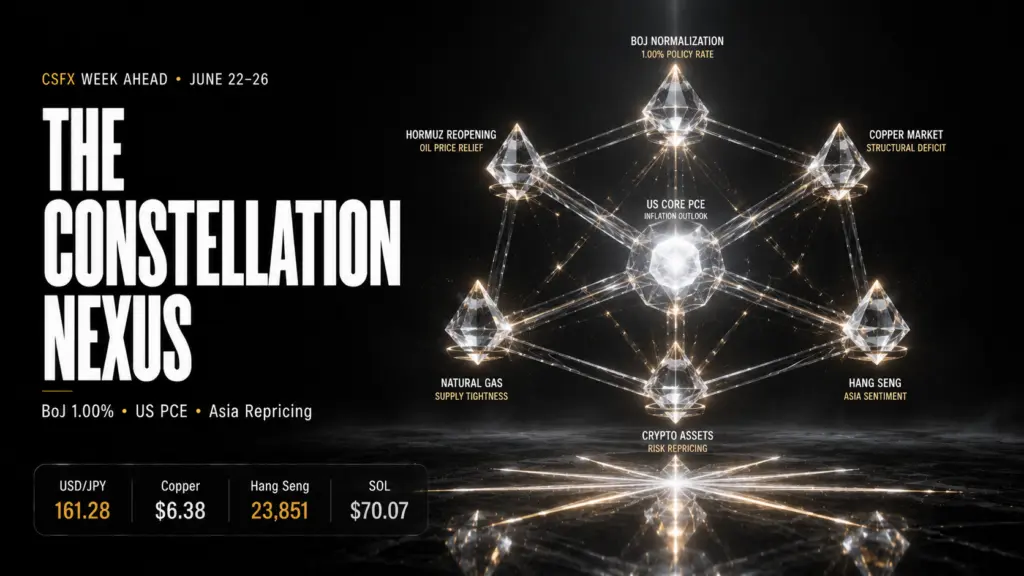
ASIA-PACIFIC WEEKLY · 22–26 JUNE 2026 The BoJ Just Made Its Biggest Move Since 1995. Now the Fed’s Favourite Inflation Number Gets to Decide If It Meant Anything

ASIA-PACIFIC WEEKLY · 22–26 JUNE 2026 The BoJ Just Made Its Biggest Move Since 1995. Now the Fed’s Favourite Inflation Number Gets to Decide If It Meant Anything

USD/JPY touched 161.82 — a fresh multi-decade high — then the BoJ hiked to 1.0% in a 7-1 vote and the pair pulled back to 161.28. The question for this week is whether Thursday's US core PCE print confirms the yen's recovery or kills it before it starts. Every other trade follows from that answer.

Two things happened in the same week that are supposed to move USD/JPY in opposite directions — and the result is a pair sitting at 161.28 that nobody quite knows how to read. Mid-week, USD/JPY touched 161.82, its highest level since the 1980s. Then the Bank of Japan, in a 7-1 vote, lifted its policy rate to 1.0% — the first time at that level since September 1995 — and the pair pulled back. Not sharply. Not dramatically. Just enough to say the BoJ is willing to act, and the market is willing to respect that. The question is whether it means anything structurally, or whether Thursday's US core PCE print wipes out the yen's tentative recovery before the BoJ can build on it.

That is the central question for the week of 22–26 June — and it is genuinely uncertain in a way that most FOMC-week questions are not. The Fed's preferred inflation gauge lands Thursday at 20:30 SGT. A hot core PCE number reaffirms the hawkish hold, keeps the dollar bid, and tells traders that the 250 basis-point gap between the Fed and the BoJ is going to stay wide for a lot longer than the BoJ's historic hike suggested. A soft print gives the BoJ credibility without the Fed fighting it — and opens the door to USD/JPY testing 158.00 to 159.00 as the rate differential narrative begins to shift.

USD/JPY hit 161.82 — its highest since the 1980s — and then...

Continue reading...
0
0

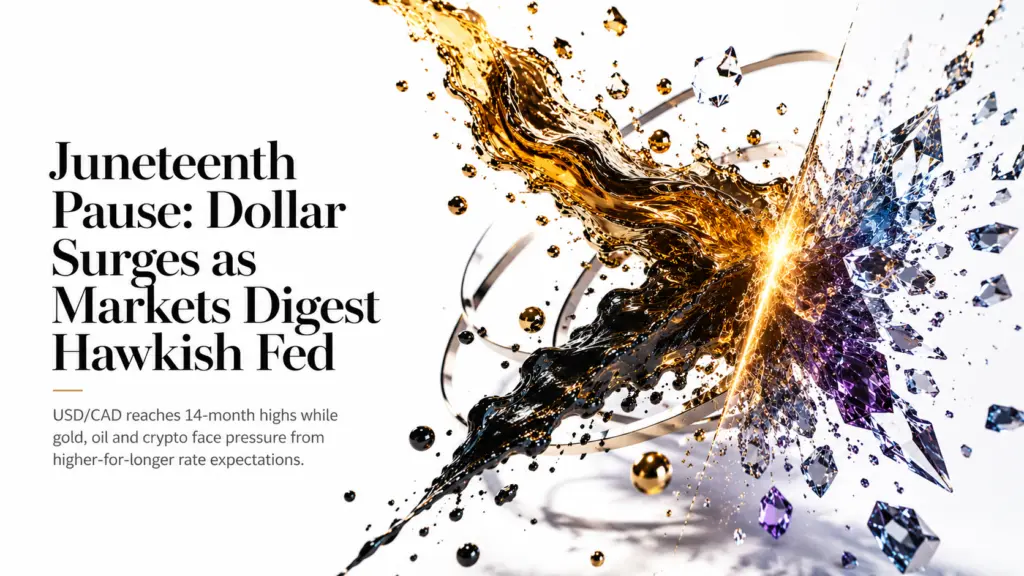
US SESSION · FRIDAY 19 JUNE 2026- JUNETEENTH HOLIDAY Wall Street Goes Dark for Juneteenth. The Dollar Didn’t Get the Memo

US SESSION · FRIDAY 19 JUNE 2026- JUNETEENTH HOLIDAY Wall Street Goes Dark for Juneteenth. The Dollar Didn’t Get the Memo

USD/CAD pushed to a 14-month high, gold and Bitcoin both fell on the same hawkish Fed, and Nvidia closed out a record Thursday with a $25 billion bet on its own future — all while the NYSE and Nasdaq sat empty.

Dow 51,564.71 (Thu close, record) · S&P 500 7,500.58 · Nasdaq 26,517.93 · USD/CAD 1.4174 · Gold $4,149 · WTI $75.77 · NVDA $210.33 · BTC $63,230 · US 20Y 4.82%

Today is the kind of session that looks quiet on the surface and is anything but underneath it. The NYSE and Nasdaq are dark for Juneteenth National Independence Day — the first federal-holiday closure of US cash equities since Independence Day last year — and the bond market is shut alongside them. But forex, commodity futures and crypto never asked for the day off, and what they are doing right now is the more interesting story.

Wall Street did not leave quietly. Thursday's close was a record one: the Dow finished at 51,564.71, the S&P 500 jumped 1.08% to 7,500.58, and the Nasdaq surged 1.91% to 26,517.93. Two things did that — the signing of the US-Iran memorandum of understanding, which formally ends a conflict that had been running since February, and a wave of semiconductor strength led by Nvidia. Then Friday opened, the equity desks went home, and three other markets were left to argue about what Thursday actually meant.

A hawkish Fed and a peace deal are pulling in opposite directions on almost everything — and the dollar, not the index, is where that argument is being settled today.

The Fed That Wasn't Supposed to Surprise Anyone

Kevin Warsh's first meeting as Fed Chair was supposed to be the easy one — a hold at 3.50 to 3.75%, fully priced, nothing to see. The hold happened....

Continue reading...
0
0

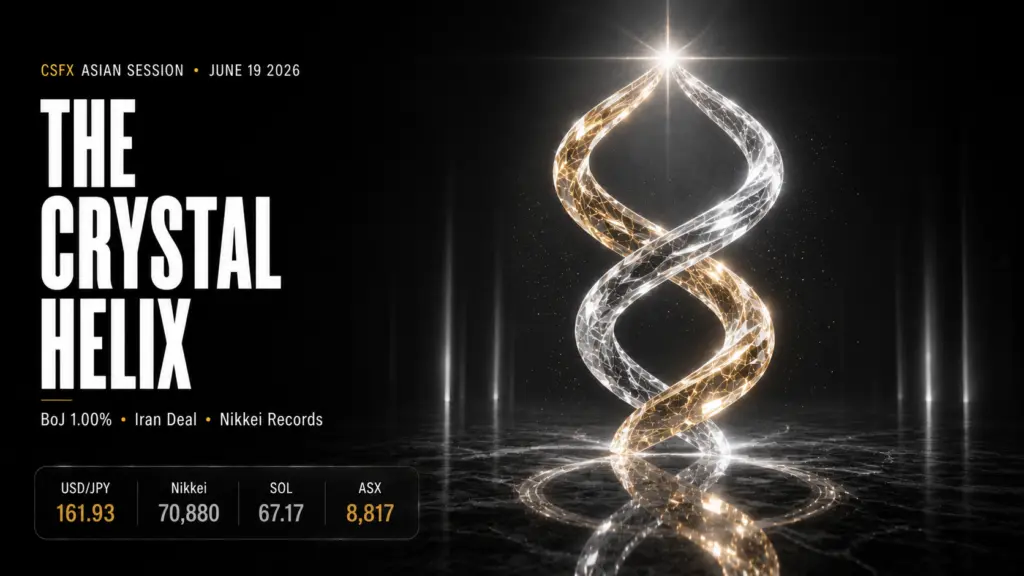
ASIAN SESSION · THURSDAY 18 JUNE 2026 · POST-FOMC The BoJ Hike Fuels the Nikkei. Then Warsh Spoke — and USD/JPY Jumped Back Above 160

ASIAN SESSION · THURSDAY 18 JUNE 2026 · POST-FOMC The BoJ Hike Fuels the Nikkei. Then Warsh Spoke — and USD/JPY Jumped Back Above 160

Japan hiked. The Nikkei broke 70,000. Then the FOMC held with a hawkish dot plot, removed 2026 cuts, and Warsh told markets inflation is not finished. The yen carry trade got a brief window — and the dollar walked back in.

Thursday's Asian session is the morning after two of the most consequential central bank decisions of 2026 arrived within 24 hours of each other — and told markets contradictory things. Japan's BoJ hiked to 1.00% on Tuesday, its first time at that level since 1995, with the Nikkei 225 subsequently breaking 70,000 for the first time in history. That was the good news story for Asia. Then at 14:00 ET on Wednesday, Kevin Warsh held rates at 3.50 to 3.75% — as expected — but the dot plot removed the last pencilled-in 2026 cut and showed several participants considering hikes. At 14:30 ET, Warsh's first press conference framed the Iran deal's oil deflation as a welcome development but declined to call it sufficient to change the rate path. USD/JPY, which had briefly dipped on the BoJ hike toward 159, has since climbed back above 160. The yen is weaker again.

This is the central paradox of Thursday's session in a single number: USD/JPY above 160 after both the BoJ hiked to 1.00% and the Fed held at 3.50 to 3.75%. The gap between those two rates — 250 basis points — is still the largest in G10 FX. The carry trade did not die when Japan moved to 1%. It compressed slightly and then recovered when Warsh made clear the Fed is not moving toward cuts any time soon. The yen is trapped between a BoJ that is moving carefully and a Fed that is staying put. Until one of those changes materially, USD/JPY holding above 160 is the...

Continue reading...
0
0

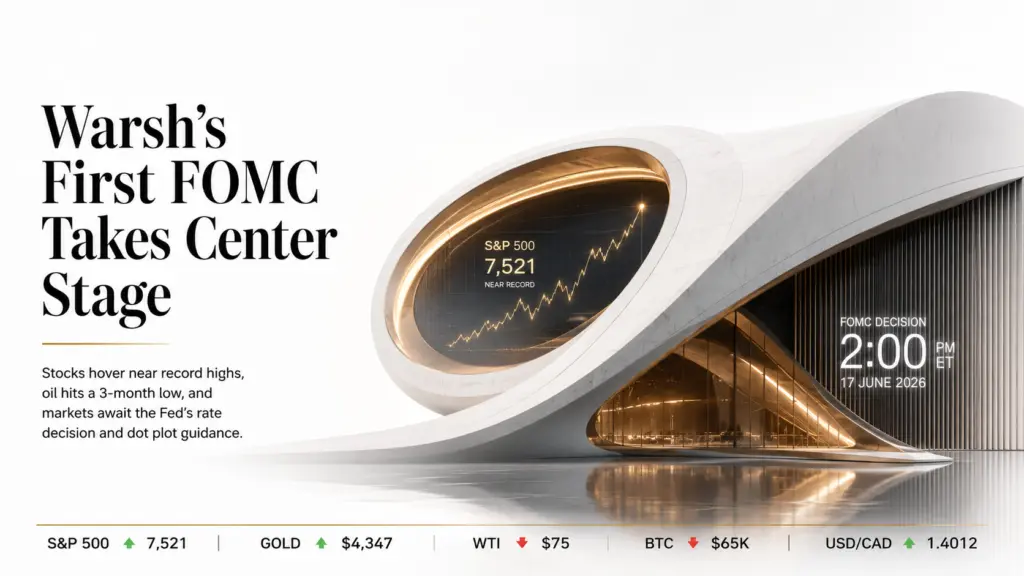
US SESSION · WEDNESDAY 17 JUNE 2026 · FOMC DAY Oil at a 3-Month Low. The S&P 500 a Whisker From Its Record. And at 2:00 PM ET, Everything Changes

US SESSION · WEDNESDAY 17 JUNE 2026 · FOMC DAY Oil at a 3-Month Low. The S&P 500 a Whisker From Its Record. And at 2:00 PM ET, Everything Changes

Wall Street is sitting on its hands this morning. WTI at $75.40 — a 15-week low. The S&P 500 near 7,521, a whisker below its all-time record. The 20-year yield pinned at 5.05%. May retail sales came in at +0.9% — nearly double the forecast. And at 2:00 PM ET, Kevin Warsh tells you whether any of this matters or whether the fight against inflation is still on.

The session before a Fed decision is always the same in structure and always different in content. The structure is a holding pattern — low volume, narrow ranges, every participant waiting for the same thing. The content today is unusually rich. Oil is at a 15-week low on Iranian barrel flows beginning to return through a reopening Strait of Hormuz, doing exactly the disinflationary work the Fed has been unable to do through rate policy alone. May retail sales came in at +0.9% against a +0.5% forecast — the strongest reading since January, proof that the US consumer has not cracked under 4.2% inflation. The S&P 500 is sitting near 7,521, a whisker below its all-time record. And the 20-year Treasury yield is pinned at 5.05%, which is the bond market saying: I am not convinced Warsh is dovish yet.

The rate decision at 2:00 PM is settled — a hold at 3.50 to 3.75% is priced at 97% probability. What is not settled is everything around it: the dot plot, which is expected to erase the last pencilled-in 2026 cut and may show some participants beginning to price hikes; and the press conference tone at 2:30 PM, where Warsh will either acknowledge that the Iran deal's disinflationary impulse changes the calculus — which is dovish — or foreground the still-elevated core services CPI and the surprise retail beat — which is...

Continue reading...
0
0

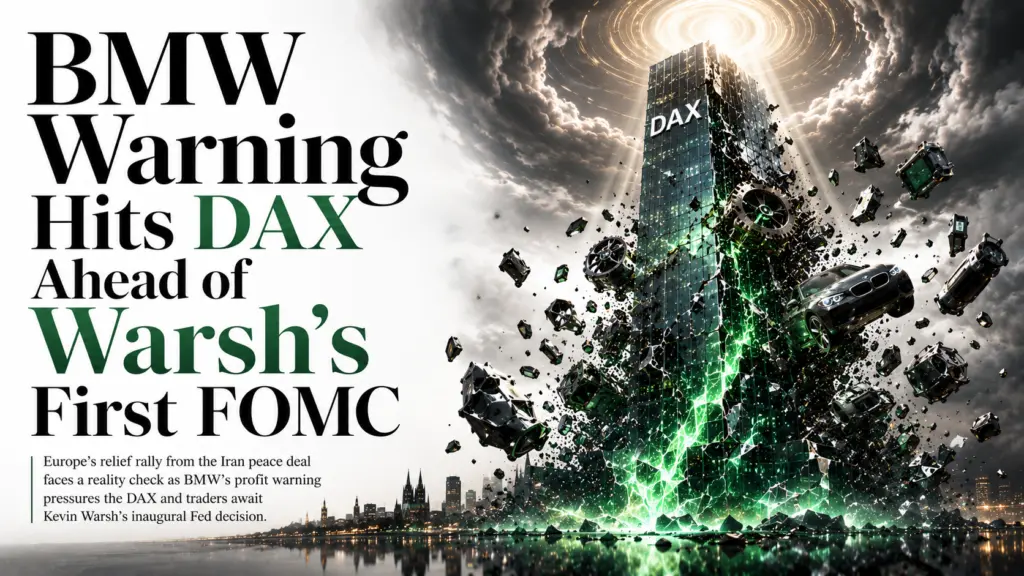
EUROPEAN SESSION · WEDNESDAY 17 JUNE 2026 BMW Just Blew a 7% Hole in the DAX. And Europe Still Has to Trade Through Warsh Tonight

EUROPEAN SESSION · WEDNESDAY 17 JUNE 2026 BMW Just Blew a 7% Hole in the DAX. And Europe Still Has to Trade Through Warsh Tonight

Europe opens with an Iran peace rally on one hand and a BMW profit warning that has dragged the entire German auto sector lower on the other. The DAX is down. Silver is retreating. BP is being crushed by $78 Brent. And at 20:30 GMT tonight, Kevin Warsh speaks for the first time as Fed Chair — and every position in today's session either gets validated or reversed in that press conference.

There is a particular kind of session that European traders know well — one where the domestic news is telling you one thing and the global macro is telling you something different, and your job is to figure out which one dominates by close. Wednesday 17 June is that session in its most concentrated form. On the domestic side: BMW issued a 2026 profit warning overnight flagging weaker deliveries and margin pressure from EV transition costs. Shares fell nearly 7%, dragging Mercedes-Benz down 3.2% and Volkswagen down 2.4%. The German auto sector — which carries disproportionate weight in the DAX — is having one of its worst single sessions since the EV cycle began.

On the global macro side: the Iran peace deal has ended the conflict, WTI is near $76, Brent near $78, and the structural backdrop for European equities has materially improved. Lower oil means lower energy costs for German manufacturers, lower Eurozone inflation, and less pressure on the ECB to follow Thursday's hold with another hike. These are genuine tailwinds. They just are not visible today because BMW's profit warning is dominating the headlines and the session's positioning is cautious ahead of Warsh at 20:30 GMT. Every rate-sensitive instrument in today's session is in a holding pattern until that press conference.

BMW dropped 7% in a session that was supposed to be about the Iran...

Continue reading...
0
0
Lin Brings

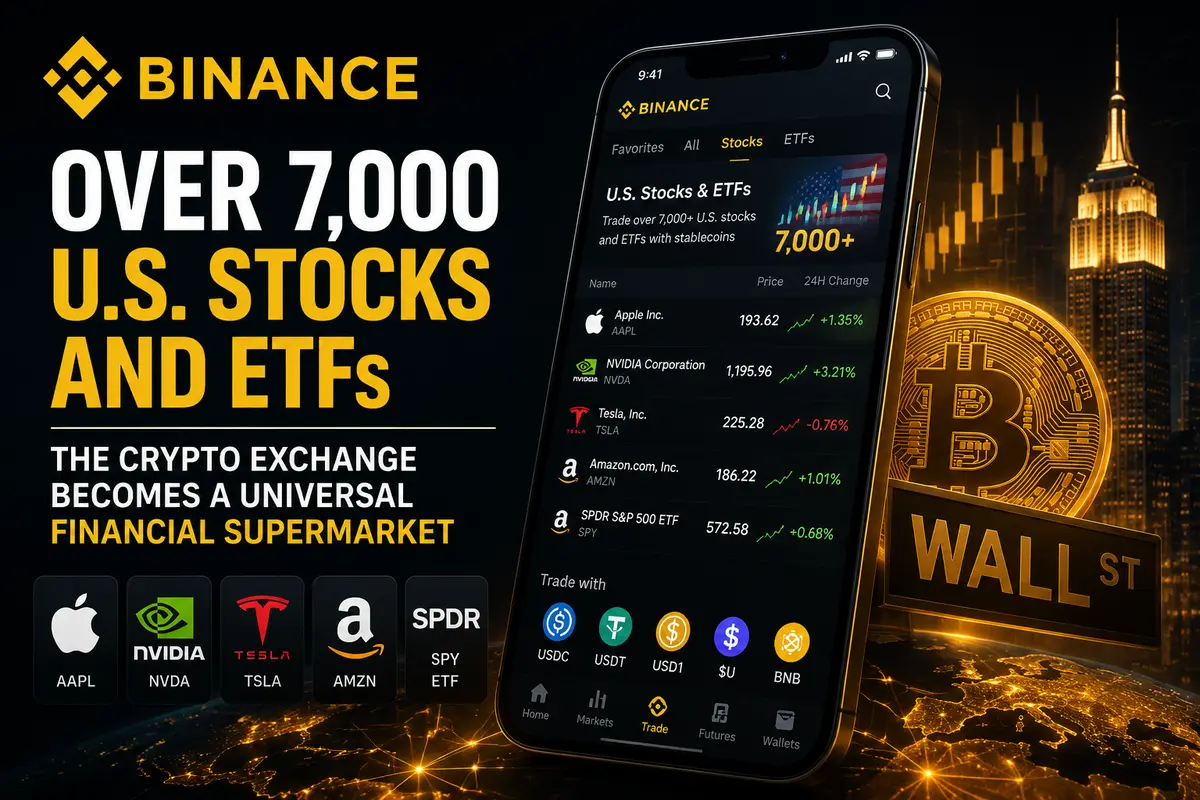
Binance Adds Over 7,000 U.S. Stocks and ETFs: The Crypto Exchange Becomes a Universal Financial Supermarket

Binance Adds Over 7,000 U.S. Stocks and ETFs: The Crypto Exchange Becomes a Universal Financial Supermarket

Introduction: A Game-Changing Move for 300 Million Users

Imagine waking up in the morning, opening a single app, seeing Bitcoin up 3% overnight, selling part of it, and immediately using those funds to buy NVIDIA stock. No bank transfers, no waiting, no intermediaries. Everything happens in one place, in one currency, at one speed. This is not a futuristic scenario — it is the reality that the world’s largest crypto exchange has just enabled for its users.

Binance, a platform that has grown from a startup into an empire with 300 million users in just eight years, has made more than just another update. It is making a claim to become a universal next-generation financial hub. More than 7,000 U.S. stocks and ETFs are now available for trading directly in the same interface that was previously reserved exclusively for cryptocurrencies.

Let’s break down what is really behind this announcement, how it works, and why it may turn out to be far more significant than just another feature in a long list of exchange upgrades.

What Binance Has Actually Launched and How It Works

From Crypto Monopoly to a Multi-Asset Future

When Changpeng Zhao launched Binance in 2017, he likely could not have imagined that within eight years his creation would be trading Apple, Tesla, and Amazon alongside Dogecoin and Solana. But today, that is a reality. The platform has introduced functionality that allows users in certain jurisdictions to buy and sell more than 7,000 U.S. stocks and exchange-traded funds (ETFs).

The number 7,000 is striking. For comparison, the New York Stock Exchange lists around 2,800 companies, while NASDAQ has approximately 3,300. This means Binance covers virtually the entire U.S. public equity market, including ETFs that represent baskets of stocks. This is not just “a few popular stocks added” — it...

Continue reading...
0
0

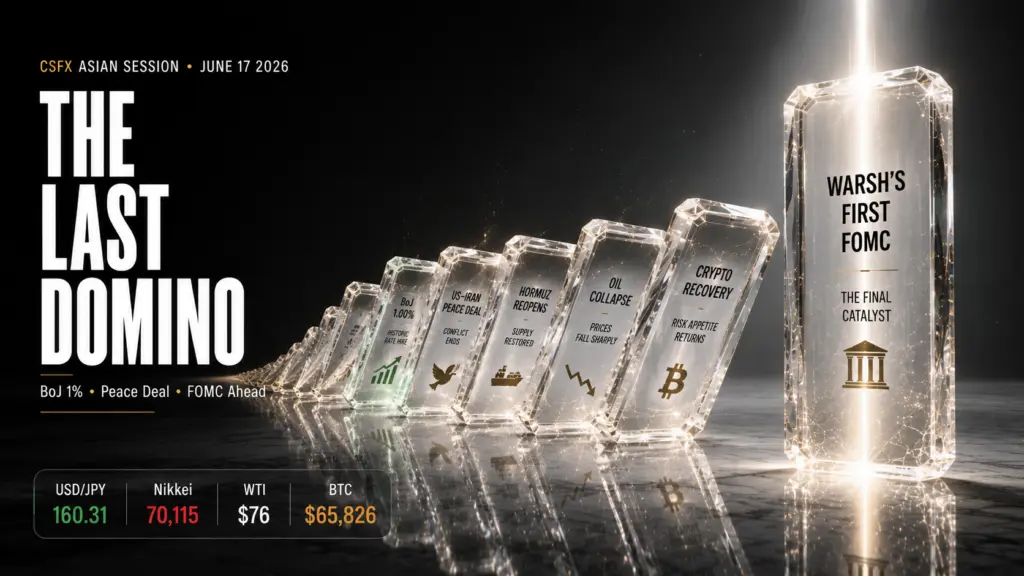
ASIAN SESSION · WEDNESDAY 17 JUNE 2026 The Nikkei Just Broke 70,000. The Iran War Is Over. And Everyone Is Waiting for Warsh

ASIAN SESSION · WEDNESDAY 17 JUNE 2026 The Nikkei Just Broke 70,000. The Iran War Is Over. And Everyone Is Waiting for Warsh

Japan hiked to 1% for the first time since 1995. The US-Iran peace deal is signed. Crude is at a three-month low. The yen is still weak. And Asia is riding all of it into the most consequential Fed meeting of the year — all in a single Wednesday morning.

There are sessions you look back on months later as the moment everything changed, and sessions that just feel like they should be that moment but are actually the pause before the real move. Wednesday's Asian session is genuinely the former. Two events that had been holding the region in suspense for weeks have both resolved in the market's favour overnight. The Bank of Japan hiked to 1.00% — the first time at that level since 1995 — and the US-Iran peace deal has ended the three-month conflict, reopened the Strait of Hormuz, and sent WTI crude crashing toward a three-month low near $76. And yet the story of this session is not those two events. It is the Nikkei 225 breaking 70,000 for the first time in history.

The carry trade did not unwind. That is the most important thing to say about the BoJ hike. Every trader who had been positioned for a violent yen strengthening on the hike — and there were many — is waking up to a world where USD/JPY is at 160.31, nearly unchanged, and AUD/JPY is holding firm near 113.21. The reason is sequencing: the Fed is still at 3.50 to 3.75% and tonight Kevin Warsh may lean hawkish. A 250 basis-point gap between the Fed funds rate and the BoJ policy rate is still enormous carry. You do not unwind that on a 25bp move by Tokyo — especially when the BoJ's forward guidance was careful and the dissenting board member voted...

Continue reading...
0
0
Navigation menu
instaforex banner