

Asian Currencies Stabilize After Their Slide on U.S. Labor Market Data

Monday Calm After Friday’s Storm
Monday opened with a sense of relief across Asian currency markets. Not because everything suddenly improved, but because conditions had stopped getting worse. After Friday’s sharp sell-off, when stronger-than-expected U.S. employment data hit regional currencies like a sledgehammer, markets entered a pause. Investors are digesting the information, reassessing risks, and recalculating their positions.
The U.S. Dollar Index remained near a two-month high but failed to move significantly higher. Dollar futures were also largely unchanged. Asian currencies stabilized, with some even posting modest gains.
Sentiment, however, remains cautious. Geopolitical tensions have once again come to the forefront after Iran and Israel exchanged strikes on Sunday evening. The Strait of Hormuz remains under threat. Oil prices are elevated, inflation risks are rising, and the U.S. dollar—typically comfortable in such an environment—continues to pressure virtually every other asset class.
The U.S. employment report released on Friday was the defining event of the week. The economy added 172,000 jobs in May, significantly exceeding expectations. Many analysts had anticipated a slowdown to around 150,000–160,000 jobs. Instead, payroll growth came in at 172,000. While not a record-breaking figure, it was strong enough to reinforce the view that the Federal Reserve is unlikely to rush into cutting interest rates.
Moreover, markets are increasingly pricing in not only a prolonged period of stable rates but also the possibility of another rate hike later this year. Traders see a non-zero probability of such a move by December. For Asian currencies, that is a troubling prospect. Higher Fed rates support a stronger dollar, and a stronger dollar generally means weakness everywhere else.
Yen Back at a Critical Threshold
The Japanese yen once again found itself at the center of attention. The USD/JPY exchange rate hovered around 160.31, its highest level since late April.
Back in late April, Japanese authorities spent a record $73 billion on currency interventions to push the exchange rate away from the 160 level. Just six weeks later, the yen has returned to the same territory.
The difference is that in April the yen briefly broke through 160, prompting an aggressive response from Japanese officials. Today it remains near the level but has not decisively crossed it—at least not yet. Traders are proceeding cautiously, mindful of how the previous challenge to this threshold ended.
Japan’s Ministry of Finance has repeatedly signaled its readiness to intervene again. Verbal warnings have been frequent, and officials have openly stated their willingness to act if necessary.
Yet words and actual intervention are not the same thing. Japan’s foreign-exchange reserves, while substantial, are not unlimited. Traders know this and will continue testing the authorities’ resolve—carefully and incrementally. The question is no longer whether USD/JPY will challenge 160 again, but when it will do so and how Tokyo will respond.
Additional pressure on the yen came from revised Japanese growth data. First-quarter GDP expanded at an annualized rate of 1.8%, down from the preliminary estimate of 2.1%. Japan’s economy is growing, but more slowly than previously believed. This provides another argument for the Bank of Japan to proceed cautiously with any future rate hikes. If rates remain low, the yen is likely to remain weak.
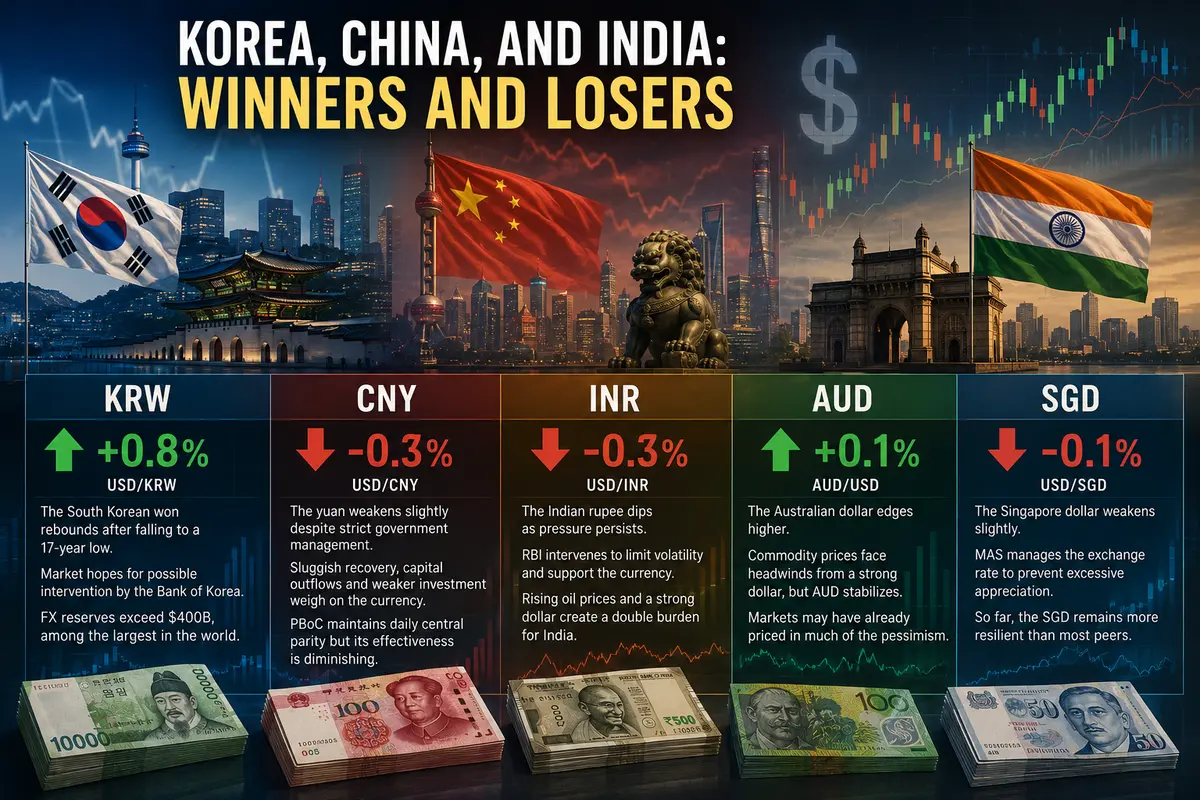
Korea, China, and India: Winners and Losers
After falling to a 17-year low on Friday, the South Korean won attempted to recover. On Monday morning, USD/KRW declined by 0.8%, meaning the won strengthened modestly.
The cautious optimism stems from hopes that South Korean authorities may intervene in the foreign-exchange market. The Bank of Korea has already stated its readiness to curb excessive volatility. So far, these have been words rather than actions. However, if the won continues to weaken, intervention may follow.
South Korea’s foreign-exchange reserves exceed $400 billion, among the largest in the world, giving policymakers considerable firepower should they decide to defend the currency.
China’s yuan, which remains tightly managed by the government, weakened by 0.3% in the domestic market. The decline was modest but noteworthy. Beijing dislikes sharp currency movements, yet preventing depreciation against a strong dollar is becoming increasingly difficult.
China’s post-pandemic recovery remains sluggish, foreign investment has declined, and capital outflows continue. All of these factors weigh on the yuan. The People’s Bank of China maintains a daily central parity rate around which the currency is allowed to fluctuate within a limited range. The mechanism still works, but its effectiveness appears to be diminishing.
India’s rupee also weakened by 0.3%. The Reserve Bank of India actively intervenes in currency markets to prevent excessive fluctuations. India possesses massive foreign-exchange reserves and is willing to use them to support the rupee.
Nevertheless, the currency remains under pressure. India is a major oil importer, and rising crude prices driven by Middle East tensions represent a significant challenge. Expensive oil combined with a strong dollar creates a double burden for the Indian economy.
The Australian dollar, often referred to as a commodity currency, rose by 0.1%. The gain was symbolic and barely noticeable, yet it was still one of the strongest performances in the region.
Australia’s economy is heavily dependent on commodity exports. A stronger U.S. dollar typically puts downward pressure on commodity prices, but the Australian dollar has stopped falling for now. Perhaps the market had already priced in too much pessimism.
The Singapore dollar weakened by 0.1%. Singapore is a small city-state with substantial reserves and highly sophisticated economic management. Its monetary policy focuses on managing the exchange rate rather than setting interest rates.
Authorities actively smooth currency fluctuations, preventing excessive appreciation of the U.S. dollar against the Singapore dollar. So far, this approach has worked relatively well, and Singapore’s currency has suffered less than many of its regional peers.
Middle East: A New Escalation
While Asian currencies were attempting to stabilize, tensions in the Middle East flared once again.
Late Sunday evening, Iran launched several missiles toward northern Israel. According to regional sources, Israeli air defenses intercepted the projectiles. There were no reported casualties and only limited damage. Nevertheless, the incident represents a further escalation.
Tehran stated that the attack was retaliation for Israeli operations in the southern suburbs of Beirut. Israel responded with strikes of its own on Monday. Reports indicate that the U.S. president urged Israel to avoid further escalation, though those appeals appear to have had little effect.
Concerns surrounding the Strait of Hormuz are intensifying. This narrow waterway, through which roughly one-fifth of the world’s oil supply passes, is once again at the center of global attention.
Iran has repeatedly threatened to close the strait in the event of a full-scale conflict involving the United States or its allies. Meanwhile, the U.S. has demonstrated military resolve through strikes on Iranian positions on Qeshm Island.
For Asian currencies, this creates a double challenge. First, geopolitical tensions reduce risk appetite, driving investors toward the U.S. dollar as a safe-haven asset. Second, higher oil prices worsen the trade balances of many Asian economies that rely heavily on energy imports. Deteriorating trade balances typically translate into weaker currencies.
Inflation risks are also increasing. Higher oil prices fuel inflation globally, but the impact is particularly acute in Asia, where economies are generally more dependent on imported energy than either the United States or Europe.
And higher inflation often means higher interest rates. Higher U.S. interest rates, in turn, support a stronger dollar.
The result is a vicious cycle that is proving increasingly difficult for Asia to escape.

Comments
No comments yet. Be the first to share your thoughts!
Comments only for logged-in users.