

China’s Gold Rush: Why the Country Is Buying Record Volumes of the Precious Metal
A Two-Year Record: The Figures Speak for Themselves
When Chinese customs authorities publish gold import data in the middle of summer, analysts around the world wait with keen anticipation. June 2026 delivered a remarkable surprise: overseas purchases of the precious metal reached approximately 173 tonnes, the highest level since March 2024. Imports increased for the third consecutive month, creating a trend that can no longer be ignored.
China, the world’s largest gold market, is demonstrating an appetite that has not diminished even after the sharp decline in international gold prices. On the contrary, lower prices have encouraged Chinese buyers to take action.
Expressed in more familiar terms, 173 tonnes is equivalent to almost 5.6 million troy ounces. By comparison, South Africa, once the world’s leading gold producer, currently mines around 100 tonnes per year. In other words, China imported almost twice as much gold in a single month as an entire country produces in a year.
This is more than ordinary purchasing activity. It is a demonstration of financial strength and strategic planning. The buyers include not only private investors but also state-owned and commercial banks responsible for managing gold import quotas.
What is driving this flood of gold into China? The answer lies in three key factors: gold prices, the exchange rate of the yuan, and changes in regulatory requirements. Each deserves separate consideration because, taken together, they have created a perfect storm that is encouraging banks and investors to rapidly increase their holdings.
Buying the Dip: A Strategy That Has Worked for Centuries
When international XAUUSD ... gold prices fall sharply, two types of market participants usually emerge. Some panic and sell, while others—particularly experienced Asian investors—view the decline as an opportunity.
“Buying the dip” is a principle that has worked for thousands of years, and Chinese banks and private investors continue to follow it with remarkable consistency.
During the first half of 2026, gold experienced a significant correction after retreating from its record highs. For many global investors, this became a reason for concern. For Chinese buyers, however, it was a signal that the time had come to replenish their reserves.
The domestic gold premium, which remained in place throughout much of the first half of the year, reinforced this effect. It meant that Chinese banks could purchase gold more cheaply on international markets—even after accounting for logistics costs—than they could within China.
Commercial banks holding gold import licences faced a choice: use their allocated quotas or risk losing them. In an environment of unstable prices, they chose to act aggressively.
Every tonne of imported gold represents more than just physical metal. It is also insurance against future economic shocks. Banks are building inventories to provide physical backing for retail sales and gold accumulation programmes, while also maintaining reserves in case demand suddenly surges. Judging by current trends, that demand is continuing to grow.
The Role of the Yuan and Regulatory Changes
The strengthening of the yuan against the US dollar has been another important factor supporting gold imports. When the Chinese currency becomes stronger, overseas purchases automatically become cheaper.
Every cent saved through favourable exchange-rate movements can be used by banks to purchase additional quantities of the metal. This creates a snowball effect: the stronger the yuan becomes, the more gold can be purchased with the same amount of money, further increasing the appetite for imports.
However, the most important trigger may have been the change in the regulatory framework. New gold import licensing rules came into effect on June 1, 2026.
This marked a turning point. Banks seeking to adapt to the new requirements began actively using their existing quotas to avoid the risk of losing them in the future. Under China’s tightly controlled system, in which the People’s Bank of China issues import licences irregularly, any change in the rules is treated as a signal for immediate action.
Analysts note that some banks may have booked gold shipments before June, while the physical metal appeared in customs statistics later because of the time required for financing, transportation, and customs clearance.
This delay between the purchasing decision and the official registration of imports added extra volume to the June figures, creating a “double-peak” effect. Even after accounting for this technical factor, however, the growth remains impressive.
Retail Demand: Gold Accumulation Programmes and ETFs
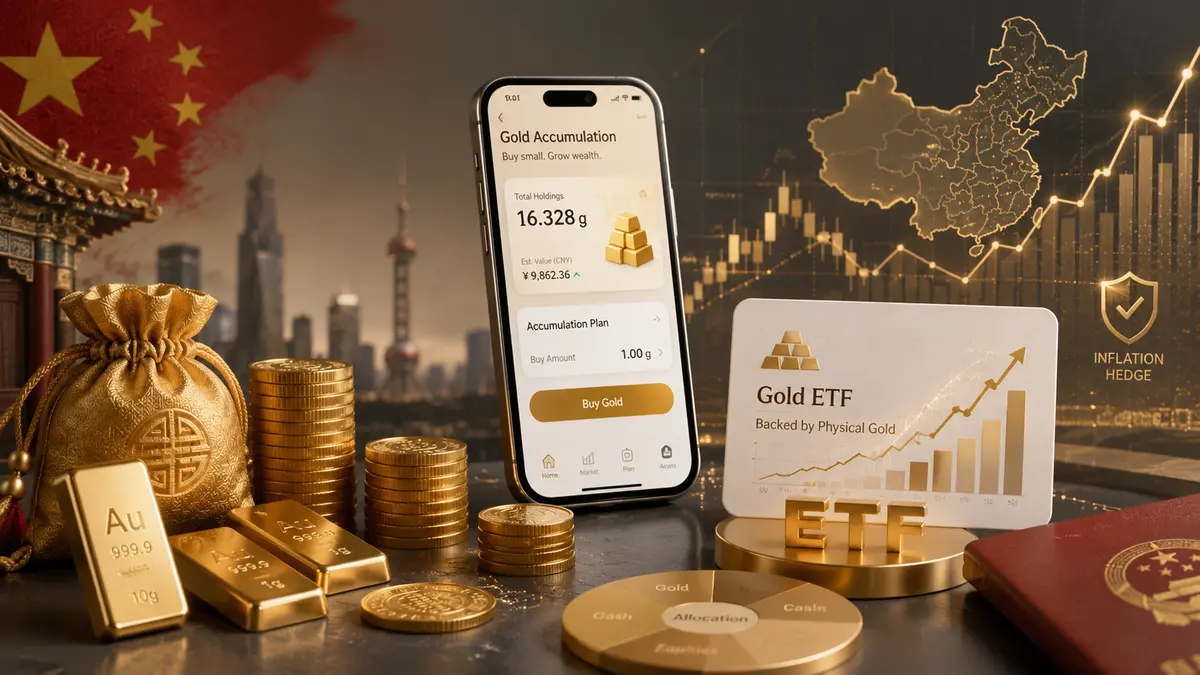
Private investors in China who do not have access to the wholesale market use alternative investment instruments. Gold accumulation programmes offered by many banks allow individuals to purchase the metal in small quantities, gram by gram.
This democratises access to gold and transforms it into a practical savings instrument for the middle class. Given the instability of financial markets and persistent concerns about inflation, these programmes are becoming increasingly popular.
Gold-backed exchange-traded funds are another widely used instrument. Since the beginning of the year, Chinese gold ETFs have attracted approximately 28 tonnes in net inflows.
This is not a record figure, but it demonstrates that institutional investors are also participating in the trend. Interest in Chinese gold ETFs is rising as investors lose confidence in traditional assets such as property and equities, both of which have experienced difficult market conditions.
Importantly, Chinese investors do not view gold merely as another financial asset. They increasingly see it as a tool for preserving capital during periods of global uncertainty.
Trade wars, tariffs, and geopolitical risks are making gold more attractive than many alternative investments.
Comparison with the Global Market: Why Is China Buying While the West Is Selling?
Against the background of China’s aggressive purchasing activity, Western markets appear considerably more restrained. Investors in the United States and Europe often sell gold when prices rise, taking profits from their positions.
China follows the opposite strategy: falling prices are treated as an opportunity to increase holdings. This cultural and strategic difference has deep historical roots.
Chinese banks and state institutions regard gold not simply as an investment but as a strategic reserve. Unlike Western hedge funds, which may change their positions every week, Chinese institutions often operate with investment horizons measured in decades.
By accumulating reserves today, they are protecting themselves against potential crises in the future. Judging by their actions, they appear to believe that such crises may not be far away.
China also remains the world’s largest gold producer, but domestic mining output is unable to satisfy the country’s growing demand. Imports are therefore critically important for supplying the market.
Every tonne brought into the country helps reduce the imbalance between domestic production and consumption.
What Comes Next for China’s Gold Market?
The outlook for the coming months remains positive. If international gold prices continue to be attractive and the yuan strengthens further, imports may remain at elevated levels.
The new licensing regime is also likely to encourage banks to use their quotas more actively, providing additional support for purchasing volumes.
However, risks remain. A sharp strengthening of the US dollar USDEUR ... or tighter monetary policy in China could reduce demand. Furthermore, an improvement in the geopolitical environment could encourage investors to move into riskier assets, weakening interest in gold.
Under current conditions, however, such scenarios appear relatively unlikely.
Analysts emphasise that rising Chinese demand for gold is not merely a temporary market trend but a structural shift. An increasing number of Chinese investors are treating the precious metal as part of a long-term investment portfolio.
Should this trend continue, China could become an even more dominant force in the global gold market than it is today.
Conclusion: China’s Growing Appetite for Gold
China’s June gold import figures are more than a statistical anomaly. They reflect deep strategic processes taking place within the country.
Chinese banks, private investors, and state institutions are actively expanding their reserves, taking advantage of every opportunity to add more gold to their holdings. They are doing so not despite falling prices, but largely because of them.
A stronger yuan, the domestic gold premium, and the new licensing regime have created favourable conditions for import growth. Gold accumulation programmes and ETFs are supporting retail demand, while banks remain the main driving force behind large-scale wholesale purchases.
As a result, China continues to increase its influence within the global gold market, and this trend appears likely to strengthen.
For investors closely following the market, China’s actions represent an important signal. When China buys gold on such a scale, it suggests that the country continues to see substantial value in the metal.
Investors may wish to pay attention to this signal, particularly at a time when the global economy remains unstable. Gold is one of the few assets that has retained its appeal for thousands of years—and China understands this exceptionally well.

Comments
No comments yet. Be the first to share your thoughts!
Authentication Required
You must be logged in to post a comment.