

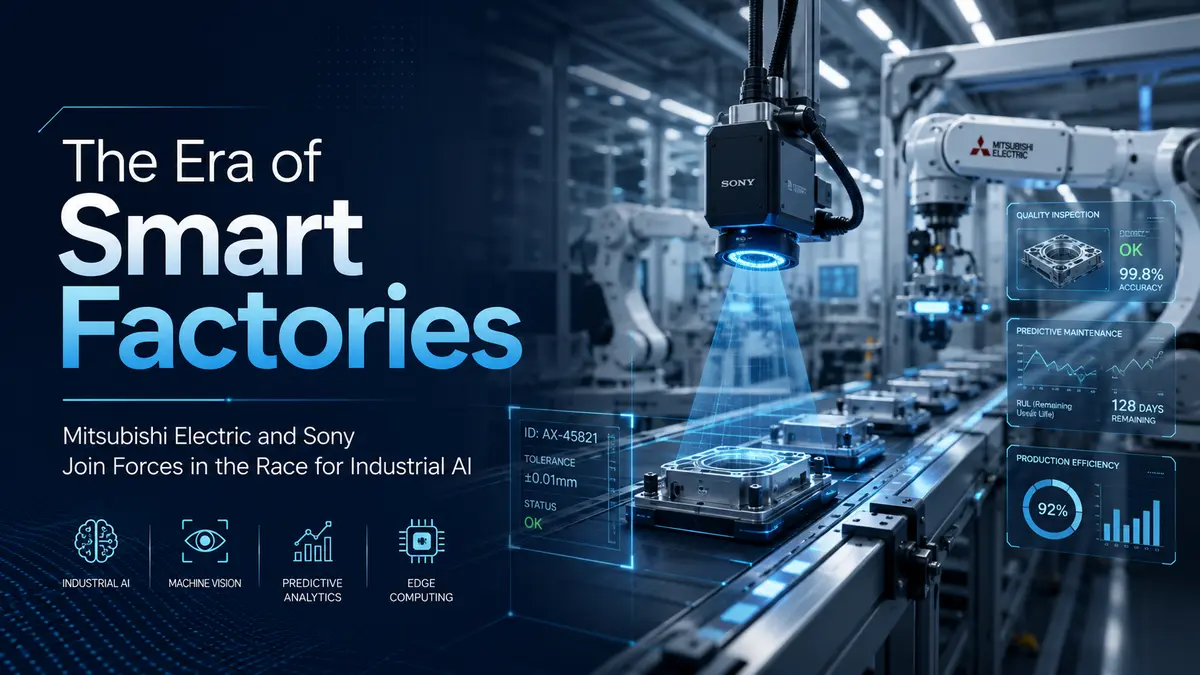
The Era of Smart Factories: Mitsubishi Electric and Sony Join Forces in the Race for Industrial AI
A Partnership of Giants: When Vision Meets Automation
Japanese industry, which has always been renowned for its technological excellence, is taking another enormous step into the future. MSBHF ... Electric, a veteran of factory automation with decades of experience, and SNEJF ... Semiconductor Solutions, a recognized leader in sensors and imaging technology, have announced the creation of a joint venture. The future company will be called Advanced Vision Solutions—a name that sounds more like a promise than a simple sign on the door of a new office.
The partnership between these two corporate giants is far more than another business deal. It is an attempt to unite two different philosophies, two engineering traditions, and two approaches to what the factory of the future should look like. Mitsubishi Electric knows virtually everything about robots, conveyor systems, and manufacturing control technologies. Sony, meanwhile, has spent years perfecting imaging technology and learning how to convert light into digital data with extraordinary precision. When these two worlds collide, they create something greater than the sum of their parts.
The joint venture is scheduled to be established in October 2026, although this is merely the formal launch date. Engineers and managers are already working actively to ensure that the company can operate at full capacity from its very first day. Mitsubishi Electric will hold a controlling 60% stake, which makes sense because it will serve as the primary integrator of the solutions at real manufacturing facilities. Sony will retain 40%, but its role should not be underestimated: without its sensors, the entire project would have little practical meaning.
This ownership structure is more than a collection of numbers. It sends a clear message to the market about which company will take the leading role and which will serve as the key technology partner. In reality, however, experience suggests that Sony’s 40% stake may carry no less weight than Mitsubishi Electric’s 60%. In projects of this kind, technological contributions are often more important than a company’s formal share of the capital. Sony understands this perfectly well. It is willing to accept a smaller stake because it is not interested in corporate power struggles—it wants large-scale industrial adoption of its sensors, an area in which Mitsubishi Electric has exceptional expertise.
Edge AI Versus the Cloud: The Battle for Milliseconds
What exactly is the AI sensor that the companies are discussing, and why is it so important? In the traditional world of industrial automation, video monitoring and quality-control systems operate according to a familiar process: capture an image, send it to a server, wait for the server to process it, and then receive a response. This takes time—sometimes fractions of a second and sometimes several full seconds. In high-speed manufacturing, even such seemingly minor delays can be critical.
Edge AI sensors completely change this model. They process information locally, directly inside the sensor itself, without sending the data to the cloud or a remote server. As a result, response times can be reduced to microseconds. Imagine a conveyor belt on which components are moving at several meters per second. If the system detects a defect in one of them, it must make an immediate decision: stop the production line, reject the defective component, or instruct a robot to adjust its actions.
This is precisely what Mitsubishi Electric and Sony intend to offer. Their joint solution will analyze visual data directly on the image sensor, eliminating delays associated with data transmission and remote processing. It is like looking into a mirror and seeing your reflection instantly instead of waiting for a special courier to deliver your photograph from another city.
The system will go even further. It will not merely observe and recognize objects—it will learn. The artificial intelligence algorithms embedded in these sensors will be capable of detecting even the slightest changes in the production environment. For example, a machine may develop a minor vibration that is not yet visible to the human eye but could begin causing defective products several hours later. An AI sensor could detect and analyze the vibration, automatically adjust the equipment’s operating parameters, or send the operator a clear recommendation: “Warning: maintenance required.” This is the predictive analytics that companies have discussed for years but have often struggled to implement in practice.
Labor Shortages and Robotization: The Social Context of the Technological Leap
Like many developed countries, Japan is facing a serious demographic challenge. Its population is aging, the number of young people is declining, and factories are struggling to find enough workers. Those who remain in the workforce are becoming older every year, and their knowledge and experience disappear when they retire. This is a systemic problem that threatens not only individual businesses but the country’s entire industrial sector.
In this environment, automation is no longer simply a method of increasing efficiency. It is becoming the only realistic means of survival. Factories that fail to introduce robots and automated systems risk gradual decline because they will have no one to fill their available positions. However, robots still require control, monitoring, and maintenance. This creates another challenge: where can companies find qualified specialists to manage an expanding fleet of industrial robots?
The answer also lies in technology. Intelligent AI-powered sensors can make robots and automated production lines more independent. They can operate with minimal human involvement, identify problems, report them to a central control system, and ideally even resolve them without an operator’s intervention. This reduces dependence on human labor, lowers the number of employees required to operate a facility, and shifts the emphasis toward more highly skilled work that depends not on physical strength but on judgment and decision-making.
The new system being developed by Mitsubishi Electric and Sony is designed specifically for this purpose. It is intended to support not merely workerless manufacturing but labor-saving production, in which people are freed from repetitive and monotonous tasks and given the opportunity to perform more intellectually demanding work. This may sound like a socially responsible mission, but in reality, it is also a harsh necessity. Companies must either automate or eventually disappear from the market.
Competition and the Global Context: Japan’s Response to Worldwide Challenges
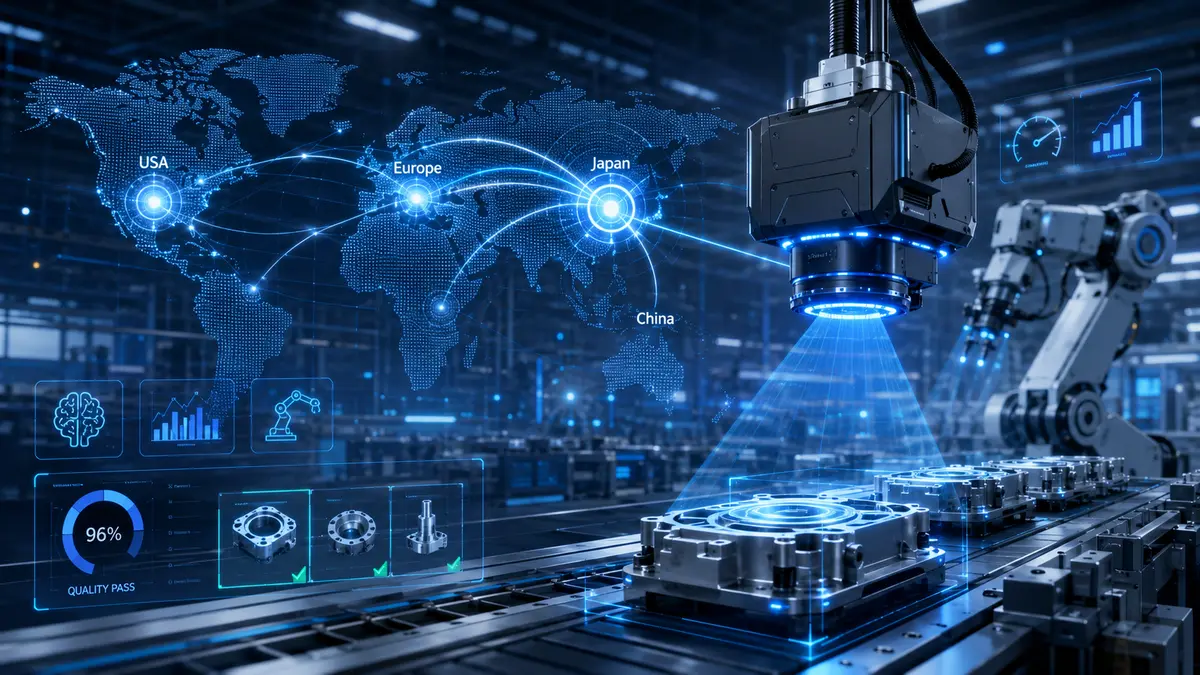
Mitsubishi Electric and Sony are not the only companies competing in this field. Around the world, businesses ranging from Germany’s SMAWF ... and Bosch to America’s INTC ... and NVDA ... are actively developing similar solutions. Industrial AI has become a global race in which the stakes are higher than ever.
China, for example, makes no secret of its ambitions in this sector. Companies based in Beijing and other major technology centers are actively developing industrial computer-vision systems, and they are not constrained by a lack of resources. Government support and the scale of the domestic market allow them to introduce and expand solutions quickly, even when those solutions are not yet technically perfect.
European manufacturers are focusing on quality standards and system integration. They offer comprehensive solutions covering not only visual inspection but also many other aspects of production management. Their principal advantages are decades of experience and a high level of customer trust.
The Japanese partnership between Mitsubishi Electric and Sony is attempting to establish its own distinctive position. Its key advantage is the combination of Sony’s world-class optics and sensor technologies with Mitsubishi Electric’s deep understanding of industrial processes. In theory, this partnership could outperform competitors that possess only one of these areas of expertise.
However, there are also potential obstacles. Japanese companies have historically been conservative when introducing new technologies. They need time to test solutions, adapt them to internal standards, and ensure that products are nearly perfect before releasing them to the market. While they are still testing, Chinese competitors may introduce an imperfect but functional product and capture a significant share of the market. Speed versus quality remains an eternal dilemma.
Nevertheless, Advanced Vision Solutions has stated that its products will be easy to deploy. The partners promise that customers will not need specialized knowledge of optics or artificial intelligence to integrate the sensors into their production lines. This is an important claim because it shows that the companies are focusing on large-scale accessibility and the democratization of technology rather than offering highly specialized products for a limited group of experts.
Multimodal Technology: More Than Vision Alone
The story does not end with visual sensors. Mitsubishi Electric and Sony are looking much further ahead. They plan to integrate information from many other sources across manufacturing facilities. This may include data on temperature, vibration, pressure, sound, electricity consumption, and in certain cases even odors. Together, these capabilities could transform the system from the factory’s “eyes” into a genuine brain capable of processing multimodal information.
Multimodality is one of the key concepts of the future. Instead of operating one system for video, another for acoustic analysis, and another for thermal sensors, Advanced Vision Solutions intends to provide a unified platform. All data will be collected into a single stream, analyzed together, and used to create a complete picture of what is happening on the factory floor.
This is an extremely important innovation because real-world problems are rarely limited to a single type of data. A defect in a component may be caused not only by inadequate lighting but also by machine vibration resulting from a worn bearing, which may simultaneously generate a distinctive sound. If the system can see, hear, and sense conditions at the same time, it will be far more likely to diagnose the problem correctly and recommend the appropriate solution.
For factories seeking to move toward fully autonomous operations, these multimodal systems will become critical. They make it possible not only to inspect product quality but also to manage the manufacturing process in real time, dynamically adapting to changing conditions. This is no longer conventional automation. It is something that can genuinely be called intelligent manufacturing, in which a factory independently decides how it should operate.
Benefits for Customers: Simplicity and Accessibility
One of the most interesting promises made by the partners is that they will simplify the deployment of AI solutions. According to the companies, customers will not require extensive knowledge of optics or artificial intelligence. This is a bold claim considering the complexity of modern neural networks and the exceptionally high accuracy requirements of industrial equipment.
How do they intend to accomplish this? Most likely, through standardization and intuitive user interfaces. The sensors could be supplied with pre-trained models designed for the most common manufacturing tasks. Customers would simply install the devices, point them at the appropriate section of the production line, and make minimal adjustments to suit their specific operating conditions. The system would handle the remaining work automatically.
If the companies genuinely succeed, this could revolutionize the market. Today, implementing a machine-vision system at a factory often requires a team of qualified engineers who spend weeks or even months configuring algorithms, collecting data, and training models. The process is expensive and time-consuming. Advanced Vision Solutions promises to make it accessible to medium-sized and even small businesses that cannot afford to maintain their own AI departments.
This would greatly expand the potential market. The technology could be used not only by automotive giants and electronics manufacturers but also by food-processing companies, pharmaceutical plants, and packaging facilities. All of them could employ such systems for quality control and process optimization. This is precisely the market segment in which Mitsubishi Electric and Sony could become exceptionally competitive, particularly in Japan and other Asian countries where demand for these solutions is enormous.
Conclusion: A Technological Alliance That Could Redefine Industry
The partnership between Mitsubishi Electric and Sony is more than a corporate announcement that can be read and quickly forgotten. It reflects several major trends that are transforming the world. Automation has evolved from an optional investment into a necessity. Artificial intelligence is moving out of remote cloud data centers and into phy






Comments
No comments yet. Be the first to share your thoughts!
Authentication Required
You must be logged in to post a comment.