

China Gives the Green Light: Apple Intelligence Is Finally Coming to the Chinese Market
Thursday Morning: Alibaba and Baidu Shares Surge on the News
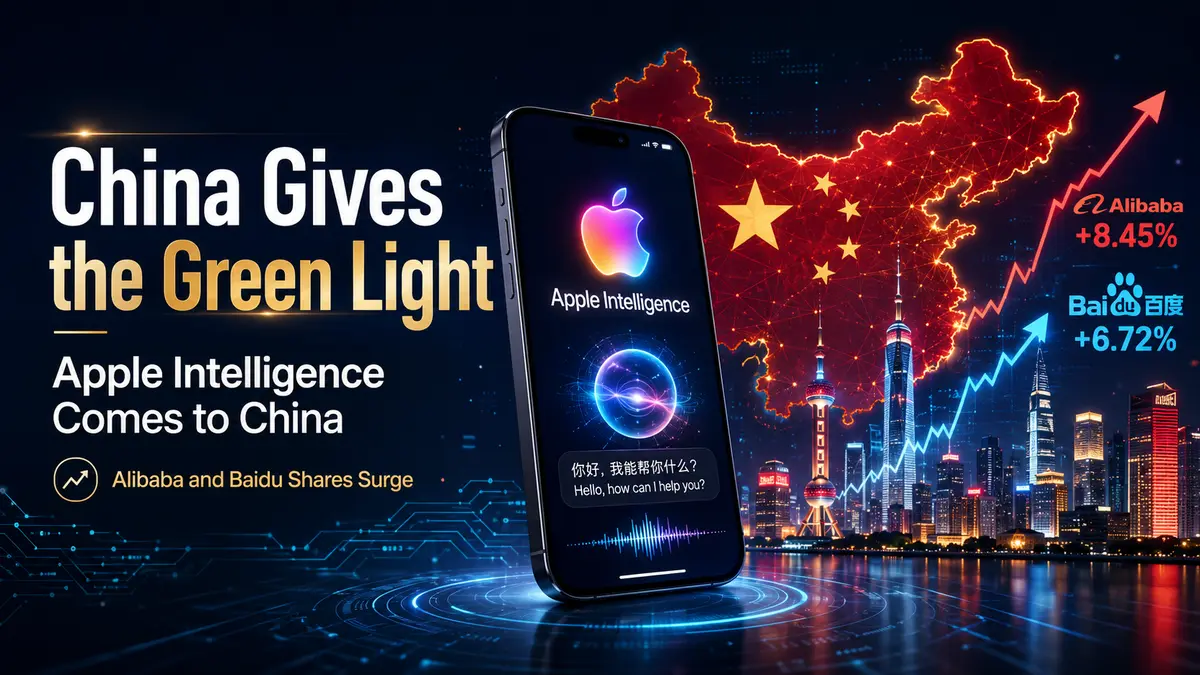
Thursday began on a celebratory note for China’s technology sector. Shares of Alibaba Group BABA ... traded in Hong Kong jumped nearly 5% by the middle of the trading session, while Baidu BAIDF ... gained around 4%. The reason for this widespread optimism is simple: Apple AAPL ... has finally received the long-awaited approval from Chinese regulators to launch its artificial intelligence services in the country.
The market had been waiting for this development for months, if not longer. Apple Intelligence, the company’s flagship AI platform, is already available in the United States and several other countries but has remained unavailable in China. The delay was not caused by technical difficulties but by Beijing’s strict regulatory requirements.
Chinese law requires all generative AI services to undergo mandatory registration and review before they can be offered to the general public. For Apple, this barrier proved more difficult to overcome than it was for many other companies because the Cupertino-based technology giant wanted to use its own models and proprietary approach. However, China’s main internet regulator withheld its approval for an extended period.
Now, according to information reported by the media, Apple appears to have made concessions that satisfied all parties. AI features on iPhones in China will not operate solely using Apple’s proprietary technology. Instead, they will rely on Chinese AI models—not just one, but two—from Alibaba and Baidu.
Alibaba’s Qwen and Baidu’s Technology: The Two Pillars of Apple Intelligence in China
According to Reuters sources familiar with the matter, Apple Intelligence in China will have a two-layer architecture. Its foundation will be Alibaba’s Qwen large language model, which is considered one of the most powerful and advanced AI models currently available in China.
Alibaba has officially confirmed its involvement, stating that Qwen will support Apple’s AI services across the company’s entire device ecosystem, including the iPhone, Mac, iPad, and even the Vision Pro headset.
However, Alibaba is not the only participant in this partnership. Baidu, which has spent several years developing its own AI technology under the Ernie brand, has also joined the alliance. According to some reports, Baidu’s technology may be used for specific features or more specialized tasks, such as processing voice requests or supporting local search functions.
This solution appears to be more than a simple compromise. It is a carefully calculated strategic move. Instead of challenging the regulator and attempting to impose its own standards, Apple chose to integrate with leading local technology providers.
This approach not only accelerated the approval process but also gave Apple access to some of China’s strongest AI models, which have been trained using the local language, domestic content, and Chinese cultural context. For users, this means that AI on their iPhones will not merely speak Chinese like a translation tool. It will communicate more naturally, as though it were developed within the local cultural environment.
Why This Matters for Apple and China
For Apple, this step had become essential. The company had been losing market share in China, its second-largest market after the United States. Several factors contributed to this decline, including the country’s economic slowdown, growing consumer support for domestic brands such as Huawei and Xiaomi, and the absence of modern generative AI features on the iPhone.
While Apple’s competitors promoted built-in assistants powered by generative AI, intelligent camera systems, and personalized recommendations, the iPhone increasingly appeared to be falling behind in China. Apple Intelligence was expected to correct this imbalance.
However, receiving regulatory approval is only the first step. The second is technical integration. Apple’s engineers will need to adapt the company’s interfaces and APIs to work with the Qwen and Ernie models so that users do not notice a significant difference between Apple’s native AI experience in the United States and the localized AI experience in China.
This will not be a simple task, but Apple already has experience integrating local services into its products. For example, the company uses Amap instead of Google Maps for certain services in China.
For Alibaba and Baidu, the partnership sends a powerful signal to the market. Their technology will now support AI services used by hundreds of millions of Chinese iPhone owners. This is more than just a commercial agreement. It is recognition that their AI models have reached a globally competitive level.
Unsurprisingly, this has stimulated investor interest, as reflected in Thursday’s stock market performance. Alibaba and Baidu shares are rising not only because the companies may generate revenue from the agreement—although they almost certainly will—but also because the partnership strengthens their reputations and could open the door to new corporate contracts.
Investor Reaction: What Did the Market Say?
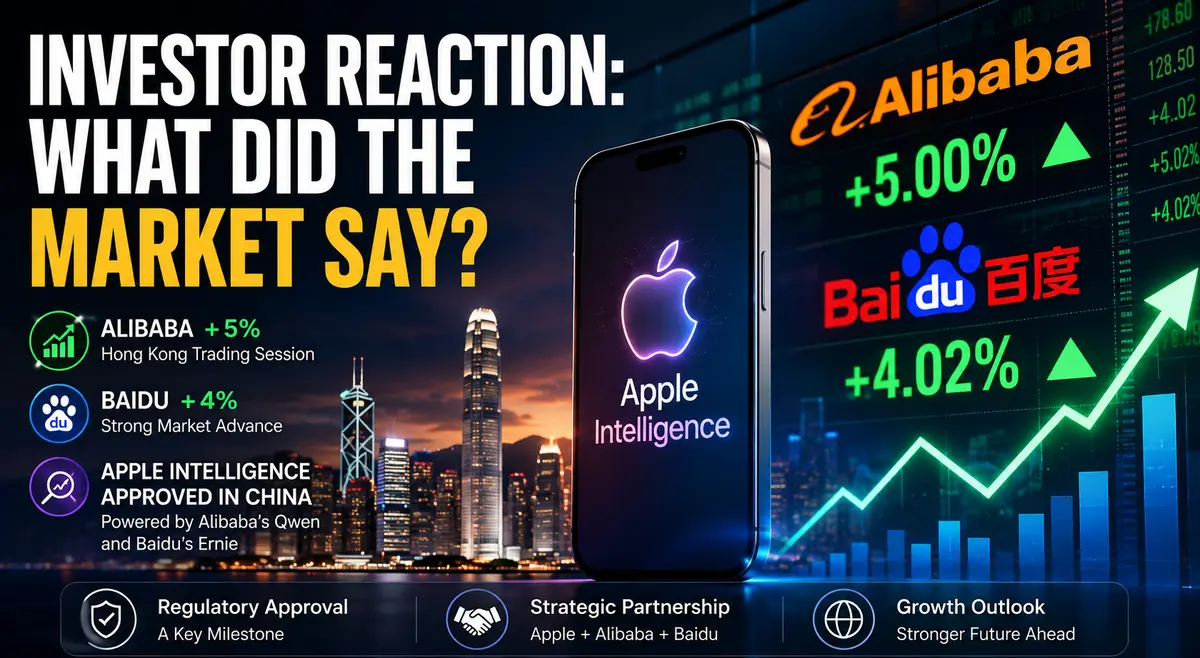
Alibaba shares listed in Hong Kong gained nearly 5% by the middle of the trading session, following several weeks of largely sideways movement. Baidu jumped approximately 4%, representing another significant advance.
Investors are clearly pricing in not only the regulatory approval itself but also the partnership’s long-term potential.
Why did the market react so strongly at this particular moment? The development removes one of the main obstacles to Apple’s growth in China while simultaneously improving the growth prospects of Alibaba and Baidu.
Previously, investors questioned whether Apple could maintain its position in the face of intense competition and substantial regulatory barriers. Those concerns are now beginning to fade. Apple Intelligence is becoming a reality in China, and it will be powered by some of the country’s leading AI models.
Interestingly, Apple shares in the United States also recorded a modest increase in pre-market trading, although the movement was not nearly as dramatic. This is understandable because China is an important—but not the only—growth driver for Apple’s global business.
For the Hong Kong and Shanghai markets, however, the announcement became a major catalyst. Asian investors tend to be considerably more sensitive to changes in China’s regulatory environment.
Looking Ahead: What Will Change for Users?
For ordinary iPhone owners in China, the launch of Apple Intelligence means their smartphones will finally receive the features that have already been widely discussed in Western technology reviews.
These may include an intelligent assistant capable of writing text, rewriting emails, searching for information online, generating images, and even helping users organize their daily schedules. These functions will now be available in Chinese and adapted to local conditions.
Perhaps the most important question is how the launch will affect competition. Huawei and Xiaomi have offered their own AI solutions for some time, but Apple is now entering the race with powerful local partners.
Rather than simply trying to catch up, the Cupertino-based company is becoming part of China’s domestic AI ecosystem. This changes the competitive landscape. Chinese smartphone manufacturers could previously point to the iPhone’s lack of advanced AI capabilities as a major weakness. That argument may soon disappear.
Political and Regulatory Considerations
The political context cannot be ignored. China has spent several years promoting the concept of technological sovereignty, with cloud computing and artificial intelligence representing two of the most tightly controlled areas.
The approval of Apple Intelligence using Chinese AI models is more than a bureaucratic formality. It demonstrates that Beijing is prepared to cooperate with foreign companies—but on its own terms.
It also sends a message to other Western businesses: companies that want to provide AI services in China must be prepared to integrate with local technologies rather than simply importing their existing solutions.
At the same time, the development represents a victory for Apple. The company has experienced several difficult years in China, including declining sales, supply-chain challenges, and reports of possible restrictions on the use of iPhones within parts of the government sector.
By securing approval for Apple Intelligence, Apple is demonstrating its willingness to negotiate and adapt rather than engage in confrontation. On such an enormous and demanding market, this may be the only realistic strategy.
Conclusion: A Triumph of Compromise
The approval of Apple Intelligence in China is a classic win-win-win situation.
Apple gains access to approximately 1.4 billion consumers with the modern AI capabilities it needs to keep its products competitive. Alibaba and Baidu receive recognition of their technological strength and gain a major corporate client, boosting their market valuations and creating new commercial opportunities.
Meanwhile, Chinese regulators demonstrate that they can control the development of artificial intelligence within the country without completely discouraging foreign investment.
The market’s response was overwhelmingly positive. Shares of the technology giants rose, suggesting that investors believe the partnership has significant potential.
Naturally, several questions remain. How quickly will the integration be completed? How smoothly will Apple’s interfaces be adapted? Could new technical or regulatory complications emerge?
Nevertheless, the first and most difficult stage appears to have been completed. This means that Chinese iPhone users may be able to try the new AI assistant within the coming months.
The launch could mark the beginning of a new phase in China’s digital revolution.




Comments
No comments yet. Be the first to share your thoughts!
Authentication Required
You must be logged in to post a comment.