

WTI Oil Loses Ground: Asian Session Makes Its Adjustments
Morning on the Commodities Front: Oil Starts the Day in Negative Territory
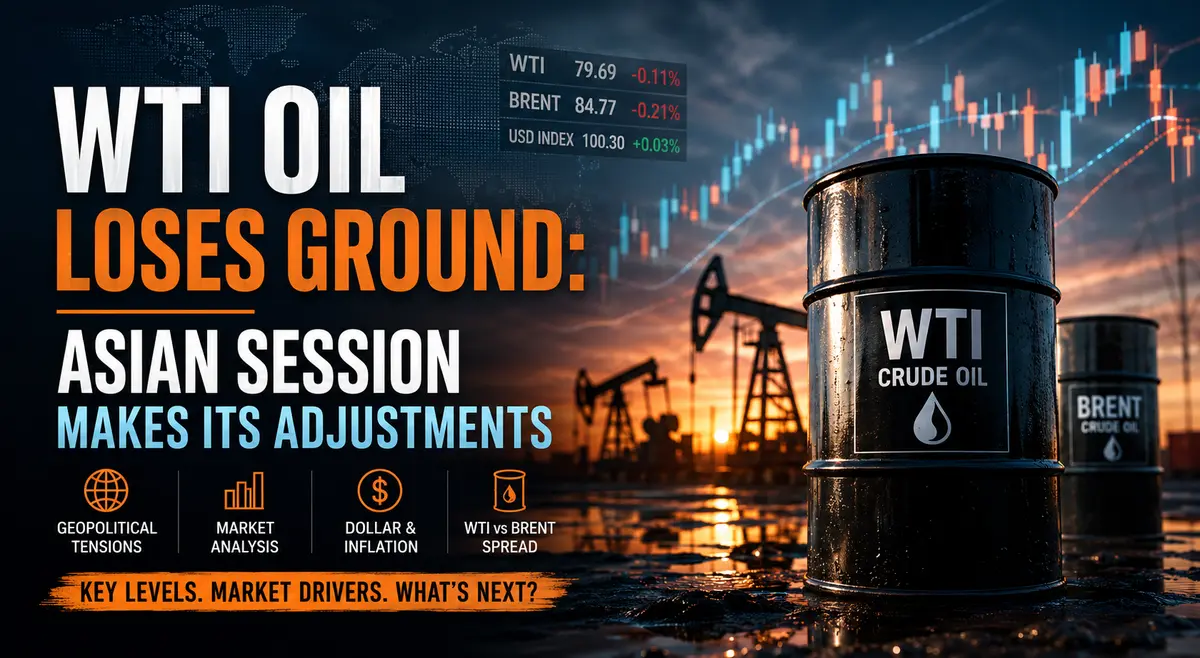
Oil futures opened Thursday’s Asian trading session with a small but telling decline. August-delivery WTI WTI ... crude futures on the New York Mercantile Exchange fell by 0.11% to $79.69 per barrel. The drop may appear insignificant—just eleven hundredths of a percent—but in commodity markets, even such modest movements are rarely accidental. Behind every price tick lies a complex combination of calculations, expectations, and an invisible struggle between buyers and sellers. The Asian session often sets the tone for the rest of the trading week.
It is particularly interesting that the decline is taking place against the backdrop of a stronger dollar, even though the increase is only symbolic. The U.S. Dollar Index gained 0.03% and held at 100.30. This may seem insignificant, but because oil is priced in U.S. dollars, even such a microscopic increase can trigger profit-taking. The mechanism is straightforward: when the dollar appreciates, oil becomes more expensive for holders of other currencies, potentially reducing demand. This time, however, the situation is far more complex than a simple currency correlation.
The technical picture once again reminds us that the market is in a state of tense equilibrium. Support is located at $70.77 per barrel, providing a relatively wide downside buffer and leaving room for manoeuvre. Resistance is significantly higher at $81.27. The price is currently hovering almost midway between these two levels, although it remains closer to the upper boundary. This is an important signal: sellers are not yet prepared to send oil into a deep decline, but buyers are no longer showing the same level of aggression as before.
Brent and WTI: Twin Brothers with Different Personalities
September-delivery Brent crude, traded on ICE, also moved into negative territory, falling slightly more sharply by 0.21% to $84.77 per barrel. The difference between the two benchmark grades, known among traders as the spread, stood at $5.08. This is a relatively normal figure, although the spread can occasionally become either much wider or much narrower.
The spread is more than just a statistical figure. It is an important indicator of market sentiment. When Brent rises faster than WTI, it may indicate supply problems in regions outside the United States. When WTI outperforms Brent, the difference is often connected to local factors within the U.S. market.
This time, the decline in both grades appears synchronized, although Brent BZUSD ... has fallen slightly more noticeably. One possible explanation is that the European market is more sensitive to geopolitical developments, and there is currently no shortage of them. Iran, the Strait of Hormuz, and the possibility of supply disruptions all affect Brent more strongly than American WTI, which remains more closely connected to the domestic U.S. market.
However, the situation in the United States is also far from reassuring. According to the latest figures, crude oil inventories are not declining as quickly as expected, while drilling rig activity remains at a low level. As a result, both benchmark grades have come under pressure, and the Asian session has merely confirmed this trend.
Why Is Oil Falling When It Should Be Rising?
This is the question currently troubling many traders and analysts. Geopolitical tensions in the Middle East have reached an extreme level. The United States has carried out strikes against Iranian facilities for the fifth consecutive day, while Tehran is threatening to close the Strait of Hormuz—a strategically vital route for global oil supplies.
Under such circumstances, oil prices would normally be expected to surge. Instead, they are falling. Something appears not to add up.
This apparent paradox can be explained by several factors. First, markets have already begun to adjust to the news. The first strike might trigger an emotional reaction, as might the second. By the fifth day of escalation, however, investors tend to stop panicking unless they see actual disruptions to oil supplies.
This is known as the desensitization effect, and it works against oil bulls. As long as oil continues to reach the market, tankers continue passing through the strait, and inventories remain at acceptable levels, there is no solid foundation for panic.
Second, other forces are pushing prices lower even when the news appears bullish. These forces are connected to macroeconomic expectations. U.S. inflation data came in softer than forecast, and the markets are increasingly leaning towards the expectation that the Federal Reserve will leave interest rates unchanged.
This may be positive for long-term economic growth, but it is less supportive of commodity speculation. When interest rates remain high, the cost of storing oil and financing trading positions increases. Some traders therefore prefer to reduce their exposure in order to lower their expenses. This pressure can outweigh even significant geopolitical risks.
Third, China must not be overlooked. The world’s largest oil importer reported disappointing economic growth of only 4.3% in the second quarter—the weakest result in three years.
For the oil market, this sends a direct signal: if the Chinese economy is slowing, demand for fuel is also likely to weaken. China purchases enormous volumes of crude oil, and even relatively small changes in its imports can have a major impact on global prices. Investors understand this and are beginning to revise their forecasts.
Technical Levels: Where Will the Decline Stop?
The support level at $70.77 per barrel appears strong enough to prevent the price from entering a much deeper correction. Nevertheless, this remains a relatively low threshold—almost $9 below the current market price.
In other words, from a technical perspective, oil has room to fall by almost 11% without breaking through any major support levels. This is a concerning signal for traders expecting a rapid recovery.
Resistance at $81.27, by contrast, is very close—only around $1.50 above the current price. This means that any attempt to move higher is likely to encounter a dense wall of sellers seeking to lock in profits at that level.
Considering that oil has been unable to establish itself confidently above $80 for several weeks, this resistance level has also become psychologically important. The market appears to be saying: “We tried to move higher, but the sellers were stronger. Let us pull back, regain strength, and try again.”
This configuration creates an interesting dynamic. Oil is trading within a relatively narrow range, with strong support below and heavy resistance above. This is a classic consolidation pattern that often precedes a powerful price movement.
The only question is which direction the breakout will take. If geopolitical tensions intensify, oil could break above $81.27 and continue moving higher. If economic data continues to disappoint and the dollar strengthens, oil could test the lower boundary of the range.
The Dollar, Inflation, and Interest Rates: The Macroeconomic Backdrop
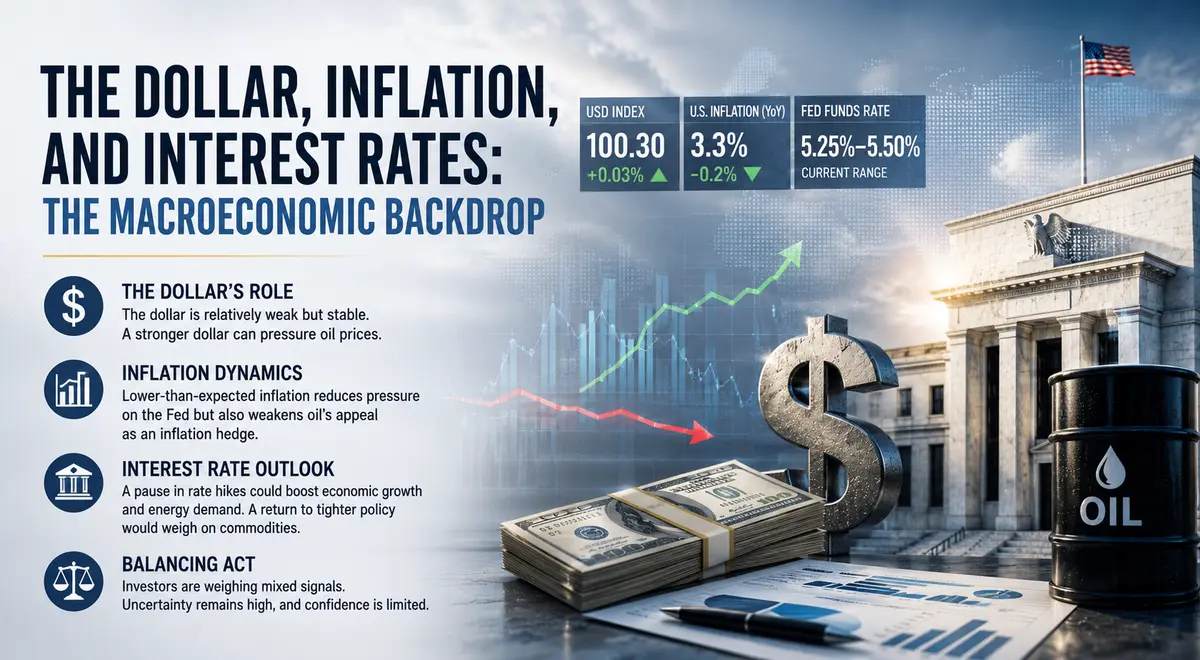
It is essential to analyse the oil market together with currency and monetary factors. The dollar is currently going through a relatively weak period, although it is far from collapsing.
A U.S. Dollar Index reading of 100.30 remains relatively high by historical standards, even though the index was recently higher. The dollar’s decline over recent weeks was driven by expectations that the Federal Reserve would soften its monetary policy. These expectations partially limited the decline in oil prices. However, as soon as the dollar begins to show signs of stabilization, oil starts losing support.
The softer-than-expected U.S. inflation figures are creating a mixed effect. On the one hand, lower inflation reduces pressure on the Federal Reserve and allows it to keep interest rates unchanged, which may support economic growth and demand for oil.
On the other hand, slowing inflation reduces the appeal of commodities, including oil, as inflation hedges. Investors begin asking themselves whether they still need this form of protection when inflation is already slowing. Some respond by closing their oil positions and redirecting capital into other assets.
The outlook for interest rates will remain a key factor for oil over the next several months. If the Federal Reserve genuinely pauses its monetary tightening cycle, the decision could provide a new boost to economic activity and, consequently, energy demand.
However, if inflation accelerates again or signs of economic overheating emerge, the central bank may be forced to resume raising interest rates. This would put renewed pressure on commodity markets. For now, investors appear to favour the first scenario, although confidence remains limited.
Brent and WTI: A Premium for Quality or for Risk?
The $5.08 difference between Brent and WTI is more than just a number. It reflects global market imbalances.
Brent traditionally trades at a premium because it is a more international benchmark. It is produced in the North Sea and serves as a reference price for crude oil traded across Europe, Africa, and parts of Asia.
WTI is more closely connected to the U.S. market, and its price frequently reflects local factors, including inventory levels in Cushing, Oklahoma, pipeline capacity, and drilling activity.
Under current conditions, the spread expands or contracts depending on which risks the market considers most important. When investors are concerned about disruption in the Middle East, Brent may receive an additional risk premium because it is more vulnerable to supply interruptions involving the Suez Canal or the Strait of Hormuz.
WTI is relatively better protected from such risks because American crude has traditionally been consumed domestically or exported to nearby countries.
However, the situation has changed somewhat in recent years. The United States has become a major oil exporter, meaning that WTI is now also influenced by global demand. This has strengthened the correlation between the two benchmarks, while the spread now tends to remain within a relatively narrow range.
The current spread of $5.08 lies somewhere between its historical extremes, suggesting a degree of balance in the market. A sudden widening of the spread could indicate serious problems in one region. A narrowing spread, meanwhile, would suggest that market conditions are becoming more closely aligned.
Investors in Search of Balance
What is currently driving investor behaviour? The commodity market has developed a particularly interesting structure. On one side, geopolitical risks are pushing prices higher. On the other, macroeconomic uncertainty is pulling them lower.
This conflict creates volatility, making oil futures both attractive and dangerous for speculative traders.
Long positions in oil remain relatively popular, but their number has begun to decline. Futures and options data indicate that major hedge funds are gradually reducing their bullish exposure and shifting towards more neutral strategies.
This suggests that even the most committed oil bulls are beginning to question whether the current upward momentum has already exhausted itself.
At the same time, short positions are increasing, although not as rapidly as might be expected. Bears are also uncertain about their strength because too many factors could suddenly move in oil’s favour.
An escalation of the conflict, supply disruptions, or an unexpected decline in inventories could instantly force short sellers to close their positions. As a result, the market remains frozen in a state of tense anticipation. The decline during the Asian session therefore appears more like a technical correction than the beginning of a long-term downward trend.
What Comes Next? Several Plausible Scenarios
The first scenario involves stronger oil prices following a genuine geopolitical escalation. If Iran takes actual steps to restrict shipping through the Strait of Hormuz, or if the United States launches more damaging strikes against Iranian infrastructure, oil prices could quickly break through resistance and move towards $85 per barrel or higher.
Under this scenario, Brent could reach $90, while the spread between Brent and WTI could widen to $6–7. Given the level of tension in the region, this remains a realistic possibility.
The second scenario involves a further correction driven by macroeconomic pressure. If economic data from China continues to disappoint and the dollar begins strengthening more decisively, oil could fall towards support around $75 per barrel or even lower.
This would not necessarily represent a catastrophe. It could simply be a normal correction within a broad trading range. However, the decline could continue for several weeks and significantly weaken sentiment among buyers.
The third and intermediate scenario is the continuation of the current trading range. Oil could remain between $78 and $81 while waiting for new market drivers.
The conflict in the Middle East may continue to simmer without developing into a full-scale war, economic data could remain mixed, and the dollar may stay relatively stable. This is perhaps the most likely scenario over the next several days, although it does not guarantee that the market will not produce an unexpected surprise.
Instead of a Conclusion: Keep Calm, Just Keep Calm
The current decline in WTI crude during the Asian session is not a reason to panic. It appears to be ordinary market noise within the broader context of consolidation.
The oil market is currently passing through a period in which even minor news can trigger significant price movements. Nevertheless, major market participants prefer to wait rather than act impulsively. This is understandable, because millions of dollars—and millions of barrels—are at stake.
Investors should monitor not only oil prices but also the structure of the market, including the Brent-WTI spread, the shape of the futures curve, and hedge fund activity. These indicators may provide more reliable signals about the future direction of the market than momentary news headlines.
It is also worth remembering that oil is far too important an asset to react to every minor development. Sometimes the best decision is simply to wait, observe how the situation develops, and then make a balanced and carefully considered choice.
This is precisely one of those moments when a good trader is a patient trader.


Comments
No comments yet. Be the first to share your thoughts!
Authentication Required
You must be logged in to post a comment.