

Oil Swings: Why WTI Is Rising in Asia While the World Holds Its Breath
Introduction: A Friday Morning on Commodity Markets
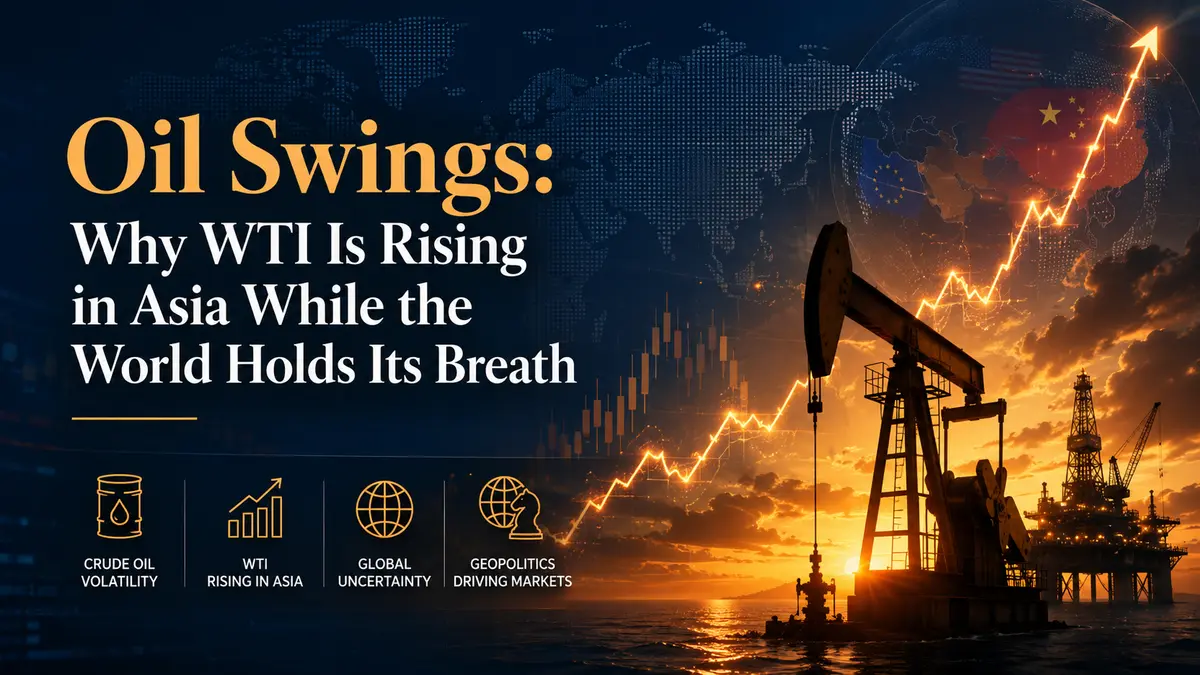
Asian trading on Friday began with a scenario that has already become familiar in recent weeks: WTI crude oil is showing moderate growth. August futures on the New York Mercantile Exchange added about 0.3%, stopping near $72.28 per barrel. At first glance, this may seem unremarkable: ordinary volatility during an ordinary trading day. But behind this routine figure lies a complex picture of geopolitical contradictions, economic fears, and the fragile balance between supply and demand.
The rise in prices is taking place against the backdrop of a weaker U.S. dollar — the dollar index fell by a quarter of a percent to 100.43 points. The connection is direct: the cheaper the dollar, the more attractive commodity contracts become for holders of other currencies. But this alone is far from enough to explain the current dynamics. Oil is now reacting to an entire set of events, each of which pulls the price either upward or downward in its own way. Let’s take a closer look at what is really happening in the black gold market.
Technical Picture: Levels That Speak
Support and Resistance Zones
Friday’s trading outlined clear technical reference points. Support settled at $67.82 — a level to which the price fell during the session, but where it repeatedly found buyers. Resistance was recorded at $76.08, although current trading is taking place significantly below this zone.
The gap between these levels is almost $9, which suggests one thing: the market is still searching for direction. A wide range is a sign of high uncertainty, when neither bears nor bulls can gain a decisive advantage. Traders are acting cautiously, reluctant to push the price toward extreme values.
Comparison with Brent: The Spread as an Indicator
The price difference between the two main crude benchmarks provides interesting information. Brent futures for September delivery rose by a quarter of a percent to $76.49 per barrel. The spread between Brent and WTI is now about $4.21 in favor of the European benchmark.
This widening spread reflects the geographical characteristics of the market. WTI is more sensitive to internal U.S. dynamics — inventory levels in Cushing, the state of pipeline infrastructure, and the activity of American producers. Brent, meanwhile, depends more heavily on global factors — the situation in the Middle East, OPEC+ policy, and demand from China and India.
The fact that the spread remains above $4 indicates that the geopolitical risk premium in Persian Gulf countries is still present. And this premium is unlikely to shrink in the near future.
The Iran Factor: The Main Driver or the Main Mystery
Renewed Strikes and Rising Tensions
The main news of the week shaking oil markets is the escalation of the conflict between the United States and Iran. President Trump announced the end of the ceasefire and intensified strikes on Iranian targets. Tehran responded, and the region once again found itself at the center of a military confrontation.
For the oil market, this means one thing: the Strait of Hormuz — a bottleneck through which around 20% of the world’s oil passes — is once again at risk. Any threat to this corridor automatically adds several dollars to the price of a barrel simply because of fear. Markets price in risks even if actual supplies have not yet been disrupted.
But there is another side to the coin. The rise in oil prices caused by geopolitics also fuels inflation expectations in the United States. And high inflation, as we know, pushes the Federal Reserve toward a tighter policy stance. Tighter monetary policy, in turn, can slow economic growth and reduce demand for energy resources.
As a result, the same event has a two-directional effect on oil prices. The short-term effect is growth caused by fears of supply disruptions. The long-term effect is downward pressure due to the possibility of recession. The market is now trying to understand which of these effects will outweigh the other.
Diplomatic Background: The Calm Before the Storm
Notably, diplomatic efforts are continuing in parallel with military action. According to informed sources, regional mediators are trying to save the memorandum of understanding between Washington and Tehran.
This diplomatic track is the only thing preventing oil prices from exploding higher. If markets were convinced that a full-scale war was inevitable, WTI could already be trading above $80. But the hope for negotiations, however faint, limits risk appetite and prevents bulls from accelerating further.
Investors are now in wait-and-see mode. They are watching every statement from the White House and every move by Iranian diplomats. In such an atmosphere, even neutral news can trigger sharp movements — and significant events even more so.
The Dollar Factor: Weakness as Support
The Dollar Index: What Is Behind the Decline
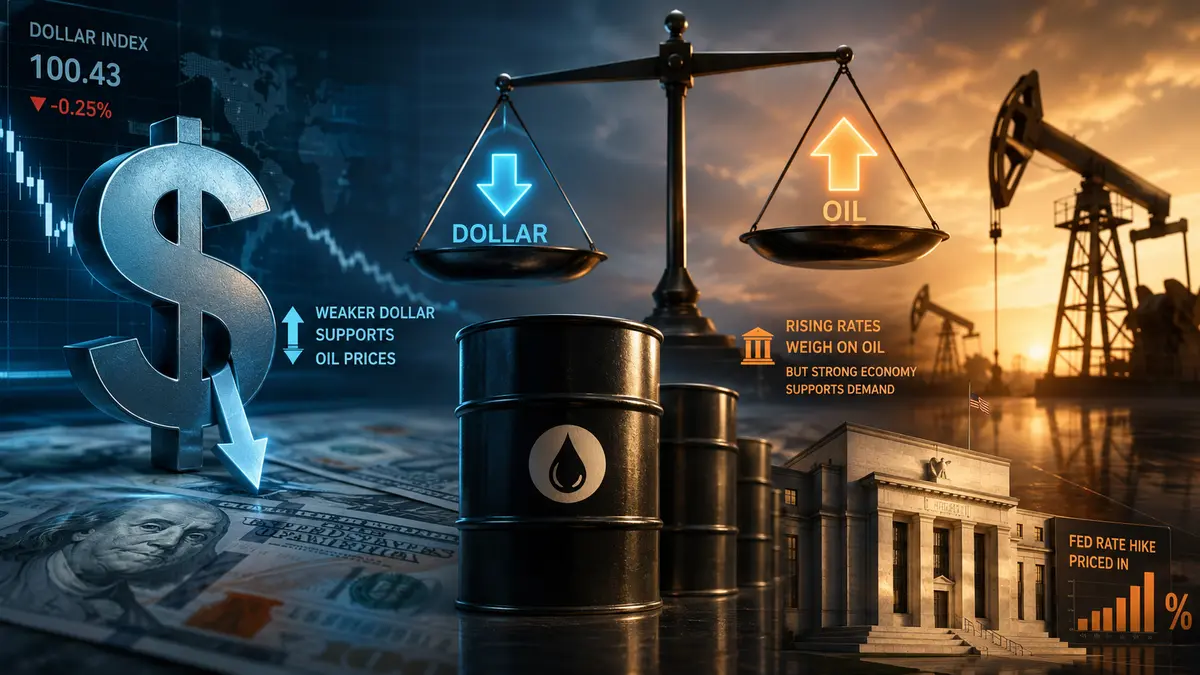
The weakening of the dollar seen on Friday became an additional support factor for oil futures. The USD index, which measures the U.S. currency against a basket of six major currencies, fell to 100.43 points.
For oil, which is traded in dollars, this is a classic positive signal. When the dollar becomes cheaper, buyers from countries with other currencies find it easier to purchase barrels. Demand rises, and prices receive support.
But this week’s dollar weakness is ambiguous. On the one hand, it reflects disagreements within the Federal Reserve over the future path of interest rates. On the other, it reflects investor concerns about geopolitics and its impact on the U.S. economy.
Interestingly, even with a weaker dollar, oil is not showing explosive growth. This suggests that other factors, including recession fears, are exerting pressure that outweighs the currency effect.
Fed Rates and Their Impact on Oil
Here we arrive at the key contradiction of the current moment. According to CME FedWatch data, markets are increasingly pricing in a Federal Reserve rate hike this year. This is happening precisely because of fears that a geopolitical shock will accelerate inflation.
But interest rates are a double-edged sword for the oil market. On the one hand, higher rates usually strengthen the dollar, which weighs on commodity prices. On the other, rising rates signal a strong economy — and a strong economy consumes a lot of oil.
In the current situation, the market tends to interpret policy tightening as more negative than positive. There are too many signs that the U.S. economy is slowing, and an additional rate hike may become the straw that breaks the camel’s back.
OPEC+ in the Shadows: Why the Cartel Is Silent
Meetings and Decisions
Against the backdrop of geopolitical battles, another important player has somewhat faded into the background — OPEC+. The cartel, which traditionally actively comments on the market situation and adjusts production, has taken a wait-and-see position this week.
OPEC+’s current strategy is careful observation without sudden moves. On the one hand, high oil prices benefit exporters. On the other, excessively high prices can push inflation higher and provoke a recession in developed countries, which would ultimately crush demand and prices.
The cartel has found itself in a classic dilemma: inflate the market as much as possible, but not overdo it. And the geopolitical factor only complicates this task by adding variables that cannot be calculated in advance.
Discipline Within the Alliance
Another aspect that markets are monitoring closely is compliance with production quotas by member countries. Some OPEC+ members traditionally exceed their limits, creating additional supply and putting pressure on prices.
But under current conditions, when demand remains uncertain due to the macroeconomic situation, even a small deviation from quotas can have a noticeable impact on the market balance. That is why traders are closely watching production statistics, looking for any signs of discipline breaking down.
Supply and Demand: Fundamental Reference Points
U.S. Inventories: Unexpected Surprises
Weekly reports from the U.S. Department of Energy on crude oil and petroleum product inventories traditionally influence prices. This week’s data showed that commercial inventories declined more than expected, while refinery processing remains high.
A decline in inventories is a classic bullish signal. But markets reacted to it rather cautiously, which suggests that macroeconomic and geopolitical factors are currently outweighing fundamental data.
Interestingly, the market paid almost no attention to U.S. production data, which remains at record levels. American shale oil producers continue to increase volumes, offsetting production declines in other regions.
Demand from China: Recovery or Stagnation
The China factor remains one of the main mysteries for oil traders. The world’s second-largest economy is showing signs of recovery after a period of stagnation. Inflation data published this week showed continued growth in consumer prices, which usually points to a revival in demand.
However, the pace of recovery remains slower than expected. China’s oil imports, although higher than last year, are still far from pre-crisis peaks. Investors are waiting for more aggressive stimulus from the Chinese government that could boost the economy and, accordingly, oil demand.
For now, the market sees a picture of mixed signals, which adds uncertainty to oil prices.
India and Other Consumers
Against the backdrop of China’s slowdown, India’s role as a driver of oil demand has grown. The country is rapidly increasing imports, taking advantage of favorable prices and a growing economy. Indian refineries are operating at high utilization rates, processing cheap Russian oil and exporting finished products.
Southeast Asia is also gradually recovering, although the process remains uneven. Overall, emerging markets continue to support global oil demand, despite recession fears in developed countries.
Market Psychology: What Prices Really Depend On
The Role of Speculators and Hedge Funds
The oil market has long been shaped not only by fundamental factors, but also by the expectations of major players. Hedge funds managing billion-dollar portfolios can move the market in the short term almost on their own.
At the moment, these funds’ positioning looks rather cautious. Open interest data shows that speculators have reduced both long and short positions, preferring to stay in cash and wait for clearer signals.
This behavior increases volatility. When liquidity is low, any significant inflow of orders can cause a sharp price movement. The market has become like a powder keg — it only takes a spark to trigger an explosion, regardless of direction.
Fear of Missing Out and Fear of Losses
On an emotional level, traders are now caught between two fears. The fear of missing out on a rally if geopolitics suddenly spins out of control and oil surges to new highs. And the fear of losses if a recession does materialize and prices collapse.
This confrontation makes the market nervous and erratic. Sharp intraday reversals may occur on news that would have gone unnoticed at another time. And this nervousness will become the main characteristic of trading in the coming weeks.
Conclusion: Waiting for a Trigger
WTI oil futures, which rose by 0.28% on Friday, are only the visible part of the iceberg. Behind this modest figure lies an extremely complex puzzle, where pieces of geopolitics, macroeconomics, technical levels, and market psychology form a picture that no one can fully read.
The price of $72.28 per barrel is a point of balance between opposing forces. Between fear of escalation in the Middle East and fear of a global recession. Between a weaker dollar and expectations of higher rates. Between supply shortages and restrained demand.
Support at $67.82 and resistance at $76.08 define the corridor in which oil will trade until an event occurs that can knock the price out of this range. Such an event does not necessarily have to be a global catastrophe — sometimes a statement from an official or inventory data is enough to wake up a dormant market.
The rise in oil during Asian trading may simply be a technical correction, or it may become the beginning of a more sustained movement. In a world where military action alternates with diplomacy and economic data contradicts itself, any forecast remains only an assumption.
One thing can be said with certainty: there will be no calm days on the oil market. Ahead lie new waves of volatility, unexpected reversals, and possibly historic price levels. The only question is which direction this market will choose when the accumulated tension finally finds an outlet.

Comments
No comments yet. Be the first to share your thoughts!
Authentication Required
You must be logged in to post a comment.