

Asian Stocks Fall Amid Strikes on Iran and Samsung
Introduction: A Thursday When Geopolitics and Corporate News Hit Markets
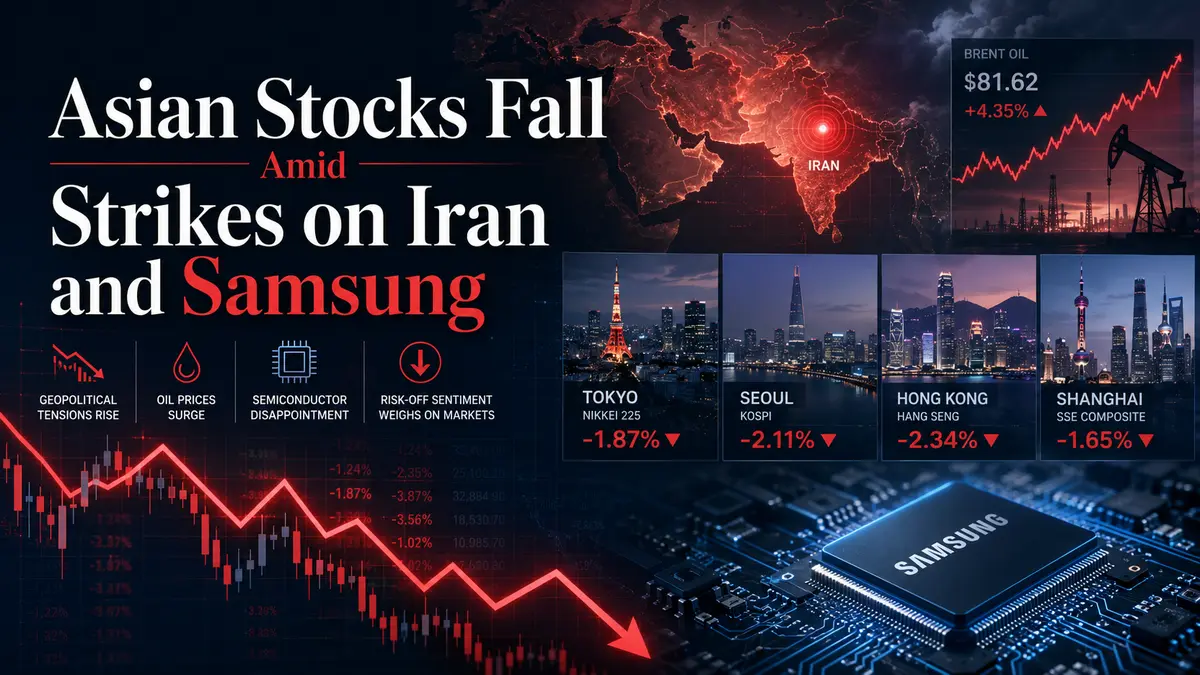
Thursday, Asian trading session. Investors in Tokyo, Seoul, Shanghai, and Hong Kong open their terminals and see red numbers. Most Asian stock markets are declining amid new U.S. military strikes on Iran and rising oil prices, which have suppressed risk appetite. An additional negative factor was investor disappointment with Samsung Electronics’ results, which continues to weigh on South Korean stocks.
Wall Street closed mixed overnight after the minutes of the Federal Reserve’s June meeting confirmed a cautious monetary policy stance. Nasdaq 100 and S&P 500 futures were trading unchanged on Thursday, giving the market no clear direction.
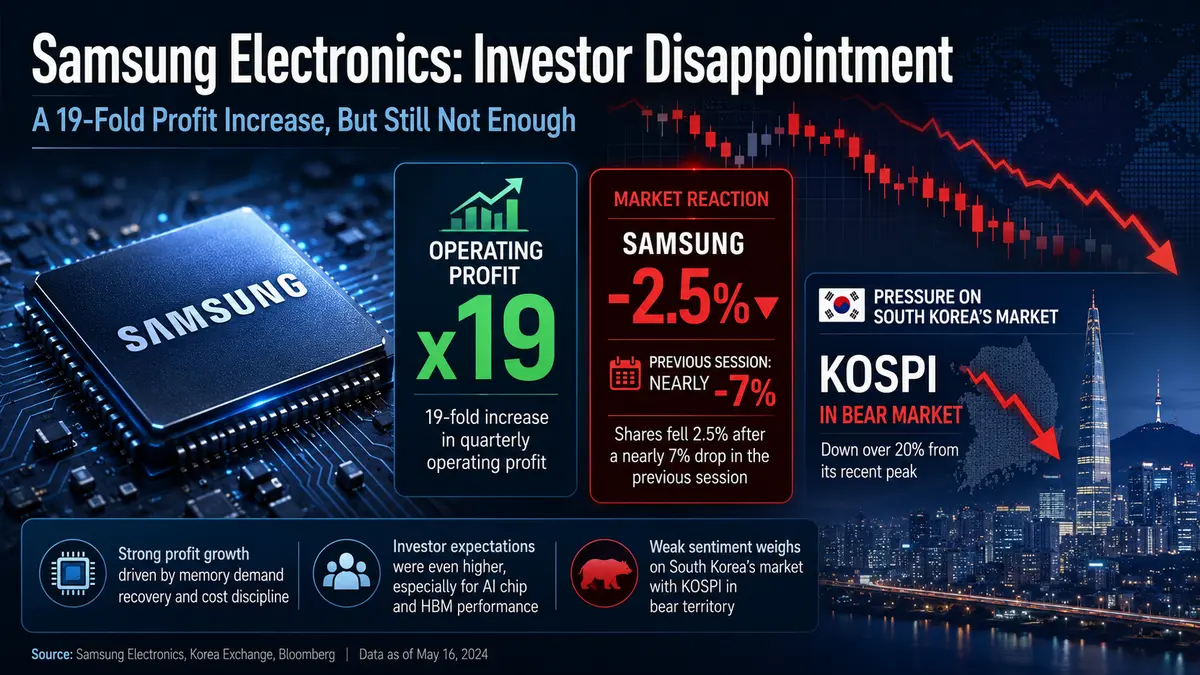
The latest wave of selling followed a volatile week for semiconductor stocks. Profit-taking last week accelerated on Tuesday after Samsung Electronics’ 19-fold increase in quarterly operating profit failed to meet investors’ elevated expectations.
South Korea remained under pressure. Samsung fell 2.5% after dropping nearly 7% in the previous session, while LG Innotek lost more than 5%. However, SK Hynix rebounded 3.5% after demand for the company’s planned $28 billion U.S. market offering exceeded the available shares by seven times.
The KOSPI fell nearly 1.8%, extending its decline after officially entering a bear market this week — the index has dropped more than 20% from the record high reached last month.
Japan became the regional growth leader. The Nikkei 225 gained about 1.5%, while the TOPIX rose 0.5% thanks to renewed buying in chip supplier stocks. Murata Manufacturing climbed nearly 5%, while TDK rose more than 2%. Kioxia Holdings gained as much as 11% after Bain Capital confirmed its exit from its investment in the flash memory manufacturer.
In other markets, Australia’s S&P/ASX 200 fell 0.8%, the Shanghai Composite lost 0.6%, the Shanghai Shenzhen CSI 300 declined 0.3%, and Hong Kong’s Hang Seng weakened 0.7% ahead of China’s June inflation data. Singapore’s STI delivered the best performance, rising 0.7%.
Market sentiment remained restrained after the United States launched another strike on Iran’s military infrastructure. Iran responded with new missile and drone attacks on U.S. military facilities in Kuwait and Bahrain, while President Donald Trump said that the temporary understanding with Tehran was effectively “over.”
Let’s break down why Asian markets are falling, how geopolitics and corporate news are affecting investor sentiment, and what awaits the region in the coming days.
Geopolitical Background: Iran Back in the Spotlight
New U.S. Strikes on Iran
The main topic on Thursday is the latest U.S. military strikes on Iran. The Trump administration said the operations were aimed at protecting commercial shipping through the Strait of Hormuz following recent attacks on cargo vessels.
Iran responded with new missile and drone attacks on U.S. military facilities in Kuwait and Bahrain. President Donald Trump said that the temporary understanding with Tehran was effectively “over,” though he later clarified that he did not expect the conflict to expand.
Market Reaction: Rising Oil Prices and Lower Risk Appetite
Rising oil prices have intensified concerns about inflation. Although oil prices remain significantly below the peaks reached at the beginning of the conflict, any increase in energy prices puts additional pressure on the economy.
Investors are moving away from risk, which is leading to declines in stock markets. Asian markets, which are heavily dependent on exports and global trade, are especially sensitive to geopolitical uncertainty.
Samsung Electronics: Investor Disappointment
A 19-Fold Profit Increase, But Still Not Enough
Samsung Electronics reported a 19-fold increase in quarterly operating profit. This is an impressive result that reflects strong demand for memory chips used in artificial intelligence.
However, investors expected more. Elevated expectations meant that even a 19-fold profit increase was not enough to satisfy the market. Samsung shares fell 2.5% after dropping nearly 7% in the previous session.
Pressure on the South Korean Market
Samsung is South Korea’s largest company and one of the main drivers of the Korean market. The decline in its shares is putting pressure on the entire KOSPI index, which has already entered a bear market after falling more than 20% from its record high.
SK Hynix: An Island of Stability
Demand for the ADR Offering Exceeded Supply by 7 Times
Against the backdrop of general pessimism, SK Hynix is showing growth. The company’s shares rebounded 3.5% after demand for its planned $28 billion U.S. market offering exceeded the available shares by seven times.
This indicates strong investor interest in SK Hynix, which is a leading supplier of memory chips for Nvidia and a key beneficiary of the AI boom.
Why SK Hynix Is Rising
SK Hynix has stronger positions in the HBM memory segment than Samsung. Demand for these chips is growing exponentially, and SK Hynix is at the center of this growth.
Japan: The Regional Growth Leader
Nikkei 225 Gains 1.5%
Japan became the regional growth leader. The Nikkei 225 gained about 1.5%, while the TOPIX rose 0.5%.
The reason was renewed buying in chip supplier stocks. Murata Manufacturing climbed nearly 5%, while TDK rose more than 2%.
Kioxia: Bain Capital Exit
Kioxia Holdings gained as much as 11% after Bain Capital confirmed its exit from its investment in the flash memory manufacturer. This marked the completion of one of the most successful private equity deals in Japan.
Other Markets: Mixed Performance
Australia: Down 0.8%
Australia’s S&P/ASX 200 fell 0.8%. Australia is sensitive to commodity prices, and rising oil prices are putting pressure on the economy.
China and Hong Kong: Awaiting Inflation Data
The Shanghai Composite lost 0.6%, the Shanghai Shenzhen CSI 300 fell 0.3%, and Hong Kong’s Hang Seng weakened 0.7% ahead of China’s June inflation data.
Singapore: The Best Performer
Singapore’s STI delivered the best performance, rising 0.7%. Defensive buying supported the market.
What Comes Next: Scenarios for Asian Markets
Geopolitical Uncertainty
If the conflict between the United States and Iran continues to escalate, Asian markets may continue to fall. Investors will move away from risk, and oil prices may rise even further.
China Inflation Data
China’s inflation data, which is scheduled for release on Thursday, may provide new signals for markets. If inflation comes in above expectations, it could increase pressure on markets.
Fed Minutes
The minutes of the Fed’s June meeting confirmed a cautious monetary policy stance. If the Fed continues to signal a hawkish position, markets may continue to decline.
Conclusion: Asian Markets Under Pressure
Asian stocks are falling amid strikes on Iran and disappointment with Samsung’s results. Most markets in the region are declining, with the exception of Japan, which is showing growth thanks to buying in chip supplier stocks.
Samsung fell 2.5% after dropping nearly 7% in the previous session, while SK Hynix rebounded 3.5% thanks to strong demand for its ADR offering. The KOSPI entered a bear market after falling more than 20% from its record high.
Geopolitical uncertainty and rising oil prices are suppressing risk appetite. Investors remain cautious as they await new signals.
Asian markets are under pressure. Geopolitical uncertainty, corporate news, and macroeconomic signals will determine their direction in the coming days. Investors will closely monitor developments, understanding that the situation could change at any moment.

Comments
No comments yet. Be the first to share your thoughts!
Authentication Required
You must be logged in to post a comment.