

Binance Adds Over 7,000 U.S. Stocks and ETFs: The Crypto Exchange Becomes a Universal Financial Supermarket
Introduction: A Game-Changing Move for 300 Million Users
Imagine waking up in the morning, opening a single app, seeing Bitcoin up 3% overnight, selling part of it, and immediately using those funds to buy NVIDIA stock. No bank transfers, no waiting, no intermediaries. Everything happens in one place, in one currency, at one speed. This is not a futuristic scenario — it is the reality that the world’s largest crypto exchange has just enabled for its users.
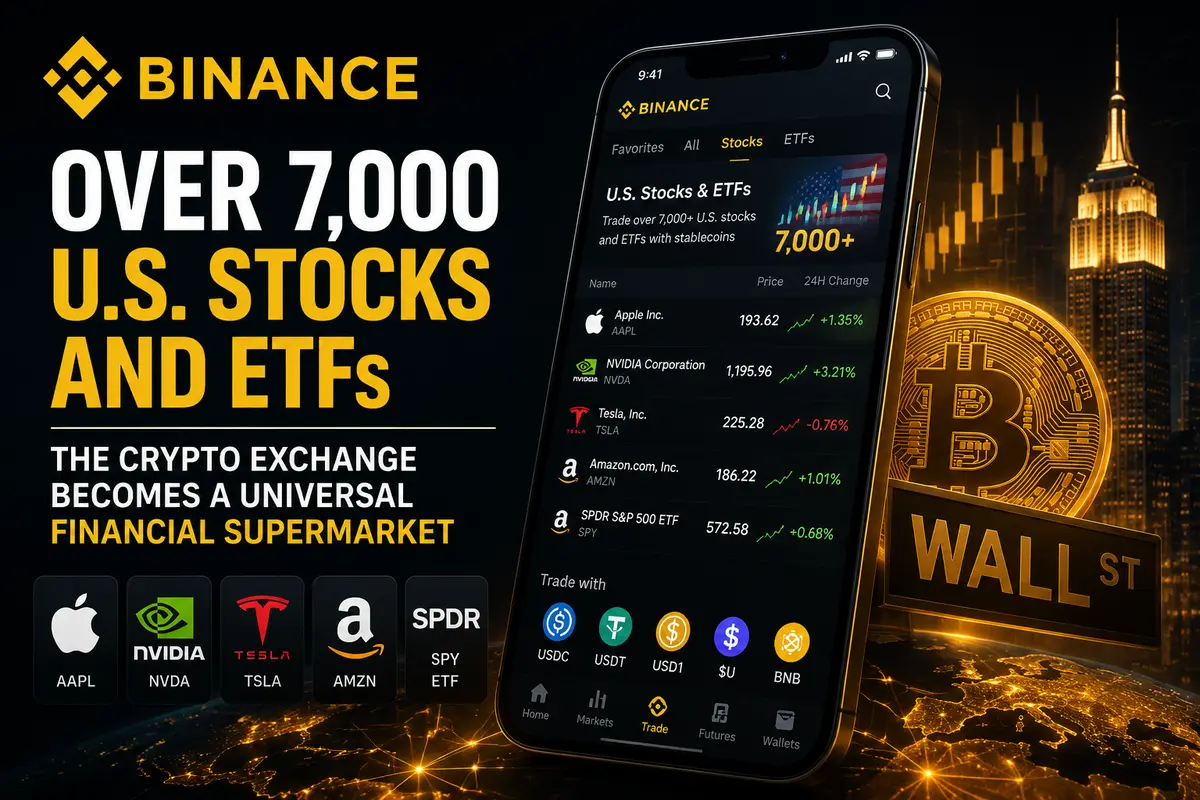
Binance, a platform that has grown from a startup into an empire with 300 million users in just eight years, has made more than just another update. It is making a claim to become a universal next-generation financial hub. More than 7,000 U.S. stocks and ETFs are now available for trading directly in the same interface that was previously reserved exclusively for cryptocurrencies.
Let’s break down what is really behind this announcement, how it works, and why it may turn out to be far more significant than just another feature in a long list of exchange upgrades.
What Binance Has Actually Launched and How It Works
From Crypto Monopoly to a Multi-Asset Future
When Changpeng Zhao launched Binance in 2017, he likely could not have imagined that within eight years his creation would be trading Apple, Tesla, and Amazon alongside Dogecoin and Solana. But today, that is a reality. The platform has introduced functionality that allows users in certain jurisdictions to buy and sell more than 7,000 U.S. stocks and exchange-traded funds (ETFs).
The number 7,000 is striking. For comparison, the New York Stock Exchange lists around 2,800 companies, while NASDAQ has approximately 3,300. This means Binance covers virtually the entire U.S. public equity market, including ETFs that represent baskets of stocks. This is not just “a few popular stocks added” — it is full-scale access to the U.S. equity market.
A key detail that makes this announcement revolutionary is settlement in stablecoins. Users can buy stocks using USDC, USDT, USD1, $U, and even BNB (Binance’s native token). No traditional dollar bank accounts, no expensive conversions, no SWIFT transfers. Just crypto instantly converted into ownership exposure to companies.
Trading is available on a 24/5 schedule — the standard market structure with weekends off, but continuous access during trading days. This is still not crypto-style 24/7 trading, but it matches traditional equity market norms.
Technical Implementation: Tokenization as a Bridge Between Two Worlds
Binance offers access to stocks and ETFs through two mechanisms. The first is direct execution via partnerships with regulated brokers. The second is tokenized securities through its bStocks feature.
What are bStocks?
bStocks are digital tokens pegged to the price of real-world company shares. When you buy a Tesla bStock, you hold a token that reflects Tesla’s stock price in real time. It is not the legal stock itself, but an economic equivalent. You get the same price exposure, the same risk profile, and the same potential returns.
This hybrid model allows Binance to scale the offering. Where broker partnerships exist, trades are executed traditionally. Where they do not, tokenization fills the gap. For the user, the experience is seamless — just a “buy stock” button in a familiar interface.
This approach is not entirely new. Exchanges like FTX (before its collapse) experimented with similar models. But Binance has two major advantages: scale (300 million users) and brand recognition as the most well-known crypto exchange globally.
Why This Matters for Users and the Market
Financial Inclusion for the Unbanked
One of the most overlooked aspects of this launch is reduced barriers to entry. Binance explicitly highlights stablecoin settlement as a way to serve users without access to traditional banking.
This is not just marketing. Hundreds of millions of people globally have internet access but no bank account. They live in countries with unstable currencies, high banking fees, and expensive currency conversion costs. For them, stablecoins are not just an alternative — they are often the only functional financial system.
Now, these users can invest in global stocks with as little as $10 or $100. No bureaucracy, no documentation, no need for a foreign bank account. This is financial democratization in practice.
The Power of Convenience: Why Users Stay
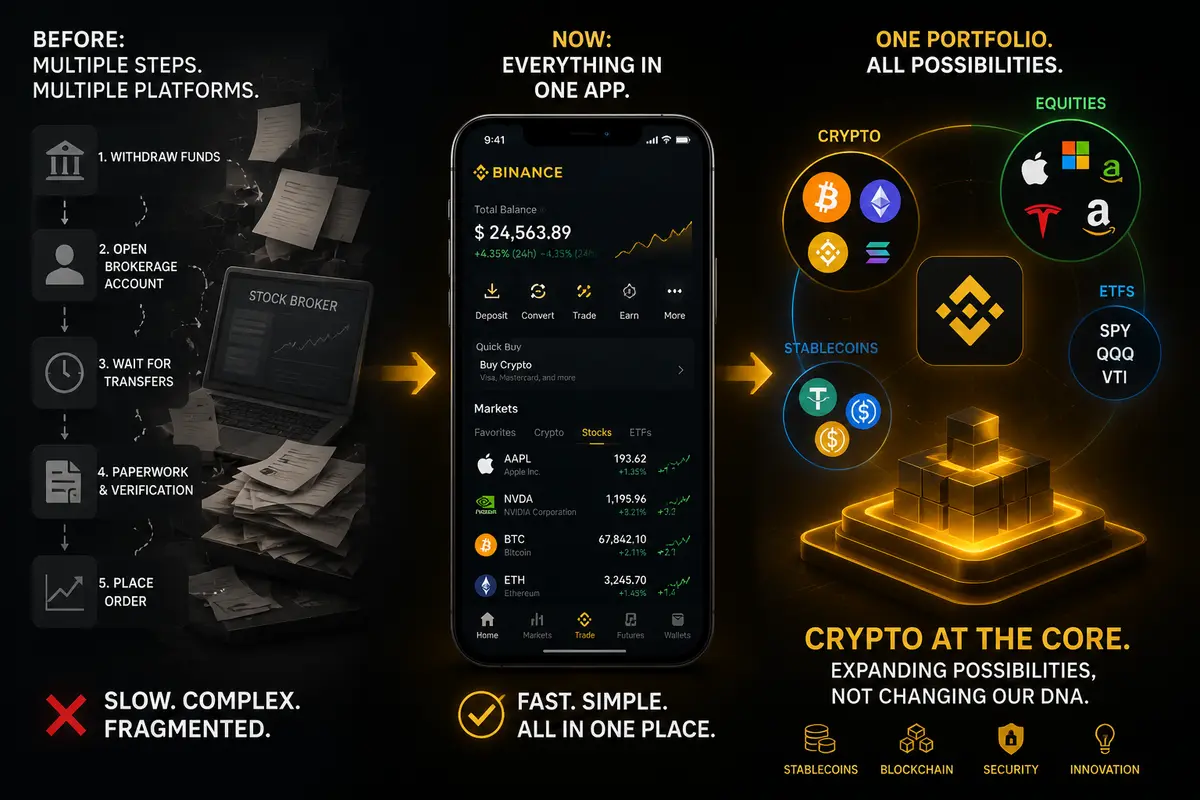
Consider a user who originally joined Binance to buy Bitcoin. They are familiar with the interface and trust the system. Previously, buying stocks required withdrawing funds, opening a brokerage account elsewhere, waiting for transfers, and dealing with paperwork.
Now, everything happens in a few clicks. This is not just convenience — it is ecosystem lock-in. The more assets a user can hold and trade in one place, the less incentive they have to leave.
The psychological shift is also important. Crypto and equities were previously seen as separate worlds. Now they coexist in a single portfolio. This increases flexibility and reduces cognitive friction, encouraging more frequent allocation changes between asset classes.
What Remains Unchanged: Crypto at the Core
Binance emphasizes that crypto remains its core business. Stocks are an expansion, not a pivot. The exchange is not becoming a traditional brokerage that occasionally offers crypto — it remains a crypto-native platform expanding into traditional assets.
Stablecoins are still crypto instruments, meaning the ecosystem remains blockchain-based even when trading Apple or IBM shares. This is evolution, not replacement.
Risks and Challenges
Regulatory Minefield
Binance has long faced regulatory scrutiny across the U.S., UK, EU, and parts of Asia. Adding equities intensifies this pressure significantly. Stock markets are heavily regulated, with strict investor protection and reporting requirements.
Tokenized equities, in particular, raise concerns among regulators like the SEC, which has previously viewed such instruments as potentially unregistered securities. This likely explains why availability is limited to specific jurisdictions.
VPN circumvention remains a potential enforcement challenge, as global platforms are difficult to fully restrict.
Competition with Traditional Brokers
Robinhood, Charles Schwab, Fidelity, and Interactive Brokers now face a competitor offering both crypto and equities in one platform.
However, Binance currently lacks the depth of research tools, execution quality, and investor protections offered by traditional brokers. The trade-off is clear: speed and simplicity versus institutional safeguards.
For many younger or emerging-market users, speed and accessibility may matter more.
Risk of Asset Confusion
There is also a behavioral risk. Mixing highly volatile crypto assets with relatively stable equities in one interface may blur risk perception.
Cryptos can move 20% in a day; stocks like Apple rarely do. Without clear separation and education, users may misjudge risk profiles, leading to financial mistakes.
What This Means for the Future of Finance
The End of Financial Segmentation
We are witnessing the erosion of the boundary between traditional finance and crypto. Banks are adopting blockchain technologies, central banks are exploring digital currencies, and crypto exchanges are integrating traditional assets.
The result is a unified investment ecosystem where users choose instruments, not platforms.
What Might Happen Next (2027–2028)
Likely developments include expansion into European and Asian equities, leveraged products, and more complex derivatives.
Binance may also introduce portfolio automation tools, dividend reinvestment features, and possibly its own ETF products.
The logical next step is becoming a full-scale global financial ecosystem.
Conclusion: A New Era for 300 Million Users
Binance’s addition of 7,000 stocks and ETFs is not just another crypto exchange update. It is a structural shift in how financial platforms are defined.
For 300 million users, it means freedom of movement between asset classes without friction. For the global financial system, it is another sign that crypto infrastructure is merging with traditional markets.
Challenges remain — regulation, competition, and risk management — but the direction is clear. Finance is becoming unified, borderless, and instantaneous.
Binance is betting that the future lies in combining all asset classes into one ecosystem. If that bet succeeds, this moment may be remembered as the point when a crypto exchange stopped being “crypto” in the narrow sense — and became simply a global financial platform.
And perhaps that is the real revolution: not new assets, but a new way of interacting with money itself — without intermediaries, without borders, and without delay.

Comments
No comments yet. Be the first to share your thoughts!
Authentication Required
You must be logged in to post a comment.