

Asian Markets at a Crossroads: Japan and Australia Await Central Bank Signals
Tuesday — the day when decisions matter more than news
Tuesday began on Asian stock markets with a tense silence. There was none of Monday’s euphoria, when investors celebrated the peace agreement with Iran. Nor was there the panic of last week, when stocks plunged as much as 10% in a single day. Instead, markets found themselves somewhere in between: mixed performance, caution, and anticipation.
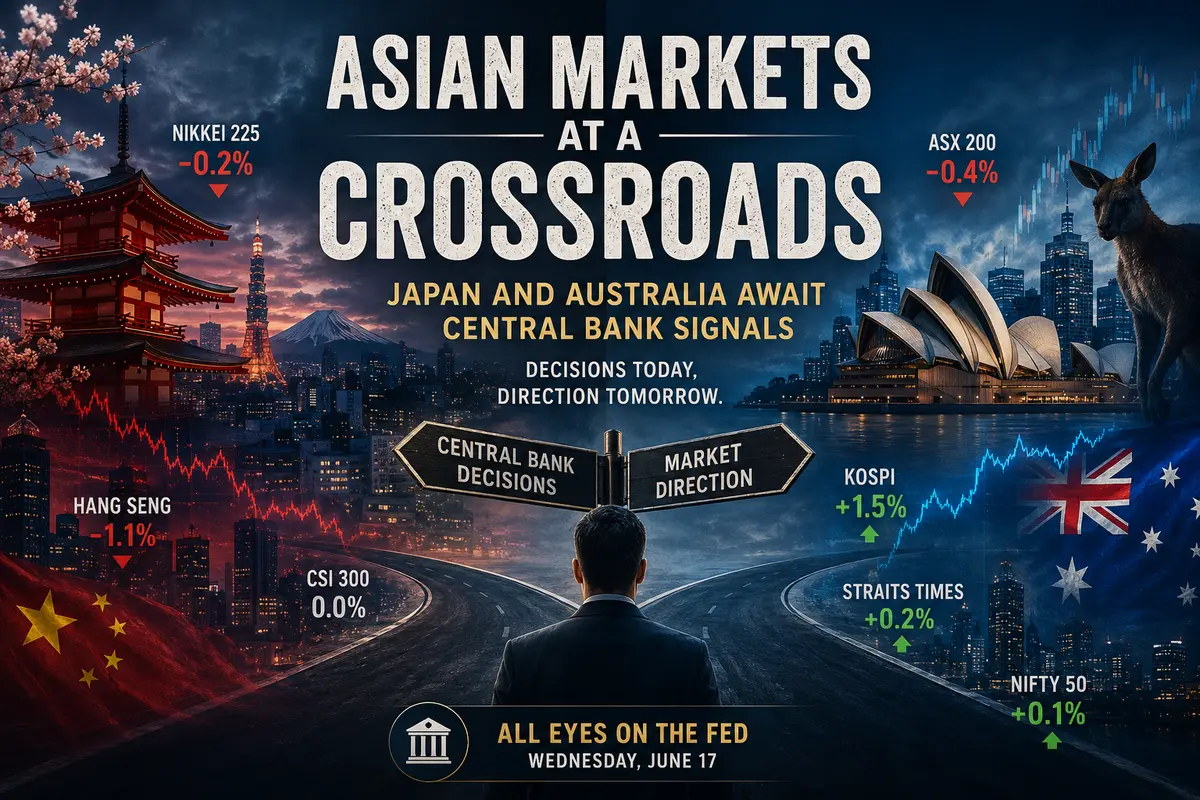
Japan’s Nikkei 225 slipped 0.2%. Australia’s ASX 200 lost 0.4%. Chinese indices were largely unchanged. Hong Kong’s Hang Seng fell more than 1%. Only South Korea’s KOSPI posted a strong gain, rising 1.5% on the back of strength in the technology sector.
Why such divergence? Because each market has its own catalyst. In Japan, investors are focused on the Bank of Japan, which is expected to raise interest rates to their highest level in 31 years. In Australia, attention is on the Reserve Bank of Australia, which is widely expected to keep rates unchanged. In China, weak economic data disappointed investors. In South Korea, a rally in semiconductor stocks continues following a recent rebound.
Yet what unites all these markets is anticipation—anticipation of decisions, signals, and greater clarity.
And that anticipation defines Tuesday.
Japan: Bank of Japan Expected to Raise Rates to 1%
The Bank of Japan meets today, June 16. The central bank is expected to raise its short-term policy rate by 25 basis points to 1.0%, the highest level in 31 years. The last time rates were at this level was in 1995.
Why is the BOJ taking this step? Inflation remains above its 2% target. Consumer spending has been resilient. Energy prices, while easing following the peace agreement with Iran, remain higher than a year ago. Meanwhile, the yen remains weak at around ¥160 per U.S. dollar, increasing import costs and adding inflationary pressure.
The BOJ has also signaled this move well in advance. Previous meetings included discussions of this scenario, meaning markets have largely priced in the expected hike.
As always, however, the signals matter more than the action itself. Analysts at Bank of America note that Tuesday’s rate increase is already largely reflected in market pricing. Investors are now focused on what the BOJ says about the coming quarters.
Will there be further hikes to 1.25% or even 1.5% by year-end? Or is this a one-time move, with rates remaining at 1.0% for an extended period?
If the BOJ delivers a hawkish message—indicating readiness to raise rates further if inflation remains elevated—the yen could strengthen. A stronger yen is typically negative for Japanese exporters such as Toyota, Sony, and Honda, but positive for domestic consumption because imports become cheaper.
If the BOJ remains cautious, the yen is likely to stay weak, benefiting exporters and potentially supporting equities.
For now, markets do not know which path the central bank will choose. That uncertainty explains the Nikkei’s modest 0.2% decline. It is not panic—it is caution.
Australia: RBA Expected to Hold Rates Steady
In Australia, the Reserve Bank’s policy meeting concludes today. The RBA is expected to keep its benchmark interest rate unchanged at 4.35%.
The central bank has already raised rates by 75 basis points this year, from 3.6% to 4.35%. At its previous meeting, policymakers indicated they intended to pause and assess the economic impact of those increases.
Inflation in Australia is slowing but remains above target. The labor market remains strong. Economic growth continues, though at a modest pace, with quarterly GDP growth of 1.2%—lower than that of the United States or India.
If the RBA adopts a neutral or dovish tone, the Australian dollar could weaken. A weaker currency generally benefits mining companies by making their products more competitive internationally, potentially supporting stock prices.
If, however, the RBA delivers a hawkish message—signaling willingness to raise rates further if inflation does not slow—the Australian dollar could strengthen, putting pressure on exporters.
For now, uncertainty prevails. The ASX 200 fell 0.4%, with mining companies and banks leading the declines.
South Korea: The Tech Rally Continues
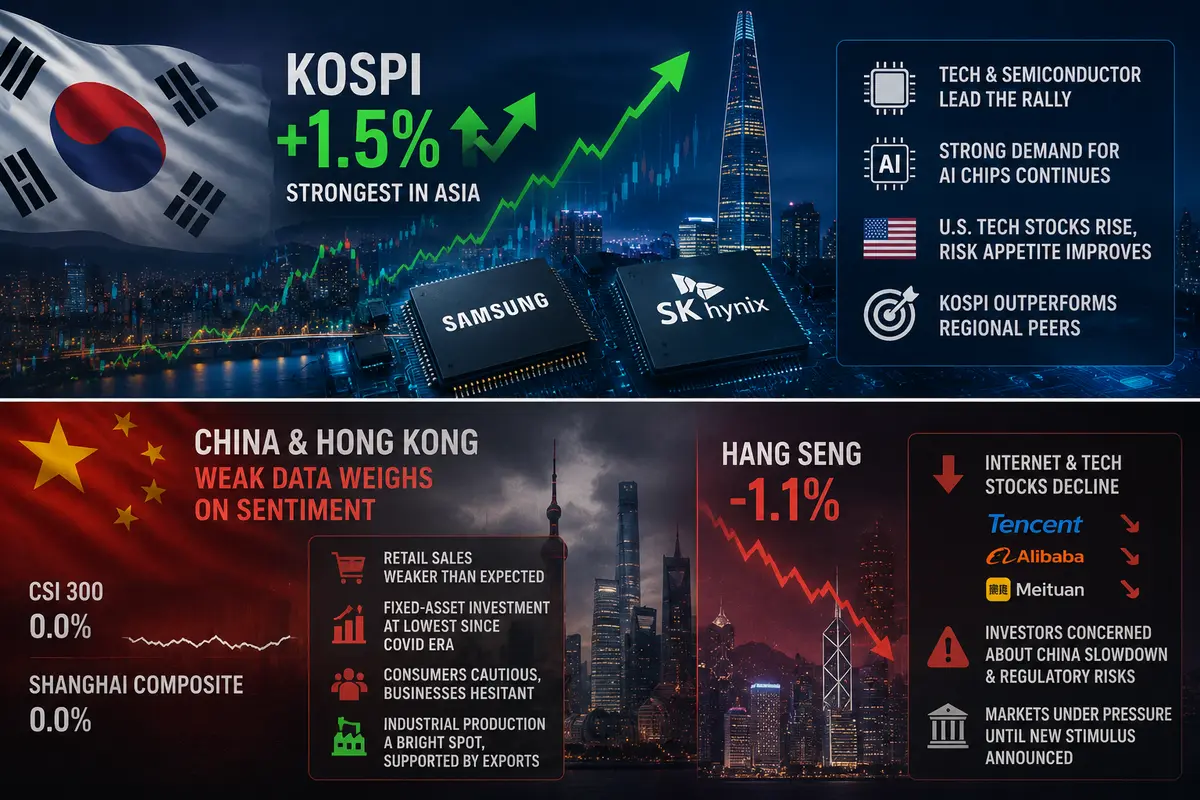
South Korea’s KOSPI gained 1.5%, making it the strongest-performing major market in Asia on Tuesday. The rally was driven by continued strength in technology and semiconductor stocks.
Samsung and SK Hynix, which suffered declines of 8–10% last week before rebounding, continued their recovery. Investors remain confident that demand for artificial intelligence-related chips will stay robust despite recent market volatility.
The overnight rise in U.S. technology stocks on Monday also supported sentiment. The peace agreement between the United States and Iran improved overall risk appetite globally.
For now, the KOSPI appears more resilient than many of its regional peers. However, that could change quickly if the Federal Reserve delivers a hawkish message tomorrow.
China and Hong Kong: Weak Data Weighs on Sentiment
China’s CSI 300 and Shanghai Composite traded largely sideways on Tuesday following disappointing economic data for May.
Retail sales declined more than expected. Fixed-asset investment fell to its lowest level since the COVID-era crisis. Chinese consumers remain cautious, and businesses are reluctant to invest.
The one bright spot was industrial production, which exceeded forecasts thanks to strong external demand. China continues to export large volumes of goods, particularly to the United States and Europe.
However, domestic demand remains weak. Youth unemployment is elevated, the property sector remains under pressure, and the economic recovery continues at a slow pace.
Hong Kong’s Hang Seng dropped more than 1%, led lower by internet and technology stocks. Tencent, Alibaba, and Meituan all traded in negative territory. Investors remain concerned about China’s economic slowdown and the possibility of tighter regulatory oversight.
Chinese markets are therefore likely to remain under pressure until Beijing announces additional stimulus measures.
Singapore and India: Modest Gains
Singapore’s Straits Times Index rose 0.2%—a modest gain, but a gain nonetheless. As a city-state heavily dependent on trade and finance, Singapore benefits from improved global sentiment. The peace agreement with Iran has helped support investor confidence.
Futures on India’s Nifty 50 added 0.1%, also a modest advance. India remains one of the world’s fastest-growing economies, but it is sensitive to oil prices. Monday’s decline in crude prices provided support, but oil stabilized on Tuesday, limiting further gains.
What Comes Next? The Federal Reserve Meeting on Wednesday
The most important event of the week is the U.S. Federal Reserve’s June 16–17 meeting, which concludes tomorrow. Its outcome will likely determine the direction of global markets.
The Fed is expected to leave interest rates unchanged. However, investors will focus closely on comments from the new Fed Chair, Kevin Warsh.
If Warsh delivers a dovish message—indicating that inflation is easing and the Fed may pause further tightening—the U.S. dollar could weaken, boosting Asian markets. Equities, particularly technology stocks, would likely benefit.
If Warsh takes a hawkish stance—arguing that inflation remains too high and that further rate increases remain possible—the dollar could strengthen and Asian markets could come under pressure. Export-oriented economies such as Japan, South Korea, and China would be especially vulnerable.
For now, nobody knows what Warsh will say. That uncertainty has left markets frozen in place.
Conclusion: The Calm Before the Storm
Tuesday in Asia is a day of waiting.
No dramatic moves. No sweeping market trends. Just mixed performances shaped by local factors.
Japan and Australia are waiting for central bank decisions. China is digesting weak economic data. South Korea is enjoying a technology-led rally. Hong Kong is struggling with losses in the internet sector.
Yet the real focus is tomorrow’s Federal Reserve meeting. Its message could shape market direction for weeks to come.
Investors are unwilling to take major risks ahead of such a pivotal event. Many have trimmed positions, reduced exposure, and chosen to wait.
Silence. A heavy, tense silence that can feel more unsettling than noise itself. Because in silence, all one can do is wait. And waiting is often the hardest part—not only in trading, but in life.
Tomorrow, however, we will know more. Tomorrow, Warsh will deliver his message. And the silence will end.
Then comes the storm. Or the sunshine.
No one knows yet.
Everyone is waiting.

Comments
No comments yet. Be the first to share your thoughts!
Comments only for logged-in users.