

Asian Markets Plunge: AI Bubble Bursts, Iran Strikes, and KOSPI Bleeds
A Monday Investors Won’t Forget
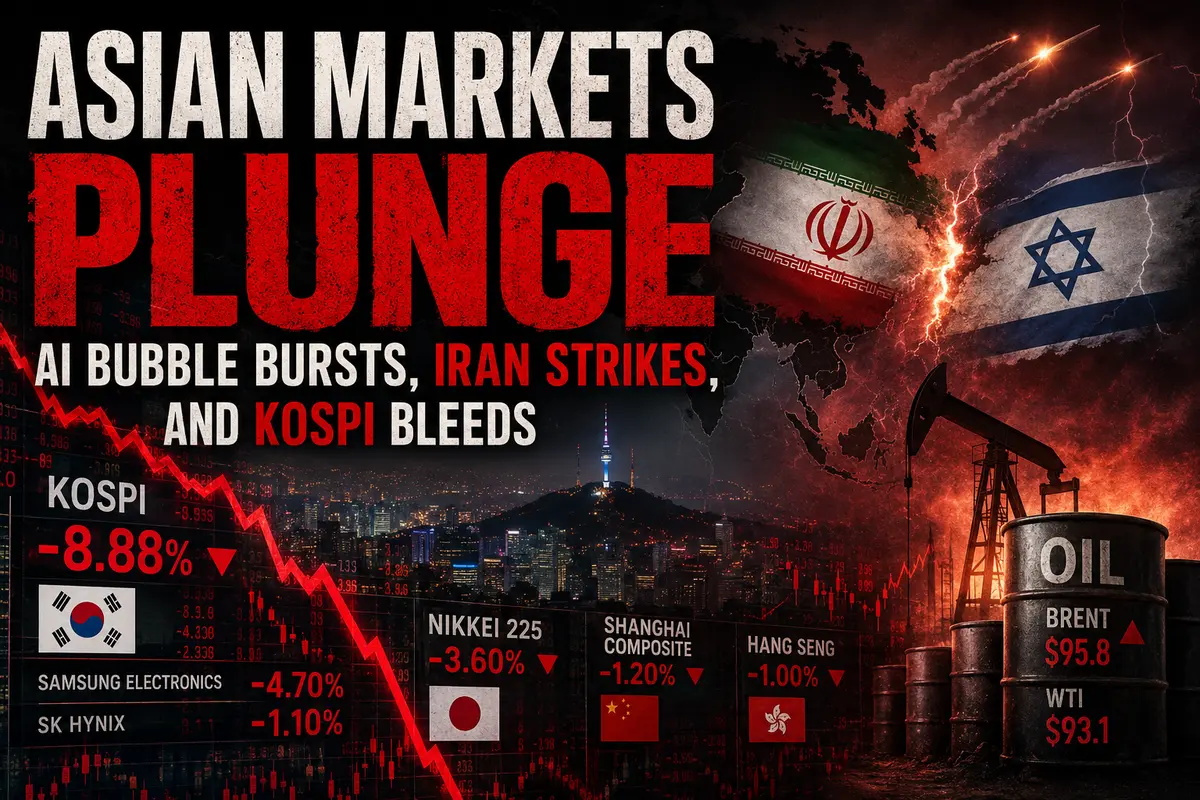
If you opened your brokerage app on Monday morning and couldn’t believe your eyes, you weren’t alone. Asian stock markets experienced a genuine bloodbath. And no, this wasn’t just another minor correction that investors could shrug off and move on from. This looked much more like a full-scale selloff, fueled by a toxic mix of an overheated artificial intelligence sector, military strikes in the Middle East, nervous investors finally taking profits, and fresh U.S. economic data that crushed hopes for imminent rate cuts.
South Korea’s KOSPI became the undisputed antihero of the day. The index collapsed by nearly 9%. An 8.8% decline isn’t just a drop—it’s a meltdown. To put it into perspective, KOSPI erased virtually all the gains accumulated during the previous six months of explosive growth in a single trading session. The reason? The Korean market’s biggest stars—semiconductor manufacturers—suddenly lost their untouchable status.
KOSPI: When Champions Fall the Hardest
Samsung Electronics—a name spoken with reverence in South Korea—saw its shares tumble 4.7%. For a company of Samsung’s size and stature, that’s a devastating move. Given its enormous weighting in the index, when Samsung falls, the entire market feels the impact.
Yet Samsung wasn’t even the biggest story. SK Hynix, the world’s second-largest memory chip manufacturer, lost “only” 1.1%. And the reason it held up better was simple: on Friday, the company made a brilliant strategic move by announcing a partnership with NVIDIA—the undisputed leader of the AI revolution. SK Hynix will supply advanced memory chips to NVIDIA, and that announcement became a lifeline amid a sea of red.
Still, why were losses so severe? Just weeks ago, investors were celebrating Korean chipmakers. Analysts were raising price targets, investors were buying shares aggressively, and KOSPI was outperforming nearly every major stock market in the world.
Then came reality.
The technology sector—and particularly anything connected to artificial intelligence—had reached valuation levels that defied common sense. Stocks had climbed too quickly and too far, driven largely by expectations and promises. On Friday, Wall Street finally did what many believed was inevitable: investors hit the brakes. The U.S. technology sector fell 4.5% in a single session. And when America sneezes, Asia catches a cold.
In KOSPI’s case, that cold felt almost fatal.
Japan: Nikkei Falls but Holds Up Better Than Korea
While KOSPI plunged nearly 9%, Japan’s Nikkei 225 lost a comparatively modest 3.6%.
Does that sound like a victory?
Under normal circumstances, a 3.6% decline would be considered a disaster. But compared to South Korea’s collapse, Japanese investors could almost breathe a sigh of relief.
That doesn’t mean Tokyo escaped unscathed.
Technology giant SoftBank—the company with stakes in Alibaba, Uber, and numerous other technology ventures—plunged 7.5%. That’s significant because SoftBank isn’t just another stock; it serves as a barometer for sentiment across Japan’s technology sector.
Semiconductor-related companies fared even worse. SUMCO, a producer of silicon wafers for semiconductors, dropped more than 10%. Renesas Electronics also lost around 10%. Investors indiscriminately dumped anything connected to chips, regardless of fundamentals.
To make matters worse, revised Japanese GDP figures released Monday showed first-quarter growth slowing from 2.1% to 1.8%. The downgrade was driven largely by weaker business spending, suggesting Japanese companies are investing less than economists had anticipated.
That immediately raises a critical question: can the Bank of Japan realistically raise interest rates next week?
Many expected the central bank to continue normalizing policy, but weaker growth data complicates that outlook. If the economy is already struggling, tightening monetary conditions risks undermining the recovery. As a result, many investors now believe the Bank of Japan may once again postpone rate hikes, leaving the yen weak, imports expensive, and exporters caught in limbo.
Iran and Israel: A Geopolitical Blow to Markets
Technology and interest rates weren’t the only problems confronting Asian markets.
Another issue emerged from a region many investors had hoped would fade from the headlines: the Middle East.
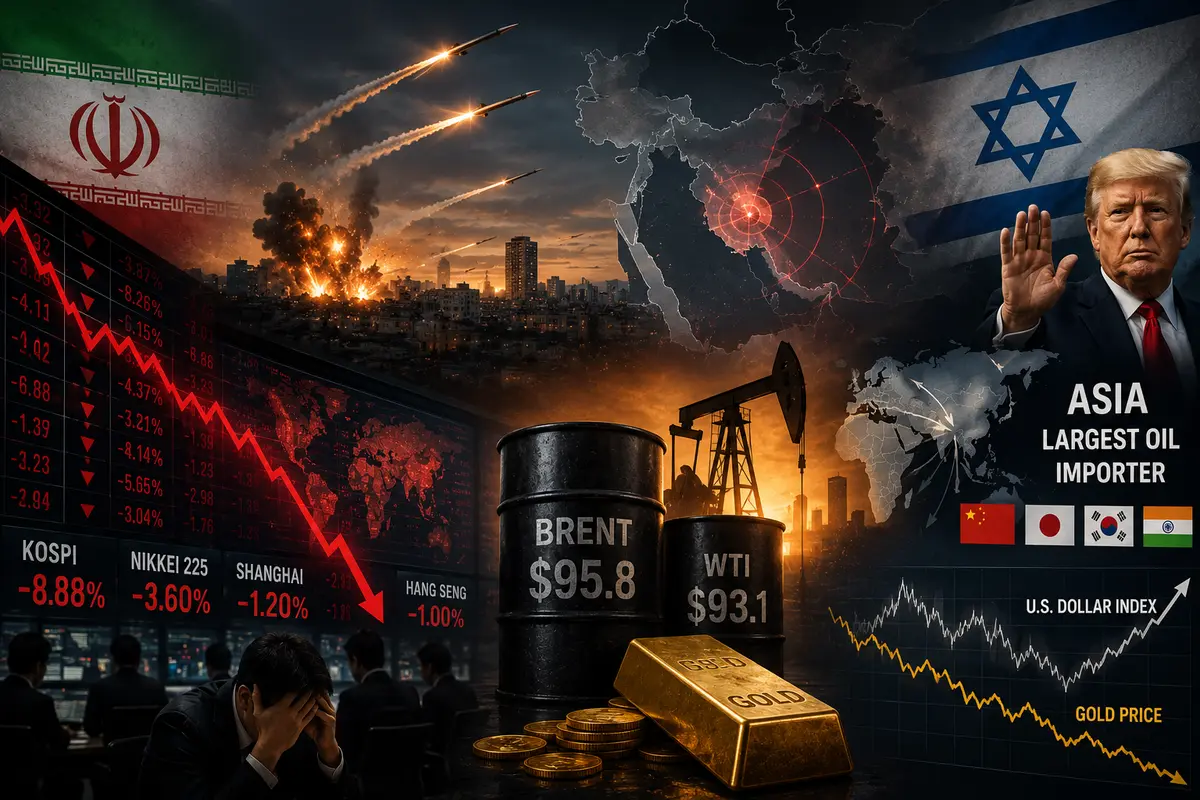
On Sunday, Iran and Israel exchanged direct airstrikes. Not proxy attacks. Not indirect confrontation. Direct military action.
It marked the first open clash since the ceasefire reached earlier in the spring and shattered hopes that tensions were genuinely easing.
Iran launched several missiles toward northern Israel. Israeli air defenses intercepted most of them, and no casualties were reported. Nevertheless, the symbolism mattered. Tehran described the strike as retaliation for Israeli operations near Beirut. Israel vowed to respond.
And suddenly, markets found themselves staring at another escalation cycle.
Donald Trump, in a somewhat unexpected statement on Sunday, urged Israel not to retaliate, citing progress in peace negotiations. Yet when missiles are flying through the sky, few investors are inclined to trust diplomatic optimism.
For Asian markets, the most immediate consequence is oil.
Brent crude surged toward $96 per barrel, while WTI climbed above $93. Asia remains the world’s largest oil-importing region. China, Japan, South Korea, and India all depend heavily on imported energy. Rising oil prices hit transportation firms, manufacturers, and consumers alike.
In other words: inflation.
And adding insult to injury, gold—the traditional safe haven during times of crisis—has not provided much relief. A strong U.S. dollar and expectations of persistently high interest rates continue to pressure precious metals.
For many Asian investors, there suddenly seems to be nowhere to hide.
China and Hong Kong Also Feel the Pain
China wasn’t spared either.
The CSI 300 Index, which tracks 300 of mainland China’s largest companies, fell 1.6%. The Shanghai Composite lost 1.2%, while Hong Kong’s Hang Seng Index declined 1%.
Compared to Korea, those losses may appear modest. But that perception is misleading.
Chinese equities have already struggled throughout much of the year, meaning they simply had less speculative excess to unwind. Unlike South Korea or Taiwan, China never fully participated in the AI-driven stock market frenzy.
Still, China faces its own challenges.
The post-pandemic recovery remains slower than policymakers hoped. The property sector continues to represent a major structural risk. Now rising oil prices threaten an already fragile manufacturing environment.
One positive factor remains: unlike the Federal Reserve, China’s central bank is still expected to maintain an accommodative stance. Interest rates are already low and could fall further if needed. That provides some support—but not enough to offset concerns stemming from both the Middle East and the United States.
What’s Happening in America?
The Asian selloff did not emerge in a vacuum.
On Friday, Wall Street closed sharply lower. The S&P 500 declined 1%, while the technology-heavy Nasdaq plunged 4.5%, wiping billions of dollars off the market value of the world’s largest companies.
The catalyst was the U.S. labor market.
The economy added 172,000 jobs in May, significantly above expectations of roughly 130,000. Strong employment data suggests the Federal Reserve has little reason to rush into cutting rates. Some analysts have even revived discussions about the possibility of another rate hike later in the year.
For technology companies—which thrive on cheap capital and lofty future-growth assumptions—that is deeply problematic.
Higher rates mean a higher cost of capital, making long-duration growth investments less attractive.
There was, however, a small glimmer of hope. During Monday’s Asian trading session, U.S. stock futures edged higher. S&P 500 futures gained about 0.2%, while Nasdaq futures rose roughly 0.7%.
Investors are clearly hoping for a rebound when U.S. markets open.
The question is whether it will be a genuine recovery—or merely a dead-cat bounce.
Given the scale of the turmoil across Asia, confidence remains fragile.
The AI Bubble: Reality or Just a Correction?
Let’s be honest.
The artificial intelligence sector has experienced extraordinary growth over the past eighteen months. Every NVIDIA announcement became a market-moving event. Every new chatbot launch generated excitement. Shares of companies that merely mentioned “machine learning” often soared by double-digit percentages.
That kind of momentum rarely continues indefinitely.
The real question isn’t whether a correction was inevitable. The question is how deep it will become.
If this is merely profit-taking ahead of the typically slower summer months, markets could resume their upward trend within a few weeks. KOSPI could once again become a global leader.
But if investors begin reassessing expectations for AI adoption and profitability, the downturn may have further to run.
Analysts who were enthusiastically upgrading technology stocks only weeks ago are now striking a more cautious tone.
“We’re not saying AI is a fraud. We’re saying the rally became too fast and valuations became too stretched. The market needs to cool down.”
South Korean chipmakers sit at the center of this storm. They benefited more than almost anyone from the AI boom because modern AI systems depend heavily on advanced memory chips.
If enthusiasm fades, they could also suffer the most.
What Should Ordinary Investors Do?
No one can offer guaranteed advice.
History shows that investors often make their biggest mistakes during periods of panic. They sell near the bottom, buy near the top, and allow emotions to dictate decisions.
Right now, markets are clearly in panic mode.
A 9% one-day decline in KOSPI is textbook panic. A 3.6% drop in Nikkei is hardly normal either.
Moments like these are rarely ideal for major investment decisions.
If you bought Samsung shares at elevated prices while everyone was predicting further gains, today’s losses undoubtedly hurt. But selling immediately after a sharp decline means locking in losses that may eventually recover.
At the same time, nobody knows how long this downturn will last.
If tensions between Iran and Israel escalate into a broader conflict, if oil rises toward $120 per barrel, or if the Federal Reserve ultimately tightens policy further, current market levels could look generous in hindsight.
For now, a cautious approach may be the most sensible: avoid making drastic changes unless you urgently need cash, and avoid trying to catch a falling knife by buying every dip under the assumption that the bottom has arrived.
The bottom usually appears where nobody expects it.
Outlook: Waiting for Signals from the West
Over the coming days, two factors will likely dominate market sentiment.
The first is the United States.
If futures gains translate into a meaningful Nasdaq rebound of 1–2%, Asian markets may stabilize on Tuesday and potentially stage a modest recovery. If U.S. stocks continue falling, however, Asia could face another painful session.
The second is the Middle East.
Will there be another attack? Will Israel heed calls for restraint, or retaliate? Will Iran consider the current exchange complete, or escalate further?
No one knows.
And markets hate uncertainty even more than bad news. Bad news can be priced in. Uncertainty encourages investors to liquidate positions and wait on the sidelines.
One thing seems certain: Monday, June 8, 2026, will be remembered as a black Monday for Asian markets.
The real story isn’t just how far the indexes fell. It’s what the selloff revealed about the market’s underlying condition. Investors are nervous. Valuations remain stretched. Confidence is fragile.
When geopolitical tensions escalated, profit-taking accelerated, and faith in the AI rally wavered, the outcome became almost inevitable.
The only surprise was how few people wanted to believe it—until Monday morning arrived.

Comments
No comments yet. Be the first to share your thoughts!
Comments only for logged-in users.