

Oil Prices Surge: Iran Strikes, the Truce Collapses, and Markets Are Shaken

A Missile Strike That Shattered a Fragile Peace
The calm that lasted only a few weeks vanished in an instant. Late Sunday night, as most residents of Tel Aviv were preparing for bed, fiery trails of Iranian missiles lit up the skies over northern Israel. Israel’s Iron Dome air defense system sprang into action immediately—interceptions, explosions in the sky, sirens, and panic followed. Reports suggest that most of the projectiles were intercepted, but the significance of the attack far outweighed its direct military impact.
Why now? Why would Iran take such a risk? Tehran did not mince words. Iranian officials stated openly that the strike was retaliation for Israeli attacks on the southern suburbs of Beirut. Those operations were reportedly aimed at Iranian assets and proxy forces in Lebanon. One of the strikes hit an area near the Lebanese capital, where, according to Iranian authorities, advisers from the Islamic Revolutionary Guard Corps (IRGC) were among those killed.
Israel responded in its usual uncompromising manner, warning that the attack would not go unanswered. The message from Israeli military officials was essentially: “If we are attacked, we respond ten times harder.” Once again, the region appears to be standing on the edge of a broader conflict.
Perhaps most alarming is that the ceasefire reached in April—painstakingly negotiated by diplomats and viewed by many as a lifeline—now looks little more than a piece of paper. This is the most serious incident since the truce was signed. Hopes for diplomacy have dissipated faster than the smoke from the intercepted missiles.
Oil Markets React in Panic: The Numbers Speak for Themselves
As Asian markets opened on Monday morning, traders wasted no time reacting.
Brent crude futures, the global benchmark for oil prices, jumped 2.6% to $95.49 per barrel. U.S. benchmark WTI crude rose 2.4% to $92.70 per barrel.
At first glance, those figures may not seem extraordinary—oil has traded much higher in the past. But the speed of the move and the broader context are what matter.
Just days earlier, on Friday, markets had been celebrating. Brent closed near $93 per barrel, while WTI finished around $90.54. Investors believed tensions were easing and that the worst might be over.
Then came Monday, and those hopes evaporated.
Traders in Singapore, Tokyo, and Shanghai spent the night reshuffling portfolios. Some made fortunes from the sudden rally; others suffered heavy losses. Yet the real concern lies not in the money itself, but in what these price movements represent.
The Strait of Hormuz: The World’s Chokepoint
This is where the real fear begins.
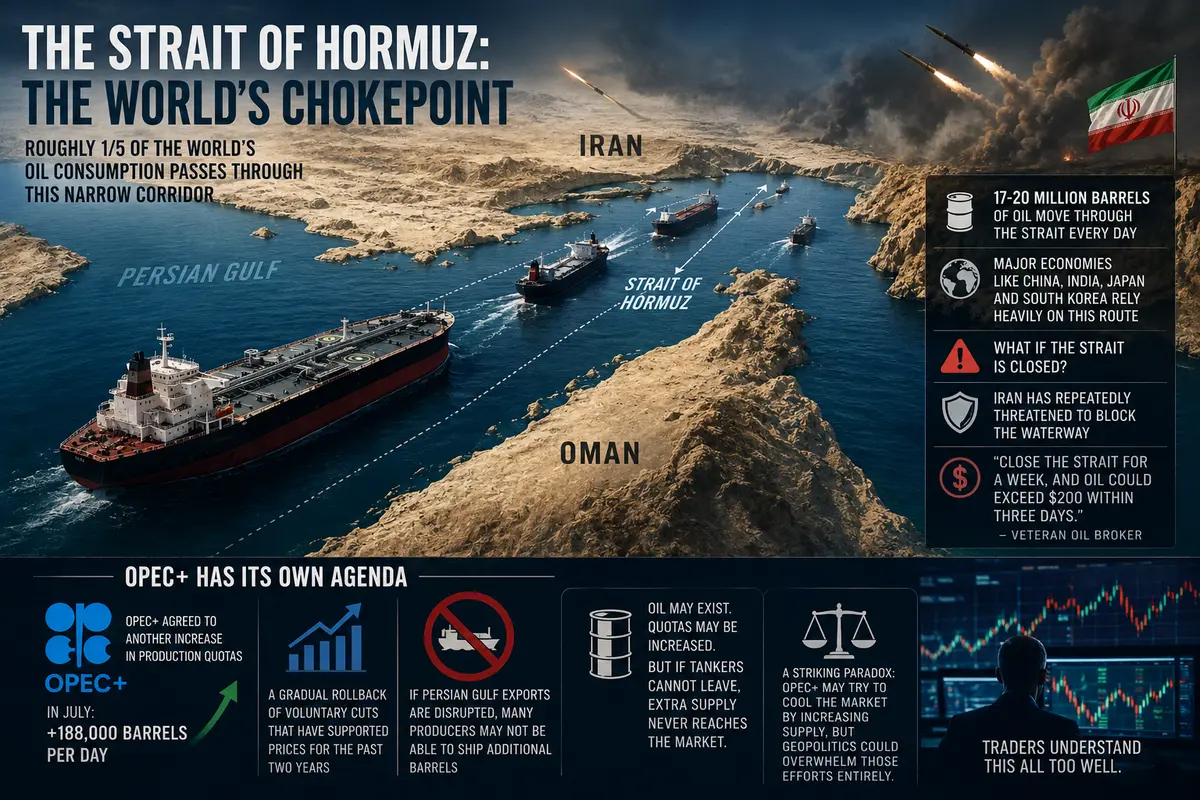
The Strait of Hormuz is not just a narrow stretch of water between Iran and Oman. It is one of the most strategically important energy routes on the planet. Roughly one-fifth of the world’s oil consumption passes through this corridor.
Every day, an estimated 17–20 million barrels of oil move through the strait aboard tankers. Major economies—including China, India, Japan, and South Korea—depend heavily on this route.
Following Iran’s latest strike, the question “What if the strait is closed?” no longer feels hypothetical.
Iran has repeatedly threatened to block the waterway in response to external pressure. In the past, many analysts viewed those threats as political posturing. After actual missile launches, however, the possibility appears far more credible.
As one veteran oil broker once put it: “Close the Strait of Hormuz for a week, and oil could exceed $200 within three days.”
That may sound dramatic, but the reasoning is straightforward. Alternative routes are limited. Saudi Arabia and the UAE have pipeline networks that can bypass part of the maritime traffic, but their capacity is only a fraction of what normally moves through the strait by tanker.
OPEC+ Has Its Own Agenda
While politicians and military leaders exchange threats, OPEC+ continues pursuing its own strategy.
Last month, the group and its allies agreed to another increase in production quotas. In July, output is set to rise by 188,000 barrels per day. The move is part of a gradual rollback of the voluntary production cuts that have supported prices for the past two years.
Yet there is a major complication that often goes unmentioned.
If exports from the Persian Gulf are disrupted—a scenario that becomes increasingly plausible if the conflict expands—many producers may be physically unable to ship those additional barrels.
The oil may exist. The quotas may be increased. But if tankers cannot leave the region, the extra supply never reaches the market.
It is a striking paradox: OPEC+ may be trying to cool the market by increasing production, but geopolitics could overwhelm those efforts entirely.
Traders understand this all too well.
Trump Urges Restraint—But Will Anyone Listen?
Another key question is how Washington will respond.
Donald Trump, who has often portrayed himself as a leader focused on avoiding major wars, reportedly signaled on Sunday that he intends to advise Israeli Prime Minister Benjamin Netanyahu against launching a retaliatory strike on Iran. According to reports, the message is essentially: “Stay calm and avoid escalation.”
For Trump, this would represent a notable shift. During his presidency, he withdrew the United States from the Iran nuclear deal, authorized the strike that killed Qassem Soleimani, and imposed some of the toughest sanctions ever placed on Tehran.
Why the change?
The answer may be political. With the election campaign intensifying, a new major conflict in the Middle East is likely the last thing Trump wants. Higher gasoline prices in the United States could severely damage any candidate’s prospects. If regional tensions spiral into a broader war, fuel prices could surge dramatically—an outcome with obvious political consequences.
But whether Netanyahu will heed such advice is another matter entirely.
Israel faces its own domestic pressures. Memories of previous attacks remain fresh, and much of the public expects a strong response. Within parts of the Israeli establishment, the prevailing view is simple: “If we do not respond to a missile attack, we lose.”
Trump may advocate restraint. Military leaders may argue otherwise. At the center of it all stands a prime minister known for making unpredictable decisions.
What Happens Next? Three Possible Scenarios
1. The Optimistic Scenario
The conflict remains limited. Both sides exchange a few blows but avoid a wider war. Diplomats return to the negotiating table, and tensions gradually ease.
In that case, Brent crude could retreat toward the $90–93 per barrel range.
The probability of this outcome, however, appears low—perhaps no more than 20%. Emotions are running high, and multiple actors have incentives to escalate rather than de-escalate.
2. The Realistic Scenario
Both sides carry out additional strikes, casualties mount, and rhetoric intensifies, but neither side crosses the threshold into full-scale war.
The Strait of Hormuz becomes a persistent risk zone. Tankers face sharply higher insurance costs, and every oil transaction carries a geopolitical premium.
Under this scenario, oil prices could stabilize between $95 and $100 per barrel and remain there for months.
This would effectively become the new normal.
3. The Worst-Case Scenario
Iran attempts to disrupt or block shipping through the Strait of Hormuz.
Israel responds by targeting Iranian oil infrastructure.
The conflict expands to involve proxy forces in Lebanon, Syria, and Yemen, triggering a much broader regional confrontation.
In such circumstances, even $150 oil might not represent the upper limit.
Hopefully, events never reach that stage. Yet recent developments have made even pessimistic scenarios seem less far-fetched than before.
What Does This Mean for Ordinary People?
While analysts debate futures contracts and hedging strategies, ordinary people around the world feel the consequences in a far more direct way.
A driver in India, Kenya, or virtually any other country sees rising fuel prices and immediately understands what they mean. Higher oil prices lead to higher transportation costs. Higher transportation costs raise the price of goods. Inflation gains fresh momentum.
And perhaps the most frustrating part is the uncertainty.
The ceasefire that many hailed as a diplomatic breakthrough did not survive even two months. Optimism now feels fragile.
Markets are not merely reacting to specific price levels—they are reacting to the growing sense that no one is fully in control of the situation.
For now, all anyone can do is watch closely.
Because the next blow may not only hit military targets. It may hit global prices—and the consequences will be felt even by people who have never heard of the Strait of Hormuz.

Comments
No comments yet. Be the first to share your thoughts!
Comments only for logged-in users.