

Cardano Cryptocurrency Plunges 10% in a Bearish Market Pullback
Friday the 13th for ADA Holders
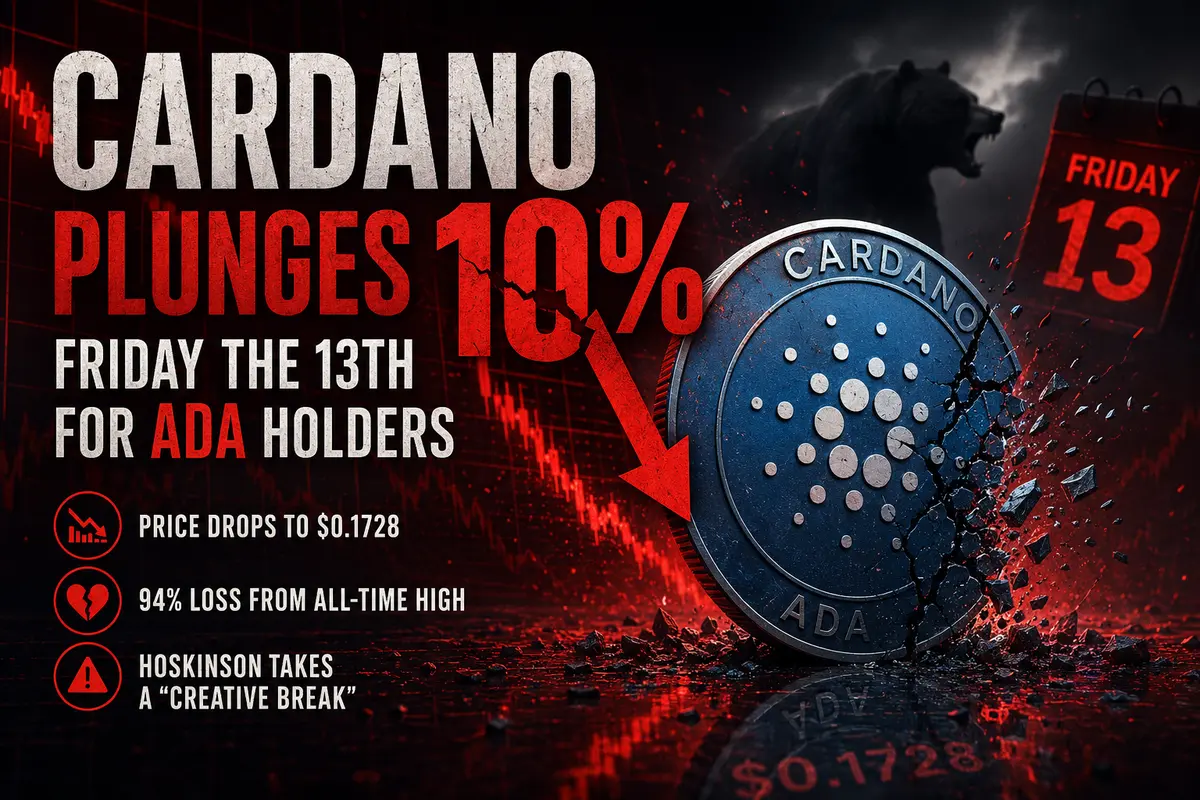
Friday turned into a bloodbath for Cardano supporters. Cardano, once among the world’s top three cryptocurrencies and a contender for the throne, fell 10.17% in a single day. The price dropped to $0.1728, marking its sharpest decline since June 4 and coming at a time when the broader market was already on edge.
The numbers confronting ADA holders are enough to break the heart of even the most resilient crypto enthusiast. Cardano’s market capitalization shrank to $6.28 billion. That sounds enormous until you remember that at its peak in 2021, Cardano was worth nearly $95 billion. Since then, its value has evaporated like morning mist. The token has lost 94% of its value from its all-time high of $3.10 reached on September 2, 2021.
Over the past week, Cardano has fallen 26%. Twenty-six percent in seven days is not a correction—it is a collapse. Trading volume over the last 24 hours reached nearly $937 million, accounting for 0.69% of the entire cryptocurrency market’s turnover. People are selling in panic. Some are cutting their losses; others are simply leaving and may never return to the asset.
At the time of writing, Cardano ranks 15th among all cryptocurrencies by market capitalization. It was once third. That decline in ranking is perhaps the clearest indication of how much has gone wrong.
But the most frightening aspect for holders is not the numbers themselves. It is the news accompanying them. Project founder and spiritual leader Charles Hoskinson announced that he is taking a “creative break.” Just four words posted on X: “I’m taking a break. TTYL.” The market heard those words—and collapsed.
Four Words That Wiped Out Billions
It is difficult to overstate Hoskinson’s influence on Cardano. He is not merely the founder; he is the face, voice, and driving force behind the project. In a world where many cryptocurrencies function as decentralized autonomous organizations, Cardano remains, to a large extent, “Hoskinson’s coin.” When Hoskinson says he is stepping away, the market hears: “The project is losing its captain.”
The announcement did not come out of nowhere. It followed a series of troubling forecasts and alarming developments. Just a day earlier, in a YouTube video, Hoskinson warned that the Cardano ecosystem was on the verge of a “wave of failures.” He predicted that many projects built on Cardano would not survive a prolonged crypto winter and worsening market conditions. He had been warning about this since the beginning of the year—and, as it now appears, he may have been right.
A community accustomed to his charismatic presentations, deep technical analyses, and philosophical discussions about the future of blockchain was left confused and unsettled. Without the captain who had guided the ship through years of storms, ADA holders suddenly felt abandoned.
Hoskinson also expressed disappointment that the community was unwilling to use treasury funds to support ecosystem growth. “There doesn’t seem to be much appetite from the community to spend the treasury to take these ventures to the next level,” he lamented. When a founder complains about community greed or passivity, investors often view it as a serious red flag.
A Cracked Foundation: What Went Wrong?
The 10% daily price drop is only the tip of the iceberg. To understand the market’s reaction, one must look beneath the surface at the crisis that has been unfolding inside the ecosystem for weeks and months.
The first major issue was the shutdown of TapTools, a key analytics platform for the Cardano blockchain. More than one million users relied on it to track transactions, analyze liquidity pools, and monitor DeFi projects. TapTools announced it was ceasing operations, citing unsustainable infrastructure costs and the departure of key personnel, including co-founders and senior executives. This was not merely a startup shutting down—it was the loss of critical infrastructure that supplied data to the entire ecosystem.
The second problem was the cancellation of Cardano Summit 2026. The flagship annual event, scheduled to take place in Singapore, was scrapped after the community voted against allocating treasury funds to support it. Imagine Apple canceling an iPhone launch event because shareholders refused to pay for the venue. Such a decision signals a deep crisis of trust and governance paralysis. If the community cannot agree on funding its own flagship conference, how will it agree on complex protocol upgrades or strategic partnerships?
The third issue lies in the ecosystem’s financial metrics, which look catastrophic compared with competitors. Cardano’s total value locked (TVL) in decentralized finance stands at roughly $124 million. By comparison, Ethereum’s approaches hundreds of billions of dollars, while Solana commands tens of billions. Cardano’s share of the DeFi market remains tiny.
Perhaps the most painful blow to Cardano’s self-image is transaction fee generation. Over the past seven days, the blockchain generated only $2,848 in fees. Less than many Manhattan pizzerias earn in a day. A network built on sophisticated scientific principles and expensive infrastructure is generating minimal economic activity. Developers are not building applications because there are too few users, and users are not coming because there are too few applications. It is a vicious cycle from which Cardano has yet to find an escape.
Anger and Disappointment: Community Reaction
The crypto community is not a faceless mass of anonymous wallets. It consists of real people who invested their savings in hopes of a better future. Their reaction was predictably intense.
Social media erupted. Many accused Hoskinson of abandoning a sinking ship. Others demanded that he stay and help steer the project through the crisis. The level of toxicity in Cardano discussions reached extremes typically seen only during the harshest bear markets.
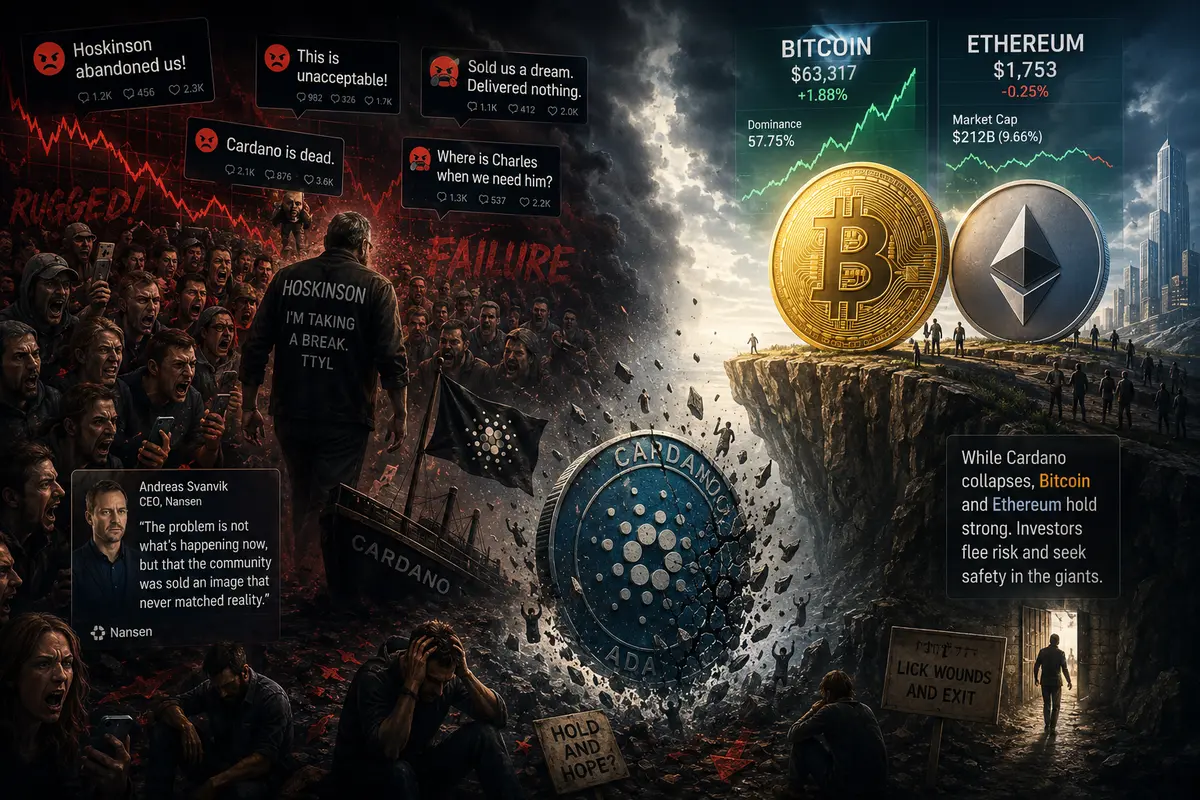
Criticism also came from respected industry figures. Andreas Svanvik, CEO of analytics platform Nansen, argued that the problem was not what is happening to Cardano now, but rather that the community had been “sold an image that never matched reality.” For a project that has long marketed itself as scientifically rigorous and institutionally focused, such criticism strikes directly at its reputation.
Many long-term holders who patiently waited for the “next bull cycle” are beginning to surrender. The fall below the psychologically important $0.20 level for the first time in years shattered the classic “Hold and Hope” strategy. For many, it has become “Lick Wounds and Exit.”
Bitcoin and Ethereum: Giants Standing Amid a Fallen Hope
While Cardano experiences its own apocalypse, the rest of the market appears considerably more stable. This highlights that ADA’s troubles are not merely the result of a bearish market—they are specific to the project itself.
Bitcoin, the benchmark of the crypto universe, traded around $63,317, gaining 1.88% on the day. Although still below its historical highs, Bitcoin remains resilient. Its market capitalization stands at approximately $1.266 trillion, representing 57.75% of the entire crypto market. Rising Bitcoin dominance is a classic sign that investors are fleeing risky altcoins for the safest crypto asset.
Ethereum declined only 0.25%, trading around $1,753. In practical terms, it remained flat. Ethereum’s market capitalization is roughly $212 billion, accounting for 9.66% of the market. Ethereum faces pressure as well, but it is not collapsing by 10% in a single day. It has a vast DeFi ecosystem, hundreds of thousands of developers, and mainstream adoption.
The gap between Cardano and the rest of the market has become enormous. While Bitcoin and Ethereum are experiencing stagnation or modest corrections, Cardano is in full-scale freefall. Investors are not merely reducing risk exposure—they are actively abandoning a specific project in which they have lost confidence.
Technical Picture: Bottom or Abyss?
From a technical perspective, Cardano is deeply oversold. The Relative Strength Index (RSI) has dropped to 20.12, a level many traders consider a “panic zone.” Such readings often precede a rebound because most sellers have already exited the market, leaving only the most committed holders behind.
However, traditional technical analysis may fail when fundamental problems are this severe. The key support level currently sits around $0.1717. If that breaks, the next destination could be multi-year lows.
The upper boundary of the recent trading range is $0.2392—the level from which Cardano collapsed this week. Returning there would require a powerful positive catalyst, such as Hoskinson’s unexpected return with a credible recovery plan or a major institutional investment. At present, neither appears likely.
Trading volume has exploded to $937 million over the past 24 hours, several times higher than monthly averages. Investors are exiting positions. Some are moving into stablecoins, others into Bitcoin. Many, however, appear to be cashing out entirely.
Looking Ahead: What Comes Next for Cardano?
Forecasting Cardano’s future is difficult because there are so many variables. Nevertheless, several scenarios stand out.
Scenario 1: Existential Crisis
If Hoskinson does not return—or returns only to announce a permanent departure—ADA’s market capitalization could fall to $2–3 billion. The price could slide into the $0.05–$0.08 range. Cardano would become a zombie blockchain: technically operational but largely irrelevant. Venture capital would lose interest, and developers would migrate to platforms such as Solana, Aptos, or Sui.
Scenario 2: Restructuring
Hoskinson returns but hands leadership to a new DAO structure. Treasury governance is reformed, spending becomes more transparent, and long-promised upgrades such as Leios finally launch and deliver meaningful scalability improvements. In this case, panic could subside, and the price might stabilize around $0.20–$0.30. However, meaningful growth would still require years and exceptional execution.
Scenario 3: Strategic Partnership or Acquisition
A major player—perhaps Chainlink or even a traditional financial institution—recognizes value in Cardano’s scientific foundations and academic network. A strategic alliance injects capital, resources, and renewed relevance into the ecosystem. This is the most optimistic scenario, but also the least likely. Few investors are eager to catch a falling knife.
Lessons for Investors
What should ADA holders do? There is no universal answer, but several approaches are worth considering.
For those who entered recently and are facing losses of 80–90%, selling now may feel like locking in disaster. However, if confidence in the project is completely gone and every new headline causes anxiety, exiting may be the healthiest choice. Peace of mind is worth more than a few thousand dollars.
For those who have held ADA since 2020 or earlier, many may still be sitting on gains even at current prices. It may be worth considering taking partial profits or reallocating some capital into Bitcoin. Bitcoin is likely to survive the current downturn. Whether Cardano will do the same remains an open question.
For traders who enjoy catching falling knives, an RSI near 20 suggests a bounce is possible. But betting against such overwhelmingly negative news flow is essentially gambling. Waiting for the price to reclaim and hold above $0.20 before entering long positions may be the more prudent approach.
For now, all that remains is to watch. Cardano was a fascinating academic experiment. It taught the market that science and philosophy alone are not enough. A blockchain needs products people actually want to use. It needs applications that solve real problems. It needs economic activity and transaction fees that someone is willing to pay. So far, Cardano has struggled to deliver those things. And while Hoskinson is “taking a break,” few expect that to change anytime soon.

Comments
No comments yet. Be the first to share your thoughts!
Authentication Required
You must be logged in to post a comment.