

WTI Crude Oil Futures Fall During Asian Trading
A Morning That Started in the Red
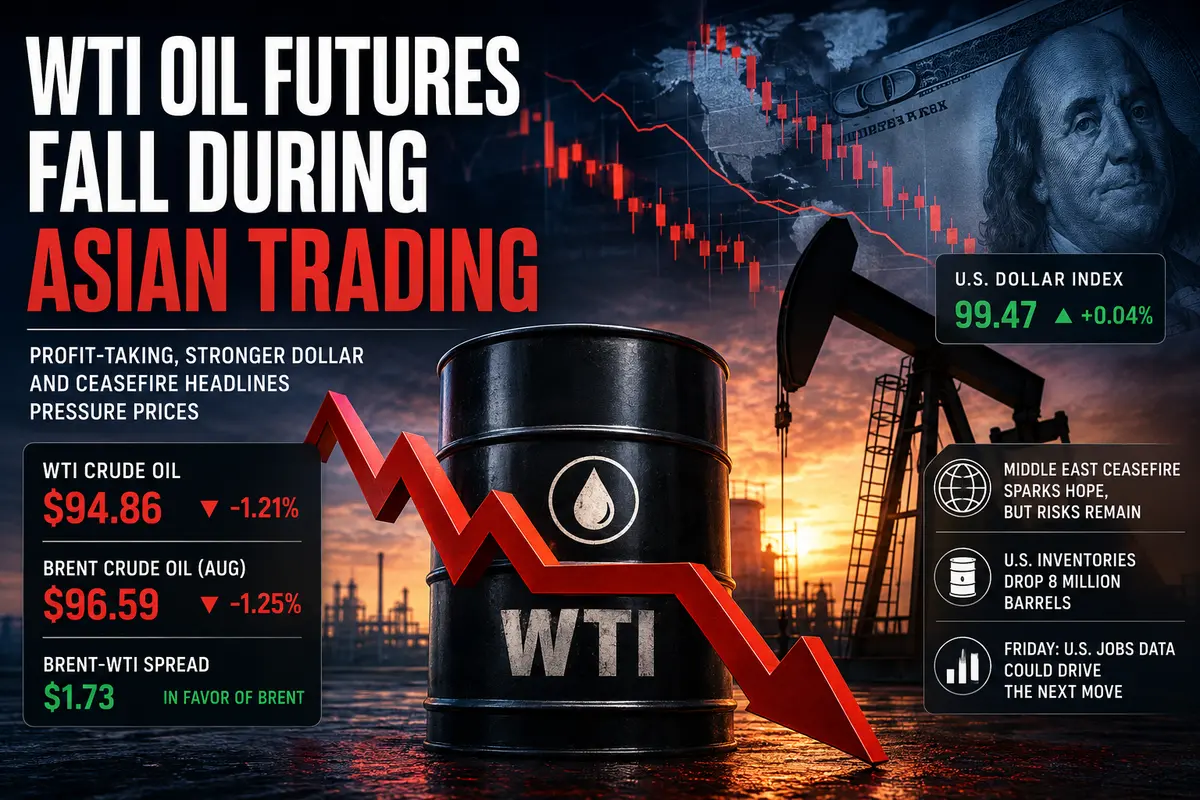
Thursday’s Asian trading session delivered a cold shower for oil bulls. Futures on West Texas Intermediate (WTI) crude oil, the benchmark for the U.S. market, moved into negative territory. And not just slightly—at the time of writing, WTI was down 1.21%, trading at $94.86 per barrel.
For traders accustomed to volatility, a one-percent move is hardly dramatic. But context matters. Just a day earlier, oil had posted its third consecutive session of gains. Market participants were beginning to embrace the idea that crude was back in favor, with geopolitics and tightening inventories providing strong support. Then came the pullback—not a crash, but sharp enough to make investors pause.
The decline coincided with a stronger U.S. dollar. The U.S. Dollar Index futures, which track the greenback against a basket of six major currencies, rose 0.04% to 99.47. It may seem insignificant, but in currency markets even small moves matter. When the dollar strengthens, oil—priced in dollars—typically becomes more expensive for foreign buyers, putting downward pressure on prices. The inverse correlation remains intact even on days when geopolitical headlines suggest higher oil prices.
Brent crude, the European benchmark, also came under pressure. August Brent futures fell 1.25% to $96.59 per barrel. The price spread between Brent and WTI narrowed to $1.73 in favor of Brent. Just a week ago, the spread was above $2. A narrowing spread suggests that U.S. crude is appreciating relative to its European counterpart, reflecting shifts in global supply flows.
The technical picture also offers food for thought. WTI has established support at $86.35 per barrel—a level sellers failed to break during previous sessions. Resistance stands at $96.98. With the current price at $94.86, the market sits roughly in the middle of that range. Traders looking at the charts see upside potential if resistance is broken, but they also recognize that support is not far below.
The key question is: what will serve as the next catalyst? Geopolitics? U.S. economic data? Or something entirely unexpected?
Looking Back: Three Days of Gains Followed by a Correction
To understand Thursday’s move, it helps to look at what happened beforehand. Oil had rallied for three consecutive sessions as investors pushed prices steadily higher. The reasons were significant.
The first was the Middle East. Iran and the United States exchanged strikes. Missiles were launched toward Kuwait and Bahrain. U.S. aircraft bombed Iran’s Qeshm Island in the Strait of Hormuz. Israel expanded operations in southern Lebanon. As a result, the geopolitical risk premium in oil rose by several dollars per barrel.
The second factor was U.S. inventories. The Energy Information Administration reported a weekly decline of 8 million barrels in crude oil stockpiles—nearly three times larger than analysts had expected. U.S. crude exports climbed to record levels as European and Asian buyers sought alternatives to Middle Eastern supplies amid fears of disruptions.
The third driver was seasonal demand. The U.S. summer driving season is beginning. Millions of Americans are hitting the road. Refineries are running at high utilization rates. Demand for gasoline and diesel is increasing, boosting demand for crude oil as well.
Three straight days of gains is a substantial move in any market. When an asset rises 5–7% in a short period, profit-taking is inevitable. During Thursday’s Asian session, traders who wanted to lock in gains stepped in and sold, pushing prices lower. Profit-taking remains the only explanation for the decline that is not tied to underlying fundamentals.
But are there any fundamental reasons for concern? Let’s take a closer look.
The Middle East: A Ceasefire That May Not Last
The dominant geopolitical theme in recent weeks has been the conflict involving the United States and Iran, alongside escalating tensions between Israel and Hezbollah in Lebanon.
Late Wednesday evening, news emerged that altered the landscape: Washington announced a ceasefire agreement between Israel and Lebanon.
At first glance, it sounds like a breakthrough. But as always, the details matter. According to the announcement, the agreement depends on Hezbollah halting hostile activities. Hezbollah, however, is not fully controlled by the Lebanese government. It receives funding and weapons from Iran. If Tehran chooses to continue escalating tensions, Hezbollah could continue fighting regardless of agreements signed in Washington or Beirut.
Nevertheless, markets seized on the news. Oil prices declined Thursday morning not only because of profit-taking, but also because part of the geopolitical premium was priced out. Investors began to wonder whether the conflict might genuinely de-escalate and whether a broader regional war could be avoided. If so, crude oil arguably deserves to trade $5–10 per barrel lower.
Yet caution remains warranted. Iran remains hostile. U.S. strikes on Qeshm Island have not gone unanswered, and Tehran has vowed retaliation. Missile attacks on Kuwait and Bahrain appear to have been deliberate demonstrations of capability. Meanwhile, Israeli operations in southern Lebanon continue despite the ceasefire announcement, with both sides interpreting the agreement differently.
For that reason, Thursday’s decline looks less like a trend reversal and more like a pause. Any renewed escalation would likely push prices higher again.
U.S. Inventories: Record Exports Are a Double-Edged Sword
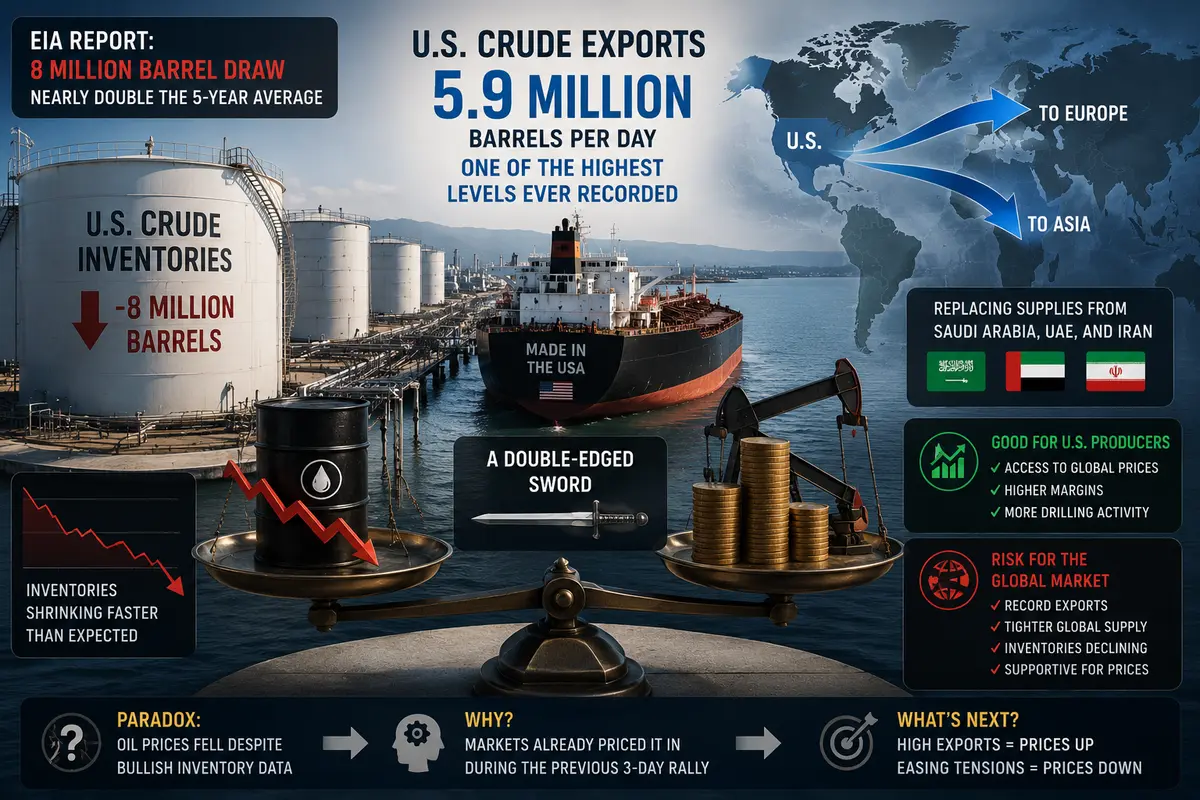
The EIA inventory report deserves special attention. U.S. crude stockpiles fell by 8 million barrels—an unusually large draw and nearly double the average seasonal decline over the past five years.
Why such a steep drop?
The primary reason is exports. U.S. crude has become highly sought after. Buyers in Europe and Asia who once relied heavily on Middle Eastern supplies are increasingly turning to American barrels.
U.S. crude exports have risen to 5.9 million barrels per day, one of the highest levels ever recorded. Tankers are crossing the Atlantic to Europe and the Pacific to Asia, replacing supplies from Saudi Arabia, the UAE, and Iran.
For U.S. producers, this is excellent news. They can sell at global prices rather than discounted domestic prices, boosting margins and encouraging new drilling activity.
For the global market, however, record U.S. exports mean inventories are shrinking faster than expected. Falling inventories are generally supportive for prices.
The paradox is that oil still declined Thursday despite this bullish data. The reason is simple: markets had already priced it in during the previous three-day rally. The focus has now shifted to what comes next. If exports remain elevated, inventories will continue falling and prices should rise. But if geopolitical tensions ease, buyers may return to Middle Eastern suppliers, reducing demand for U.S. crude and easing upward pressure on prices.
Technical Picture: Support, Resistance, and Everything In Between
Looking at the chart, WTI remains trapped between two major levels.
Support sits at $86.35. This level has been forming for several weeks. Each time prices approached it, buyers emerged and pushed the market higher. Psychologically, it represents a floor for now. A decisive break below could open the path toward $84 and eventually $80 per barrel.
Resistance is located at $96.98, the highest level seen in roughly two and a half months. Prices have tested this area three times and failed each time. A breakout would signal that bulls are serious and could pave the way toward the psychologically important $100-per-barrel mark.
At $94.86, WTI is closer to resistance than support, which remains technically bullish. However, the 1.2% decline during Asian trading serves as a reminder that the path upward is unlikely to be a straight line.
Daily technical indicators suggest the market is in overbought territory. That does not guarantee a decline—strong uptrends can remain overbought for extended periods. It does mean, however, that any negative headline could trigger a deeper-than-normal correction.
Trading volumes during Thursday’s Asian session were below average. Traders may be waiting for signals from the United States, observing local holidays, or simply avoiding major positions ahead of the weekend.
The Dollar Returns to Center Stage
The U.S. Dollar Index futures gained 0.04% to 99.47. While the move was small, the direction is noteworthy. The dollar has strengthened for a second consecutive session following stronger-than-expected U.S. economic data.
On Wednesday, two important reports were released:
-
ADP employment data showed that private employers added 122,000 jobs in May, exceeding expectations.
-
The ISM Services Index rose to 54.5, while the prices-paid component reached its highest level in nearly four years.
These figures boosted the dollar because they suggest the U.S. economy remains more resilient than expected and inflationary pressures persist. As a result, the Federal Reserve may be less inclined to cut interest rates quickly. Higher rates generally support a stronger dollar.
For oil, a stronger dollar is typically negative. Since crude is priced in dollars, buyers using other currencies face higher costs when the dollar rises, which can weigh on demand and prices.
Until now, geopolitical risks had overshadowed the currency effect. On Thursday, however, as geopolitical concerns eased slightly, the dollar once again became a key driver—and oil fell.
What the Brent-WTI Spread Is Telling Us
The Brent-WTI spread narrowed to $1.73 per barrel in favor of Brent, a relatively tight differential by historical standards.
Brent traditionally trades at a premium due to logistical advantages. WTI is produced in Texas and delivered to Cushing, Oklahoma—a major inland storage hub connected by pipelines. Brent, by contrast, is produced in the North Sea and can be shipped globally via tanker. That flexibility commands a premium.
A narrow spread indicates that U.S. crude is strengthening relative to European crude. The main reason today is surging U.S. exports. As more American crude leaves the domestic market, supply tightens and prices rise.
For traders, a narrow spread creates opportunities. Some buy WTI and sell Brent, betting that the spread will widen again. Such positioning can contribute to additional market volatility.
What to Watch on Friday: U.S. Jobs Data
Friday brings the most important economic release of the week: U.S. nonfarm payrolls.
The report has a direct impact on the dollar, and by extension, on oil.
The consensus forecast calls for approximately 180,000 new jobs.
-
If the number comes in significantly stronger—around 220,000 or more—the dollar could strengthen further, potentially pushing oil down another 1–2%.
-
If payroll growth is much weaker—around 130,000—the dollar may weaken, allowing oil to recover Thursday’s losses and potentially move even higher.
-
A third possibility is that the report lands close to expectations, resulting in a muted market reaction and leaving oil trading in the $93–96 range while investors wait for the next catalyst.
Most analysts favor the third scenario. The U.S. economy appears to be slowing, but not collapsing. The labor market is cooling, but not freezing. Payroll growth in the 160,000–190,000 range seems the most likely outcome—insufficient to dramatically strengthen or weaken the dollar.
Bottom Line
Thursday brought a correction to the oil market. A 1.2% decline is far from catastrophic, but it does send a message. The three-day rally appears to have lost momentum, investors are taking profits, and the geopolitical risk premium has begun to fade following ceasefire headlines involving Israel and Lebanon.
However, the broader trend remains bullish. U.S. inventories are declining at a rapid pace. American crude exports continue to reach record highs. Seasonal summer demand is only beginning. And the Middle East conflict has not disappeared—it has merely quieted down temporarily.
For that reason, Thursday’s pullback is not necessarily a cause for panic. Instead, it may be an opportunity for investors to reassess positions and potentially add exposure at lower prices.
Asian trading is winding down. U.S. markets are about to take over. Friday’s employment report is just around the corner. Volatility is likely to remain elevated.
For those who understand the forces driving the market, that volatility is not a problem—it is an opportunity.

Comments
No comments yet. Be the first to share your thoughts!
Authentication Required
You must be logged in to post a comment.