

Bitcoin Over the Abyss: An Oil Truce Beckons, but Bond Yields Keep a Stranglehold
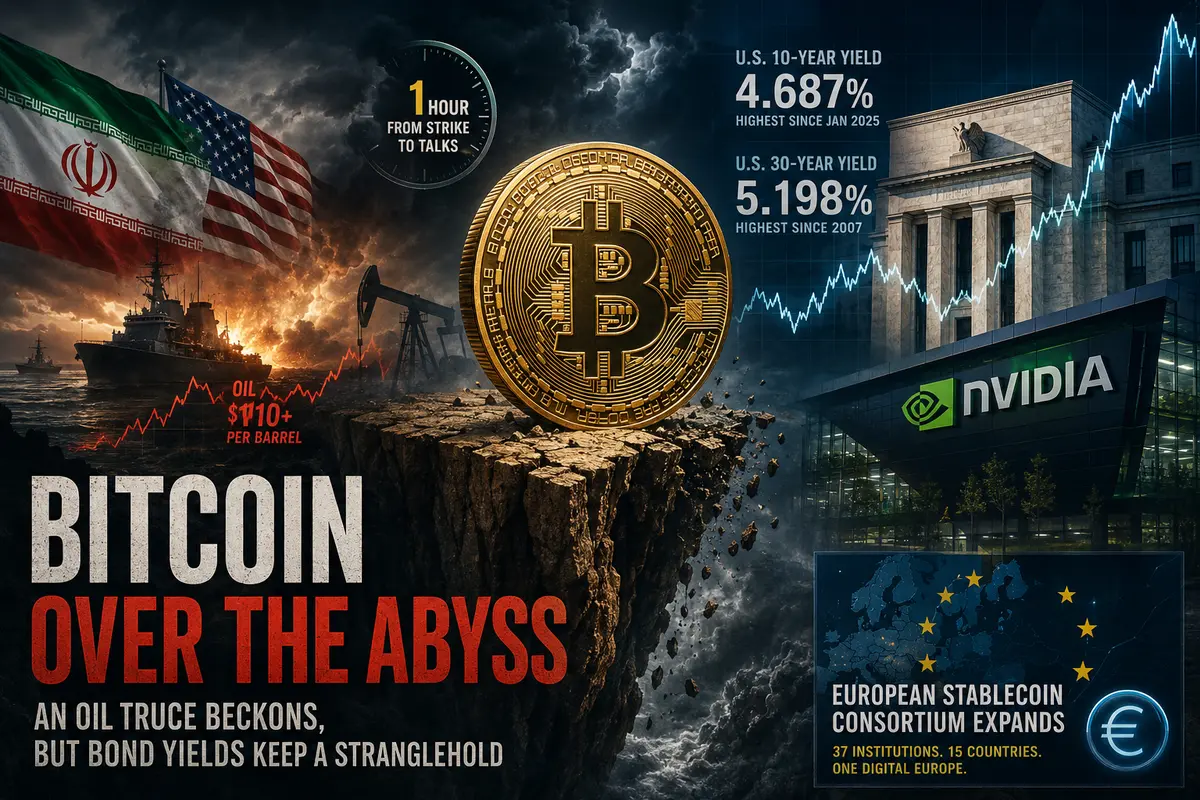
Seventy-seven thousand one hundred twenty-seven dollars. On Wednesday evening, Bitcoin hovered at that mark, gaining a symbolic four-tenths of a percent for the session. A move that, in normal times, wouldn’t even make the news feed now tells an entire story. A story about how the world’s leading cryptocurrency is trying to find solid ground after being rejected from the coveted eighty-two-thousand-dollar level and thrown back into the abyss of uncertainty. And that abyss is lined not with technical failures or regulatory fears, but with old-fashioned macroeconomic forces — Treasury yields, oil prices, and geopolitical swings orchestrated personally by Donald Trump.
The Iranian Pendulum: From Bombs to Negotiations in Sixty Minutes
Trumpian diplomacy is always theater, and the current Iranian drama is no exception. On Tuesday, the U.S. president made a statement that left traders breathless. He admitted he was “an hour away” from authorizing another military strike against Iran. One hour. Sixty minutes separated the world from another escalation in the Persian Gulf, another spike in oil prices, another wave of inflation, and, as a consequence, another collapse in risk assets, including cryptocurrencies. But the strike was postponed. Trump decided to give diplomacy one more chance.
The admission was a masterful rhetorical maneuver. At the same time, Trump portrayed himself as both a decisive leader ready to press the button and a prudent peacemaker who prefers negotiations over war. For markets, this creates an explosive mixture of hope and fear. Hope that the conflict may genuinely be moving toward resolution. Fear that the entire structure could collapse at any moment. Vice President J.D. Vance added fuel to the fire by declaring that the United States would remain “ready for combat” if negotiations fail. A double signal: we believe in peace, but our hand remains on the trigger.
For Bitcoin, this mixed rhetoric cuts both ways. On one hand, any easing of geopolitical tensions means lower oil prices; lower oil prices mean weaker inflationary pressure; weaker inflation means fewer reasons for the Federal Reserve to raise rates; and fewer rate hikes are a green light for risk assets. Along this chain of logic, hopes for peace push Bitcoin upward. But on the other hand, as long as the war is unresolved, as long as the Strait of Hormuz remains threatened, as long as oil stays above one hundred ten dollars per barrel, inflation fears are not going away. And Bitcoin remains trapped in limbo, unable either to break resistance or collapse toward new lows.
Yields as Executioners: Why Bonds Are Draining Money from Crypto
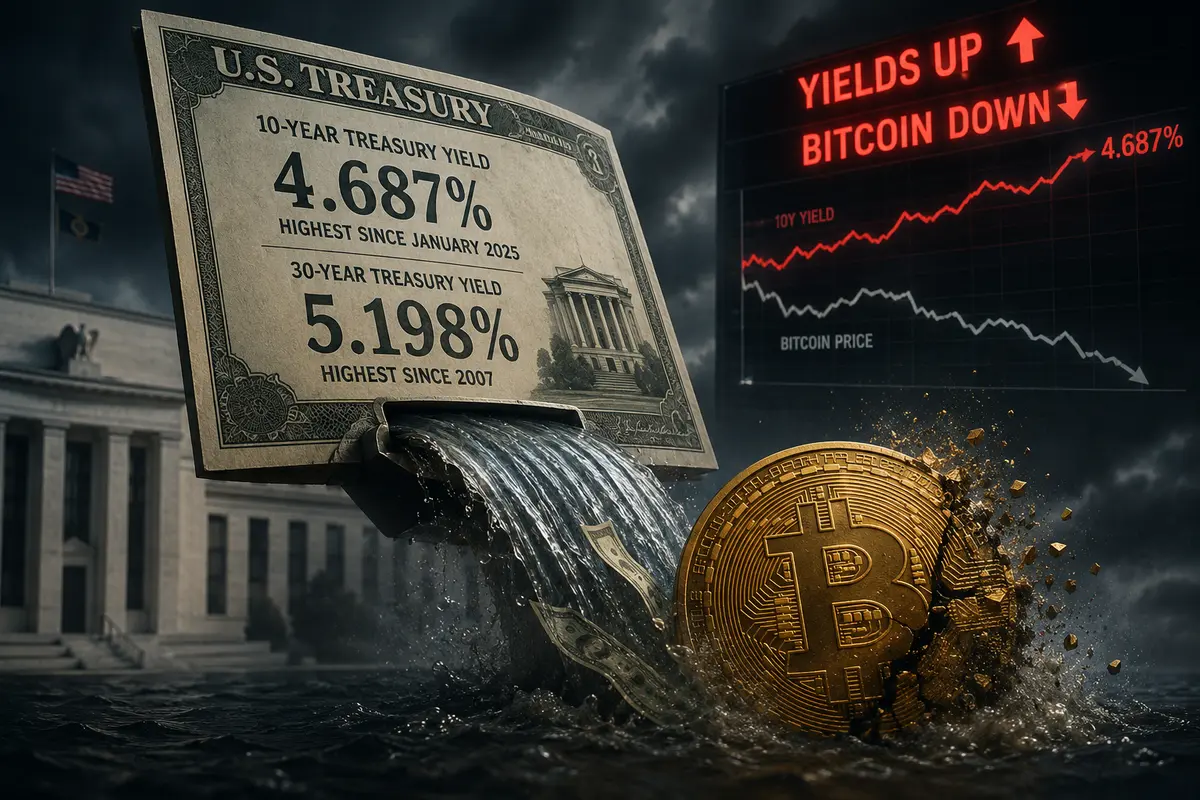
But the real killer for Bitcoin right now is neither Iran nor Trump. It’s the U.S. Treasury market. The yield on ten-year Treasuries climbed to 4.687% — the highest level since January 2025. Thirty-year Treasury yields reached 5.198%, levels not seen since 2007, back before Lehman Brothers collapsed and the phrase “mortgage crisis” became a death sentence.
These numbers are deadly poison for Bitcoin and the entire crypto market. The mechanism is simple and ruthless. When “risk-free” U.S. government bonds begin yielding nearly five percent annually in dollars, investors radically rethink what qualifies as “good returns.” Why put money into volatile Bitcoin, which can lose ten percent in a single day, when you can safely collect guaranteed interest from the U.S. government? It’s pure opportunity-cost mathematics. And as long as yields continue to rise, that math works against cryptocurrencies.
Rising yields, in turn, are fueled by the same inflation fears created by war and expensive oil. A vicious cycle emerges: war drives oil higher, oil drives inflation higher, inflation pushes yields higher, and yields drag Bitcoin lower. There are only two ways to break this cycle: either a genuine end to the conflict and the restoration of oil supplies, or a determined Federal Reserve willing to hold rates steady despite inflation.
Nvidia as a Lifeline for Risk Assets
On Wednesday evening, all eyes were fixed not on the White House or Tehran, but on Santa Clara, where Nvidia was preparing to release its quarterly earnings report. For the crypto market, this might seem unrelated, but the connection is direct. Nvidia is the flagship of the artificial intelligence boom — the same boom that has largely dictated risk appetite across financial markets over the past year. If Nvidia posts strong results and delivers an optimistic outlook, it could support the entire spectrum of risk assets, including cryptocurrencies. If the report disappoints, a wave of risk aversion will wash over Bitcoin as well.
Investors were reluctant to place major bets ahead of the earnings release. That explains Bitcoin’s sluggish price action on Wednesday. No one wants to end up on the wrong side of the trade when Nvidia publishes its numbers. Too much depends on these results. Too many trillions of dollars in market capitalization hang in the balance. In moments like this, cryptocurrencies — as the asset class most sensitive to market sentiment — typically freeze in anticipation.
Europe’s Response: A Stablecoin Consortium Gains Strength
While Bitcoin struggled against macroeconomic headwinds, Europe witnessed an event that could have far-reaching implications for the entire crypto landscape. A European banking consortium planning to launch a euro-pegged stablecoin announced a major expansion. Twenty-five new members joined the project, bringing the total number of participating financial institutions to thirty-seven from fifteen countries.
The list of new members reads like a “who’s who” of European finance: ING, BNP Paribas, BBVA, ABN Amro, Rabobank, Sabadell, Bankinter, Bank of Ireland, Handelsbanken, and Nordea. These are not garage startups. These are systemically important banks that have shaped the continent’s financial landscape for decades. And now they are joining forces to create a European digital currency capable of competing with American stablecoins.
The project, formally organized under the Amsterdam-registered company Qivalis, positions itself as Europe’s answer to U.S. dominance in digital payments. “The euro is Europe’s currency, and blockchain-based financial infrastructure should use it — built by European institutions and governed by European rules,” said Qivalis CEO Jan-Oliver Sell. In that statement, one can hear not just a business strategy, but a geopolitical manifesto. Europe does not want to depend on American stablecoins. Europe wants its own digital euro, under its own control and governed by its own rules.
The consortium’s expansion also signals that traditional banks are no longer ignoring cryptocurrencies. They are entering the game — but on their own terms: with regulation, compliance, and consumer protection. This could fundamentally reshape the crypto industry, shifting the center of gravity away from decentralized, often loosely governed projects toward institutional, regulated structures. For Bitcoin, this is both a threat and an opportunity. A threat because regulated stablecoins could absorb demand that once flowed into decentralized crypto assets. An opportunity because blockchain legitimization by major banks increases trust in the industry as a whole.
Altcoins in Hibernation, Ethereum Frozen in Place
While Bitcoin searched for direction, the rest of the crypto market remained lethargic. Ethereum, the second-largest cryptocurrency, stood frozen at $2,118, showing neither growth nor decline. Most altcoins traded within narrow ranges, as though holding their breath while waiting for a signal.
This hibernation is understandable. When macroeconomic uncertainty reaches such extremes, investors typically reduce exposure to the most volatile assets. Altcoins, capable of losing tens of percent in a single day, become toxic. Capital either flows into Bitcoin as the most reliable of the unreliable cryptocurrencies or exits the crypto market altogether in favor of dollars and bonds. Altcoins remain suspended in uncertainty, waiting for clarity on Iran, oil, Nvidia, and bond yields.
Seventy-seven thousand dollars per Bitcoin is neither victory nor defeat. It is an intermediate station on a journey whose direction remains undefined. If Nvidia delivers strong earnings, if Trump and the Iranians genuinely move closer to peace, if yields stop rising — Bitcoin could quickly return to eighty-two thousand and move higher. But if negotiations collapse, if oil surges to new highs, if yields continue their relentless climb — seventy-seven thousand may look like the peak from which the crypto market tumbles for much longer.
That is the essence of the current moment: Bitcoin is balancing on a knife’s edge, and the direction of its fall will be decided not on crypto exchanges, but in diplomatic cables, Federal Reserve meeting rooms, and Nvidia conference halls. A cryptocurrency born as an alternative to governments and corporations is today more dependent on them than ever before.

Comments
No comments yet. Be the first to share your thoughts!
Authentication Required
You must be logged in to post a comment.