
Silicon Revolt: How 48,000 Samsung Workers Are Bringing a Tech Giant to Its Knees
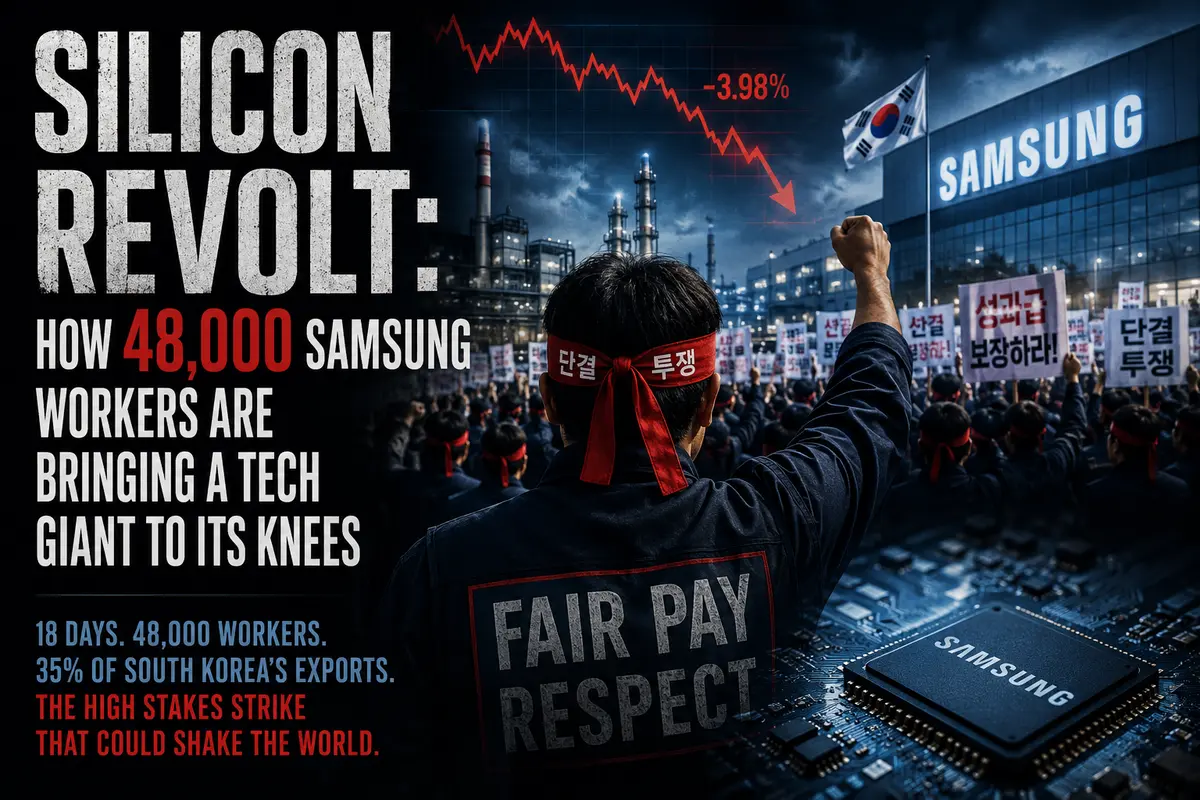
The news that came out of South Korea on Wednesday hit global technology markets with the force of a finely tuned industrial press. The largest labor union at Samsung Electronics — a company whose name has become synonymous with South Korea’s economic miracle — announced the start of a full-scale strike. Eighteen days, forty-eight thousand workers, and the complete collapse of negotiations mediated by the government. This is not merely a labor dispute; it is an event capable of redrawing the global semiconductor landscape and leaving a deep scar on South Korea’s export-driven economy. And what terrifies investors most is that this is happening not on the periphery, but at the very heart of global memory chip manufacturing, where Samsung has maintained an iron grip for decades.
Breakdown of Negotiations: Why the Government Failed to Save the Situation
When a government steps into a labor dispute, it is always a sign of extreme concern. South Korea’s labor authorities, usually operating behind the scenes, moved center stage this time and sat down at the negotiating table alongside Samsung management and union representatives. It was a desperate move driven by the understanding of what was at stake. Yet even state mediation failed to bridge the gap dividing the two sides.
The union submitted a proposal whose full details remain undisclosed, but the core issues are known: performance bonuses and compensation. It sounds like a standard list of demands, but behind those words lies a deeper shift in the relationship between Korean chaebols and their workers. For decades, Samsung cultivated a culture of loyalty in which employees identified themselves with the corporation, while the corporation provided stability and generous bonuses during prosperous years. But now, as the semiconductor industry undergoes tectonic shifts driven by the AI boom, trade wars, and supply-chain restructuring, that unwritten pact has begun to crack.
Management rejected the union’s proposal. We do not know exactly what was said inside the negotiating room, but the outcome speaks for itself — no compromise was reached, and the bridges have been burned. The union, sensing its strength and mass support, refused to back down. The phrase that it “will proceed with the legally planned general strike tomorrow as scheduled” sounds like a manifesto. This is not a spontaneous uprising; it is a cold, calculated move prepared long in advance and merely waiting for its moment.
48,000 People and 18 Days: The Anatomy of a Manufacturing Collapse
The figures reported by Yonhap are enough to unsettle anyone familiar with the semiconductor industry. Forty-eight thousand striking workers are not just an abstract mass. They are engineers, technicians, operators of ultra-precision equipment — the people who keep memory chip production lines running. Samsung is the world’s largest producer of DRAM and NAND memory chips, and its factories operate nearly around the clock. Shutting down even a single production unit for one day can mean millions in losses and delivery delays stretching weeks ahead. And here the discussion is about eighteen days.
Semiconductor manufacturing is designed in such a way that it cannot simply be switched on and off like a light bulb. Chip fabrication lines are continuous technological processes in which silicon wafers pass through hundreds of stages involving vacuum chambers, chemical baths, and photolithography systems. A production halt means not only the loss of current output, but also the risk of equipment damage and the need for subsequent recalibration, retuning, and testing. Even after the strike ends, factories will not be able to return instantly to full capacity. In practice, downtime could stretch over months once the time required to restore normal operations is taken into account.
And all of this is happening precisely when global demand for memory chips is entering another growth cycle. Artificial intelligence requires enormous volumes of high-speed memory. Data centers around the world are buying HBM chips — the high-bandwidth memory segment in which Samsung is one of the global leaders. Any disruption in supply right now is not merely lost revenue; it is a risk of losing market share that competitors such as SK Hynix or Micron Technology would immediately seize.
Thirty-Five Percent of Exports at Stake: A National Alarm
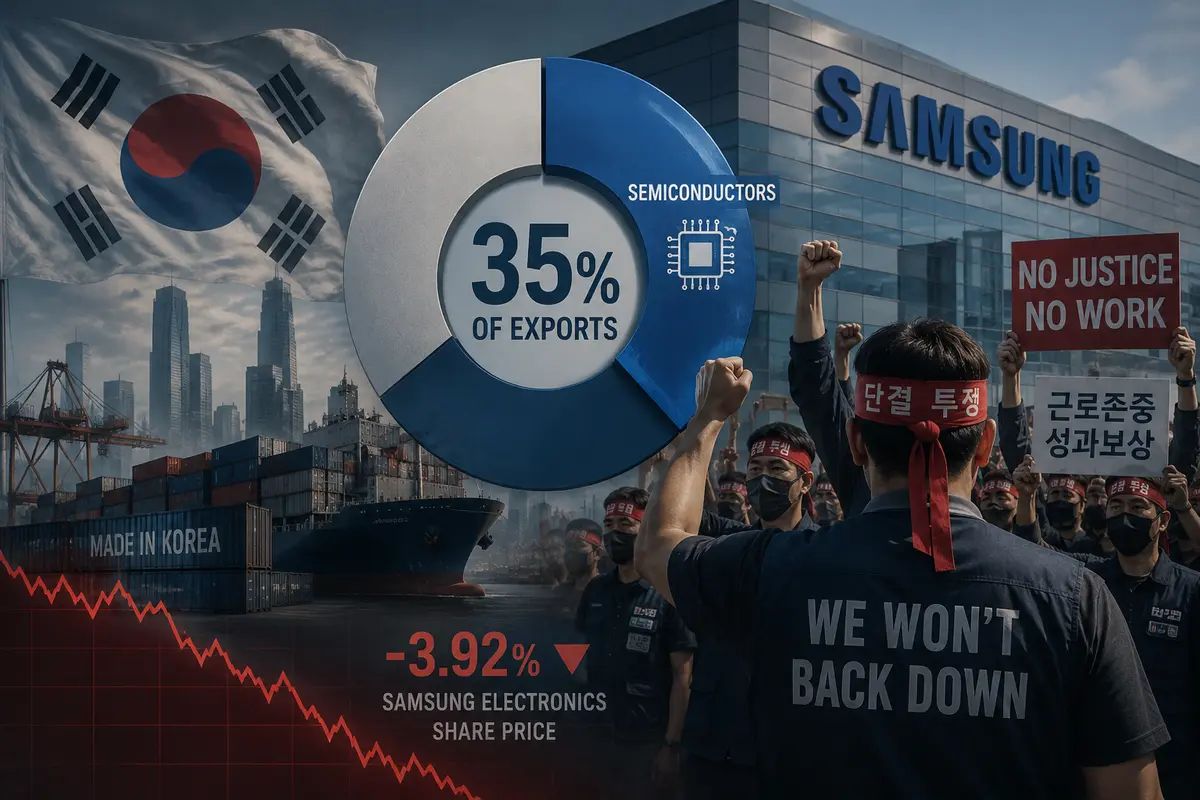
The South Korean government understands the scale of the threat better than anyone. Semiconductors account for roughly thirty-five percent of the country’s total exports. This is not simply an important industry — it is the backbone of the entire economy, its main engine and provider. When that engine begins to falter, the entire state organism shakes. South Korea’s export-oriented model, which brought prosperity for decades, suddenly appears frighteningly vulnerable to domestic disruptions within key corporations.
The government has already expressed growing concern. Behind the scenes, frantic efforts are likely underway to restart negotiations and find leverage over both sides. But the situation is complicated by the fact that South Korea’s labor movement has grown significantly stronger in recent years and no longer fears challenging industrial giants. Memories of nationwide strikes in previous years and the famous sit-in protests at Hyundai factories are still fresh. And judging by the determination in its statements, Samsung’s current union appears ready to go all the way.
The company’s shares, which plunged nearly four percent after the report emerged, are merely the first and most obvious indicator of the damage. Billions of dollars in market capitalization evaporated within hours of trading — the market is voting with its feet. Investors understand that even if the strike does not last the full eighteen days, the very fact that labor relations at Samsung have reached such a boiling point signals systemic problems. This is not a one-off incident; it is a symptom of deeper dysfunction within a management model that was long considered exemplary.
A Domino Effect for Global Supply Chains
The world may not yet fully grasp what this strike threatens beyond South Korea. Samsung is not just a Korean company. It is a critical link in the global electronics supply chain. Smartphones, servers, automobiles, smartwatches, gaming consoles — all rely on memory chips manufactured at Samsung facilities. Disruptions in DRAM and NAND supplies could trigger a domino effect rolling across continents.
Electronics manufacturers, already scarred by the painful lessons of the pandemic-era chip shortage, are now watching the news from Korea with alarm. They remember how semiconductor shortages halted automotive assembly lines and drove up prices for gaming consoles. The current situation is potentially even more dangerous because it affects a specific and critically important segment — memory. No processor can function without memory. And if Samsung’s supplies are interrupted, the world could face a new wave of shortages, potentially more concentrated and severe than before.
The strike at Samsung is ultimately a story about how the human factor can suddenly outweigh all technological achievements, all trillion-dollar investments, and all strategic plans. Forty-eight thousand people demanding fair performance bonuses may accomplish what neither trade wars nor geopolitical crises could — bringing the conveyor belt of global technological progress to a halt. And the way this conflict is resolved will determine not only the fate of one company, but also the trajectory of the global electronics industry for years to come.
Comments
No comments yet. Be the first to share your thoughts!
Comments only for logged-in users.