
A Month and a Half Down: Gold Falls Back to March Levels
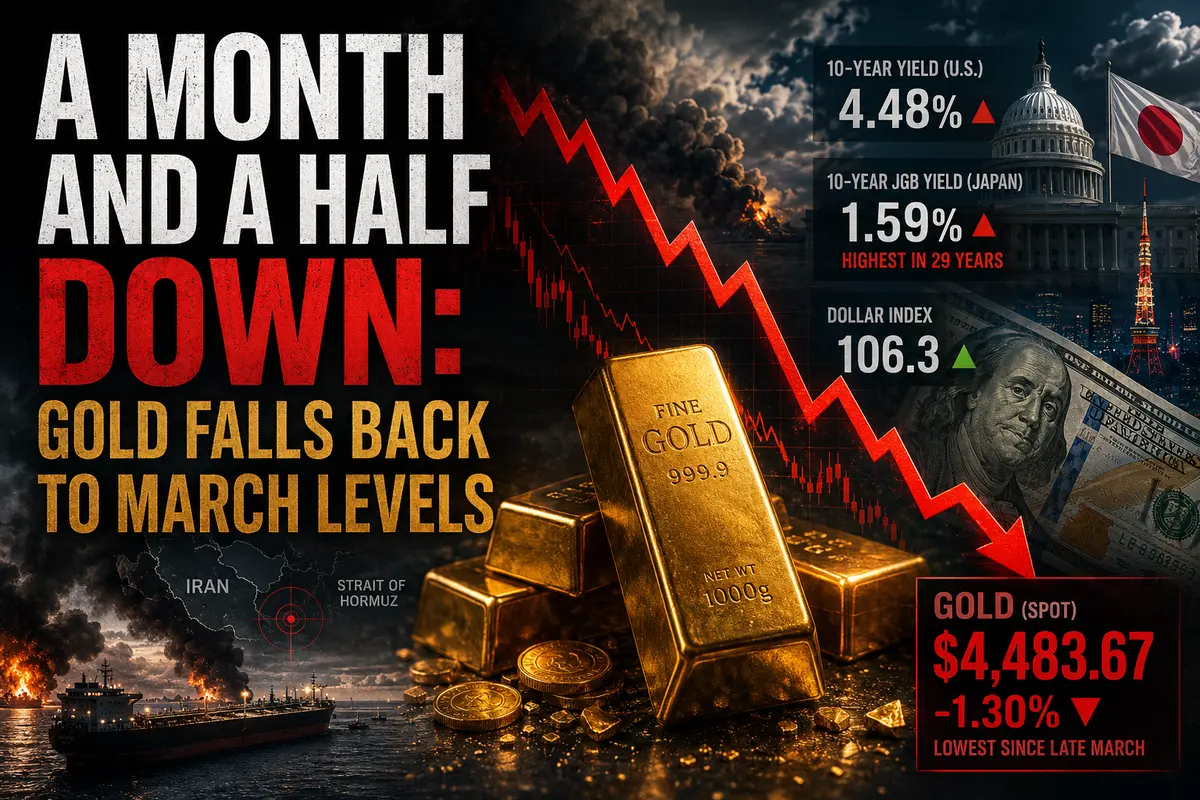
Monday began with a heavy blow for the precious metals market. During Asian trading, spot gold plunged 1.3%, falling to $4,483.67 per ounce. This marks the lowest level since late March — a month and a half of gains and optimism erased in a single trading session. Futures performed even worse, dropping 1.7% and settling near $4,484. For those accustomed to viewing gold as an unshakable fortress during turbulent times, what is happening now feels almost like betrayal: the world is burning, yet the safe-haven asset is failing to provide safety.
But the gold market has never been a simple mechanism reacting solely to geopolitics. It has its own rules, its own internal logic — and right now, that logic is working against the metal with the same force that political crises usually work in its favor. To understand what is happening, one must step away from war headlines and look at the bond market — because that is where the main drama is unfolding, casting its shadow over precious metals prices.
Yields Not Seen in Decades
The main killer of gold on Monday was the global rise in bond yields. Not in one country or one region, but almost everywhere simultaneously, as if an invisible conductor had waved a baton and forced the world’s bond markets to move in unison.
In the United States, yields on 10-year Treasury bonds climbed to a monthly high. This is the benchmark that guides nearly every other debt market in the world, and when it rises, the consequences ripple through the entire financial system. But an even more striking signal came from Japan. Yields on Japanese 10-year government bonds reached their highest level in 29 years on Monday. Nearly three decades — longer than the careers of many traders currently sitting at their terminals. Japan, which for decades symbolized zero interest rates and cheap money, has suddenly found itself at the forefront of a global reassessment of monetary expectations.
What unites Tokyo and Washington in this surge of yields? The answer is simple and alarming: inflation expectations. Markets are betting that the war with Iran, disruptions in the Strait of Hormuz, and soaring energy prices are not temporary episodes, but a prolonged story that will continue fueling inflation for a long time. And if inflation persists, central banks will have to act — and act aggressively.
The Pressure Mechanism: How Bonds Kill Gold
The relationship between bond yields and the price of gold is one of the most fundamental in the financial world. Gold pays no interest. That is both its greatest curse and its greatest blessing at the same time. When interest rates are low or negative, gold flourishes: nobody sacrifices income by abandoning bonds in favor of the metal. But when yields rise, every investor must calculate opportunity costs. Holding gold means giving up guaranteed annual returns of five, six, or seven percent from reliable government securities. And the higher those returns climb, the harder life becomes for gold.
Right now, markets are pricing in exactly such a scenario. Inflation fueled by energy prices amid the war with Iran will force central banks around the world not only to keep rates high, but to raise them even further. Monetary tightening is not something gold likes to hear. Every hint of higher rates, every new surge in yields hits the metal like a sledgehammer.
And the most unpleasant reality for gold bulls is that this mechanism works against geopolitical logic. One would think that war, drones over nuclear facilities, and Trump’s threats should drive investors toward safe-haven assets. But when those same events simultaneously push yields higher, the effect becomes the opposite. Gold is caught in a vise: geopolitics pulls it upward, yields drag it downward — and for now, the latter are clearly winning.
The Dollar Strikes Back
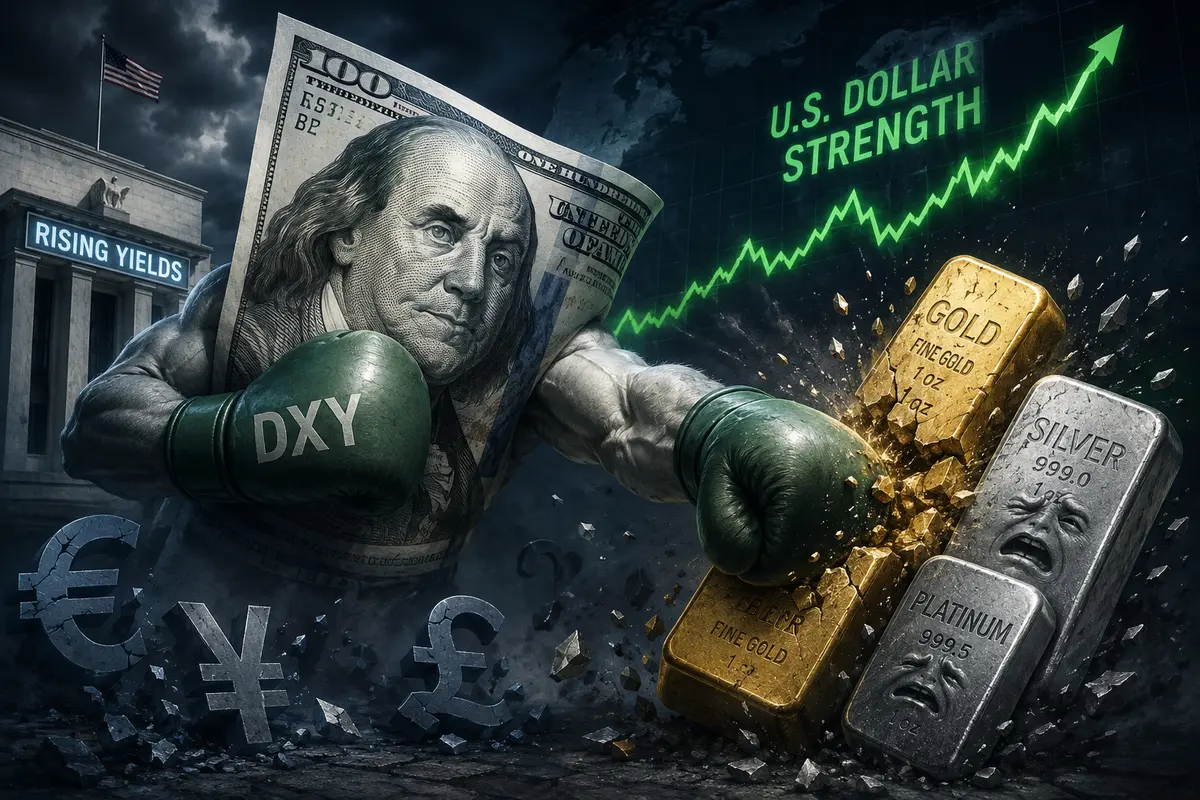
There is also a third factor adding pressure across the entire precious metals complex: the strengthening U.S. dollar. The American currency, supported by those same rising yields, is appreciating against most global currencies, automatically making gold more expensive for holders of other currencies. An investor in Tokyo, Frankfurt, or London looking at gold prices in dollars must also account for exchange rates: even if the dollar price remains unchanged, gold may still become more expensive in euros or yen simply because local currencies are weakening.
But when the dollar price falls while the dollar itself strengthens, foreign buyers suffer a double blow. The metal becomes both more expensive in their local currency and less attractive as an investment. Unsurprisingly, gold’s “younger brothers” are suffering even more under such conditions. Spot silver plunged 1.9% on Monday to $74.58 per ounce. Platinum, while holding up somewhat better, still declined 0.3%, settling just above $1,972. Industrial precious metals are taking a double hit: from rising yields and from fears of a slowing global economy, for which high interest rates always mean cooling demand.
Trump and the Clock That Keeps Ticking
Meanwhile, on the geopolitical front, nothing has fundamentally changed — and paradoxically, that lack of change itself is becoming negative for gold. It seems counterintuitive: the conflict remains unresolved, threats continue daily, yet the metal is falling. But markets are more complex than the simple formula of “war equals higher gold.” Markets react not to the conflict itself, but to escalation or de-escalation. If tensions remain high without moving to a new level, gold gradually loses momentum.
And tensions do remain high. Trump warned that “the clock is ticking” for Tehran — words that sound like the ticking of a time bomb. According to sources, the United States and Israel are considering renewed military action against Iran. Peace negotiations have produced no meaningful results. Trump’s summit in China, on which many pinned diplomatic hopes, ended without substantial progress on the Iranian issue.
But the market has already heard all of this. These risks are already priced in. For gold to rise again, a new shock is needed — either an escalation of the conflict or an unexpected shift toward monetary easing. So far, neither is happening, and the metal continues drifting lower, carried downward by rising yields like a boat pulled toward a waterfall by the current.
What Comes Next: A Battle of Narratives
The gold market now stands at a unique crossroads where two powerful narratives collide. The first is the narrative of fear: war, Iran, threats, nuclear facilities, a potentially closed strait. This narrative demands buying gold. The second is the narrative of rates: inflation, tightening, rising yields. This narrative demands selling gold.
On Monday, the second narrative won decisively. But that does not mean it will always prevail. The geopolitical situation in the Middle East remains explosive. A single incident — an attack on a tanker, a strike on a military base, the interception of an aircraft — could instantly reverse the picture and launch gold into a rally capable of recovering weeks of losses in a single day.
Yields, too, cannot rise forever. Somewhere there is a ceiling beyond which high borrowing costs will begin damaging the economy itself, forcing central banks to stop. But where that ceiling lies, nobody knows. Japanese bond yields at 29-year highs are a serious signal that the era of cheap money is ending, while the new era has yet to take clear shape.
Gold at a month-and-a-half low is neither a death sentence nor a reason for panic. It is a reflection of tectonic shifts in global finance unfolding right now, while drones circle above the Persian Gulf and traders in London and New York recalculate their models trying to understand what the world will look like six months from now. And until there is an answer, gold will continue swinging between fear and mathematics, between geopolitics and yields, between the instinct for self-preservation and cold calculation. And we will watch this battle with bated breath, because its outcome will determine not only the price of the yellow metal, but much more across the global economy.
Comments
No comments yet. Be the first to share your thoughts!
Comments only for logged-in users.